


Two longtime feminists inspired by Gloria Steinem take stock of the federal rollbacks threatening the progress their generation fought to secure.

This op-ed was adapted from a piece originally published by the Santa Barbara Independent. It has been republished with permission.
We belong to a generation inspired by Gloria Steinem’s writings and speeches. Her call for women to pursue self-affirmation, political power and equality, both in the workplace and at home, helped shape our lives. Steinem inspired us to pursue ambitious professional roles, and we became activists and feminist advocates. We worked hard to expand women’s participation in public life and had the pleasure of mentoring younger women who became involved in their communities and sought leadership roles across sectors.
Today, many of the crucial strides achieved by the women’s movement have been reversed, and fighting for women’s rights feels more urgent than ever.
- Federal policies and economic uncertainty are limiting opportunities for women in the workplace.
- Women continue to face barriers to corporate leadership, especially in the technology sector, where gender-balanced leadership has stalled.
- The Supreme Court’s decision to overturn Roe v. Wade has led to chaos, confusion and tragedy in women’s access to reproductive healthcare.
- The retreat from diversity and gender-equity initiatives at universities and corporations threatens efforts to expand opportunities for women, racial minorities and LGBTQ+ people.
- Continued discussion of the SAVE Act without acknowledging its stark and specific impact on married women’s right to vote is unconscionable. Access to the ballot is an essential part of women’s ability to participate fully in public life.
Federal policies shape women’s lives across the country—in our workplaces, schools, healthcare systems and homes, in red and blue states alike. And issues that begin at the federal level are not abstract and will affect women and families locally. Consider these examples:
- The dismantling or retrenchment of diversity initiatives threatens efforts to address barriers to women’s advancement in senior government and military positions.
- Changes to military service policies and physical standards raise questions about women’s opportunities to serve and advance, as well as the treatment of LGBTQ+ service members.
- Federal workforce reductions undermine economic security and career opportunities for Black women, who have historically constituted a substantial share of the federal workforce.
- Proposed cuts and changes to federal education programs, including teacher training, could narrow professional and leadership opportunities for educators, including Latinas working at every level of education.
- Restrictions on federal funding for reproductive healthcare also weaken access to contraception and cancer screenings.
- Changes to staffing and operations at the Department of Education’s Office for Civil Rights raise concerns about whether students’ Title IX discrimination complaints will receive timely and thorough investigations.
- The unresolved status of the Equal Rights Amendment remains an unfinished chapter in the struggle for women’s equality.
These issues are not abstract. They affect whether a woman can obtain healthcare, whether a teacher has the resources to support her students, and whether an employee can challenge discrimination. Decisions made in Washington reach into our workplaces, schools and homes.
Women’s organizations, journalists and community leaders across the country can document those consequences and press public officials for answers. Which services are being reduced? Who is losing access? What protections remain, and how can people use them? Answering those questions makes the effects of federal policy visible—and gives communities the information they need to respond.
The women’s movement taught us that rights require sustained attention and collective action. That work continues wherever women organize, mentor one another and insist that their experiences shape public policy. The progress that inspired our generation must remain available to the generations that follow.
Steinem reminded women, “Voting isn’t the most we can do, but it is the least. To have a democracy, you have to want one.” Let’s also remember that women have been a majority of the electorate for the past two decades. When it comes down to tough choices, voters must demand America gets it priorities straight. After all, as Steinem asked bluntly: “Who needs a ballroom?”
*
A note from Ms. editors: We want to hear from you for The Majority, a new campaign collecting stories about how reproductive freedom has enabled readers to build the lives they want and need.
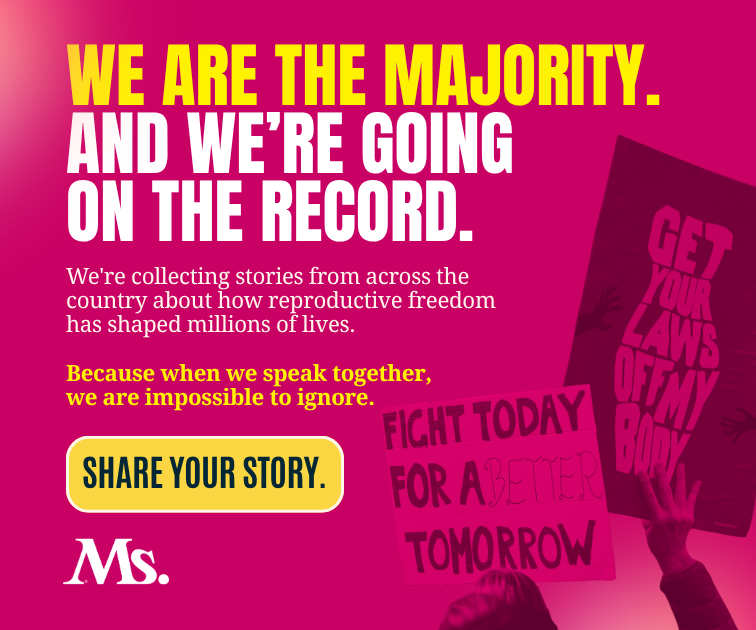
Poll after poll shows a majority of Americans support reproductive healthcare access. Yet public debate overlooks the lives shaped by abortion access, contraception, IVF, miscarriage care, maternal healthcare or comprehensive sex education—countless women who chose to pursue an education, have children, not have children, protect their health and chart their own future. What’s your reproductive freedom story? Add your voice. Together, these stories will help show not only why reproductive freedom remains a majority value, but also what it makes possible.