From ‘Love Island’ to Election Day: How Close Is the U.S. to Deciding Elections by Phone?

Five nights a week, millions of Americans vote on Love Island USA with just a few taps on their phones. Yet when Election Day arrives, most still stand in line, mail absentee ballots or travel to polling places. Despite using smartphones to bank, buy homes, file taxes and manage their healthcare, Americans still can’t use them to vote. The contrast raises an increasingly common question: If Americans trust their phones with nearly every other aspect of life, how close are we to trusting them with democracy?

While internet voting already exists in limited form for some military, overseas and disabled voters, expanding it to the broader public remains one of election administration’s most contentious debates. Supporters argue that allowing eligible voters to cast ballots securely from their phones could remove one of the most persistent barriers to participation. Critics counter that convenience cannot come at the expense of election security, warning that no current internet voting system has yet demonstrated the level of security, transparency and public trust required for democratic elections.

Whether Americans will someday choose presidents the same way they choose reality TV winners remains an open question.

Women’s Sports Were Built by Letting Girls In

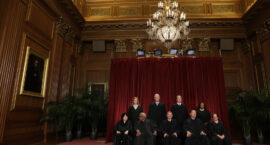
When the Supreme Court upheld West Virginia’s ban on transgender girls participating in girls’ school sports in West Virginia v. B.P.J., it said the ruling was about protecting the safety and fairness of women’s and girls’ sports. I hear that claim against everything I actually lived.

Thirty years ago, in United States v. Virginia, the Supreme Court held that generalizations about “the way women are” cannot justify denying opportunity to women whose talent and capacity place them outside the average description. That principle didn’t just build my generation of athletes. It built a generation of women: the litigators and judges, the surgeons, the CEOs and entrepreneurs, the senators and governors, the police officers and firefighters and fighter pilots, the women who were the first of everything. Every one of those doors was held shut by the same argument Virginia made: Most women wouldn’t want this, most women couldn’t do it.

Women of my generation didn’t fight to be seen as individuals—as athletes, as leaders, as whatever they had it in them to be—only to watch that principle eroded now, in their name and over their objection.

More than half a century ago, this country decided that girls who had been told they didn’t belong on the field belonged there after all. I got to live the proof of that promise. The work now is to keep that promise for every kid who wants to play.

Making Americans Smokers Again: Trump Administration Cuts Anti-Tobacco Programs

In May, the federal Centers for Disease Control and Prevention (CDC) reported one of the greatest public health victories of the past 50 years. A government survey found that cigarette smoking among U.S. adults dropped to an all-time low of 9 percent in 2025, the first time the smoking rate hit single digits. In the 1970s some 40 percent of U.S. adults smoked daily, as well as 16 percent of teenagers, but a culmination of tobacco taxes, smoking bans and remarkably successful public education campaigns turned around what is still the nation’s largest cause of preventable death. 

Which is why it is so astounding that the Trump administration, despite its stated goal to “make America healthy again,” is rolling back its smoking cessation efforts.

A Single Abortion Clinic Closing Rarely Makes Headlines. What Happens When None Are Left?

Picture a map of the United States. It’s 2022, and in southern states like Texas and Tennessee, there are clusters of black dots that represent independent clinic closures. These are abortion care black holes: communities where it’s no longer possible to get an abortion at a nearby clinic.

Fast forward to present. It’s 2026, four years after the Supreme Court’s decision in Dobbs v. Jackson Women’s Health Organization, and black dots have multiplied in states across the country. It no longer matters if the state is red or blue, governed by conservatives or progressives. None are immune to the increasing weight of political pressure, financial strain and operational difficulty that are forcing independent clinics to close or stop providing abortion care.

Each of these black dots is a community suffering a healthcare crisis, and they are proliferating across the United States at a rapid rate.

Independent clinics are often the only places to get clinical abortion care, unbiased information and support for pregnancy options. They are where people go to feel safe and respected, whether they are getting an abortion, continuing a pregnancy or getting gender-affirming care. In small towns and rural spaces, these clinics are often the only safe place for many people, especially those who are LGBTQIA+. If clinics close, there is often nowhere else to go.

And once abortion clinics close, it’s not as simple as reopening when they can, if they can. Even if a specific restriction is lifted, severe financial constraints, continued political hostility, threats of violence and legal uncertainty still stand.

The Mask Is the Message

Most of us have seen the photograph by now.

I keep coming back to the masks.

Masks have always carried meaning. A surgeon wears one to protect a patient. Someone recovering from an illness wears one to protect themselves and others. A firefighter wears one to survive long enough to save someone else.

But when someone covers their face while intimidating another person, threatening a community, or committing a crime, the purpose isn’t protection. It’s concealment. It’s a way of saying: I want to do this, but I don’t want anyone to know it was me. That’s why Patriot Front marches with their faces covered.

Federal immigration agents carrying out arrests in public places wear face coverings for the same reasons: They create anonymity. They make accountability harder. They allow participants to disappear back into ordinary life once the march is over. They make denial easier.

I’ve participated in protests and marches over the years alongside hundreds—sometimes thousands—of people. Not one of us wore a mask. We stood behind our words and convictions. We accepted that our names belonged with our beliefs.

‘Hands Off Ohio!’: FBI Raid of Voting Rights Group Raises Alarms Over Voter Intimidation

On the morning of June 11, agents from the Federal Bureau of Investigation raided the Cleveland offices of the Ohio Organizing Collaborative (OOC), a grassroots pro-democracy organization focused on registration, civic engagement and community organizing for marginalized communities.  

According to reports, agents seized documents and computer files and questioned staff members for several hours. Investigators also contacted employees and community leaders at their homes, workplaces and schools. While some agents reportedly carried subpoenas and asked questions related to voter fraud, officials have not publicly explained the specific focus of the investigation.  

The mission of the OOC is to build power among everyday Ohioans through racial, social and economic justice organizing. In the aftermath of the raid, many local leaders and voting rights advocates expressed concern that the investigation could discourage voter registration and civic participation ahead of the 2026 midterm elections.

Trump Escalates Pressure to Pass the SAVE America Act Before Senate Recess

President Donald Trump is pressuring Senate Republicans to pass the SAVE America Act before lawmakers leave for their August recess, even calling on them to abolish the filibuster if necessary.

Despite the pressure, Republicans still don’t have the votes to move the legislation forward. But after four failed attempts in two years, they’re once again looking for a legislative vehicle to make it law.

About 80 percent of women who marry change their last names, meaning millions could be forced to produce additional paperwork to prove both their identity and citizenship before registering to vote or updating their registration. Students, military families, naturalized citizens, voters with disabilities, Americans who have recently moved, and trans Americans who have changed their names would also face new barriers to casting a ballot. And all of it is aimed at solving a problem that election officials and researchers have repeatedly found is extraordinarily rare.

Once voters understand those consequences, support for the legislation drops sharply. Polling shows that while “proof of citizenship” sounds popular in theory, support falls into net opposition once Americans learn that many eligible voters would need to track down documents like passports or birth certificates just to register or update their voter registration.

Nevertheless, Republicans continue searching for a path to enact the SAVE America Act. Will millions of eligible Americans, especially women, soon face new obstacles to exercising their fundamental right to vote?

This story is updated regularly as Congress and the Trump administration continue efforts to enact the SAVE America Act.

Walking Through the Door Dobbs Left Open: A Groundbreaking Idaho Case Tests Whether the Constitution Protects a Pregnant Woman’s Right to Self-Preservation

When most people think about post-Dobbs abortion litigation, they assume every lawsuit is trying to overturn the Supreme Court’s decision. But a groundbreaking case in Idaho charts a different course. Brought by maternal-fetal medicine specialist Dr. Stacy Seyb, the lawsuit argues that medically necessary abortion care is protected by a constitutional right Dobbs never addressed: the fundamental right to self-preservation.

To understand this novel legal strategy, I spoke with Wendy Heipt, a senior attorney at Legal Voice and a member of Seyb’s legal team. Rather than asking the courts to revive Roe, Heipt argues that no state can force a pregnant person to sacrifice their life or health by denying medically necessary care.

“This case isn’t about abortion,” she told me. “It’s about self-defense.”

If the courts agree, the case could establish a new constitutional framework for protecting pregnant women facing medical emergencies—even under the legal landscape created by Dobbs.

It is a reminder that some of the most consequential battles over reproductive freedom may turn not on revisiting old precedents, but on recognizing constitutional protections the Supreme Court never considered.

‘The Headspace Gap’: The Mental Load of Living in a World Designed for Men

There is a reality we seldom notice: the physical contortion constantly required and tolerated by women to get through the day.

It’s everywhere if you pay attention: the woman struggling to reach and hold on to the strap on the moving subway car; the corporate attorney changing her gait to avoid blisters from her heels; any woman choreographing her every move inside a public restroom stall, accommodating a space designed to be barely sufficient.

The distraction caused by an ill-fitting built world has a tangible consequence: Headspace that would otherwise be focused on a goal or fulfilling one’s potential is wasted on silly workarounds. (And we know these workarounds cost money too.) This is headspace that our male counterparts have available to them.

It is no longer the case that our labor market is predominantly male, and design should reflect that. In a century characterized by the emergence of some of the most frivolous comforts, to ignore gender bias in design is to convey indifference toward the health, safety, performance and comfort of our women.

I call this the headspace gap. It perpetuates patriarchy, operating as a product by design.

(Adapted from the new book Man-Made: How We Designed a World That Leaves Women Out, and How We Can Make It Right.)

War on Women Report: Trump Administration Defines Embryos as ‘Children,’ Eliminates LGBTQ Veteran Healthcare *and* Guts Teen Pregnancy Prevention Programs

MAGA Republicans are back in the White House, and Project 2025 is their guide: the right-wing plan to turn back the clock on women’s rights, remove abortion access, and force women into roles as wives and mothers in the “ideal, natural family structure.”

We know an empowered female electorate is essential to democracy. That’s why day after day, we stay vigilant in our goals to dismantle patriarchy at every turn. We are watching, and we refuse to go back. This is the War on Women Report.

Since our last report:
—This month marked the fourth anniversary of Dobbs. Today, 41 states have some form of abortion restrictions in place, including 13 states that ban abortion entirely.
—HHS has terminated 53 of its 67 grants for the federal Teen Pregnancy Prevention Program, totaling about $68 million and affecting grantees in two dozen states.
—Two family planning programs sued the Trump administration for curtailing the Title X grant program, which funded clinics providing reproductive healthcare services to low-income patients.

… and more.