Poems Wherein the Bullet Speaks: A Review of Heidi Kasa’s ‘The Bullet Takes Forever’

You might not be advised to buy a book for its cover, but the same can’t be said about its title. Consider the title of Heidi Kasa’s first book of poetry, published by Mouthfeel Press: The Bullet Takes Forever. In seven syllables, Kasa’s title conjures a wide swath of loss, both vertical and horizonal, the catastrophic consequences of gun violence, robbing us of time and life itself.

Consider the power wielded by the prototypical word “take” to state the obvious: a word with more than fifty meanings, according to the Oxford English Dictionary. Also, among the first words we learn to spell as children. How the title lands is a fine indicator of the way Kasa’s poems will strike the courageous reader, the reader willing to dwell on a time in this space dedicated to examining violence, delivered more than not upon the most vulnerable among us.

Some of the poems speak for themselves, such as the list poem titled “Back to School Shopping List 2024,” beginning with “1. backpack (big enough to hide behind)”—and then progressing as time would progress: “2. notebook (for reunification records)” and “7. spelling test (words: tourniquet, instructions, wound, direct, manual, pressure).”

One cannot help but observe that narrative poems are few, likely because the reader can provide the narrative. Reading Kasa’s gun poems triggers the narratives that have lived for decades in our minds and hearts and bodies. We know the story. We have been living the story.

The Most Popular Supreme Court Justices Are Women

Weekend Reading on Women’s Representation is a compilation of stories about women’s representation in politics, on boards, in sports and entertainment, in judicial offices and in the private sector in the U.S. and around the world—with a little gardening and goodwill mixed in for refreshment!

—Knowing that whoever is nominated will face intense scrutiny for potential sexual misconduct, a woman could be Maine Democrats’ safest choice.
—”It’s worth remembering that in moments of past darkness we have triumphed not by moderating our opinions or softening our asks, but by dreaming big and daring boldly,” writes Janai Nelson.

If You’re Alone on the Prairie, Would You Rather Meet a Man or a Wolf?

It would be easy to be cynical about a remake of Little House on the Prairie. At a moment when “tradwife” nostalgia and gender politics dominate so much of our cultural conversation, the series arrives as an unexpected relief—and maybe just what we need today.

There’s a nod to the old debate over whether men or bears are more dangerous. There’s the diversity of a post-Civil War America: free Black men, Native Americans, mixed-race chosen families, and more.

But the show isn’t interested in hammering home a lesson from either side of our political divide. It’s more interested in showing the country as it was, and maybe still is.

From ‘Love Island’ to Election Day: How Close Is the U.S. to Deciding Elections by Phone?

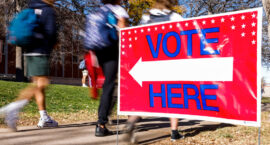
Five nights a week, millions of Americans vote on Love Island USA with just a few taps on their phones. Yet when Election Day arrives, most still stand in line, mail absentee ballots or travel to polling places. Despite using smartphones to bank, buy homes, file taxes and manage their healthcare, Americans still can’t use them to vote. The contrast raises an increasingly common question: If Americans trust their phones with nearly every other aspect of life, how close are we to trusting them with democracy?

While internet voting already exists in limited form for some military, overseas and disabled voters, expanding it to the broader public remains one of election administration’s most contentious debates. Supporters argue that allowing eligible voters to cast ballots securely from their phones could remove one of the most persistent barriers to participation. Critics counter that convenience cannot come at the expense of election security, warning that no current internet voting system has yet demonstrated the level of security, transparency and public trust required for democratic elections.

Whether Americans will someday choose presidents the same way they choose reality TV winners remains an open question.

Women’s Sports Were Built by Letting Girls In

When the Supreme Court upheld West Virginia’s ban on transgender girls participating in girls’ school sports in West Virginia v. B.P.J., it said the ruling was about protecting the safety and fairness of women’s and girls’ sports. I hear that claim against everything I actually lived.

Thirty years ago, in United States v. Virginia, the Supreme Court held that generalizations about “the way women are” cannot justify denying opportunity to women whose talent and capacity place them outside the average description. That principle didn’t just build my generation of athletes. It built a generation of women: the litigators and judges, the surgeons, the CEOs and entrepreneurs, the senators and governors, the police officers and firefighters and fighter pilots, the women who were the first of everything. Every one of those doors was held shut by the same argument Virginia made: Most women wouldn’t want this, most women couldn’t do it.

Women of my generation didn’t fight to be seen as individuals—as athletes, as leaders, as whatever they had it in them to be—only to watch that principle eroded now, in their name and over their objection.

More than half a century ago, this country decided that girls who had been told they didn’t belong on the field belonged there after all. I got to live the proof of that promise. The work now is to keep that promise for every kid who wants to play.

Making Americans Smokers Again: Trump Administration Cuts Anti-Tobacco Programs

In May, the federal Centers for Disease Control and Prevention (CDC) reported one of the greatest public health victories of the past 50 years. A government survey found that cigarette smoking among U.S. adults dropped to an all-time low of 9 percent in 2025, the first time the smoking rate hit single digits. In the 1970s some 40 percent of U.S. adults smoked daily, as well as 16 percent of teenagers, but a culmination of tobacco taxes, smoking bans and remarkably successful public education campaigns turned around what is still the nation’s largest cause of preventable death. 

Which is why it is so astounding that the Trump administration, despite its stated goal to “make America healthy again,” is rolling back its smoking cessation efforts.

Can You Believe They Put This in Writing? The Wildest Quotes From Heritage’s ‘Project 2026’

The Heritage Foundation has once again taken it upon itself to craft a plan for how to supposedly save America. The report—”Saving America by Saving the Family: A Foundation for the Next 250 Years”—focuses on marriage, family and the American Dream, and has become widely known as “Project 2026,” a follow-up to Heritage’s infamous Project 2025 blueprint.

Project 2025 clocked in at 900 pages; the sequel is around 150. We read the whole thing and pulled out the passages that gave us chills, made us laugh out loud, compelled us to suddenly need to take a long walk and hug our dogs, or inspired another donation to our local abortion fund.

This isn’t intended to be a fact-check or a line-by-line rebuttal. It’s intended to show you how some of the country’s most influential conservative thinkers are talking about feminism, contraception, abortion, LGBTQ+ people, higher education, marriage, motherhood and the role government should play in all of it—because you’re probably too busy to read hundreds of pages of anti-feminist slop.

And because, as former Vice President Kamala Harris famously said about Project 2025: “Can you believe they put that thing in writing?” They did—twice now!

This is the roadmap they’re offering. These documents tell us how their authors understand the country, the family and women’s place in both. We should know what it says.

A Single Abortion Clinic Closing Rarely Makes Headlines. What Happens When None Are Left?

Picture a map of the United States. It’s 2022, and in southern states like Texas and Tennessee, there are clusters of black dots that represent independent clinic closures. These are abortion care black holes: communities where it’s no longer possible to get an abortion at a nearby clinic.

Fast forward to present. It’s 2026, four years after the Supreme Court’s decision in Dobbs v. Jackson Women’s Health Organization, and black dots have multiplied in states across the country. It no longer matters if the state is red or blue, governed by conservatives or progressives. None are immune to the increasing weight of political pressure, financial strain and operational difficulty that are forcing independent clinics to close or stop providing abortion care.

Each of these black dots is a community suffering a healthcare crisis, and they are proliferating across the United States at a rapid rate.

Independent clinics are often the only places to get clinical abortion care, unbiased information and support for pregnancy options. They are where people go to feel safe and respected, whether they are getting an abortion, continuing a pregnancy or getting gender-affirming care. In small towns and rural spaces, these clinics are often the only safe place for many people, especially those who are LGBTQIA+. If clinics close, there is often nowhere else to go.

And once abortion clinics close, it’s not as simple as reopening when they can, if they can. Even if a specific restriction is lifted, severe financial constraints, continued political hostility, threats of violence and legal uncertainty still stand.

The Mask Is the Message

Most of us have seen the photograph by now.

I keep coming back to the masks.

Masks have always carried meaning. A surgeon wears one to protect a patient. Someone recovering from an illness wears one to protect themselves and others. A firefighter wears one to survive long enough to save someone else.

But when someone covers their face while intimidating another person, threatening a community, or committing a crime, the purpose isn’t protection. It’s concealment. It’s a way of saying: I want to do this, but I don’t want anyone to know it was me. That’s why Patriot Front marches with their faces covered.

Federal immigration agents carrying out arrests in public places wear face coverings for the same reasons: They create anonymity. They make accountability harder. They allow participants to disappear back into ordinary life once the march is over. They make denial easier.

I’ve participated in protests and marches over the years alongside hundreds—sometimes thousands—of people. Not one of us wore a mask. We stood behind our words and convictions. We accepted that our names belonged with our beliefs.