Sundance 2026: Documentary ‘Silenced’ Exposes How Defamation Suits Muzzle Survivors and Journalists

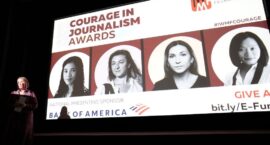
Featuring the cases of Amber Heard, Gisèle Pelicot, Brittany Higgins, Colombian journalists at Volcánicas and others, Silenced traces a global pattern of defamation suits used to punish survivors and the reporters who amplify their stories.

It’s a fitting but frustrating coda that Silenced itself faced legal threats right after its festival premiere.

(This is one in a series of film reviews from the 2026 Sundance Film Festival, focused on films by women, trans or nonbinary directors that tell compelling stories about the lives of women and girls.)

How Junk Science Is Driving Reproductive Health Policy: A Live Conversation With Guttmacher Institute, Georgetown University’s O’Neill Institute and Ms. (Online; Tuesday, Feb. 17)

As false claims and junk science increasingly distort public understanding of reproductive health, leading experts are coming together to confront the growing threat mis- and disinformation pose to access, policy and democracy itself.

On Feb. 17, the Guttmacher Institute, Ms. magazine and Georgetown University’s O’Neill Institute for National and Global Health Law will co-host a virtual webinar examining how misinformation is reshaping debates around contraception, abortion and sexual and reproductive health and rights in the United States.

Keeping Score: Renee Good Fatally Shot by ICE; Women Work Longer and Are Paid Less Worldwide; N.Y. Fights Back Against Federal Childcare Freeze

In every issue of Ms., we track research on our progress in the fight for equality, catalogue can’t-miss quotes from feminist voices and keep tabs on the feminist movement’s many milestones. We’re Keeping Score online, too—in this biweekly roundup.

This week:
—”We had whistles. They had guns,” said Becca Good, wife of Renee Good, who was killed in Minneapolis by ICE agent Jonathan Ross.
—In central Texas, five months after the Sandy Creek flooding, “many are still homeless, and only 36 percent of FEMA claims in our area have been approved,” said survivor Brandy Gerstner. “FEMA must be independent, fully funded and strengthened—because when it fails to function, real families pay the price.”
—Anti-Muslim and anti-South Asian hate increased around the election of NYC Mayor Zohran Mamdani.
—The Department of Veterans Affairs announced new abortion bans.
—Meta has removed the social media accounts of dozens of reproductive health and LGBTQ groups.
—Women worldwide earn just a third of what men do when unpaid domestic labor is taken into account.

… and more.

Musk Isn’t Stopping Grok From Creating Explicit Photos of Minors Using AI. Here’s What Can Be Done.

Since the end of December, X’s artificial intelligence chatbot, Grok, has responded to many users’ requests to undress real people by turning photos of the people into sexually explicit material. After people began using the feature, the social platform company faced global scrutiny for enabling users to generate nonconsensual sexually explicit depictions of real people.

The Grok account has posted thousands of “nudified” and sexually suggestive images per hour. Even more disturbing, Grok has generated sexualized images and sexually explicit material of minors.

X’s response: Blame the platform’s users, not us.

What 200 Gen Z Women Told Me About Birth Control Should Alarm Every Woman in America

Birth control is the single most powerful tool for women’s economic mobility and autonomy in modern history. It changed everything: When women could plan if, when and with whom they wanted to have children, college enrollment soared, dropout rates fell and poverty rates declined. The ability to access contraception has been directly tied to women’s ability to stay in school, build careers and make decisions about their own futures.

So why, in 2025, are we finding ourselves in a messaging war on birth control?

What Ariana Grande’s Weight-Loss Discourse Gets Wrong

We can’t afford to look away from changing beauty norms in our society, and how they are fueling eating disorders. 

Jennifer Rollin, an eating disorder therapist based in Maryland, says, “What I hear from a lot of clients is that when they are trying to recover from their eating disorder in this society, it almost feels wrong, because ‘everyone around me is talking about Ozempic,’ and ‘all the celebrities are talking about their big amount of weight loss.’”

But while it can feel cathartic to criticize or distance ourselves from prominent women who seem to be conforming to dangerous beauty standards, that criticism is harmful and does not bring us any closer to addressing the problem.

Women in Politics Weekly Roundup: Miami’s First Woman Mayor; Congress Moves to Reform How We Vote; Forbes Ranks World’s 100 Most Powerful Women

Weekend Reading for Women’s Representation is a compilation of stories about women’s representation in politics, sports and entertainment, judicial offices and the private sector—with a little gardening mixed in!

This week:
—A seachange in New Mexico’s new women-majority legislature.
— The Ranked Choice Voting Act has been introduced in Congress, which would require RCV for all primary and general congressional races beginning in 2030, allowing voters to express their ranked support for multiple candidates.
—Eileen Higgins is elected as Miami’s first woman mayor. She ran on a platform of structural reforms: affordable housing, climate resilience, improved municipal governance and expanded representation.
—Australia enacts a nationwide ban on social media accounts for children under 16.
Forbes 2025 ranking of the world’s 100 most powerful women spotlights an increasingly diverse and influential generation of female leaders across business, politics, technology, media and culture.

… and more.

Shout Your Abortion Short Films Seek to Normalize Keeping Abortion Pills at Home: ‘You Always Have Options’

The grassroots abortion-stigma-busting juggernaut Shout Your Abortion has released two new powerful public service announcements urging people across the U.S. to order abortion pills in advance to have on hand, in case they have an unwanted pregnancy.

Made by Detroit-based filmmaker Na Forest Lim, the short films follow two women—a teenager named Dani and a single mother in her 30s named Poppy—who find out they are pregnant and use abortion pills at home, supported by friends and family.

Both of the main characters have easy access to abortion pills: Dani’s friend arrives with pills in her backpack, and Poppy keeps a pack tucked away in her top dresser drawer.

Building on that vision of easy access, the Dani PSA shows what it looks like when abortion pills are already part of teenagers’ lives and a pregnancy never has the chance to become a crisis.