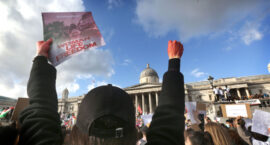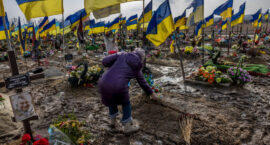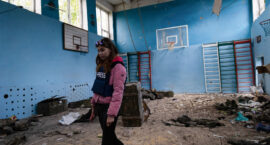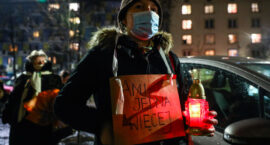
How the International Women’s Media Foundation Fights for Women in Journalism and Strengthens Press Freedom

Last year, 12 women journalists were murdered, and the number of women journalists imprisoned rose by 64 percent. By continuing to award courageous journalists, the International Women’s Media Foundation is making it known that the threat of violence against women reporters is ever-present. Still, it also is a testament to the unwavering spirit of women journalists globally. 

Over the next several months, Ms. and IWMF will collaborate monthly to highlight the works of these journalists, all of whom are nominees or winners of the Courage in Journalism award.

(This essay is part of the “Feminist Journalism is Essential to Democracy” project—Ms. magazine’s latest installment of Women & Democracy, presented in partnership with the International Women’s Media Foundation.)

On World Refugee Day, 110 Million People Must Leave Home to Flee Conflict and Persecution

Compounded crises—including conflict, climate and COVID-19—are driving unprecedented levels of human suffering, economic vulnerability and forced displacement. 

Tuesday, June 20, we celebrate World Refugee Day—honoring the strength and bravery of those who have been forced to flee their homes. With the 2023 theme of World Refugee Day, “Hope away from home,” we must question whether we, as humanitarians, are effectively using our resources to create an environment for refugees to become self-sufficient.

Journalist-Activist Nadezhda Azhgikhina on Global Journalism, Women’s Wartime Roles, and Why We Can’t Just ‘Cancel Russian Culture and All Russians’

Ms. spoke with Russian journalist and activist Nadezhda Azhgikhina about the global demise of journalism and women’s roles in peace negotiations between Russia and the U.S.

“I believe it’s possible for women in Russia and in Ukraine to find a common language and help each other. It’s women’s potential which expedites and eases a common language of peace so that we can all overcome the consequences of the tragedy we collectively face today.”

Art as Protest—and Therapy—in War-Ravaged Ukraine

Art inspired by the Russian invasion of Ukraine fills Rivne, a city in northwestern Ukraine within a three-hour drive from the Polish border—where an exhibition of 44 paintings by Ukrainian artists opened last year at The Euro Gallery.

“Every moment is precious,” one artist said. “If I have a last opportunity to say something, I have to make it through art by telling the truth.”

The Patriarchs’ War on Women

Assaults on women’s and LGBTQ+ rights—and attempts to put women “in their place”—constitute a backlash against feminist progress expanding women’s full inclusion in public life.

As women’s participation becomes more prominent in domestic and international politics, here’s why political sexism and gender policing are also becoming more virulent—and what to do about it.

(This essay is part of Women’s Rights and Backsliding Democracies project—a multimedia project made up of essays, video and podcast programming, presented by Ms., NYU Law’s Birnbaum Women’s Leadership Network and Rewire News Group.)

Ukraine’s Frontline Mothers

More and more women have joined the ranks of the Ukrainian Armed Forces (UAF) since the country’s large-scale mobilization rapidly rolled out this past year, switching up the traditional wartime narrative that portrays women, and mothers with children especially, as victims of war instead of as agents of change.

(This article originally appears in the Spring 2023 issue of Ms. Join the Ms. community today and you’ll get the issue delivered straight to your mailbox!)

Standing Together for Freedom: A Commitment to 14 Democratic Principles

As people around the world stand up for democracy and human rights, dictators are learning from one another how to suppress challenges to their rule more effectively. That’s why this week’s second Summit for Democracy could not come at a more critical time. Led by the United States, the Netherlands, Zambia, South Korea and Costa Rica, this meeting of leaders from more than 100 governments provides a global policy stage to build stronger democratic alliances and double down on commitments to address the summit’s three themes: respect for human rights, combatting corruption, and countering authoritarianism.

Freedom House, along with the Bush Center and the McCain Institute, led a coalition of organizations from around the world in drafting a Declaration of Democratic Principles in the run-up to the summit.

Why Women Are More Likely to Be ‘Citizens of Nowhere’

More than 10 million people are stateless around the globe, with no “home” country to call their own—and women and children are most likely to fall outside citizenship laws.

For stateless women, their very existence—and the right to live a life as a full citizen of a country—has been blotted out by geopolitics and sexism.