Listen, Rate, Review and subscribe on:


Transcript
Michele Goodwin: Welcome to On the Issues with Michele Goodwin at Ms. magazine. As you know, we’re a show that reports, rebels and tells it just like it is. On our show, we center your concerns about rebuilding our nation and advancing the promise of equality—and that really was what Gloria Steinem was committed to doing.
Barack Obama, archival audio: Speaking of game changers and disruptors, there’s a young girl named Gloria Steinem who arrived in New York to make her mark as a journalist—and magazines only wanted her to write articles like “How to Cook Without Really Cooking for Men.”
Gloria noticed things like that. She’s been called a “champion noticer.” She’s alert to all the ways, large and small, that women had been—and, in some cases, continue to be—treated unfairly just because they’re women.
As a writer, a speaker and an activist, she awakened a vast and often skeptical public to problems like domestic violence, a lack of affordable child care and unfair hiring practices. Because of her work, across America and around the world, more women are afforded the respect and opportunities that they deserve. But she also changed how women thought about themselves.
Michele Goodwin: This week, Gloria Steinem passed away at the age of 92, surrounded by many people who loved her. She passed away peacefully at her home in New York City on September 2.
We will miss her at Ms. magazine. I will personally miss her myself. She has been a part of what I see as my own personal journey. It’s a journey that includes Ms. magazine, but it started before we created Ms. Studios and before I joined Ms. magazine.
As I’ve written about in The New York Times, I left home at the age of 15 with 10 bucks in my pocket and a plane ticket to New York. I shared the complications of a childhood that included many things of deep privilege, but also incredible pain.
Gloria Steinem, archival audio: If there is any legacy, I would just say that I was trying to make the world a little more fair and a little more representative than it was when I got here.
Michele Goodwin: Some of that Gloria experienced in her life. She was born March 25, 1934, in Toledo, Ohio. She crisscrossed the country with her mother, sister and father. She described it as living in a caravan, crisscrossing the country as her father worked as a salesman. But he left the family when she was 10, leaving Gloria to care for her mother, who had long suffered from mental illness and terrifying hallucinations. As a result, Gloria, for a period of time, did not attend school because she was tending to her mother.
She would later come to say that she made a decision not to have children because she had already had one mother to take care of.
You know, it’s a story that we don’t often talk about. The sensitivity that came from her own childhood—there are aspects of it that mirrored and matched mine. And it’s something that we don’t talk about because the pronatalism that takes place in our country suggests that all women should always want to have children; that they should take care of those children; that they should stay at home and not work; that if they go to college, they should go to college to meet someone to marry and then be satisfied with that life.
To want more, to care for more, is something that has really been an enormous challenge in our country. Gloria Steinem understood that.
Her career included not just the creation of Ms. magazine. Ms. was a pathbreaking magazine. It wasn’t just that—but that itself was absolutely huge. It was monumental.

In Ms. magazine, before there was Roe v. Wade, Gloria Steinem, Billie Jean King and others spoke and wrote about having abortions. This was when abortion was still criminalized throughout much of the United States. In fact, to be able to have an abortion in the United States often meant that a woman would have to say there was something mentally wrong with her. That could create a condition under which a doctor would be given an exception to perform an abortion if the woman was mentally fraught.
What Gloria knew—and what was clear across the country—was that girls and women were dying from illegal and back-alley abortions. Clearly, there were those who survived them.
Gloria Steinem, archival audio: This is a joint statement by the United Women’s News Conference to announce action in response to the abortion situation in New York state.
Over the years, male-dominated legislatures and courts have tossed around women’s rights like a political football. The current threat to the right to abortion in New York is the most serious and the most stark example of this kind of maneuvering with women’s lives.
If Governor Rockefeller signs it, the Donovan-Crawford bill just passed by the state Legislature would take away the right to abortion in New York. We are here to make known the unity of women behind the demand that abortion be a woman’s right to choose.
We are here to announce a united demonstration on Monday to protest the passage by the state Legislature of the Donovan-Crawford bill and to ensure that Governor Rockefeller vetoes that bill. We are here to announce our determination to stand together in defense of a woman’s right to abortion in New York, and to work together until the right to safe, legal abortion becomes a right recognized by law in every state of this country.
On Monday, May 15, at 12 noon, we will meet at 40th Street and Sixth Avenue for a march to Governor Rockefeller’s New York office at 22 West 55th Street. Every person who believes that abortion should be a woman’s right to choose, and that Governor Rockefeller should veto the bill that would take away that right, is urged to join us to make her or his voice known.
Governor Rockefeller, the people of New York and the people of the entire country must know that the majority of the people in New York support the right to abortion by choice, and that we will stand together to win and to defend that right.
In addition, we will work on a national level to win legal recognition of our right to abortion by choice. We support the Abortion Rights Act of 1972, which has been introduced into Congress by Congresswoman Bella Abzug.
We are carrying on many kinds of campaigns to make known the attacks on women’s right to abortion and to expose those who are perpetrating them. Right now, our attention—and the attention of the women of the entire country—is on the fight here in New York, and we will concentrate our immediate efforts on defeating the attack codified in the Donovan-Crawford bill.
The Monday demonstration is an essential aspect of that fight. Whatever happens here, we will continue our fight until every woman has the right to decide for herself whether or not, and when, to have an abortion.
Michele Goodwin: Gloria herself went to England to terminate a pregnancy when she was 22 years old. It was 1956, and she later wrote about this illegal abortion that she had in London. She wrote about the two things the doctor requested of her in her 2015 memoir, My Life on the Road. I’m so grateful that I have a signed copy from her.
She wrote:
Dr. John Sharpe of London, who in 1957, a decade before physicians in England could legally perform an abortion for any reason other than the health of the woman, took the considerable risk of referring for an abortion a twenty-two-year-old American on her way to India. Knowing only that she had broken an engagement at home to seek an unknown fate, he said, “You must promise me two things. First, you will not tell anyone my name. Second, you will do what you want to do with your life.” Dear Dr. Sharpe, I believe you, who knew the law was unjust, would not mind if I say this so long after your death: I’ve done the best I could with my life. This book is for you.
What an incredibly powerful tribute to a person who had such a dynamic life and made such an incredible impact on the lives of all Americans, no matter their background.
She went on to college. She went on to spend two years in India as part of the Chester Bowles Fellowship. Her time in India truly helped to shape so much of the nuance behind what she understood in terms of class, race, sex and sex equality—and the inequalities along all of those paradigms.
During those two years in India, she worked with incredibly vulnerable women across a variety of roles. She spent time in villages with women, organizing nonviolent protests against government policies. Much of this sparked her interest in grassroots activism.
After graduation, she did something incredibly important—something that ultimately leads to us at Ms. magazine: She became a journalist. She understood the power of narration and journalism. And she understood what is known as an African adage: The tale of the hunt will always glorify the hunter until the lioness has her say.
The only way for women to begin to have their say was for women to put pen to paper.
Imagine, in the 1960s and the 1970s, that over the course of centuries, women’s stories were not being told by women—or that the stories told by women were shuttered to the side. The voices given priority on nightly news and in newspapers and magazines were not the voices of women, even though concerns that affected women’s lives were not being translated by women.
And so what Gloria Steinem became was a translator, a truth-teller, a person who, like Shirley Chisholm, was unbought and unbossed in telling stories.
She began writing freelance pieces for Esquire in the 1960s. At this point, she was living in New York. Her first major published piece was in 1962, and it was about birth control and how college students’ views on sex were changing.
Keep in mind, listeners, that at the time, there were states in the United States that banned even married people from being able to access contraception. That is really hard for people to imagine—except that now we are living in a post-Dobbs reality, where so much that Gloria Steinem fought for and worked so hard for is being dismantled, or even has been dismantled.
But let’s talk first about what she was able to help achieve in the United States.
From writing about contraception, she went on to join together with Dorothy Pitman Hughes, taking their famous photo with both fists in the air. You remember that. You must see that. Take a look for that photo: Gloria and Dorothy, fists raised in the air, representing women’s power and the importance of women’s power. It wouldn’t be long after that that she would found Ms. magazine.
But what ended up catching the attention of so many in journalism—and she would later say that if people were mad at her, they would refer to her as a Playboy Bunny—was her undercover story about what was happening at the Playboy Club.
This investigation was published in 1963 in Show magazine. Gloria went undercover as a Playboy Bunny at the Manhattan Playboy Club and detailed the seedy and sexist reality behind Hugh Hefner’s empire, long before the recent documentary came out.
From there, she went on to become a founding editor and writer at New York magazine in 1968. She continued to tell important stories, and she wrote about how, after Black Power, women’s liberation would be essential.
This, combined with her work on abortion, was critical because this was the period leading up to Roe v. Wade.
What Gloria was seeing is what I’ve written about and what we’ve been presenting in the pages of Ms. magazine for so many years: Parents coming home and finding their daughters dead in a bathtub full of blood, after being so desperate that they tried to self-administer an abortion with a coat hanger. Husbands coming home and finding their wives dead on the dining room table. Women found in motel rooms, bleeding out on stacks of newspapers and sheets. Maternity wards filled not with women who had just had babies, but with women experiencing sepsis and near death after botched, back-alley abortions.
That is not the only story of illegal abortion, because Gloria had a safe one in London. There were doctors doing the best they could under an unjust system to help women and girls.
But the reality was that there were women and girls who were so desperate—women who had experienced rape, girls who had experienced incest, women who were on the brink of going to college or already in college, knowing that they would not be able to stay in college while pregnant and with a child.
And, in fact, even at that time, there was a famous case that Ruth Bader Ginsburg talked about at her Supreme Court confirmation hearings. It concerned a woman in the military who became pregnant. A condition of being in the U.S. military at the time was that you could not be pregnant while serving, and she was both pregnant and unmarried.
The irony of these times, as women were bleeding out, dying and filling maternity wards, was that the U.S. military was not only allowing abortion but demanding it of women who were pregnant.
In the case that Ruth Bader Ginsburg discussed during her confirmation hearing, Capt. Susan Struck actually wanted to continue her pregnancy. The U.S. military said, “You are not able to do this while pregnant. You must have an abortion.”
It was a strange irony that the federal government could demand an abortion for a woman who wanted to continue a pregnancy. But behind all of this was a matter of someone else using the master’s tools to control women and their reproductive lives.
Gloria Steinem began calling for the reproductive freedom of all women and girls, and understood that it would be essential to full, equal citizenship and participation in society. That is why, up until the day she passed away—quite literally—she was fighting for the ratification of the Equal Rights Amendment and saw it as critically important. This is where she turned her attention after Roe.
And let’s be clear: The path to Roe was not an easy one. She was involved in steady activism in that space—attending rallies, leading rallies and curating rallies.
She wrote and spoke about how men in journalism would push back and tell her, “You are a great writer. You have so much potential. You are a terrific editor. But you should stop with this other stuff—this women stuff, this feminism stuff—because you have great potential, and that’s going to weigh you down.”
That was not Gloria’s philosophy at all. Her philosophy was that there was an agenda that must be met, and that agenda was simply this: the equality of all persons.
It’s something inscribed in our Constitution, and it’s something that needed to be made a reality. And not only is it in our federal Constitution, but in each and every state is this promise of equality. Where did women fit into that?
This was a concern of Gloria’s, and across her life’s work she made something very clear. It was the truth to power with which she founded Ms. magazine: Equality has to be for all.
There should be no such thing as a feminism that looks white. In fact, she scoffed at that. She laughed at that because Gloria Steinem believed that the early feminists—the people who really made feminism come alive—were the Black women she learned from.
For some people, they have to sit with that, and it may be confusing for them: Black feminism—what is that? But Gloria had this perspective that there was much our nation still had to learn from Black women.
She understood, particularly given her time in India, that the population of women who had suffered through the transatlantic slave trade—being kidnapped from their homes, being brought into a land where they were forced into sexual and physical labor, where they were denied the very identity of a person or citizen and instead inscribed in American law as property, no higher than a mule, goat, sheep or horse—had endured the unthinkable.
The children they bore were not legally theirs, but were owned by the people who owned them and could be traded, sold, rented out or leased out.
She understood that those women, who survived that and then survived Jim Crow and Jane Crow, had a sense of what constitutionalism really meant. They had a sense of what democracy really meant. They had a sense of what it would take to make things right. They had a sense of what it means to persevere against all odds, and yet lead a civil rights movement that would not be exclusionary—that would not say, “This is just for us. This is just about Black women and their children.”
What Gloria understood, remarked upon and found remarkable about the women she saw during that Jim Crow era—the era before the Civil Rights Act of 1964 and the Voting Rights Act of 1965—was that these women were really about progress and inclusion for all. They held a sense that what democracy really promises is something that embraces everybody, and that equality is not just for one group and voting rights are not just for one set of people, but for all people.
She was moved by Fannie Lou Hamer at the 1964 Democratic National Convention, when Hamer talked about the struggle of Black women in Mississippi, including herself. Hamer was taken to a county jail by white police officers and put in a cell. A police officer gave two men a blackjack and told them to beat Fannie Lou Hamer. Gloria remembered that it made an impression on her.
And this arc of Gloria’s life included the importance of storytelling. In 1970, she testified before the Senate in support of the Equal Rights Amendment, and she continued on with that work.
Her life is one of numerous firsts. Many will reflect—and have been reflecting—on what she said about holding the torch. It made her angry for people to say, “Well, you’re going to put that torch down.” Instead, her perspective was: “You light other torches.” This is what you do with your torch. But you don’t give up, and you don’t give in. You continue the work.
You know, after Congress failed to pass the Equal Rights Amendment in 1970—well, it’s one that needed to be ratified, right? After that didn’t happen right away, with the legislation that would need to be ratified by three-quarters of the states, she founded the National Women’s Political Caucus with fellow feminist leaders and more than 300 women from across the United States.
This group worked to include women in all aspects of political life. Its members included Shirley Chisholm, Bella Abzug, Betty Friedan and Fannie Lou Hamer, whom I just talked about.
We will miss Gloria at Ms. magazine, and there are so many across the country who will, because the torch that was lit for her—and the torches she lit for others—had an effect across so many aspects of life.
When you think about the work of Pauli Murray coming into effect, it was as if what Pauli Murray aspired to and wanted, Gloria Steinem—along with others—picked up.
When I think about Justice Ruth Bader Ginsburg before she became a judge and justice, she was at the ACLU, working to dismantle what had been literally hundreds of sex-discriminatory laws. The blueprint for so much of that had already been provided by Pauli Murray.
And you all know who Pauli is. Those of you who have listened to my show—and, for those of you who are new to the show—Pauli Murray was, simply put, a badass.
Pauli Murray really created a legal blueprint for Brown v. Board of Education, and also for the frameworks that would dismantle sexual harassment in the workplace—or at least provide a remedy for it.
What Gloria Steinem was able to do was pick that up from the lens and the lane of an activist, to show how these things could be done. I think about that with regard to Justice Ruth Bader Ginsburg because while Ginsburg was doing this from the legal front, the person helping to socialize the narrative, write the narrative and curate the narrative certainly was Gloria Steinem.
When I reflect back on the 50th anniversary of Ms. magazine, and the time I spent with Gloria then and before—and in the period since, when we were doing our book tour—something struck me time and again.
Whether we were at Politics and Prose in Washington, D.C., the Hammer Museum in Southern California or other parts of the country, we talked about the book and had hundreds of people showing up. One of the things that struck me was how many people came up and said that their mother was born in another country—and that their mother kept Ms. magazine in the house.
Gloria’s influence was not simply domestic, and if it were, it would be enough. But her reach also extended beyond the United States. Women around the world could have this sense of power, this sense that their voices mattered, this sense that they could make a difference not only in their own lives but in the lives of others.
That it was their life. Their choice to be educated, to work in whatever profession they chose and to govern their own bodies and reproductive health—all of that is part of Gloria’s legacy.
As we turn to thinking about what comes next, I want to encourage everybody who is thinking about Gloria’s passing, Dolly Parton’s passing and Cassandra Wilson’s passing.
Gloria also believed in joy.
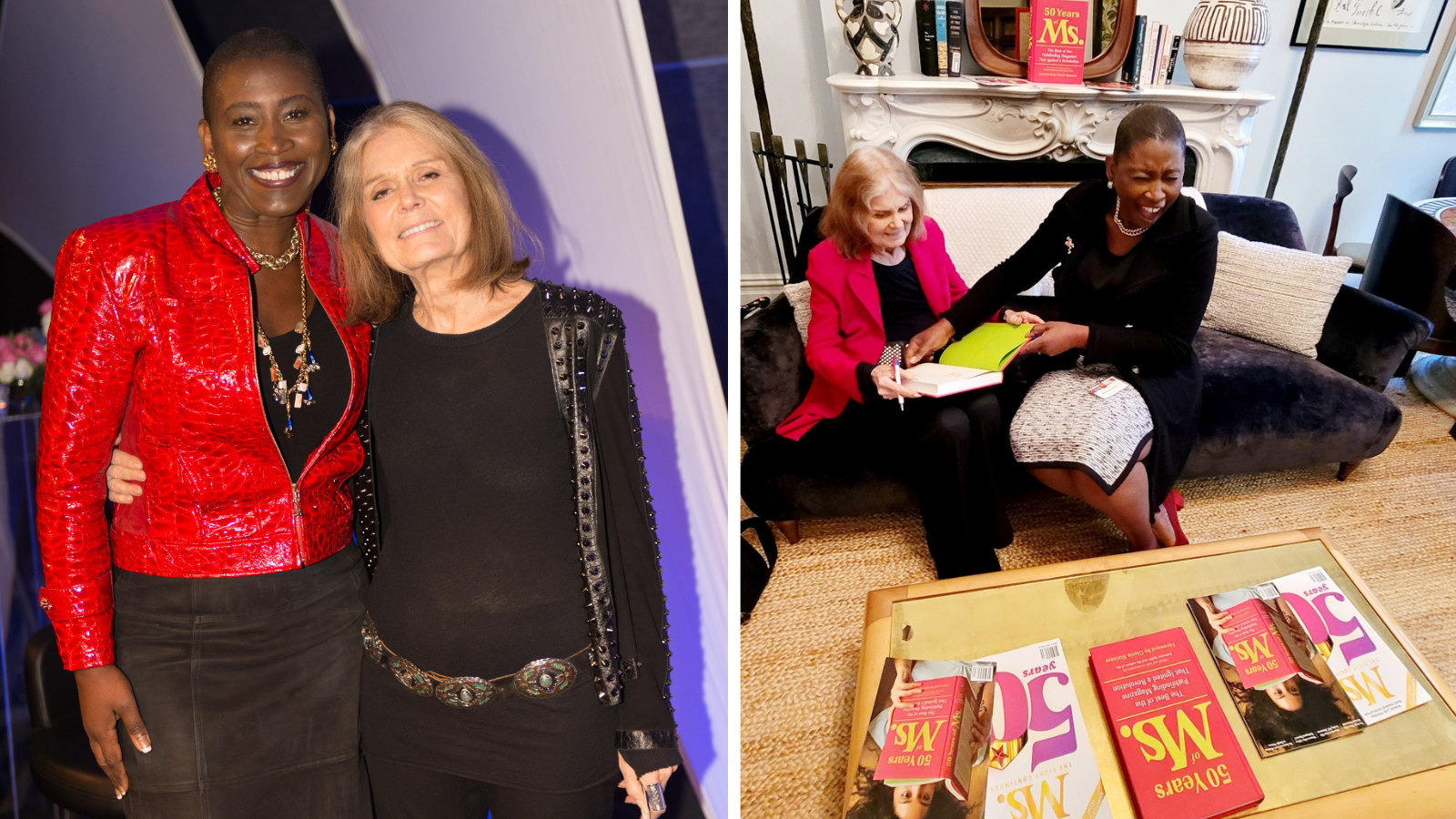
There’s an image of the two of us together at an event recognizing the 50th anniversary of Ms. magazine. She has me cracking up. We’re sitting on a small couch together, and she’s signing books. I don’t remember what joke she told or what the statement was, but she’s smiling, and I am truly laughing with her.
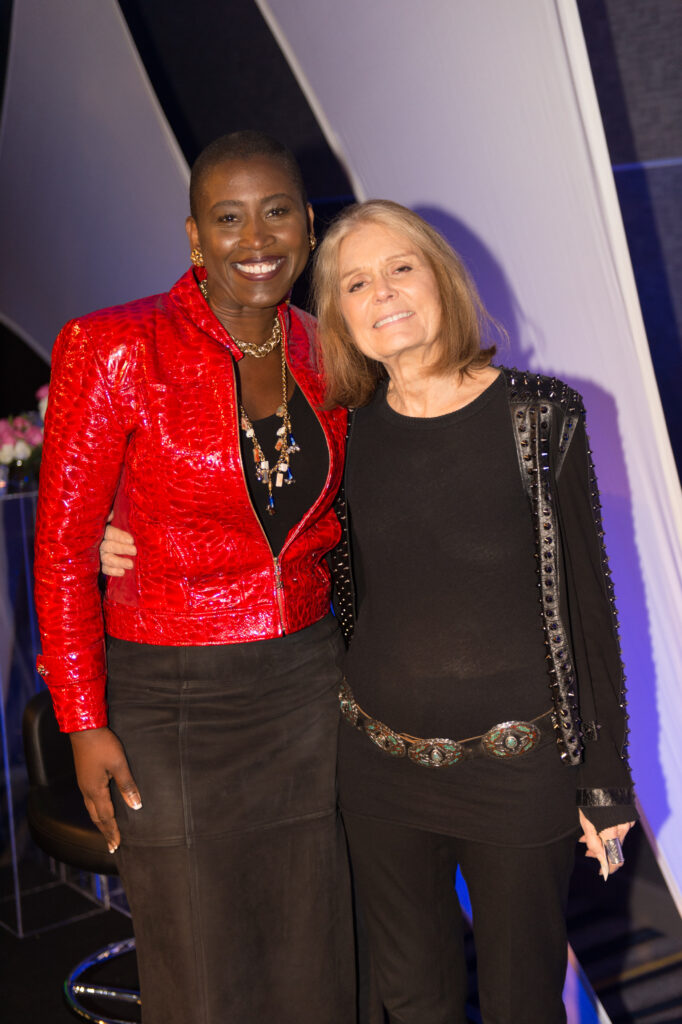
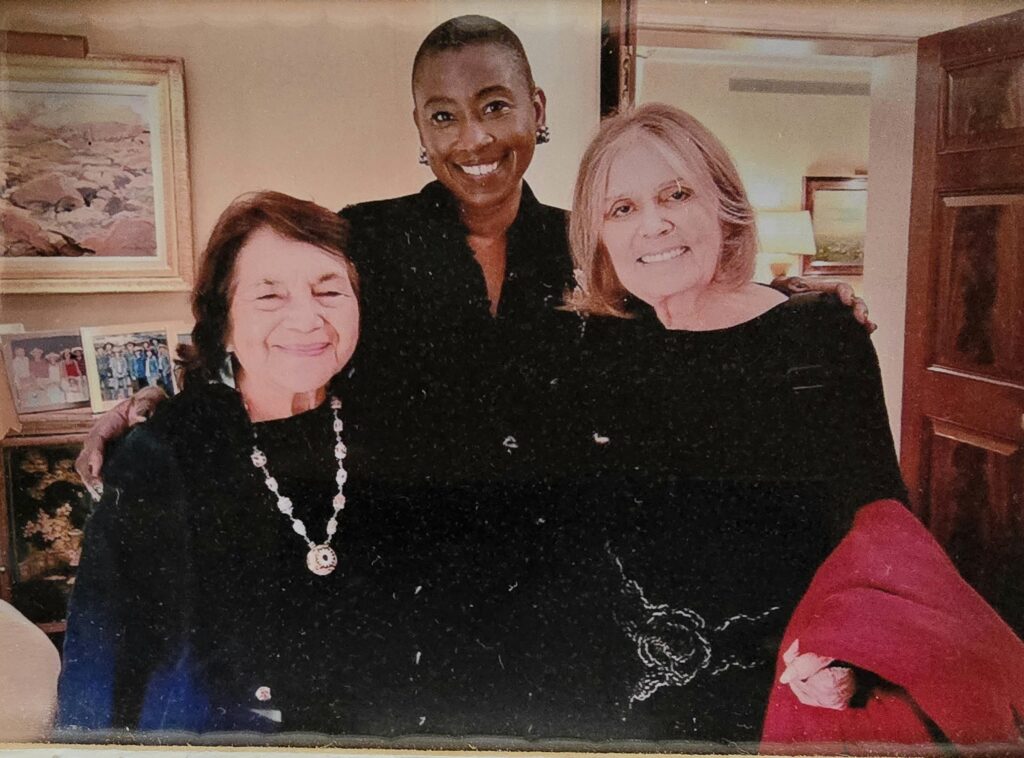
I’ve got a number of photos with Gloria from times we’ve been together. But that one really touches my heart—especially now, at a time when so many people feel defeated and worried.
Gloria passes away at a time when Roe has been overturned by our Supreme Court. It’s a time when there is an act that proposes essentially burdening and suppressing the voting rights of millions of women in the United States. She passes away at a time when the Supreme Court, just in its last term, essentially issued the death knell for the Voting Rights Act.
It’s a time when there are so many executive orders seeking to roll back what have been matters of progress in terms of women and their lives.
It can be incredibly daunting in light of all of that—the attacks on the academy, the attacks on law firms, the attacks on civil society organizations, the direct attacks on civil rights.
With all of that, it can be hard to think about the importance of making a joyful noise, the importance of keeping a torch lit, the importance of holding on and persevering with that torch in order to light other torches.
It can be hard to see that the flame is still burning. But it is.
It would do a disservice to Gloria Steinem’s legacy—and to those she fought with, worked with and worked toward a better day with—to forget that.
The torch is still burning. The light is still there.
We will, in fact, get there.
And, you know, she believed that the truth will always set you free.
At her 90th birthday, Gloria said to the BBC that she hoped her legacy might help individual people become more of the unique, valuable, loved and lovable person they want to be.
So let me close with two reflections from Gloria herself.
In January 2017, after Donald Trump assumed the presidency of the United States, she was at the Women’s March in Washington, D.C.
And here’s what Gloria said:
Gloria Steinem, archival audio: We are here and around the world for a deep democracy that says we will not be quiet, we will not be controlled, we will work for a world in which all countries are connected.
God may be in the details, but the goddess is in connections.
We are at one with each other. We are looking at each other, not up.
No more asking daddy.
We are linked. We are not ranked.
And this is a day that will change us forever because we are together. Each of us, individually and collectively, will never be the same again.
When we elect a possible president, we too often go home. We’ve elected an impossible president. We’re never going home.
Michele Goodwin: Gloria believed in hope. And here is one from Gloria:
Gloria Steinem, archival audio: Hope is a form of planning. If you don’t imagine what could be, you’re already defeated. We need companions in hope because we are social animals. But hope is practical and necessary.
Michele Goodwin: Listeners, I appreciate you. I value you. Let’s join together in lifting up the light of Gloria Steinem and the legacy that endures.
Gloria Steinem, archival audio: This is the upside of the downside.
This is an outpouring of energy and true democracy, like I have never seen in my very long life.
It is wide in age. It is deep in diversity. And remember, the Constitution does not begin with “I, the president.” It begins with “We the People.”
Make sure you introduce yourselves to each other and decide what we’re going to do tomorrow and tomorrow and tomorrow. And we’re never turning back. Thank you.
Michele Goodwin: Until next time, I’m Michele Goodwin, host of On the Issues with Michele Goodwin at Ms. magazine.
I thank you for tuning in for the full story. We hope that you’ll join us again.
About this Podcast
Fifteen Minutes of Feminism is part of our On the Issues with Michele Goodwin platform. Here, we count 15 minutes in feminist terms! The show features robust commentary and interviews in a powerful, concentrated dose.