Listen, Rate, Review and subscribe on:



In this Episode:
Content warning: this episode contains discussions of sexual assault.
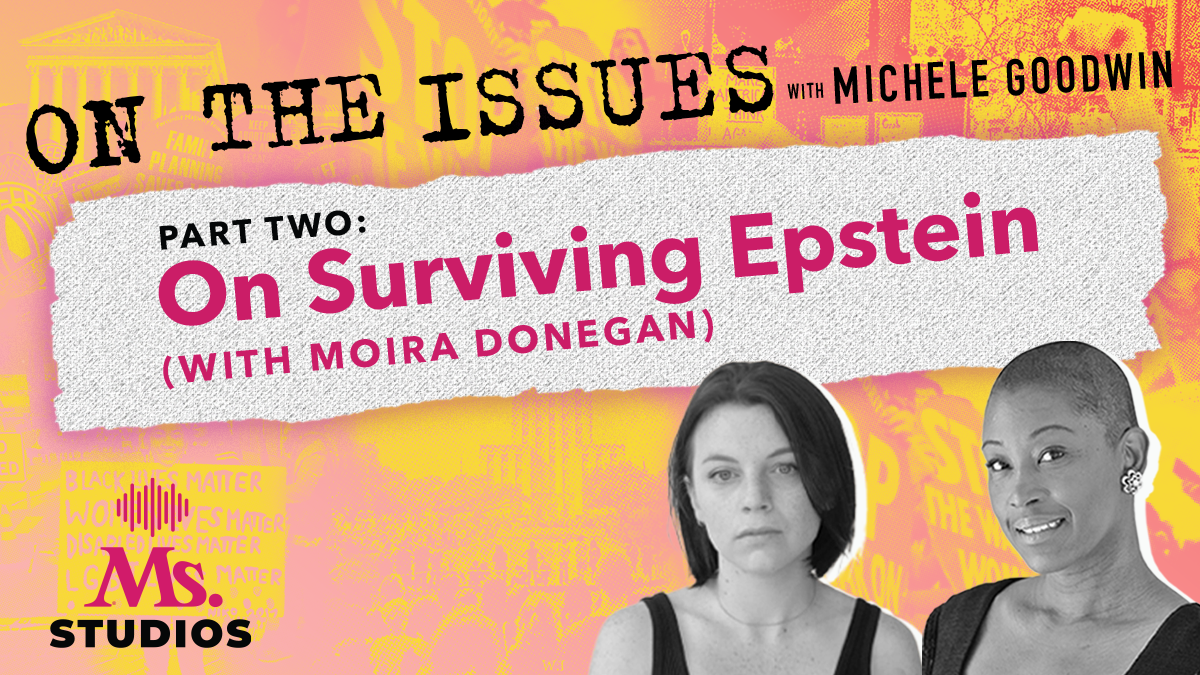
In July, the Justice Department released a controversial report about Jeffrey Epstein. Now with the release of over 23,000 files associated with Epstein, questions are being raised about the scope and scale of this sex trafficking ring and its connections to power. The House Oversight Committee has yet to hear testimony from Epstein survivors, despite urging by Rep. Ayanna Presley and others. In this episode, Dr. Goodwin is joined by journalist Moira Donegan to discuss the implications of the files, and what needs to be done in order for his victims to receive justice.
This episode is part of our ongoing series on the Epstein Files. We unpack the record, combing through the various emails, speaking with reporters, and ask the fundamental question: what will it take for men in power to treat women and girls with dignity and respect?
Background reading:
- LISTEN: “On Surviving Epstein—Part I (with Jess Michaels)”
- “The Part of the Epstein Story We Keep Ignoring? Survivors.” — Kelsey Morgan
- LISTEN: “Fifteen Minutes of Feminism: What’s In The Epstein Files? Republicans and Democrats Want to Know (with George Conway)”
Transcript:
Welcome to On The Issues. This is a show where we report, rebel, and tell it just like it is. We begin this episode with a warning given the gravity of the subject matter. In this episode, I’m joined by Moira Donegan, an award-winning journalist who writes for The Guardian. I spoke with Moira as news about Epstein and his connections to powerful men and women continues to unfold, implicating the Royal family, prime ministers, university presidents, and many others.
This series is part of our ongoing coverage of the Epstein Files, attention to the women that continue to suffer and those that are fighting back. In our series, we unpack the record, combing through the various emails, speaking with reporters, and asking the fundamental question: what does it take to treat women and girls with dignity and respect?
For context, in July, the Justice Department released a controversial report about Jeffrey Epstein, now a known and notorious sexual predator and human trafficker. Now with the release of over 23,000 files associated with Epstein—and there are thousands more—questions are being raised about the scope and scale of this sex trafficking ring and its connections to power.
The House Oversight Committee has yet to hear testimony from Epstein survivors, despite urging by Rep. Ayanna Presley and others.
In this episode, we’re not losing sight of the girls and women harmed by Epstein and the constellation of others who joined him. Instead, we are shining a bright light.
00:00:03 Michele Goodwin:
Moira, thank you so much for being with me. Our audience adores you. I love being in conversation with you. Thank you so much for all that you put forward and the diligence and integrity that you bring to everything that you write about. Thank you for joining us.
00:00:20 Moira Donegan:
Oh, that’s so kind of you. Thank you for having me.
00:00:22 Michele Goodwin:
So, in this episode…and we have been doing work in following Epstein, the Epstein Files, what this has meant in terms of our country, and really, the world. So, let me just start off with asking, how have you sorted this out and the relevance of the fact that we’re talking about Epstein?
00:00:51 Moira Donegan:
Yeah, you know, for a long time, I was a little bit allergic to the Epstein story, and I think, for me, that’s because I come from a long history of covering sexual violence, and what you learn doing that work is that most sexual violence does not occur in this, like, realm of shadowy conspiracy or vast networks of, you know, secret traffickers. What it usually occurs in is in banal situations among people who know each other, among families, among small communities, among people among whom there is trust, who transform those sorts of quotidian environments into sites of great domination and violence, right? And in my work, I’ve tried to demystify sexual violence to show not just how common it is, but how ordinary the situations in which it occurs can be, right?
00:01:57 Michele Goodwin:
Because people take that for granted, right? Like, they do…that it’s the predators within the house and next door and the uncle and the cousin, and people…thank you for saying that, because I think that, oftentimes, people are looking for the person in the white van driving through the neighborhood, and instead, it’s the car that’s pulling into the garage too often.
00:02:24 Moira Donegan:
Exactly, and so, when, you know, these Epstein conspiracy theories started bubbling up, both on the right and on the left, this was sort of like a fixation of these, you know, online communities that had great distrust of institutions and of elites, right, who were talking about this man as sort of the link that would expose a vast and secretive network of pedophiles. I was a little bit wary of that. I got to be honest with you. I thought, you know, that this isn’t really how sexual violence actually happens. It partakes of a fantasy of secrecy and shame and sort of like cloak-and-dagger conspiracizing that actual sexual predators don’t need to have recourse to, right? Because there’s so much tolerance for sexual violence in our ordinary life, and I will say, the more I have learned about Jeffrey Epstein, beyond conspiracy theorizing, but really, like, in the evidence of what has been brought forth, by wonderful reporters like Julie K. Brown of the Miami Herald.
00:03:40 Michele Goodwin:
She did a phenomenal job, Julie, yes.
00:03:42 Moira Donegan:
And has been for years, yes.
00:03:43 Michele Goodwin:
Yes.
00:03:44 Moira Donegan:
The more we hear in the testimony of survivors and the more we see in these documents that are being, you know, drip by drip, released to the public, the more convinced I am that Jeffrey Epstein had an extraordinary web of connections to very powerful people across different, you know, political persuasions, and he seems to have also been a prolific sexual trafficker of girls and very young women, and at minimum, at minimum, those very powerful people seem to have known of what he was doing to those children, those teenage girls, and been comfortable with it.
You know, the worst seems to have been some gentle mockery, but as we saw in, say, the document that was released for Jeffrey Epstein’s 50th birthday, when many, many of these powerful people he was close with contributed, you know, playful little notes and cartoons, they seem to have understood it as sort of like an element of jocular boyishness in Jeffrey, you know, something that they indulged and maybe sort of, you know, secretly admired a bit. They did not understand sexual violence as violence, and that’s very disturbing.
00:05:12 Michele Goodwin:
And as political violence, right? So, as this web, as you were saying, is unfolding, and that it’s clear that its reach is broad and deep and so resistant to the files being released, and yet, so many women with very similar stories have come forward, and it’s shocking. I mean, I would ask if you’ve been shocked by this. I don’t know who wouldn’t somehow be affected.
00:05:43 Moira Donegan:
It’s been disquieting. You know, I think what you see…you know, we’re speaking on November 13, which is the day after a vast trove of 23 thousand pages of documents from the Epstein estate, mostly emails and some text messages, have been released to the public, and what you see in those communications is the mechanism by which the powerful, and here, the very powerful, institute the notion that women and girls are objects of violence and that the violence committed against women and girls is insignificant morally.
00:06:26 Michele Goodwin:
And that’s a point, Maura, isn’t it? That if one tries to understand this, in part, it’s the tragedy of seeing the lives of girls as being insignificant. I mean, even if we were, perhaps, for an audience that we, you know, might assume has some grounding and knowledge of this, if we were to go back to the earliest of the Epstein conviction, it’s one in which the girls are framed as being sex workers. So, if the state recognizes that there’s been sexual exploitation and abuse, but yet, still frames these girls as if they were sex workers, they were prostitutes, as it was, like, sort of described in a way of trying to demean these girls, as if they were full, knowledgeable contributors to what they experienced, and then he’s allowed day releases. So, in jail overnight, but able to leave and actually even get on his plane on a regular basis. How does one reconcile what that represented?
00:07:39 Moira Donegan:
Yeah, you know, you’re talking about the deal that was made for Jeffrey Epstein, in which none of his co-conspirators in this trafficking operation were indicted and which his punishment for, you know, the sexual exploitation of, again, children was framed as a solicitation offense, and I want to say, for the record, there’s no such thing as an underage sex worker. What there are, are raped children, right? You cannot engage in sex work.
00:08:08 Michele Goodwin:
Exactly. That’s exactly right, right? In a state where there’s statutory rape, right, where we’re even…by the legal definition, it’s not plausible, it’s rape.
00:08:20 Moira Donegan:
Yeah, and this is something that was sort of blithely overlooked by those prosecutors, the lenience of this deal. You know, we are in a country and a world where sexual violence is not punished often, and it is not punished in proportion to what people profess to be their understanding of the seriousness of the crime, right? So, you’ll hear a lot of rape is terrible, but this guy does not deserve a punishment commensurate with how terrible we profess his crime to be, and in fact, it’s every guy, or at least it’s a very, very consistent interpretation, and so, you know, you see sexual violence punished as a proxy to punish something else, more often, like racial transgression. Then you see it punished as a kind of violence against women and girls, but you know, even by that very low standard for accountability for sexual predators, what Jeffrey Epstein was accused of was really, you know, orders of magnitude greater than this very, very lenient house arrest deal that he got.
00:09:33 Michele Goodwin:
You know, just in looking at that, for our listeners, in Florida, there is a statutory rape statute and law, and what this law outlines is that any person who is less than age of adult, 18, who is engaged in sex…and the state doesn’t recognize consent, right? So, any of what Jeffrey Epstein did, any of those sexual assaults and rapes, would have been considered by the state to be rape of any person that was under age 17, and here’s, basically, some quick take, which is that if the offender’s age is 18 or older, then we’re talking about felony, right? Just off the bat, felony, and so, second-degree felonies, that can mean up to 15 years in prison just from the start, right, with any one of those cases, but clearly, in this case, with the way in which it was prosecuted, that was not what Jeffrey Epstein experienced, what, typically, someone in Florida would be up against if they did the same thing.
00:10:55 Moira Donegan:
Right, and so, I think you see impunity being given to Jeffrey Epstein, both because of his status as a very wealthy man, which purchased him a degree of permissiveness and impunity to hurt others, and also because of specifically the sexual nature of his crime, which is very hard to get state actors, or frankly, non-state actors, to grapple with as serious, meaningful violence. There’s a persistent trivialization of sexual violence and a persistent sort of granting of permissiveness and impunity for particularly, you know, the wealthy elite.
00:11:37 Michele Goodwin:
So, I’m wondering if you have followed any of the individual cases, and I’m thinking here about the recent book that’s been released by Virginia Giuffre, who named a former Prince of England, Prince Andrew, as being the person who had assaulted her. Did you follow any of her case? She recently committed suicide.
00:12:14 Moira Donegan:
Yeah, Virginia Guiffre was a person who was very outspoken about her experiences with Jeffrey Epstein and with the impunity that his assaults on her and others were treated with, right? This is somebody who tried to achieve, in public, the justice that was denied to her by the State of Florida. She was very young. I believe she was 15 years old when she was first groomed and trafficked by Ghislaine Maxwell, Jeffrey Epstein’s girlfriend and procuress, and then Epstein himself, and they actually met her while she was working in the spa at Mar-a-Lago.
00:13:01 Michele Goodwin:
At Mar-a-Lago.
00:13:04 Moira Donegan:
Donald Trump’s Palm Beach, Florida club.
00:13:08 Michele Goodwin:
Which he still owns, right? The Mar-a-Lago, yes.
00:13:11 Moira Donegan:
Yes, and where he spends quite a bit of his time. You know, so, the effort to speak out, the sort of refusal to recede from the public eye or to, you know, abandon the insistence on the wrongness of what was done to her, cost Virginia Guiffre tremendously. She was hounded. She was cast as crazy. She was depicted as, you know, promiscuous, as drug-addled, as mentally ill, and she did, in fact, take her own life. She died by suicide in Australia earlier this year.
And you know, I think this is just something that I think we can get lost in, in the Epstein case in particular, because he was so close to so many powerful men, and because his wealth and his access to influence gave him a veneer of glamour, and because his story seems to serve as a metaphor for these crumbling institutions and corrupt elites. I think it’s very easy to overlook the fact that these were real people. These were real children who were being hurt in an intimate, exploitative, unfair, and very meaningful way. You know, they are not mere props or accessories in this bigger psycho drama about, you know, a collapsing liberal order. They are human beings who matter in their own right, and I worry a bit that some of their stories are getting lost in this sort of cloak-and-dagger conspiracizing about this story.
00:14:56 Michele Goodwin:
I think that that’s right, such that there is this losing sight of who they are, what they experience, the type of grooming and predations that were inflicted against them, the fact that they were not able to, generally, receive any justice, the myriad of them, those that were in New York before Florida, those that were in Florida, and then those that were in New York after Florida. Just this continuation that just seems to not have stopped, the ways in which they have been stigmatized and stereotyped as this kind of old trope as being greedy, and as you mentioned, being drug-addled.
There’s ways of not seeing that after you have sought support and help from police, from FBI, after you’ve shared your story, after you’ve rung the bell, all of that. Then what do you do? And I find that to be a curious thing amongst the sort of responses to people who’ve become so exhausted with trying to carry these loads. It’s not uncommon that they do suffer in different kinds of ways, and then the public says, well, look at them. This must not be true, because they look like sufferers. Well, it’s actually the suffering that is, oftentimes, the result, and that it’s caused by these horrors that have been inflicted upon them, and for those things to happen at any age, but let alone for that type of trafficking to take place.
00:16:37 Moira Donegan:
Yeah, you know, being disbelieved about sexual violence, as so many women are, or trivialized or smeared, that is crazy-making, right?
00:16:47 Michele Goodwin:
It is.
00:16:47 Moira Donegan:
And then the impact of being disbelieved will be used to discredit you further, right? It’s a Catch-22. You seem…you know, you’re driven crazy by how nobody believes you, and then nobody believes you because you seem kind of crazy. It’s a cycle, and I’ve seen it play out too many times. You know, I think this is also, we have to keep in mind, something that people like Epstein do on purpose. I don’t know if you saw this, Dr. Goodwin, but one of the emails that was released yesterday was a series of emails that Jeffrey Epstein sent in the autumn of 2018 to attorneys who are representing Brett Kavanaugh during his confirmation hearings, in which he suggested, along with links to several, you know, drug information websites, that they say that Christine Blasey Ford had had her memory and her sanity impaired by medications that she was on, right?
So, here you have a, at that time, long-convicted and well-known pedophile and sex trafficker advising lawyers for another accused sexual predator as to how they can best discredit their client’s victim, right? This is not something that happens merely by accident or through the kind of like received and passive bigotries of the public. This is also something that sexual predators and their allies do very consciously and on purpose.
00:18:22 Michele Goodwin:
Well, as you mentioned sexual predators and their allies, and that their allies can be very powerful people or wield and utilize their power in ways that can certainly inflict violence and be debilitating and dangerous for others, and I think that, you know, part of what you’re talking about, as well, is what becomes both chilling and also the atmosphere of fear, right? So that if you know that this is what happens to a person who commits suicide or a person who does become drug-addled and all of those things, if you’re looking at this, do you come forward, right?
It has a chilling effect. The other thing, quite honestly, is that, you know, the fear that one can have about safety and wellbeing if one wants to come forward. As we just talked about, Guiffre and her book, what happened to her, her recent death, she’s connected to Jeffrey Epstein also through Ghislaine Maxwell. So, if we could look then and just turn to the status of that, which I think people are perplexed by. So, there was a conviction. She was incarcerated in the Northeast, but that’s not where she is now. What’s happened, and why do you think what’s happened has happened, if you follow?
00:19:57 Moira Donegan:
Well, Ghislaine Maxwell is an heiress. She was British and came to the United States when she was quite young, and when she was quite young, she met Jeffrey Epstein, who, I believe, was a friend of her father’s, and they were involved. She seems to have been the primary relationship of Epstein’s life, and Ghislaine had this kind of like worshipful, dutiful approach to Jeffrey that included, according to her conviction, seeking out teenage girls, particularly, like, vulnerable ones, ones who are already kind of suffering or in unstable situations, and bringing them to Jeffrey Epstein for purposes of sexual abuse, right? So, she would go find children for him to rape and then bring them to him, and she, over the course of her relationship with Epstein, also came to know Donald Trump. Donald Trump and Jeffrey Epstein seemed to have been quite close friends.
00:21:08 Michele Goodwin:
There are photos of them together, and there is the whole birthday card thing. You know, the photos are not new. I mean, those photos have been around for a very long time. It’s only recently that they’ve been called a hoax, but they’ve been around for years.
00:21:21 Moira Donegan:
And Donald Trump has long been on the record talking about his friendship with Epstein and Epstein’s, you know, appetites for young girls. So, this is not, you know…this is not a new relationship, right? Earlier this year, the Trump administration was facing enormous pressure from its MAGA base, and particularly from some of these online communities that Donald Trump has cultivated and whose conspiracy theorizing he has thought to use for his own benefits, to release what are called the Epstein Files, you know, this vast trove of documents and information about Jeffrey Epstein and his activities, that are said to be possessed by the Department of Justice, right? And the Trump administration didn’t.
They released some stuff that had already been made public. It was kind of a nothing burger. Donald Trump really tried to signal to his base that they should stop pursuing this story, and it became one of the few, like, real lasting fractures in the MAGA coalition, is over Jeffrey Epstein, right? And so, as part of their attempts to distract the public and to get the MAGA base to move on from this story, Donald Trump and his Justice Department began floating the idea of a pardon or a commutation or some sort of lenience for Ghislaine Maxwell in exchange for her “cooperation,” and she duly testified. I think it was, like, a deputy attorney general himself, went to go interview her in prison. Like, uncommonly high up.
00:23:00 Michele Goodwin:
It was very unusual. Like, this doesn’t happen.
00:23:03 Moira Donegan:
Yes, and she, you know, duly responded that Donald Trump never had anything to do with Epstein’s sex trafficking, and then was quite quickly moved to a much more comfortable federal prison. I believe it’s a prison camp in Texas which has…
00:23:21 Michele Goodwin:
Less security, minimum security.
00:23:22 Moira Donegan:
Less security, a lot more freedom for those incarcerated.
00:23:26 Michele Goodwin:
Special meals is what I understand now.
00:23:29 Moira Donegan:
Yeah. There’s some…I think, like, maybe one of the Real Housewives was there. You know, it’s a place for…it’s not a place for people who commit sex crimes, right? It’s a place for people who…for tax evasion.
00:23:43 Michele Goodwin:
And that’s the point, right?
00:23:44 Moira Donegan:
Yes. Yeah.
00:23:44 Michele Goodwin:
Yeah, right, like, this is not the place in which you take people who’ve been involved and committed multiple sex crimes, let alone one sex crime, right? Which I think is really important for people to understand, right? So, we have states across the country that have these statutory rape laws so that minors, then, in those states are not able to consent. So that even if there’s someone who is 20 years old and says, well, she consented, that actually does not fly. It is not a defense in any of those states, and let alone somebody who has done this multiple times, over and over.
00:24:22 Moira Donegan:
And transported minors across jurisdiction lines for purposes of sexually assaulting them. Yeah.
00:24:33 Michele Goodwin:
We had Jess Michaels on our show, and Jess is a person who’s come forward who was an early…it’s just so troubling. I was going to say an early victim, because, here, we have, a spectrum of years. So much attention has been focused on, and understandably so, the years in Florida, there were so many victims there, of Jeffrey Epstein, and even the terminology that’s been used of survivor, I think it’s complicated within these circumstances. I understand that there’s a reason for recognizing that someone is able to move forward with their lives in robust and meaningful ways, but not everybody gets to be a survivor. Maybe I’ll start there, based on your work. I mean, this dichotomy between victim and survivor, while I understand one doesn’t want to re-traumatize someone as a victim, but the truth of it is, not everyone gets to be a survivor.
00:25:45 Moira Donegan:
Yeah, you know, I don’t think we can call Virginia Guiffre a survivor, right, because what happened to her killed her or contributed to her death by suicide, and you know, there’s a way in which the survivor terminology is, I think, a very well-intentioned desire to shift focus to the resilience and success of women who are not, in many cases, sort of, you know, made into permanently damaged, half-people by these experiences, but often, do go on to lift themselves out of such despair into, like, very robust, meaningful, full lives.
I think that, like, very, like, beautiful desire to shed a light on that reality can tend to sort of downplay the agency of the wrongdoers and of those who commit sexual violence, right? Because you survive a hurricane, but a hurricane is not an agent, right? And depicting sexual violence in sort of the passive voice can both focus attention on the agency of those who overcome it, but also has the, you know, unintended effect of erasing the agency of those who commit it. Men decide to rape, right? They make that choice, and women do not get…don’t get a say, and that is a reality that I think we also need to grapple with in the way that we talk about this kind of violence.
00:27:28 Michele Goodwin:
You‘re absolutely right, and I thank you for sharing that, because it’s not grounded enough in these discussions, and I’m wondering, then, about what’s the corrective in these spaces? So, when Jess Michaels was on the show and was asked whether survivors, have been given voice in these matters, and she replied, certainly not enough, and just in terms of a little bit of background, so, Jess Michaels has been coming forward. She came forward years ago. She was groomed by a trusted friend and roommate who had worked for Epstein as a recruiter, much like Ghislaine Maxwell did later.
And she was raped by Epstein at the age of 22 at his mansion, under the pretense of what was to be a job interview, and her story is much like many of the others. Jeffrey Epstein…what was articulated, Jeffrey Epstein wanted, you know, her to massage him. He had lots of people massaging him, and she thought that this would be a job that she would be able to have, to travel with him, earn a good living for, you know, while she would be employed by him and providing this service. She did not understand that this service that he really wanted was of sexual exploitation and assault, and when she, seemingly, applied for the job and was rejected because he thought that she was not a very good masseuse.
JESS MICHAELS:
And there’s a couple of things that I think are really important to understand about when I meet him this first time. He’s actually very stoic, and he’s very professional, and he is very serious about someone understanding, through the body, to the point that he makes me feel like I don’t know enough, I don’t know what I’m doing, and I question whether I’m actually going to get the job, and I kind of thought I already had an in. I already thought this was a…he’s going to train me, too. He trained Christine. He’ll train me, too, and so, he’s asking me these questions about the body that I can’t answer, and he’s like, okay, okay, well, you’re going to need to study this book.
But then gave her a second chance, and at the second chance, sexually assaulted her, and she’s come forward to tell her story, but I’m wondering, Moira, there were the people that were before the Virginia Guiffres and others. This group of girls and women who were in New York who were trafficked there, how in the world do we interrupt these cycles? And I would add to that, you mentioned our fabulous, fabulous, fabulous Julie Brown and this great work that she did. It seems to me that we might not even be here, had it not been for this amazing work that she did that had, somewhat, been lost and obscured.
00:30:02 Moira Donegan:
Yeah, you know, I think it is very telling that it was a woman reporter at a regional newspaper who dedicated amazing amounts of time and effort against, you know, no small amount of institutional resistance to getting this story out there. So, I think what we do have…you know, the silver lining of the ubiquity of sexual abuse is that we also have this vast well of women’s understanding of what sexual violence really is and what it does and how important it is, right? And that is a well of understanding that stands in contrast to the institutional indifference, right? And I think that’s our best resource, is the voices of people who do not find themselves content to accept the trivialization of this violence and the impunity for it.
00:31:08 Michele Goodwin:
What do you think…as we bring this to a close, what do you think happens next? So, there’s been the release of these 23 thousand files, which probably suggests that there are thousands and thousands more. We’ve received what we’ve received. Any intuitions about what comes next?
00:31:30 Moira Donegan:
I think it is inevitable that something very close to the full picture of what is documented about Jeffrey Epstein and Donald Trump’s involvement in his activities is going to be made public. This is a story that has not gone away, even though Donald Trump really wants it to. It is a story that Democrats are pushing because they think it is very politically advantageous to them. It’s a story that sort of the anti-institutionalists on the far right are not letting go of, either, right? And so, I think there is more to be revealed, and I think it’ll be our job, as feminists, as that happens, to keep the wrongness of sexual violence and the experiences of these women at the center of the story and to make sure that they are not erased by the power of the men who hurt them.
00:32:33 Michele Goodwin:
Moira Donegan, I want to thank you for joining me. I know that I typically ask about what is a silver lining, and I’m thinking that, perhaps, in any of this, maybe for the moment, it is actually this release of these files and that, hopefully, that will lead to justice in some way, however it comes about, because I think that you’re right. You know, there is this sense of a political profit that’s swimming around all of this, but hopefully in the space of it all, that those who are deserving of justice and deserving to be recognized and for the depths of what they experienced to be acknowledged maybe now with these files coming out, we’re going to get close to that.
00:33:25 Moira Donegan:
I hope so.
00:33:26 Michele Goodwin:
Me too. Thank you so much, Moira, for joining me. I appreciate it.
00:33:31 Moira Donegan:
Thank you so much for having me.
Michele Goodwin:
If the issues raised in this show reach close to home for you, please know that help is available. RAINN offers free, confidential support through its hotline. You can learn more at rainn.org or by calling: 800.656 HOPE or texting HOPE to 64673
About this Podcast
On The Issues With Michele Goodwin at Ms. magazine is a show where we report, rebel and tell it like it is. On this show, we center your concerns about rebuilding our nation and advancing the promise of equality. Join Michele Goodwin as she and guests tackle the most compelling issues of our times.