Listen, Rate, Review and subscribe on:


In this Episode:
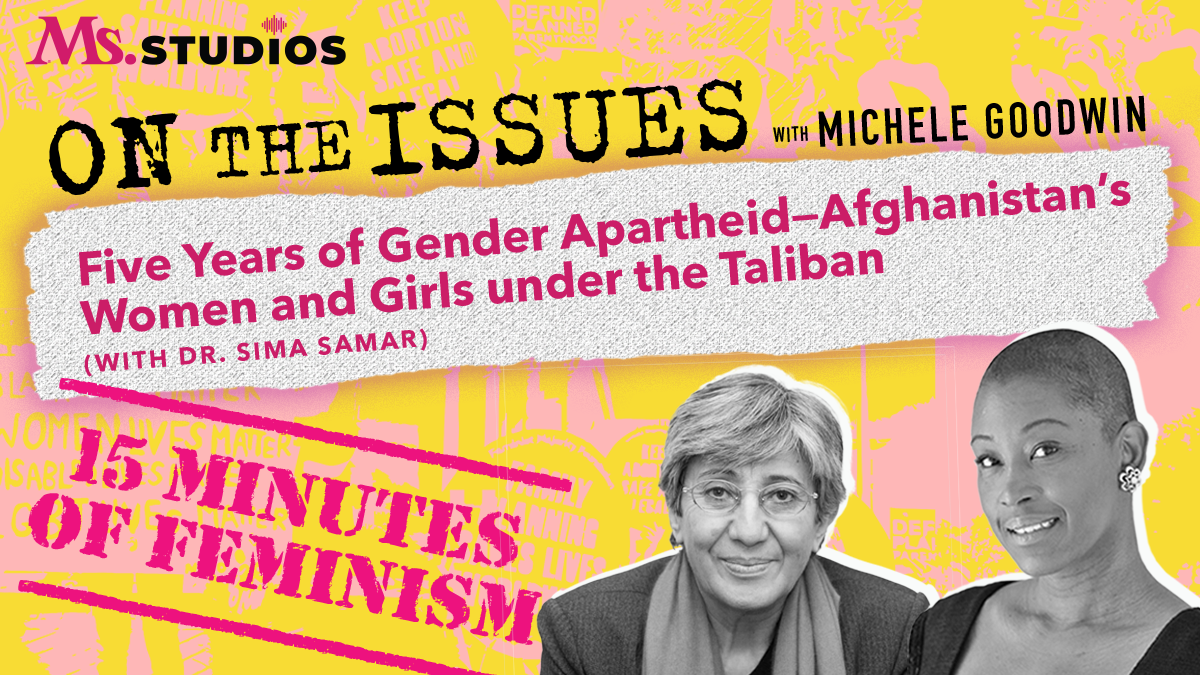
It’s been five since the United States exited Afghanistan. How are women doing?
The exit process followed the a 2020 Doha Agreement signed by the Trump administration and the Taliban. The Afghan government collapsed as the Taliban seized Kabul five years ago, on August 15, 2021. In the aftermath, gains for women’s rights were immediately under attack. While the drama of the mass exodus and airlifts are still visible in the minds of many, the plight of the women and girls left behind has largely been forgotten.
Transcript:
00:00:00
Michele Goodwin:
Welcome to 15 Minutes of Feminism, part of our On the Issues platform at Ms. Studios.
As you know, we report, rebel, and we tell it just like it is. And on 15 Minutes of Feminism, we count the minutes in our own feminist terms. We dive right in. And in this episode, I’m pleased to be joined by a guest who’s been with us before, Dr. Sima Samar, who served as the Minister of Women’s Affairs in Afghanistan, also in senior leadership in health in Afghanistan, and many other parts of the world.
She was the chairperson of the Afghanistan Independent Human Rights Commission. She served as a UN special rapporteur on matters of human rights in the Sudan. She is award-winning, and so deserved, given her bravery, her courage, her commitment to human rights.
So, listeners, as we unpack what the state of the world is right now, sit back and take a very close listen.
It is such a pleasure to be with you, Sima. Your work has been so incredibly important. As we’ve told our listeners already in the intro, you are a Nobel Peace Prize nominee. You’ve been renowned for your human rights advocacy. You have been identified as one of the most influential figures in health, in public service, in humanitarian work, not just as a woman, but as a person doing such critical work within this domain.
I want to start off with this. Five years on, you’ve described this as gender apartheid, what’s been seen in Afghanistan. What has changed about that system since 2021? Has it gotten more entrenched, or there’s been some advancements? How do you see things five years out?
00:02:23
Sima Samar:
Well, it’s my pleasure, of course, and my honor to be with you again. And thank you, so much, for doing this.
Yes, it’s five years from the Taliban regime, as we call it, gender apartheid. And I have to also mention that we, Feminist Majority Foundation, in 97, they start to say that the first, during first Taliban regime, that had gender apartheid and we were involved on stopping gender apartheid, since then. Unfortunately, we thought that they will not come back, but they came back in 2021, and more powerful, I would say, because they learn more tactics, more policy, more strategies during the 20 years when they were fighting with the Afghan government, and also international forces in the country.
Since this five year, they are really trying to restrict, and put more laws, statements, procedures in place in order to really restrict women’s rights, and put more pressure on the female population of the country. Of course, the violation of human rights, of all the peoples, unfortunately, is happening because the right to, particularly freedom of expression, doesn’t exist in that country for anyone. But it’s more strict on women, because as you might heard about the laws that they passed in 2024, August 2024, and it is actually the law for promotion of virtue, and prevention of vice.
It is actually said that women’s voice should not be heard by anyone. So, they cannot even pray loudly, and that is something I never heard in the other countries, or in my life. And their criminal procedure actually legalized the domestic violence, and legalize child marriage with their new laws.
00:04:47
Michele Goodwin:
So, to build on that just a bit, if you had to explain to someone who has never followed Afghanistan closely, just really, just didn’t know, what would you describe as daily life for folks in Afghanistan, right now, and particularly, what is daily life like now for women and girls.
00:05:12
Sima Samar:
Well, the daily life is, I would describe it that women in Afghanistan, women and girls in Afghanistan, doesn’t have the right to access to education, not the right to movement, not the right to work outside of the house. They have to be covered fully. They don’t have the right to walk on the street, and go to to the park, for example, unless they are accompanied by a male member of the family. They have to wear full hijab, as the Taliban requires. So practically, they don’t have much rights to have. So, their voice should not be heard by anyone. So, you can imagine that practically they don’t have much rights to live. So, no other country in the world has this kind of restriction on their female population.
00:06:13
Michele Goodwin:
And specifically, because it’s, specifically it’s because the female population is female that there are these kinds of restrictions, right? It’s targeted directly because they are women and girls.
00:06:25
Sima Samar:
Exactly. Exactly. Because all the laws, or 160, around 160 and more laws and procedure statements, are just too restrict and violate the rights of women and girls in Afghanistan.
Just recently, last few days ago, one of their leaders said that women should not wear perfume, even under the burka.
00:06:51
Michele Goodwin:
You know, so it’s, so it’s by sight, by smell, by touch. Here’s what, just in June of 2026, the Georgetown Institute for Women on Peace and Security, they issued a report, Five Years of Taliban Rule, the Normalization of Gender Apartheid, and the International Community’s Failure, influenced so much by you. And just a couple of points that I want to share with our listeners, today, nearly 20 million Afghan women and girls live under a system intentionally designed to deny their agency and humanity.
Girls are prohibited from secondary and higher education. Women have been excluded from most professions and decision-making roles. The Taliban institutionalized misogyny extends beyond restricting women. It is to eliminate their visibility, their autonomy, and their agency. And they’re doing just that.
And then one last piece there. While Afghan women continue to be erased from public life, Taliban representatives are increasingly welcomed into international forums and foreign capitals.
Okay. Help us make sense of that because that even included the European Union inviting the Taliban representatives to Brussels for discussions on migration and the deportation of Afghan nationals. How do you make sense of that?
00:08:22
Sima Samar:
Even today, Germany deported 31 Afghans, just claiming that they are criminals. So, we keep resisting and raising a voice that it is not, it is not according to the international human rights law. At least the European countries and Western countries who believe on human rights, and universality of human rights, they try to normalize the situation in Afghanistan. So, all the embassies and consulates is already given to Taliban in Germany. In the other countries are following that. Yeah.
So, the reason they keep…sorry…
They they deport the criminals. So, my question is that you do know that the Taliban, if they are arrested by the Taliban, then the Taliban are torturing them. Torture is a crimes against humanity. How can you send people to the country where torture is so common?
00:09:24
Michele Goodwin:
Well, and to this point, and then I want to hear the second point, which is that Afghan women, including UN staff, have now been barred from UN premises for nearly a year.
00:09:38
Sima Samar:
Yes, exactly. Women who are even working in the United Nation, they are not allowed to enter to the United Nation premises.
So, the other point is that, if the Taliban, if the the people, the Afghans who claim to be criminals, if they committed sexual gender-based violence, if Taliban arrest them, they will be tortured. If they let them go, they fuel the culture of impunity for sexual gender-based violence.
So, it’s kind of a dumping so-called sexual gender-based violence. The people who commit sexual gender-based violence in Afghanistan, and that is indirectly recognition of the Taliban action.
00:10:27
Michele Goodwin:
Well, and a couple of these decrees. So, we have a new code that enables child marriage, and it further compounds this really challenging, and dismal situation for women and girls.
So, this new decree from the Taliban enables child marriage, and you know, this is really an ongoing assault on the rights of women and girls, this decree.
There’s this other decree, number 18 called the Code on Judicial Separation of Spouses, and this was published by the Taliban in an official gazette just earlier this year, in May 14 of 2026, and it codifies the circumstances under which women and girls may seek separation from marriages. It includes provisions that uphold marriages arranged during childhood, and restricts women’s and girls’ ability to challenge or leave these unions where girls were forced into marriage as children.
00:11:33
Sima Samar:
Yeah, exactly. I mean, it’s simple to say child marriage, but I think it’s a kind of a new style of slavery, because a child, a 10-year girl, is married to 30 years, or 35-, or 40-years man, what she can do? I mean, she would be only listening and doing what he wants her to do. It’s a promotion of child marriage, of court legalization of child marriage, and then child slavery, and women slavery, actually, for sexual abuses, for sexual use, unfortunately, in the in Afghanistan.
And they, also, there are other law, other article in the law that they say if woman, if woman go to her father’s family for protection, if she faced any abuse from the husband, then she can be punished by husband or owner.
00:12:38
Michele Goodwin:
Oh, my gosh. It goes right to your point with slavery.
00:12:42
Sima Samar:
This is also legalization of slavery. Yes. And then the husband is allowed to punish her. If the husband break a bone or an open wound, if she can prove it in front of the court, a judge, then the husband will be detained for 15 days, or in prison for 15 days. But if they play with it, they put dog for fighting, for fun, for for gambling, that is six-month imprisonment. So, you can imagine what is the situation of female in Afghanistan?
00:13:23
Michele Goodwin:
Well, you know, Sima, on 15 Minutes of Feminism, we always say that we count the minutes in our own feminist terms, and I’m getting some of these feminist terms right here.
So, let me put a couple more questions to you, before we wrap up. There’s so much for us to discuss. We could just stay on child marriage, and how it even says that after puberty, that that gives further consent for the marriage. There’s a whole lot to unpack there that’s deeply troubling.
On the other hand, as we follow your work closely, and follow the work of women who are from Afghanistan, still in Afghanistan, there is resistance.
So, despite the circumstances that women and girls are living under today in Afghanistan, and they are just as challenging, and dismal, and apartheid-like, as you describe, there are also women and girls that haven’t given up, and they haven’t given up hope. And so, there are still girls that are studying, even though it’s underground. There are online schools, home-based education, secret classrooms, and they are taking enormous risks in order to do this. And you’ve talked with women inside Afghanistan, directly. What do they tell you about how they’re getting through each day?
00:14:42
Sima Samar:
I think the good part is that they are trying to find ways in order to live, in order to continue the hope, having hope for the future of the country. And it’s a lot of, a lot of young girls, and and young women who are really trying to learn and get education through different means. Either homeschool or online teaching, and so on.
But what I keep telling them that they should make every household a classroom. They have to push their male member of the family, their brothers and uncles, whoever they are, whatever they learned in the school, they have to teach them at home. That is something that shows the strong commitment of resilience and resistance against the oppression that they are facing every day.
And I think there are more thirst among them. I’m really surprised, sometimes, when I talk to these girls, how organized they are, and how much thirst they show on getting education, and how much they learn to write and discuss different issues, and that is a is a hope for the future.
00:16:05
Michele Goodwin:
Well, and you know, just before I get to the last question here, a couple of matters that I’d like to to lift up from our team here at Ms., and my fabulous producer, here is that, one that there has been discussion of pursuing gender apartheid as a distinct crime under international law, which is really important. And so, when you come back, we’ll talk about where exactly does that effort stand. Some governments frame engagement with the Taliban as pragmatic, you know, aid access, migration management, regional stability. But there also been some serious critiques about embracing the Taliban as a representative government when what it does does not represent women or girls very much at all.
And so, as we close, and there’s just not enough time. All right. Five years from now, what does progress realistically look like for you? Perhaps not the ideal, but pragmatically, what should it look like if best efforts are going forward?
00:17:17
Sima Samar:
Well, I think one, the gender apartheid hopefully will be codified on the conventions of crimes against humanity.
Secondly, I hope they avoid, really, the normalization of human rights violation, and we insist that we do believe on universality of human rights principles. And if they talk, even, with the Taliban, the dialog should be based on strong principles of human rights. Otherwise, there is a continuation of the culture of impunity, and particularly, on sexual gender-based violence, they try to deny, and take it as a normal using the excuse of respect for culture and and religion, which is not the case.
We are not the only Muslim country in this planet. So, I hope that the, not only the Afghan woman, but also the women around the world, because it’s it’s a crimes against humanity. It’s not only against Afghan women, because the other groups, the other extremist groups, already using the Taliban as an an example to apply the same restriction on women. In Mali, people are using it, and Boko Haram is using it in Nigeria.
Yes, and the other countries with the same extremist group.
00:18:46
Michele Goodwin:
So, we always ask our guests, we try to, at the end of our episodes, if there is a silver lining, what is that? Do you, is there a silver lining that you see? And I always think that this effort towards gender apartheid, making that as embedded within the broader, both linguistics and substance, of international law, is perhaps part of a silver lining.
00:19:16
Sima Samar:
Yeah, I think it’s really important, because there’s no other definition fit the situation in Afghanistan. It’s institutionalized. It’s systematic. It’s done by the so-called authority in order to restrict, and discriminate, and isolate women from public life and public…I mean, from practically, from everything. They don’t have any any social activity. I spoke with one teacher. She said that they were, she was so upset at home, and they asked her husband to go somewhere far from the city, and then, when they arrived there, the Taliban told them that she cannot get out of the car.
00:20:03
Michele Goodwin:
Wow. Wow. Wow. So, this is, you know, I think that the effort that you are making with regard to gender apartheid, is a bell that can be rung all across the world, from Afghanistan to the United States, from Nigeria to name another part of the world, and there are so many. What nation isn’t touched by the subordination that some women can experience and girls?
And so, I want to help you get this over the line, and everybody. I think that we, collectively, need to be a part of this narrative effort in order to lift up women and girls around the world.
Dr. Sima Samar, thank you, so much for joining us at Ms. Magazine.
00:20:50
Sima Samar:
Thank you. And thank you for your sisterhood and your friendship.
00:20:56
Michele Goodwin:
Absolutely.
I thank you for tuning in for the full story. We hope that you’ll join us again for our next episode, where we will be reporting, rebelling, and telling it just like it is.
For more information about what we discussed today, head to msmagazine.com. Look for us under Ms. Studios. Check out our other podcast, as well.
And if you believe as we do, that women’s voices matter, that equality for all persons cannot be delayed, and that rebuilding America, being unbought and unbossed, and reclaiming our time, are important, then be sure to rate, review, and subscribe to On the Issues with Michelle Goodwin in Apple Podcasts, Spotify, iHeart Radio, wherever it is that you listen to your podcast. We are ad free and reader supported.
Help us reach new listeners, and bring the hard-hitting content that you’ve come to expect by rating, reviewing, and subscribing.
Let us know what you think about our show. Please support independent feminist media. That is really important. And look for us at msmagazine.com for new content, and special episode updates.
And if you want to reach us to recommend guests for our show or topics that you want to hear about, then write to us at OnTheIssues@Msmagazine.com, and we do read our mail.
This has been your host, Michele Goodwin reporting, rebelling, and telling it just like it is. On the Issues with Michelle Goodwin is a Ms. Magazine joint production. Michele Goodwin is our executive producer. Our producers for this episode are Roxy Szal, Allison Whelan, Oliver Haug. We thank Mariah Lindsay and Emerson Panigrahi for research and digital assistance. The creative vision behind our work includes art and design by Brandi Phipps, editing by Natalie Paredes and Emerson Panigrahi, and music by Chris J Lee. Jeremy Alexander provides executive assistance.
About this Podcast
Fifteen Minutes of Feminism is part of our On the Issues with Michele Goodwin platform. Here, we count 15 minutes in feminist terms! The show features robust commentary and interviews in a powerful, concentrated dose.