
Listen, Rate, Review and subscribe on:


In this Episode:
In this episode, we’re looking at the upcoming midterm elections, the role of women playing in national politics, and the attacks on the women who are running for office. In Ohio, we recently saw an example of this—an unreasonably cruel and debasing attack ad from gubernatorial candidate Vivek Ramaswamy, directed at his Democratic opponent Amy Acton, who has said she was sexually abused as a child by her stepfather who was charged with rape and fled the state. The ad includes her estranged mother, claiming that Acton lied about the traumatic events in her childhood.
What do attacks like these say about our current political climate, and how will they influence voters? How is our cultural climate around gender impacting the midterms? Moira Donegan joins Dr. Michele Goodwin to unpack these important questions, just one week out from the election.
Transcript:
Michele Goodwin: Welcome to 15 Minutes of Feminism, part of our On the Issues platform at Ms. Studios and Ms. magazine. As you know, we report, rebel and tell it just like it is on 15 Minutes of Feminism. We count the minutes in our own feminist terms, and we get right to it.
In this special episode, I’m joined by Moira Donegan, a columnist at The Guardian and writer-in-residence at Stanford University. We’re looking at this year’s midterm elections, the role women are playing in national politics and the attacks on women running for office. What does that mean in the United States? What does it say about us as a nation? And what does it say about the politicians who double down on abusive messages against women?
We’re shining a light on the gubernatorial race in Ohio, looking at that recent ad by Vivek Ramaswamy—an ad that is so debasing and unworthy of being run, but one that the president himself has doubled down on, saying, what’s the big deal? What’s the big problem? Vice President JD Vance has taken a very similar stance.
And all of this comes against the backdrop of considerable trauma. Dr. Amy Acton was not running on a platform about having been sexually abused and abandoned as a child, from ages 9 to 12. It’s not something she was running on, but it is something her opponent, Vivek Ramaswamy, used in a really debasing and demoralizing ad that said more about his character and those who’ve championed him than it says about her—a person who survived such grave injustice in her life and thrived in a way that allowed her not only to become her best, but also to aid and support many others.
So, listeners, sit back and take a close listen as Moira Donegan and I unpack what’s happening as we head toward the midterms.
Michele Goodwin: So, Moira Donegan, how should we be thinking about this election cycle, these midterms and women within the space of all of this? Because there’s a lot to discuss. What is going on?
Moira Donegan: Well, there has been a shift, I think. In 2024, the Trump campaign and Republicans more broadly really leaned into male supremacy. They made this a big pitch, and they had some success in converting people who were not regular voters or regular Republican voters into Trump voters in that cycle, with this pitch of male supremacism, leaning into gender grievance and targeting transgender rights as an object of ridicule and fear.
And in this cycle, I think we might be starting to see some of the limits of that approach. By which I do not mean that male supremacy is not a trenchant and powerful force in our politics even now. But I do think that what you’re seeing with the Republican Party is that they don’t really have much else to offer.
They cannot make an economic pitch this cycle. They can’t make a foreign policy pitch this cycle. They are burdened by an unpopular war, a perception of corruption and a stagnant and faltering economy. And those have proven, at least in the initial polls—and we’ll see soon after the midterms, in less than two weeks—to be sort of an albatross on their ongoing message to their base, which is really about male and white supremacy and grievance.
Goodwin: When one thinks about 2024 and the narrative being the price of eggs—eggs, eggs, eggs. You’re not going to be able to afford your eggs.
And now, the economy. There’s a reporter who told me that he was recently in Alaska, and in the most rural areas of Alaska, the price of gas was over $25 a gallon.
Donegan: Yeah.
Goodwin: That was stunning. And at first, he asked me, “Well, what do you think it is?” And I thought, oh, $6, $7, $8! And when he said $25, it was stunning.
And so, your point about the economic backdrop—it seems to me that we can’t divorce that from the kind of grift that we’re hearing about, which is absolutely stunning, from the president on down, right?
Kimberly Guilfoyle recently, right? $100,000, was it, for credit card bills? These shakedowns. So while Americans are struggling to pay for gas, to buy food, at the same time, you’re hearing about these deals.
Donegan: Yeah, there’s a sense that there’s a widening gulf between the haves and have-nots. The rich are very conspicuous in their displays of wealth, in their efforts to purchase access to power and to purchase favorable regulatory environments.
And that’s drawing attention from people who are trying to make their paychecks stretch further, who can’t leave an unsatisfying job because they don’t think they’ll be able to get another one, who are seeing necessities drift out of their reach and who are having their own quality of life erode.
That is a recipe for populist anger, right? And Donald Trump, back in 2016, was able to make a case that he would be the champion of a forgotten middle and working class.
… There’s a sense that there’s a widening gulf between the haves and have-nots.
Donegan
Goodwin: You are so right! And it begs the question: Why do people fall for it?
In 2016, all of these guys who were holding themselves out to be Joe the Plumber: “I’m just like you.” It’s like, no, you’re a CEO. You just laid off 3,000 employees. You’re nowhere near Joe the Plumber or Eric the Electrician. That’s not who you are.
But people have fallen for that kind of messaging. Do you think they’re going to fall for it this election cycle?
Donegan: Yeah, I think what you’re teasing out is that there has been, in the past decade of our national politics, this implicit association coming from the right—and frankly, some parts of the center and the left as well—between capitalism and feminism, between wealth and feminism.
This idea that the bosses are women and the ruling class is feminized, and masculinity got offered as a sort of defiant rebuke, right?
And that was how I think Donald Trump managed this bait-and-switch for a lot of voters for a couple of cycles, saying, “My domineering masculinity is a counter to these women who we are going to cast as your oppressors.”
That’s wearing a little thin now. He’s not running against a woman anymore. Women have had their rights and their status really eroded in ways that are being felt in people’s lives.
Goodwin: Well, yeah. The list is long!
So, in fact, let’s talk a little bit about that, because we are in the landscape of Cornell.
And it’s not the first, right? It’s so cyclical. And maybe it’s a cycle that just doesn’t end, where we hear about sexual assaults and abuse on campus, and then we hear about administrative failings.
But against that backdrop, while that’s captured attention now, there’s also Ohio and this stunning ad that was released just days ago. It is so shocking by its nature.
… Voters in Ohio, and certainly across the country, are just deeply turned off.
Goodwin
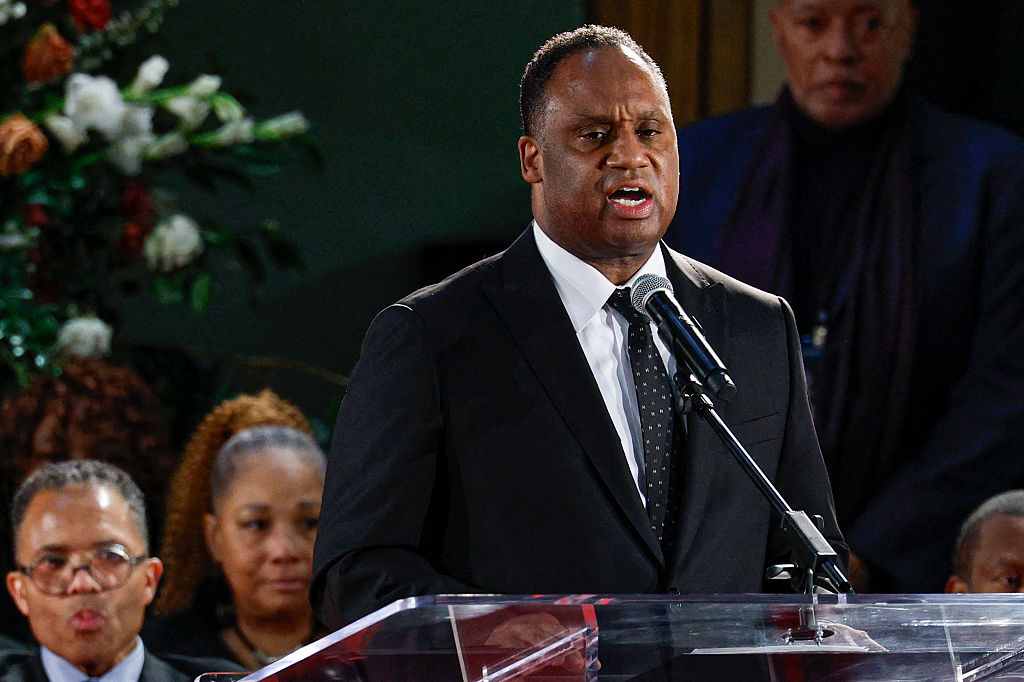
We’re running a piece at Ms. magazine by Congressman Jonathan Jackson, where he calls it morally reprehensible. This is a lane that’s so low. In political cycles, yes, people run negative ads, but this ad?
It’s beyond words.
Donegan: It’s abhorrent. It’s a really disgusting gesture.
Vivek Ramaswamy, who’s the Republican nominee for governor in Ohio, ran an ad featuring the estranged mother of his Democratic opponent, a public health official and physician named Dr. Amy Acton.
And in that ad, Acton’s mother characterizes her daughter as a liar and talks about their estrangement.
And the source of their estrangement is that the mother’s husband was sexually abusing Acton for about three years, from the ages of 9 to 12. He was indicted and arrested on those charges, and Acton’s mother took her husband’s side and skipped town with him when he was out on bond.
They have not spoken since a meeting in court, I believe, over those charges almost 50 years ago.
This is an ad that attempts to use one of the things that, in our culture, we have a tendency to understand as so abhorrent that I think we don’t quite understand how common it is: sexual violence, and particularly sexual violence against children. There’s a way in which the taboo obscures the prevalence.
But this is something that is so intimate and so definitively outside of Acton’s own responsibility.
If anything, it’s a testament to her character that she, like a lot of women who have experienced this kind of abuse, has built a life of dignity and usefulness and service to others out of the aftermath of this violence, right?
And that is a gesture that Ramaswamy made that implied that the violence was her fault, or that she lied about it, or that it rendered her defective and unworthy of power in some way.
And you’ve seen other Republicans doubling down on this ad. Ramaswamy has received—
Goodwin: Including the president.
[Clip begins]
Donald Trump: Her daughter is a liar.
Unidentified reporter: That’s a bit of a backstory about Amy Acton and her stepfather, and why she hadn’t talked to her mom for so long. Her stepfather was indicted for rape. Now that you know all that, sir, do you change your mind about the ad?
Trump: No. It’s a mother speaking badly against Amy Acton. And to me, it’s very easy. The mother—I don’t care. So if it were my mother speaking badly about me, you’d be making it the number one story on the news. Maybe you would.
You don’t know that. You don’t know that. You don’t know anything. Her mother stood by, didn’t stand by. Her mother went on television and said that the daughter who’s running for governor of Ohio is a liar and a bad person. And that’s all I know. Nobody knows. Nobody knows anything.

Can I be honest? The press is embarrassing themselves. You’re trying to take a horrible situation for a Democrat and make it look better. The mother said really bad things about a person that wants to be the Democrat governor of Ohio. The mother said terrible things. Anybody seeing that would say, “No way I’m voting for her.”
There’s nothing to it. It’s very simple. The press is trying so hard to nullify it. You know, they called me up about it. I said, wait a minute, the mother said these things. The mother looks like she’s totally lucid. She looks very smart, actually, and she felt she had an obligation to Ohio voters to tell them that her daughter is a liar.
[Clip ends]
Donegan: And Vice President JD Vance and Donald Trump have both spoken out in favor of the ad, saying that, in Vance’s case, it tells it like it is.
Donald Trump praised the ad, saying that it revealed Acton as, quote, “defective.”
And I think this is a sign of the values that are now inherent in the Republican Party. It is a worldview in which the population is divided not into equals who should represent one another with dignity and mutual responsibility.
But it’s a world they imagine in which people are divided into those who wield power and those who have power wielded against them. And they understand themselves to belong to that first category, those who wield power.
And that is something that I think places them in the same category as abusers.
Goodwin: You’ve laid that out in a way that will touch the hearts of so many, because what you’ve just shared is, first of all, the commonality of sexual assault and abuse in the home, right?
It’s not just the creepy guy with the white van who’s circling around neighborhoods.
And because this takes place in the family—stepfathers, fathers, uncles, cousins, sometimes brothers—there are women in Ohio who maybe haven’t spoken about their abuse because, of course, what they know is exactly what Amy Acton experienced.
If you speak out about this, the possibility is that you will be shamed, that you will be blamed, that you will be made to feel embarrassed by this, that you will be targeted, that there is something people will say or believe is defective about you, no matter what you have accomplished coming out of that.
And coming out of sexual abuse, starting at the age of 9 and going until the age of 12, the level of trauma that would be associated with that—I mean, it’s the kind of trauma that sometimes I think about in connection with the military, and someone being captured and tortured. That’s what it’s like!
For the little girl who’s 9 years old, who’s now captured, she’s defenseless, and this place—it’s almost like solitary confinement. Your house becomes that.
And it’s amazing the kind of treatment that we give to men who come back from war where they have been captured and in solitary confinement, even without physical abuse and torture. It’s like, wow, that’s amazing! How did you survive that? How could you get through that? Maybe you should be president.
Donegan: Maybe you should be a governor.
Goodwin: Maybe you should be a senator.
You deserve a Purple Heart for this, and people should listen to you about your determination, how you kept it together and how you were able to accomplish something in your life.
And the truth of it is, people who’ve been in the military who’ve experienced that do deserve our recognition for having survived what they have survived.
But what is stunning is that, being a woman and having survived trauma and torture and physical abuse and violence and sexual violence, it’s your fault, girl.
And what many sheriffs around the country do is say, well, the best place for you is to put you into juvenile detention.
Make it make sense, Moira Donegan.
Donegan: This comparison between the psychic aftermath of rape and abuse and the psychic aftermath of war is not just your comparison. That’s one that’s been made by clinicians.
I’m thinking of the Harvard Medical School psychiatrist Dr. Judith Herman, who is a pioneering researcher in the field of post-traumatic stress conditions. She developed her methodology for treating people who have been victims of especially prolonged and repeated violence because she saw commonalities in the symptoms of domestic violence and abuse survivors and the Vietnam veterans who were returning from war.
And the fact is that there is a tremendous well of moral expertise and resilience in the lives of women who have experienced this kind of violence. This is an untapped resource.
I think you’re right, Michele. I think we have a lot of this kind of knowledge of how to create a good life in the aftermath of really deep suffering that we’re not using, right? And that should be something that we value in our leaders.
Goodwin: Oh, absolutely. And we reject that when it comes to the experiences that women have encountered, and trans folks, too, for that matter.
It’s stunning to be able to survive a childhood of trauma like that.
And I recall, in my own personal experience, being told, “Never talk about this,” and being told that by a chair of an academic department at my university. And that was done because he thought he was protecting me.
Because one day, if you do that, you’re going to wipe your entire career away. No one will see a woman who’s survived trauma as a survivor, thriver, thought leader—all of these things that can be, when clearly you’ve had to navigate so much.
Women don’t get that kind of deference and respect that men do who’ve come through trauma and survived.
Donegan: This is a really interesting point because it’s not Amy Acton who made her childhood abuse an issue in this race.
Amy Acton was drawing on a lifetime of public health expertise and public service, this whole other life that she built in which her history of childhood abuse was just one part, right?
It was Vivek Ramaswamy who brought that in. It was him who made it an issue. It was him who said, “This is the thing that defines my opponent. This one experience, this thing that was done to her,” as opposed to everything she has done herself.
I think that’s very telling.
I think there is this tendency to think that rape or abuse have to be these singular, defining experiences in a woman’s life in order for them to be bad, in order for them to mean something.
And the truth is that it’s a simultaneity of meaning, right? It is both horrific and also not the full story. It’s not the full story of anybody’s life.
Goodwin: That’s right. That’s exactly right.
And despite this doubling down, it seems from the polling that is taking place that this calculation that was made—whether it was a desperate calculation or something else, it certainly shows signs of desperation—but it also just shows signs of a deep moral abyss.
So no matter why it happened, it seems that voters in Ohio, and certainly across the country, are just deeply turned off.
Moira, it has been a pleasure to be with you. It always is. Your insightfulness, your critical thinking and the way in which you lay it out in such concise terms for people to understand is just a joy to listen to.
I thank you very much for joining me.
Donegan: Thanks, Michele. It’s always a pleasure.
*
A note from Ms. editors: We want to hear from you for The Majority, a new campaign collecting stories about how reproductive freedom has enabled readers to build the lives they want and need.
Poll after poll shows a majority of Americans support reproductive healthcare access. Yet public debate overlooks the lives shaped by abortion access, contraception, IVF, miscarriage care, maternal healthcare or comprehensive sex education—countless women who chose to pursue an education, have children, not have children, protect their health and chart their own future. What’s your reproductive freedom story? Add your voice. Together, these stories will help show not only why reproductive freedom remains a majority value, but also what it makes possible.
About this Podcast
Fifteen Minutes of Feminism is part of our On the Issues with Michele Goodwin platform. Here, we count 15 minutes in feminist terms! The show features robust commentary and interviews in a powerful, concentrated dose.