Listen, Rate, Review and subscribe on:



In this Episode:
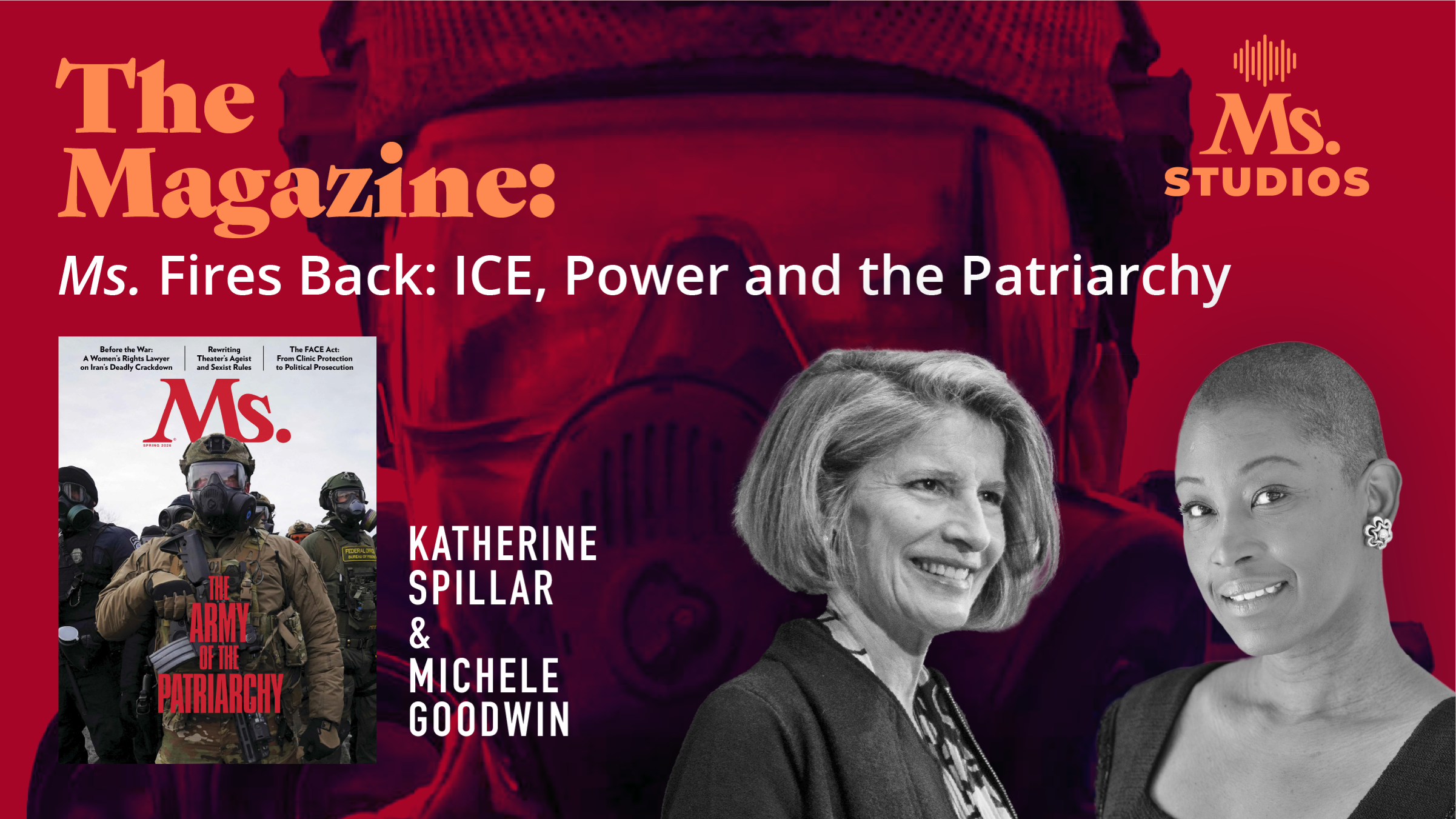
Welcome to “The Magazine,” our mini-pod, which gives a peek into Ms. magazine’s forthcoming and current issues. In this episode, take a glimpse inside our Spring 2026 issue, which explores how U.S. federal immigration agencies have become the enforcement arm of the nation’s racism and misogyny. Also in the Winter issue: a renowned women’s rights lawyer on Iran’s deadly crackdown, how the Trump administration is leveraging legislation meant to protect clinics for political persecution, and more. Get the magazine delivered right to your mailbox!
Transcript:
00:00:11 Michele Goodwin:
Welcome to The Magazine, part of our On the Issues with Michele Goodwin at Ms. Magazine platform. As you know, we report, rebel, and we tell it just like it is, and in this Magazine episode, it’s a quick dive into what you can find in the print issue that hits the newsstands and in your mailboxes. I’m joined by Kathy Spillar, the Executive Editor of Ms. Magazine and the Executive Director of the Feminist Majority Foundation. So, listeners, sit back, take a close and quick listen, because it goes by quickly.
We’re going to tell you what you can expect in the issue that is landing at the newsstands and in your mailboxes. Kathy, it’s so important, the work that we do at Ms. Magazine and Ms. Studios. We talked about that. When Gloria Steinem decided to, basically, leave Ms. in the hands of those who could be the appropriate keepers, kind of like the keepers of the light and the torch, she did this with the Feminist Majority Foundation, and that is so critically important, and with that, unlike with so many other publications that have gone under, where we no longer hear their voices, we not only are able to read, in print, and hold in our hands, The Magazine, we’re able to engage digitally.
And we’re also able to engage through Ms. Studios now, something that we created in a few years. We got together, and we said, we’re going to do this, and we have, and so, in the magazine, which is something that we’re doing, giving our readers and also our listeners the opportunity to hear what’s in our pages, and so, I want to turn it over to you, Kathy, because we have a new issue out. What’s in our pages?
00:02:10 Kathy Spillar:
Thank you, Michele. Yes, it’s the new spring issue, and in it, we feature three major feature stories that are critically important and right on top of what’s happening in this country and globally. The first one is titled The Army of the Patriarchy. It’s our cover story, and it explores how U.S. federal immigration agencies have become the enforcement arm of the nation’s racism and misogyny.
It’s an incredible conversation between Jackson Katz, who’s a leading voice in gender violence prevention and masculinity studies, and Loretta Ross, a celebrated Black feminist scholar, both of whom you’ve had on Ms. Studios podcasts, and together, they explore how government institutions and cultural narratives and political movements have shaped and weaponized issues of gender and race, with a focus on ICE, as I said, and its violent actions in Minneapolis and other cities.
And they also challenge us to start thinking and rethinking empathy and our strategies for how we’re going to build a more inclusive feminist movement by understanding how people whose precarious economic circumstances are being manipulated by this administration to engage them in its campaign of repression, and so, I think it’s something that your listeners are going to find very interesting, and urge them to get a copy of the magazine and read it.
00:03:38 Michele Goodwin:
Absolutely. Get it in your hands, and Kathy, what comes to mind when you describe that is what we talk about in print, digital, and also through Ms. Studios and our podcasts, is that we report, rebel, and we tell it just like it is. That is so important, and I want to remind our listeners here that so many of the journalists who work with us are also scholars.
These are people who are researchers. These are not people who come at a whim to these ideas, and there’s a lot of value to journalism, and you get a hot story, and you go, and you pursue it, and you figure it out, but one very unique thing about Ms. Magazine is that you have people who are learned experts, who have spent decades covering certain areas, such that when they are sharing this, they’re sharing this with a deep set of wisdom, which we can’t take for granted, and the final thing I’ll say, and then I want to hear more about what’s in our pages, is it’s courageous reporting.
One of the things that people are so disappointed about now is that they’re either having to go to BBC and see what’s happening in the United States, turn to the Guardian, turn to places outside of the journalism that we should be expecting in the U.S., and so, I’m also really proud of the work that we do, because that reporting, rebelling, and telling it just like it is, is bringing facts right down on the ground in a way that people can understand and can consume, and we’re not afraid.
00:05:10 Kathy Spillar:
And put it in historical context of the history of this country and its repression of people of color, the fight to gain rights throughout history, and how, you know, history is repeating itself in so many ways under this administration, both in its repression of racial minorities and its attack on undocumented people who live in this country, as well as the misogyny underlying all of this, and by being able to put that into perspective, I think it gives a rich context that the typical reporting out there is missing in its entirety. So, that’s why we decided to take on this story.
00:05:57 Michele Goodwin:
Great cover story.
00:05:59 Kathy Spillar:
Absolutely, and then, Michele, a second feature in this issue, which is also extraordinarily timed, is an interview with the leading women’s rights and human rights lawyer in Iran, Nasrin Sotoudeh, and we were able, also, to talk with her husband, activist Reza Khandan, who’s currently imprisoned in the notorious Evin Prison for supporting Nasrin’s work. The interviews offer a rare and a firsthand account of the mass protests from earlier this year and the brutal crackdown by the Iranian regime that gripped Iran just weeks before the US and Israeli war began, and the stakes for democracy inside Iran. We’ve had coverage of Nasrin before.
She’s been in and out of Iranian prisons herself for her work on women’s rights, and she explains the brutality of the Iran regime’s crackdown on doctors and lawyers in the wake of these mass demonstrations. They even arrested doctors and disappeared them, who had treated the protestors who were injured by the security forces, and she puts the responsibility for this deadly crackdown directly on the leader of the Islamic Republic, and a development, Michele, is she has now, herself, been arrested, and for the last 17 days, no one knows where she is. She also has been disappeared for her criticism of the Iranian regime during this period of war. We’re very concerned.
00:07:35 Michele Goodwin:
One of the things that I wanted to highlight for our listeners, our readers, those who engage with us, is that the complexity and the nuance about our reporting and the storytelling and narrative work that we do…which is to say that there are multiple things that can be true all at the same time, such that we’re not doing this binary work, which has just become so simplistic and reductive, right, because we know, at the very same time, the U.S., why are we doing this in Iran? There are children who have been murdered and killed. There are war crimes that have been identified by the U.S. doing this, and at the same time, we can speak to what’s happening to feminists, what’s happening to those who want to promote peace, those who want to promote better lives and independence and freedom and all of that. That complexity, folks can get from reading what is in Ms. magazine, consulting with us on the digital platform, and listening to the podcast.
00:08:36 Kathy Spillar:
Right. Right, and one of the last things Nasrin said in this interview is how opposed to the use of war she is. That you cannot bomb a country into democracy, and that, you know, she totally opposes…
00:08:49 Michele Goodwin:
How brilliant is that?
00:08:51 Kathy Spillar:
Yeah, it is, and she urged non-military aid, and now, she, herself, finds herself in prison somewhere. We’re in touch with her daughter trying to keep on top of the developing situation there, but we’re very, very concerned.
00:09:07 Michele Goodwin:
Yeah, you know, oh, Kathy, you and I, once we get talking, we go on and on, but just to the point that she made, you know, imagine what it is that someone says, well, I’m going to free you by bombing your house. By burning your house down, I’m going to give you liberation, right? And this is the point for people to understand. As she was saying, you know, freedom doesn’t mean obliteration. It doesn’t mean casualties of war. It doesn’t mean killing children. None of that. So, please take a look at this very important reporting that’s right in our pages in the current issue that is hitting your mailboxes, newsstands, whatnot. It’s powerful.
00:09:54 Kathy Spillar:
Yeah, and Michele, there is some good news among all of this in this spring issue.
00:09:57 Michele Goodwin:
Yes. We always try to bring some good news.
00:10:00 Kathy Spillar:
We do. We do. There’s a terrific feature on efforts…three different programs in the U.S. for incarcerated women to build knowledge, community, and pathways forward. We cover an incredible program in Louisiana. It’s a combined program between Tulane University and an organization called Operation Restoration, and it is providing women with college degrees while they are incarcerated, in prison in Louisiana. They are graduating with degrees to become clinical lab scientists and lab assistants. It’s an extraordinary study, and the program was started by a woman who, herself, had been incarcerated and was able to get a degree while she was in prison. Then we come to DC, and we talk to women involved in the DC Jail Debate Team. It’s a program of the National Prison Debate League, and by the way, these women in jail team up with Georgetown law students to prepare for debate contests, focused on everything from minimum sentencing…
00:11:10 Michele Goodwin:
Love this.
00:11:11 Kathy Spillar:
Laws to solitary confinement, and this team wins the debate against college students.
00:11:19 Michele Goodwin:
You can’t make that up. Isn’t that beautiful? And just a reminder to those who are engaging with us about the importance of compassion and love, what you were mentioning at the top of our recording about the magazine, which is that…just a couple of points for folks to just really understand. The United States incarcerates more women than any other country in the world. We’re not just talking about peer nations. Any other country in the world. We incarcerate more women than Russia, China, India, Thailand, Mexico combined.
Overwhelmingly, these are women who are incarcerated who are nonviolent offenders. Many are in because of drug use, rather than giving them the support that they need in order to be rehabilitated. They’re put in prison. Children taken away from them. We know to incarcerate one woman, let’s say, in New Jersey, it costs more per year to incarcerate her than to pay full-time tuition for her to go to Princeton. What sense does this make? In the United States, the recidivism rate is over 60 percent. That means it’s failing, and we know that if we bought a car today, Kathy, and we were told when we were purchasing that car, oh, by the way, over 60% of these cars will break down, buy it, or this computer, 66 percent of them are going to break down, we’d say no.
That system is broken. So, I just share that for those who are, you know, listening. We’ve become such a retributive society, and we say, right away, well, if they’re in jail, they must deserve it, without a sense of compassion and that, for so many women, other than…the other thing, other than drug use, it’s writing bad checks, and when you look at it, what the sociological literature shows us is that they’re not writing bad checks to go and buy furs and to buy big cars. They’re doing this to keep the lights on, to pay their rent, to pay their mortgage, to make sure that the kids have lunch money. They’re hoping the money comes in, and what the ACLU study has done…there’s an ACLU study in Mississippi.
For so many women in Mississippi, part of the reason why they are incarcerated is because they can’t pay parking tickets. Where have they traced these parking tickets to? Caregiving, because they’re shepherding the kids around, and they’re running into the school, running into the hospital. The meter has expired. Here’s a ticket on the car. You get so many of them, and guess what? You’re going to jail. So, just when we’re thinking about, well, why are these women incarcerated, please know it’s not because they killed somebody or because they stabbed somebody. For the vast majority, it’s not that.
00:14:06 Kathy Spillar:
That’s right. That’s right.
00:14:08 Michele Goodwin:
It’s these other things, and the last thing that I’ll say…because just thinking about women incarceration and some new programs that have started around the country to try to revisit sentencing of women who are in jail because they fought back after domestic violence. We can’t forget that there is also a cohort of women incarcerated around the country who tried to fight back, and not their abusers were sent to jail, but they were.
00:14:38 Kathy Spillar:
That’s right. That’s right, which is another reason that Ms. provides the magazine for free to women in prison. It’s one of our big programs, and your listeners can not only get Ms., but they can join us in the Ms. community and support these efforts. They’re so important because, although women are only, you know, 10 percent of those incarcerated here, they virtually have no opportunities that their male counterparts are getting in prison, and that’s why these programs that we explore and the kind of issues that you’ve raised are so critical, that our readers understand.
00:15:13 Michele Goodwin:
Kathy, that’s some great news to end on, and I love it when we get together to unpack what’s in the magazine. It’s great work, and it’s so illuminating, and listeners, please go pick up your copy and take a look, and then share it, please.
00:15:34 Kathy Spillar:
That’s exactly right, Michele, and thank you for all of your efforts to bring these issues to life on your podcast, your many different podcasts. We try and reach listeners and readers no matter where they are or how they get their news, and it’s all very, very important. It’s the only place, really, to get a feminist lens take on what’s happening in this country and around the world, msmagazine.com.
00:16:03 Michele Goodwin:
Absolutely. Thank you, Kathy.
00:16:05 Kathy Spillar:
Thanks, Michele.
00:16:06 Michele Goodwin:
So, friends, be sure to check out this issue when it hits the newsstands, and in the meantime, you can always take a look at what we have online in our digital space, and be sure to tune into the myriad of our podcasts, from On the Issues, to Fifteen Minutes of Feminism, and so much more.
About this Podcast
On The Issues With Michele Goodwin at Ms. magazine is a show where we report, rebel and tell it like it is. On this show, we center your concerns about rebuilding our nation and advancing the promise of equality. Join Michele Goodwin as she and guests tackle the most compelling issues of our times.