Listen, Rate, Review and subscribe on:


In this Episode:
From indigenous women’s early models of democratic governance and the overlooked contributions of enslaved women during the Revolution, to more than five decades of feminist organizing and journalism, Spillar argues that understanding women’s history is essential to understanding the country itself.
Goodwin and Spillar also turn to the urgent challenges facing women today, including attacks on voting rights, cuts to Medicaid and food assistance, the lack of paid leave and affordable childcare, and the broader targeting of women under the Trump administration.
Looking ahead, they discuss bold proposals featured in the issue—from using the Equal Rights Amendment to advance reproductive and maternal health justice, to Supreme Court reform and LaTosha Brown’s proposal for a federal Department of Democracy—and what it will take to build a democracy grounded in equality and social justice.
Transcript
0:00:03 Michele Goodwin:
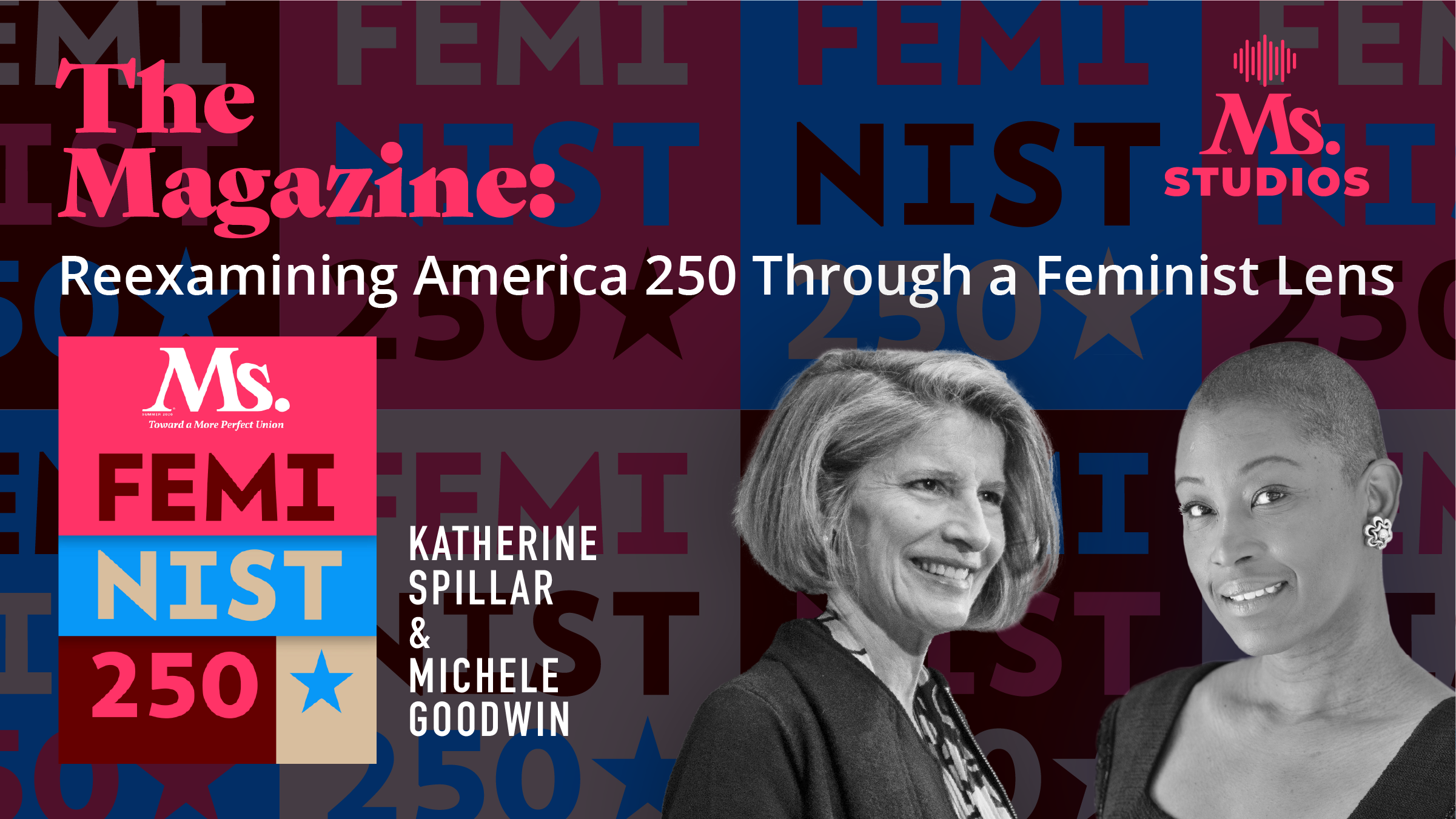
Welcome to the magazine, part of our On the Issues with Michele Goodwin, at Ms. Magazine Platform, and with the magazine, we give you a preview of what you can expect to see on the stands and in your mailboxes, and in each of these episodes, I’m joined by Kathy Spillar, who is the Executive Editor at Ms. Magazine and the Executive Director of the Feminist Majority. Sit back and take a listen.
Kathy, it’s wonderful to be with you again, another smashing issue of the magazine, and at a time that is so ripe and timely. Tell us what our readers can expect.
0:00:17 Kathy Spillar:
Thank you, Michele, and good to be with you. It is a critical time, you know? At 250 years, we wanted Ms. to take a pause and look at where we’ve come from and where we could go, toward really a more perfect union, and we felt a very deep responsibility to claw back the last 250 years, and really, in a way, rewrite history, because women have been largely left out of the history that most people know about.
So, we wanted to look back and see, what did feminists, and of course, there wasn’t even the word feminist then, but what did women, what role did they play in promoting the ideas of democracy and fighting for democracy? And again, much of that history, erased, and so, we wanted to ask, who gets remembered at this time?
Who gets erased? And how do we imagine and build a democracy that includes all of us? So, we did it in three parts. The very first part is, we called Founding Feminists. It was curated and edited by Janell Hobson, who’s been on your program, and it looks at reclaiming America’s origin story. So, we had not only feminist historians involved, but we had indigenous women who talked about the early ideas of democracy existing, pre-existing any thought of the declaration of democracy, and how some of those ideas have been incorporated.
The big difference, of course, being that women were the law in indigenous societies in Upstate New York, and shaped much of how those societies evolved. We also looked at, you know, some of the classic known women of the time, Abigail Adams, and her warning to her husband, John Adams, that if they left us out of the Declaration, we would foment a revolution.
And that’s what we’ve been doing for the last 250 years. We also looked at enslaved women and the role that they played in the Revolution, being promised their freedom if they would make runs to the front lines of the British Army, and those who escaped slavery at that time, and so, we went back and took a good look at many of those stories and brought them forward.
So, that was the Founding Feminists. Then we went through the last 54 years of Ms. Magazine and looked at, you know, how much progress we have made, but also the big lessons learned, and we can talk about that. You know, the biggest lesson is with every step forward, there is a backlash.
We cannot assume, at any point, that we’ve reached a new level of real equality, and then, I want to get some conversation going, but then, we finally looked at, so, what do we have to do to go forward, to get a real democracy that includes all of us, that is founded on the concepts of equality and social justice, and we looked at some of the leading thought leaders in this area and had them contribute too. So, we can go through any or all of that. It’s an exciting issue.
0:03:29 Michele Goodwin:
Sure. It’s very exciting, and you know, we do this quick dive, which our readers and our listeners love. Kathy, how do you respond to what’s been fomented by the current administration, which seems to suggest that there’s not a reason to carve out thinking about women? There has been the attack on DEI with women being part of the bullseye. So, how does the magazine and its focus on women and the 250 respond to that?
0:04:03 Kathy Spillar:
We show, throughout this series that’s in the magazine, and by the way, a much larger series online at MsMagazine.com/Feminist250, how important it is that we do not ignore the histories of women, of indigenous people in this country, of Black women, especially, that to ignore those histories is a tragic mistake. We can’t even understand where we are right now without understanding the role that these groups that are now being eliminated from the popular history have played.
0:04:43 Michele Goodwin:
Well, that includes white women. I mean, to be clear, the bullseye in terms of the Trump administration, and DEI includes all women, right? That that’s…
0:04:51 Kathy Spillar:
That’s true. That’s true. The good news is you cannot wipe out history, really, and Ms. has always played a role in making sure that, although, you know, much of the history that has been written has eliminated the roles that women have played, that we bring that back, and this special series is part of that effort. You’ve got to know, you know, you can’t have a nation without women. I mean, it’s that simple, right?
And you also have to understand that women, as you are saying, are at the front of the attacks on democracy. The rise of authoritarians always rely on the attack on women, on women’s autonomy, on their ability to be players in the economic system, on their very lives, and so, without that knowledge, we can’t possibly really move forward.
0:05:44 Michele Goodwin:
Well, that’s absolutely right, and part of what you’ve said, you’ve got the three different parts, there’s the founding, there’s looking at the last 54 years, and then there’s looking ahead, and one of the brilliant things that’s part of this special issue is to actually center women in a discourse in which they would otherwise be wiped out, where people don’t really understand that women have had a very progressive revolutionary voice since the very beginnings of being on these lands, with indigenous women, before anybody else got here.
And then, the fight that took place, once other women came, to promote democracy, rule of law, and constitutionalism for women. I want us to turn to the last 54 years, and then, in looking ahead, can you give us some sense about how the 250, and thinking about the 250th anniversary of the Declaration of Independence, how Ms. fits in with these last 54 years?
0:06:50 Kathy Spillar:
We have played an extraordinarily vital role in making sure that current events are seen through a feminist lens, and that attention is paid to the stories of women. You know, all too frequently, you can look through newspapers, you can look through magazines, you can look through history books, and you would think that women didn’t even exist, because the stories are not being told.
And so, that is the role that Ms. has played. It has centered women in the understanding of current events, and also was a key part of recovering our histories. So, everything from a look at how Supreme Court decisions impact women in particular, how laws passed that leave us out have been harmful, the need for laws that will cover issues like violence against women. There’s no real federal, there’s no constitutional right for women to be free from violence.
And so, we look at these issues through a lens that assesses the impact on women, and also makes sure that we don’t forget the role that women have played, the political role, the power of women’s votes. Understanding the power of women’s votes is critical, because we shape the results of elections.
And so, we can demand that those that get elected have to deal with the issues that concern us most, because we have been the reasons that they are in political power. The gender gap is very powerful and must be paid attention to. So, but without that analysis of women’s voting patterns and opinion patterns, which Ms. has centered, how would those who get elected even understand it?
0:08:40 Michele Goodwin:
Well, it brings to mind, too, the role of Ms. and Feminist Majority in elections, and making sure that voters are informed, and you’ve made such a great point about the role of women. Sometimes people forget that women are more than half the population of the United States, right?
Because it’s so distant from, then, who are the people that are in power, right? So, you have over half the population being women, who can really make a difference in elections and voting, and yet, at the same time, we see some of the places in which power is held as being male dominant, and perhaps that’s the reason why, and I know that this has been work that we’ve been doing at Ms., bringing attention to matters like the SAVE Act, which, right now, has been efforts to try to deny women and broader populations of people the right to vote.
If you can’t put your hands on your birth certificate, if you can’t put your hands on a passport, which more than half of Americans don’t even have, and then, we’re talking about millions of married women in the United States who’ve taken on their husband’s names, such that their current name doesn’t even match their birth certificate, if they could even put their hands on it, and right now, that is a critical issue leading up to midterm elections and also the next presidential election.
0:10:01 Kathy Spillar:
That’s exactly right, and your point is well taken, too. The men in power are very distant, frequently, from the needs of their constituents, their women constituents. You know, we don’t have paid family medical leave. We don’t have paid leave. We don’t have publicly funded child care.
We are suffering, especially women and their children, with the cutbacks in food assistance and the cuts to Medicaid. You know, women are disproportionately being hurt under these Trump policies that are being pursued, and yet, there’s very little talk in Congress about what we’re going to do to address those inequities.
So, the role of women politically and gaining equal representation has got to remain on the feminist agenda moving forward, and it very much is, and that’s part of what the third segment of this special series takes a look at, is how do we fight forward, more effectively, toward equality.
0:11:06 Michele Goodwin:
And that’s what I’d like to pivot to. That’s a great way to transition, Kathy, to the last of our quick take on this issue of the magazine, which is to look at what’s coming ahead. How is that broken out in the magazine?
0:11:22 Kathy Spillar:
We are very innovative. The thought leaders we turn to were just extraordinary in putting forward ideas for how we build a democracy that really includes all of us. Carrie Baker, who’s been on your program, professor, did a very thorough analysis of how the Equal Rights Amendment could be used, in so many ways, at the federal level and at the state level, towards getting us closer to equality, not only in eliminating the abortion bans that have been so dangerous and taken women’s lives across this country already, but justice for pregnant women, addressing maternal mortality as an issue, which disproportionately impacts Black women, addressing child marriage, challenging the family regulatory system that Dorothy Roberts writes about.
Those are policies and systems that disproportionately hurt women, especially poor women, and as I said, the cuts to SNAP and Medicaid and the whole discriminatory infrastructure of the Social Security system. So, this is a critical moment in time and a critical reason to reinforce the need for the Equal Rights Amendment.
So, that’s one of our key articles. We turn to Skye Perryman of Democracy Forward to take a whole look at what court reform would mean for democracy and for women, and the importance of reforming, expanding term limits on the Supreme Court, and why that is so critical if we are to be equal justice under the law for women, and then, a really innovative idea, put forward by LaTosha Brown of Black Voters Matter, a federal department of democracy. Why not?
0:13:15 Michele Goodwin:
Long overdue, Kathy.
0:13:16 Kathy Spillar:
To ensure, you know, that the laws and the rules are promoting voting rights for all, that we have civic education. I mean, part of the problem that I think our country is suffering is too many people don’t really understand how government works and the role of citizens in ensuring that there is a democracy, and how voting works. She proposes democracy audits of each state and a democracy audit of the federal government, what innovative ideas.
0:13:49 Michele Goodwin:
I love that.
0:13:49 Kathy Spillar:
And so, and those are just some of the pieces. We also have a whole piece on the need for paid leave and childcare, but it is taking an opportunity to imagine and envision a feminist democracy going forward, and that’s what we should be doing, right now, because we are going to have a chance to implement these ideas. We are, if we hang in here long enough.
0:14:17 Michele Goodwin:
And we will hang in here. Kathy, thank you, so much, for giving us a dive into the magazine and what our readers and listeners can come to expect. Please, do pick up your copy. They’re on newsstands. Look at the online, which is even more expansive than what’s been in the magazine, and stay in touch with us at Ms. Magazine and Ms. Studios, where you can get the news that has been curated, investigated, and researched by people who actually do the work in the field. Kathy, thank you, so much, for joining me and unpacking what our readers and listeners can find in this issue of Ms. Magazine.
0:15:02 Kathy Spillar:
Thank you, Michele.
About this Podcast
Welcome to the Ms. Book Club! Join authors as they delve into feminist books exploring topics ranging from the child welfare system to human rights to the intersections of race and the law.