Listen, Rate, Review and subscribe on:


In this Episode:
Welcome to the Ms. Book Club! Join authors as they delve into feminist books exploring topics ranging from the child welfare system to human rights to the intersections of race and the law.
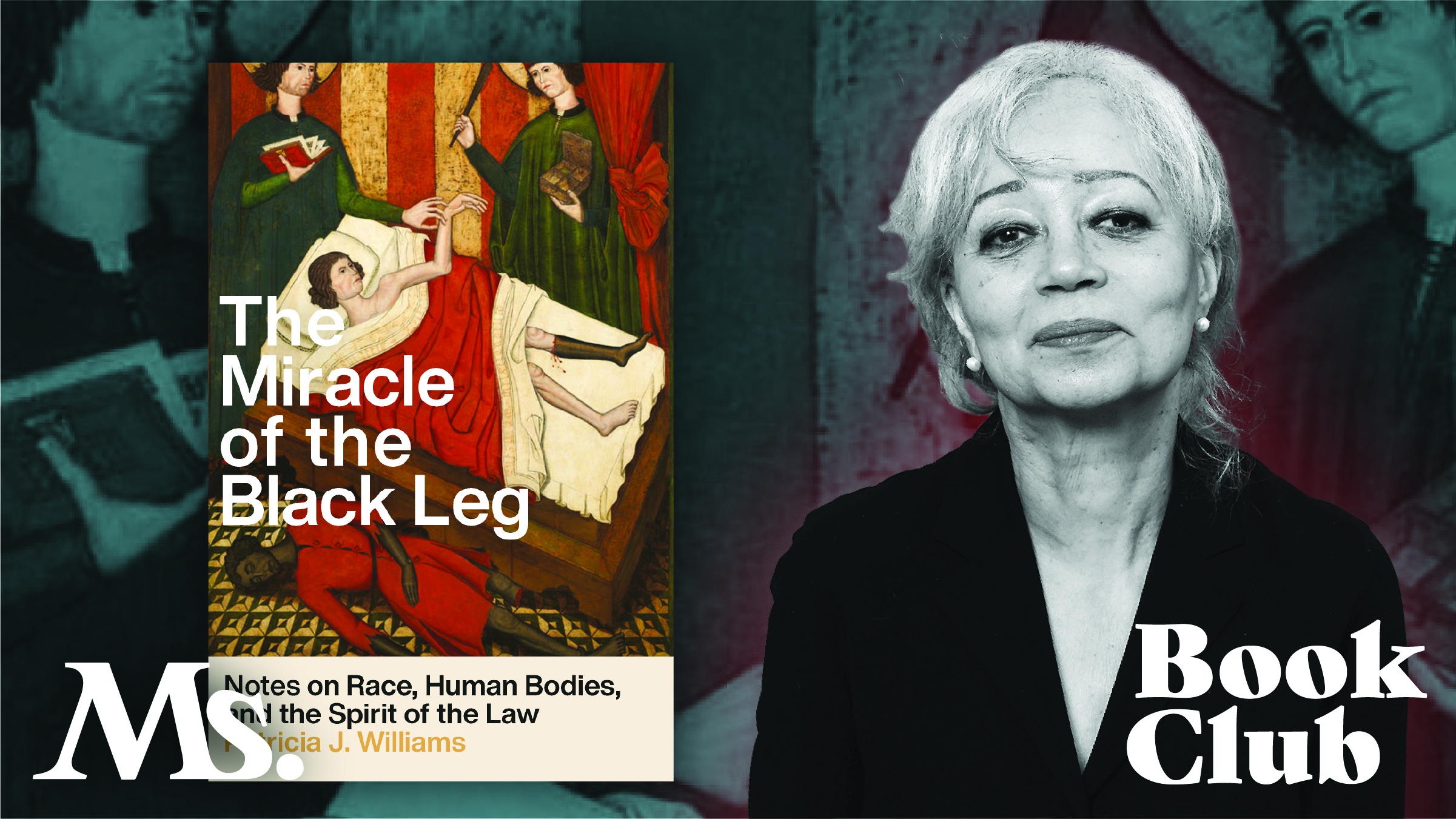
Today, we’re joined by Patricia J. Williams to discuss her recent book The Miracle of the Black Leg: Notes on Race, Human Bodies, and the Spirit of the Law. Beginning with a jaw-dropping rumination on a centuries-old painting featuring a white man with a Black man’s leg surgically attached (with the expired Black leg-donor in the foreground), contracts law scholar and celebrated journalist Williams uses the lens of the law to take on core questions of identity, ethics, and race.
Transcript:
00:00:08 Michele Goodwin:
Fans and friends, welcome to The Book Club, part of our On the Issues with Michele Goodwin at Ms. magazine platform. You know we report, rebel, and we tell it just like it is. Spring marks the launch of this special Book Club series at Ms. magazine and Ms. Studios, featuring four incredible authors, Professor Dorothy Roberts, Patricia Williams, Khiara Bridges and Keisha Blain. Their pioneering works span history, memoir, art, family, politics, law and reproductive justice.
We bring this special series together, highlighting the significant contributions of these four award-winning authors, among whom are two MacArthur Fellows, otherwise known as MacArthur Genius awardees. Their pathbreaking research and storytelling showcase the hidden, forgotten, and overlooked, giving a breathtaking look at the unexamined and the underexplored. This Book Club series is one of our ways, at Ms. Studios, to reflect on the 250th anniversary of the Declaration of Independence through a lens that centers women and explores the experiences of Black women. We present to you the Ms. Book Club Spring Edition.
Welcome to this episode of the Spring 2026 Ms. Book Club, featuring my conversation with Professor Patricia Williams, author of Miracle of the Black Leg: Notes on Race, Human Bodies, and the Spirit of the Law. Now, I have to say, I’m a huge fan. Patricia is a great friend. She’s been a superstar, lighting the path for so many. Brilliant journalist, author, and so much more. Let me get straight to it and tell you what it says from the jacket. This book begins with a jaw-dropping rumination on a centuries-old painting, featuring a white man with a Black man’s leg surgically attached, with the expired Black man’s donor in the foreground.
This is, folks, just straight from CSI. Now, Patricia Williams is a contracts law scholar and celebrated journalist. In this book, Professor Williams uses the lens of the law to take on core questions of identity, ethics and race. The chapters are horrifying, and yet, you cannot turn away. I told you it’s like CSI. For example, at the heart of “Wrongful Birth,” chapter title, is a lawsuit in which a white couple who uses a sperm bank sues when their child comes out Black. “Bodies in Law.” It explores the service of genetic ancestry testing, these companies that seek to answer the questions of who owns DNA? In “Hot Cheeto Girl,” you can’t make these titles up.
She’s brilliant. That examines the way that algorithms give rise to new predictive categories of human assortment, layered with marked, inflected cages of assigned destiny. I’m your host, Michele Goodwin, and in this episode, I speak with Professor Patricia J. Williams about her work, history, this fascinating book, and how technology is setting the standard on what it means to be human. So, sit back, and take a very close listen. It is such an absolute pleasure to be with you again. I adore your work. I adore you.
And you have a book that’s been recently released, The Miracle of the Black Leg: Notes on Race, Human Bodies, and the Spirit of the Law, and I have to just say that the cover is really quite jarring, on one hand. It stops you in your tracks. What one sees as a white person lying on a bed from centuries ago with a Black leg that’s been attached, and the Black person whose leg it was is on the floor. Welcome, Pat Williams.
00:05:07 Professor Patricia Williams:
Thank you so much, Michele. It’s always an extreme honor and pleasure to talk to you. I just…your work has so influenced my own, but yes, the cover of that book is…you know, it sort of announces itself as being of some period of Italian renaissance, early Italian renaissance, and I don’t know the author. The painting is in private hands, and it is called The Miracle of the Black Leg because it depicts the twin saints Damian and Cosmas, who were saints of medicine, of children, of healing. I think they were also saints of adoption. They are not terribly well known in the Roman Catholic Church anymore. They’re more known in the Greek and Eastern Orthodox Church.
And the story is that they perform the first transplantation, and again, I sort of have to imagine that this…because this probably dates to the 1400s or somewhere around there, and the story is that they cut off the leg of the man who was on the bed, who was either an emperor or a pope. It’s unclear, and they replaced the diseased leg, and they replaced that leg in an act of transplantation. That’s the story. What’s striking about the photograph, I think, is that there is the body of a dark man, a Black man, who is described in the literature as either an Ethiop or a Moor, and he is clearly deceased, and he’s only got one leg.
The other leg has been, again, cut off and attached to the man on the bed, and it is something which, as you say, stopped me. A student brought this image to me, and it sort of stopped me in my tracks, because I had immediate associations having to do with the contrasting colors, just reading the skin as a kind of hierarchy. When you look at this painting, it’s also arranged both in colors and sort of plains of visualization that indicate a kind of hierarchy. The twin saints are above. The man on the bier is lying flat in the middle, and the Black man is lying so far and in such darkness, almost underneath the table or the bed, that he almost disappears. You don’t see him at first.
There’s also a kind of river of ribbons, robes, and black…I mean, of red. Sort of a stream of blood that runs the…vertically through the painting, and again, there is so much to read in terms of the symbolism and the placement in that picture, that I had to step back, also, because I read it through the lens of my racial understanding, my acculturation as an African American person, as, you know, sort of the post-memory, as the historian Marianne Hirsch would call it, of having grown up in a world and in a country where medical practices indicate the exploitation of Black bodies, and again, this painting is from a period when that particular kind of reading, it may be a setup for some of the architecture of what we experience today.
But it really was before the concept of race in the United States or some of these practices was really articulated in the same way. So, I had to step back and watch what my imagination was doing with this and look at it from a kind of self-imposed remove, and I tried to find more about the actual provenance of this painting, but in the meantime, I think my book begins with the product of a year’s worth of meditating, not knowing, not having any sense of what this actually represented, and it was productive for its excavation of what I brought to those associations, and that was the beginning of my book, of just how powerful the visuals were, aside from knowing what the particular history was.
00:09:52 Michele Goodwin:
Thank you for walking us through that, because one sees exactly what it is that you observe in this painting, both the hierarchy that is established with this person being rendered invisible on the floor, the Moor, the Ethiop, who’s basically disappeared, been rendered invisible…has already performed the service, whether it was voluntary or involuntary, and now has been expendable, disposable, no longer in need of use, and then the use of red flowing, as in blood, but is actually material, fabric on the wall with wallpaper, fabric from the drapes, and then the draping that’s over the body of the person who’s now been healed through the use of this leg, and even the way in which that individual’s arm extends outside of the covers in a very gentile type of way, one also sees that contrast between the gentile of royalty, be it, as you say, pope or some significant leader, and again, the discarded.
00:11:17 Professor Patricia Williams:
And also that the red, I think, is also very significant for its religious significance. I mean, the blood of Christ, the red of the beating heart of the church. There is a symbolism to…and particularly in a renaissance painting, every color sort of has a meaning, and that’s worth excavating, as well, but it also, it seems to me, underscores the degree to which this man was identified as a Moor and at least…so, it actually evokes a kind of religious division that goes back to the Crusades that really inflects the conversation that we are still having today, that underscores, again, how Moors tended to be darker skinned, and there is that…again, perhaps some of the architecture of what then emerges in later centuries as a kind of racial construct.
00:12:15 Michele Goodwin:
Well, it’s fascinating in terms of what one can unpack in this particular painting, even with the donor, let us say…there are so many words that we could use to apply in the curiosity of the donor of the person who’s been discarded, the person whose body parts have been excavated.
00:12:39 Professor Patricia Williams:
Mined, yeah.
00:12:42 Michele Goodwin:
Then almost has, then, this Christlike…if it were not for the fact that he’s of darker tone in this painting…in the United States, people associate Christ with whiteness, but if you were to look at this painting, you could almost see this way in which the Christ depiction on the cross with the head leaning to the side is, in fact, what one sees of the person who is on the floor.
00:13:12 Professor Patricia Williams:
Yes. It looks like the images of bodies at the foot of the cross.
00:13:18 Michele Goodwin:
Yes.
00:13:18 Professor Patricia Williams:
Yeah. Yeah.
00:13:19 Michele Goodwin:
And so, then, that actually complicates, then, as you were saying…we could look at this in the lens of the modern, or we could look at it, and what were the efforts here in this depiction? Was this then a depiction of sacrifice?
00:13:36 Professor Patricia Williams:
Yeah. Yeah, or…
00:13:39 Michele Goodwin:
Christlike sacrifice?
00:13:40 Professor Patricia Williams:
Yeah, or of ongoing life in some fashion. I mean, it’s very…you know, I have to…you know, I’m not a religious scholar, but it’s such a very…an image that’s so redolent of a kind of relationship that feels familiar even today.
00:14:01 Michele Goodwin:
It certainly does. Well, in fact, it does, and your book helps to bring it into the relevance of the day. I’ll repeat the title of it, and for those of you who are listening, please come to our Ms. website, where you can see more, including the transcript of this interview, the cover of this fascinating book, and I know you’re tuning in on iTunes or Spotify and iHeartRadio, but you can also listen, also, on Ms. Studios webpage. So, the book, The Miracle of the Black Leg: Notes on Race, Human Bodies, and the Spirit of the Law.
So, Pat, I want to ask you, what motivated you to write this particular book? Our readers know you by a series of various books that have all been able to do something that, truly, is miraculous in and of itself. Take the urgent issues of the day, weave in that which is political, legal, contractual, that involves race, that involves society, and give us much to grapple with. I’ve always appreciated what you have been able to contribute to the literary body that we all, around the world, appreciate. What was the inspiration for this book?
00:15:31 Professor Patricia Williams:
Well, again, it was that period of not knowing what this painting actually was about, but it was clearly about something that felt familiar to me. So, I explored what felt familiar to me, and the dominant sense of familiarity was about a sense of a Black body being used in some way. That it was a utilitarian…and that the language of even religious donation or that this was donative in some way has always been so complicated over centuries, but particularly, in today’s world. So, I definitely had that gloss, but it allowed me to think about certain instances of how the body is being mined in a time of CRISPR, in a time of interrogation, of abortion, in a time of surrogacy, in a time of criminalizing abortions, when certain body parts…
You know, which, in the case of miscarriages, you know, the fetal remains used to be considered medical waste. Then, all of a sudden, have been redesignated as something holy and possibly, you know, the discard of human remains deserving a…everything from tax status to funeral burial, and so, that question of how you categorize a body part or a sense of the body, even that which is not fully a body part, but merely a cell, how it becomes sacralized or desacralized was something that really fascinated me. It also began with…or I related it to this wonderful sort of Southern Gothic, but very intriguing little film called Finders Keepers.
And it echoed the painting for me, in that it was the story of a man who lost his leg in a plane crash, and he wanted to be buried whole. He viewed it as an extension of his body. So, he asked for the leg to be returned after it had been amputated, and he embalmed it himself. He wrapped it up, and he put it in a Weber grill when he fell on hard times and had to move. So, he put it in a Weber grill. The Weber grill, he put in a storage unit. The storage unit, because he fell on even harder times, ended up being sold, and the man who bought it was a wonderfully fascinating character who then decided he wanted to make it part of his Halloween exhibit, and he wanted to hang this leg of a still living human being and charge admission for…
00:18:30 Michele Goodwin:
As in a circus.
00:18:33 Professor Patricia Williams:
As in a circus. It was like a freak show.
00:18:34 Michele Goodwin:
Like, from the old days when people would be on display themselves.
00:18:40 Professor Patricia Williams:
Yeah, it was exactly that kind of freak show, but what was fascinating to me was that they then ended up in a lawsuit, and the two definitions of what that leg was, was such a powerful indicator of the power of the law itself to define the edges of life and the meaning of human beings, and so, the man from whom the leg had been amputated described it like a religious…or a relic, something to be revered or venerated. He wanted to be buried with it. He wanted to be buried next to his father who’d died in the plane crash.
That the leg was his in this very different sense of possession than the man who wanted to hang it in the freak show, who said that it was his because he was a purchaser for value, and so, it was the contractarian sense that this had economic value, because he was going to charge five dollars for admission for children and 10 dollars for…and so, he had broken it down in this very utilitarian, hyper-econometric calculus, and so, you have these two very different vocabularies, sense of valuation, that it seems to me captures a lot of what’s going on.
So, in the book, I make that parallel in terms of the discourse, how the discourse shifts from when you view it, in that language of human sacredness as opposed to the language of pure cash on the barrelhead exchange, and it seems to me that flows through the way in which people discuss the value of human life as opposed to the value of the marketplace when we were dealing with COVID, for example. People said, you know, people should just go out there and do what they can, because you don’t want to sacrifice the economy, and they talked about the economy as a more sacred body than they did the people who worked in meatpacking.
00:20:35 Michele Goodwin:
Oh, that’s right, and that’s absolutely right, Pat. Yeah.
00:20:41 Professor Patricia Williams:
Yeah, and so that’s…you know, and I’m also intrigued by the degree to which…for example, there was a couple…I cited a case in which a couple were divorced, and they were fighting over the custody of the embryos, which were in a…you know, they were in a frozen state. The man wanted them disposed of, destroyed. The woman was discussing them as children, and the judge actually invoked an 1824 law from slavery to discuss those embryos as personal property, and that was a law that really hadn’t been used, you know, in a technological, high-tech, modern sense. It was really about full-born slaves as human…as property. Yeah.
00:21:42 Michele Goodwin:
So, Pat, if I could just then come in, because what you’ve laid out for us then in this conversation is what brings to mind, for me, the works of so many, but Marion Case comes to mind in a piece that she…and some conferences that we were involved in and a piece that she wrote. Pets or meat, which really was not her first, but actually seen on a sign in a documentary by Michael Moore when he’s traveling through Michigan, right? Is the rabbit today, is that your pet? You could buy it as a pet, or you could buy it as your meat, and it seems to me that, within the context of this modern discourse of the body, it’s having these dualities, or even more than the two in terms of representation.
I mean, you are absolutely right that the way in which fetuses were considered…just the day before the Dobbs decision, which overturned Roe v. Wade, was the sense that this is human tissue that can be used to further research on vaccines, on trying to get at the thorniest medical issues, such as Alzheimer’s and dementia, with the support of Republicans overwhelmingly in the 1980s and ‘90s in Congress when these issues came up, with these very eloquent speeches about the importance of medical research and support, and then today, with a kind of reverence that, in law in some states, depending upon where you are, the fetus or even the embryo, which is a collection of cells, which cannot be fully discerned, having political rights that extend as high as the rights of women or even, potentially, trumping that of women.
00:23:43 Professor Patricia Williams:
Yeah. Yeah, and it’s become a theological issue. I mean, literally, depending upon which state you’re in, it’s almost the moment of conception, you know, and tax status attaches at earlier and earlier…
00:23:59 Michele Goodwin:
Then criminal status, too, right?
00:24:01 Professor Patricia Williams:
Yes. Exactly. Yeah. Yeah, and…
00:24:03 Michele Goodwin:
Do you know…
00:24:05 Professor Patricia Williams:
And without regard for the fact that, for example, in miscarriages, women expel the nonviable fetuses all the time. That that is…I don’t know, can we attach the word natural process? But it happens…the idea that you would criminalize what the body does for its…
00:24:29 Michele Goodwin:
Right, 30 percent of pregnancies end in miscarriage or stillbirth, and then, when you say natural and given this conversation that we’re having, Pat, about these multiple lenses, it reminds me of chicken now in the grocery stores where the advertisement on the top of the package is natural. As if what else should it be, but natural?
00:24:51 Professor Patricia Williams:
Right. Right, and you actually remind me, but you know, where all of this inquiry began for me was when I was teaching in the Midwest at the University of Wisconsin, which is a large agricultural state, and I was looking at the contracts of, you know, bovine, porcine, and chicken…you know, it’s how animals were handled and how, in the process of contracting them for breeding, that there would be certain warranties of merchantability, so to speak, and about that time is when the Mary Beth Whitehead, the first surrogacy case, came to public attention.
And I was looking at that contract, and that contract actually contained a whole list of warranties of merchantability, you know, for what would happen…whether or not if, you know, she could be contractually committed to have an abortion if they discovered certain medical conditions that the fetus might suffer from, and that’s why Mary Beth Whitehead, who’s a Catholic, she didn’t want to commit to have an abortion if something happened, but she took issue with that, and that’s where the law of surrogacy started to develop, you know, the question of what are the ethics of the value in contract of a developing body, as opposed to the more sacred sense of cultural extension of body, and so, when I looked at that, those terms of merchantability, I recognized them from the…in the Mary Beth Whitehead contract, they were actually…
Whatever lawyer, in that first surrogate contract, had taken them wholesale from the bovine and porcine contracts that had been imported into our Anglo-American jurisprudence from civil law, and they were imported through the law of Louisiana, along with the bodies of slaves, and so, if you look at slave contracts and animal welfare contracts, can you return the slave? Can you return, you know, the stud horse who actually can’t breed? This was the same law. These were the same terms of merchantability, and so, it was such a startling, you know, joinder of a law that, you know, once slaves had been emancipated, we had sort of not thought of them in that literal chattel sense, and we were bringing chattel back…the law of chattel back in through this new door.
00:27:54 Michele Goodwin:
You know, what you’re saying also reminds me, then, too, of the period that then moves into eugenics, as well, right? So, the breeding, quite literally, of horses and dogs and things like that as being then…the concepts behind the ways of cultivating the fitter dog, the more attractive dog, the dog with the shiniest of hair. The dog with the best pace and muscularity becomes, then, the foundation that is, shockingly, used in the United States, coming almost as a direct throughline from the 1880s, as slavery is coming to an end, and these new conceptions, from animal kingdom to human kingdom, that then land, quite literally, at the beginning of the last century, the 20th century, and eugenics laws in these…yes, go ahead, Pat.
00:29:04 Professor Patricia Williams:
And I would sort of track it even earlier than that, and you’re right. The actual…the adoption of eugenics…
00:29:09 Michele Goodwin:
Well, you are certainly right, Pat, in terms of even before that with slavery itself.
00:29:15 Professor Patricia Williams:
Well, not just that, but also, it’s through marriage contracts. A lot of this was about blood lines and the fear of miscegenation. These were not…with the fall of slavery, the fear of miscegenation and the pollution of blood lines, so called, really, that sort of felt…visceral reaction, you know, came to its peak in the beginning of the 20th century with…and race science hardened.
00:29:45 Michele Goodwin:
Let’s take a pause on that, Pat, because talk about the weight of what you’ve just shared, right? So, the guarding against the polluted blood lines, and it’s in humans through the concerns with regard to anti-miscegenation, which becomes a concern only through the process of marriage. It’s not so much a concern as a manifestation of slavery with the sexual exploitation and abuse of Black women’s bodies. Becomes a concern, a deepening concern, after slavery is over and the potential that there is something hidden, right?
The secret of what’s in someone’s blood, let’s make sure that there is a purity and whiteness, which becomes deeply guarded, and so, these practices, these eugenical practices, that then truly manifest…and I think it’s worth our listeners knowing, because I think when people conceive of eugenics, they believe that this is some practice that was in Europe, and it was being thought through, but it was the United States that actually solidified eugenics first into law, model laws, and before the United States Supreme Court, which then, after that famous case in 1927, which is Buck v. Bell, which is based on the Virginia model law…and Virginia wants this law to be validated, essentially, by the United States Supreme Court, because when…
00:31:21 Professor Patricia Williams:
Which was to be able to sterilize people who were uncategorized racially, but also, they attributed mental capacity to race, as well. So, Buck v. Bell was, you know, a real test of the untouchability of muddled others.
00:31:45 Michele Goodwin:
That’s right. That’s right, and there’s Carrie Buck, who, at 16, had been raped by her employer’s nephew, pregnant, birth out of wedlock, and Justice Oliver Wendell Holmes, the Chief of the Supreme Court, says that three generations are imbeciles, and better than to let them starve for their imbecility, society can prevent those who are manifestly unfit from continuing their kind.
00:32:14 Professor Patricia Williams:
You know, and I think that case has been revisited, because she was not manifestly unfit. You know, they found her school records, and she…
00:32:24 Michele Goodwin:
That’s right.
00:32:25 Professor Patricia Williams:
You know, before she had been, you know, sterilized and placed in an institution, along with her mother, she was, apparently, a very good student or certainly, a passable student for those times.
00:32:37 Michele Goodwin:
That’s right.
00:32:38 Professor Patricia Williams:
And looking deeper into it, there were these racial overtones of her coming from a part of the rural world that was brown-ish, that was mixed Native American, mixed Irish, perhaps, you know, escaped slaves, and that was a community that they wanted to kettle in a way, to keep confined, not to reproduce, because, you know, the sense that they might be mistaken for white. They were on that.
00:33:17 Michele Goodwin:
You know, W. E. B. Du Bois was writing about this in terms of what the next frontier would be, this policing of the color line, and how important this would become in the United States, and he was not wrong. I think about the cases, the Ozawa and the Thind cases, as there were individuals of Asian descent who petitioned the Supreme Court, such that they could be included within the category of whiteness, I think more because of the just horrific discrimination that Black people experienced, and who wants to be shuttled into Jim Crow? Who ever would…nobody would want Jim Crow in their life, you know, being denied voting rights, where you can live, where you can sleep, accommodations, sundown laws, all of that. Nobody would want Jim Crow, but it’s fascinating the petitions to the United States Supreme Court in order to try to remove oneself from the possibilities of that, and the Supreme Court still policing the lines of whiteness and saying, no, we know what whiteness looks like when we see it.
00:34:35 Professor Patricia Williams:
Yeah, yeah, and they petitioned for citizenship, I think. It was not just that they wanted whiteness. I think that they petitioned under Aryan-ness, and you know, Indians are Aryan in the Thind case. In the Ozawa case, you know…actually, in both of those cases, they had advanced degrees from Berkeley. They spoke English. They performed what they described as full citizenship, and it wasn’t just avoiding Jim Crow. It was the quest for citizenship so they wouldn’t be removed from the country, and it was sort of analogous to…you know, they were fighting through times of, you know, the laws of exclusion, which were…
00:35:20 Michele Goodwin:
Which were quite significant.
00:35:22 Professor Patricia Williams:
Yeah. Yeah.
00:35:25 Michele Goodwin:
And it seems, as a come-around, to the times that we are in now, and certainly knowing, in the Ozawa case that, for multiple generations, his family had, in fact, been in the United States, and he had actually been in the U.S. military, as well.
00:35:40 Professor Patricia Williams:
Yes. Yes. Yes.
00:35:41 Michele Goodwin:
So, Pat, in your book, you talk about wrongful birth. You talk about…
00:35:48 Professor Patricia Williams:
Wrongful birth, yeah.
00:35:51 Michele Goodwin:
Yes, and in fact, if you could unpack a bit of that, because we are in a time in which reproduction is being contested in many ways. It’s not just with anti-abortion laws, and it’s also not necessarily just the elevation of embryos and fetuses to legal statuses of personhood, but there are also the complications of individuals and what the market allows for.
00:36:17 Professor Patricia Williams:
Yeah. Yeah. No, I think there are a couple of things going on. One is what a lot of people write off as simply wanting healthy choices. That they want their children to be healthy, and that new technology, supposedly, permits them to choose from embryos that may have a greater or lesser risk of certain deadly diseases or disabling diseases, but it’s part of a much larger discourse, at this point, as that technology becomes more and more possibly refined.
It’s overlapped with questions of whether or not you can choose embryos for qualities like intelligence or for height, and you know, there are simple genetic inheritances, you know, but intelligence is not one of the simpler things, but the fact that certain technology enterprises, tech bros, in particular, have decided that this must be possible, and now there are companies which, supposedly, promise that you can pick a high IQ. This is overlaid with, you know, raw eugenics coming out, like, out of a sewer overflowing, and so, you hear our political leaders at the highest levels…let’s put it…at the highest level talking about it’s like horses.
You know, it’s like if you made a good thoroughbred…you know, and we’re not horses, or if you make two good dogs who, you know, can breed for disposition…our human genetics don’t work that way, but a lot of people do believe it, and it’s something the Nazis borrowed from us in terms of that kind of ranking and that kind of untouchability of certain blood lines, and the degree to which that has now been woven into public policy, that, you know…now we’re talking about excluding people with bad genes. I mean, it’s not even below the surface anymore, and that exclusion convinces people that there’s a baby shortage, you know?
And that only makes sense if you’re talking about certain kinds of babies, because Lord knows, you know, as my wonderful colleague at Columbia Robert Pollack always…who was the chair of the biology department for a long time, he’s written a number of pieces about how, basically, we’re 100 thousand times more populace than any large mammal. We are not under-populating this planet, and in fact, you know, we’re facing resource collapse, because we’re so over-populated. Now, there are two ways to look at that. You know, one is to say that there are too many of the wrong people populating the population, or that we need to, you know, take stock of the technologies that have depleted those resources, that have destroyed the ecology, that are heating the planet.
And instead of taking the common sense step of allowing people, for example, in the United States just to use birth control more frequently and make it available everywhere or allow women to make that choice, we’ve done this very, I think, cruel way of simply doing things like pulling USAID. So, people are going to starve to death, or limiting immigration to certain geographies that are, you know, more fertile or less drought prone, to only certain populations, and so, citizenship has become, less and less, a matter of the right, or a bundle of rights, to have access to the resources for survival.
It’s become, more and more, an entitlement based on a capitalization of humanity, and it’s the body is having an economic value, and only if you contribute, you know, to the economy of a country, and so, now we have things like golden passports, and you can purchase citizenship, rather than it being a liberty, equality, fraternity, everything that the Statue of Liberty stands for. People are now saying, no, no, that poem was added later. You know, the status of our equality is literally being written out of the Declaration of Independence and the Constitution as being a kind of religious or racial blessing.
00:41:16 Michele Goodwin:
You know, I want to turn to this…and this builds from what you were just saying, this bodies in the law, and you write about the service of genetic ancestry testing, which has become very popular around the world. It’s been something that’s caused a lot of shock in some families. Now there are support groups, in fact, for people who did DNA testing and then found out matters that they didn’t anticipate. Oh, biologically, this really isn’t my father, and there are support groups for people who have now been shocked within the context of their families, but you also write about these questions of DNA in the book, as well.
00:41:58 Professor Patricia Williams:
Yeah. No, and I remember…actually, I mentioned Bob because we used to co-teach, the biologist with whom I used to co-teach at Columbia. We did a radio program together, and we were talking about sickle cell anemia and that people categorize it as a racial disease. That, you know, it’s a Black disease. It’s an African-American disease. It’s not. It’s a disease of the tropics, and so, if you go the entire circumference of the world at its middle, it’s an adaptation to malaria.
It’s very common in places, because it gives you some protection against malaria, even as it has these other much less sanguine consequences as a defect, and so, we were talking about the fact that it’s also common in the Mediterranean. It is common in India. It’s common, you know, all along that band of the equatorial spheres of the planet, and this woman calls me, she said, oh my god, thank God. You know, we thought we were Black, and she was…you know, we’re Italian, but now that explains it. It’s Mediterranean, but we thought there was somewhere there was Black, and it was sort of like, okay, but she was so effusive in her thank God…
00:43:17 Michele Goodwin:
And she was relieved, and of course…
00:43:18 Professor Patricia Williams:
Yes.
00:43:19 Michele Goodwin:
That’s complicated.
00:43:21 Professor Patricia Williams:
Yeah. Yeah, and I think that, you know, DNA discovery has now become almost a parlor game and television program reveals. You know, we do love our entertainment, but the questions of race are the ones that still become quite touchy, and you know, as you’ve probably heard, you know, there are people who don’t want their slave connections, for better or for worse, to be revealed in the public sphere, and I think that it will be wonderful if we did sort of buckle down and think about how slavery was a family relationship. Sorry, and not just for African Americans. It was a family…a corrupt, incestuous family relationship, given the incredible wealth brought from slave masters’ men who bred their female slaves. It brought them inventory, so-called. This is an extraordinary sense of wealth, and even after slave trading was barred by law, people increased their stocks, their so-called livestock of slaves, by breeding more with these non-consenting women.
00:44:40 Michele Goodwin:
Who became known as breeding wenches, some of them.
00:44:44 Professor Patricia Williams:
Yes. Yeah. Yeah. Yeah.
00:44:46 Michele Goodwin:
So, then, Pat, I’m thinking then about the future. It’s interesting, because DNA used to be perceived as the future. It is not the now, but there is a future ahead, and that future we’re seeing, in a variety of ways, through algorithms and whatnot that also have some relevance now, connection to the body and how the body is treated within a body politic, within the economy, et cetera, and I’m wondering, based on your reading of history, of politics, of the law, what do you predict as the future we will be encountering in terms of the body?
00:45:29 Professor Patricia Williams:
I think that we are at a very precarious point in our understanding of what this technology can or can’t do. So, I do worry that it is not the technology itself, but the faith in technology and the architecture of technology that is being designed by human beings. That the faith in technology, that this will be super…not just intelligent, but superhuman. That it will have more power than we as humans, and people are already saying, well, we don’t quite understand how it works.
That’s because they don’t want to understand how it works, and the willingness to allow it as some kind of social experiment, as a resource with no governance, strikes me as being not so much about the technology as about the political moment we’re in, where the governance of this is being…the lack of governance in this technology’s being released on human beings in a way that is unsettling the very notion of property itself, and the property of the human mind, whether we call it copyright, whether we call it the creative process, the idea that, you know, the head of the National Archives in the National…
You know, the Register of Copyrights in Washington, D.C. has been displaced to allow Elon Musk and various AI companies to take all 25 million…the largest library in the world. Volumes of the Library of Congress and turn them into mulch for AI, which, you know, again, I guess, you know, some people value the machine itself as being made much more intelligent, but the concern that you won’t be able to cite or pin in history, it sems to me a real devaluing of the sources from which this information comes from, and while it can, you know, at this point…and maybe its powers will be much more refined and delineated in a few years.
But for now, it simply, I think, diminishes the ability to make coherent citations. You have a technology that hallucinates or invents. It’s its own creative force, and it makes up stuff, but that really endangers systems of research, like the system of precedent upon which our law is based, and it also alters our sense of time if you can’t date particular kinds of information or contextualize it within, you know, other collections of…or event clusters, and so, I do worry that it’s altering our sense of time, and it’s altering our sense of the value of historical reference and of authorship, and again, there’s lots of…
00:48:46 Michele Goodwin:
I want to pick up on part of what you were just saying there, because many of our listeners also include people who are in college, who are in graduate school, and you’ve said something that is very meaningful. All of what you’ve said is very meaningful, but I want to pick up on this piece of being able to identify within a cluster, within a period of time, and to be able to pinpoint. Why is that important, Pat?
00:49:16 Professor Patricia Williams:
I think it is important to understand how things happen in the world, and it’s an exercise that relies upon very particular memories, and I value history as a discipline because it explains what happens in an era. You know, you can abstract something like the concept of genocide and say it’s bad to kill a whole people, but unless you understand the circumstances, the nuances of how it happened…what were the things that led up to it? What were the ingredients? You know, who was writing what? What were the voices that tried to resist or protest?
If you lose all of that, to simply look it up as…you know, it ends up becoming a kind of fundamentalism, I think. I don’t know, it may just be the product of the way in which I am acculturated, but when I looked at that painting and when I didn’t know its provenance, it left me to imagine, and that imagination is a very creative process. On the other hand, when I knew a little bit more about its provenance, it allowed me to disabuse myself of some of my wildest fantasizing, and sometimes, when you put that kind of wild fantasizing, it resembles the kind of conspiracy theories that we’re talking about that have sort of taken over our world right now.
You know, it helps to contextualize, because then you understand, you know, what happened to take you from point A to point B, and when you’re simply…you know, it’s like, we can see the cost of this technology. I mean, if you have a computer that’s, like, 10 years old, you probably can’t access some of the thoughts that you thought…you know, when I write, I don’t always download everything. You know, I go back to certain websites. They are disconnected, and it feels like a loss of human knowledge, the defunding or archives and the defunding of libraries.
The fact that knowledge seems to be so flickering and it can change in a minute I think is disconcerting. We humans like both routine and ritual and litany and liturgy, and somewhere between, you know, the cruel literalism of authoritarian language, that you have to do exactly what I say, and these words are the only words that matter and the sort of free-floating sense of having no history and you know, just whatever goes is a middle range of human thought that moors us, that gives us a before and after and a future, and the negotiation of those as temporal visions.
But also as intellectual visions, of suffering losses, of mourning, and saying, well, somebody else got through it with this set of resources, and the more analogous I can make it…you know, I do worry that AI robs us of our sense of analogy, of interpersonal analogy, at least yet. It is not sensate in the way that our bodies are synesthetic. You know, our stresses have smells. Our anxieties have tics. You know, our bodies communicate what our brains are thinking through our sweat pores. You know, as Emmanuel Levinas said, you know, that we really connect with people. We have mercy and sympathy and empathy for people when we look in their eyes.
You know, it connects, on some level, that I do worry that when Elon Musk or some of the tech guys that say that empathy is a wasted emotion or it’s a civilizational sacrifice, I think that this is the embodied aspect. It’s Cartesianism taken to a ridiculous extreme. That it’s all super intelligence. It’s all super mind, and we’ve left the bodies behind, and that’s why it’s so easy to cut off food aid to millions of people, or that’s why it’s so easy to say that the economy matters more than people who might die of COVID or that, quite frankly, that the figure of the potential child that one sees in some of the hagiography of the fertilized egg is more important than the full-born child.
So that we can neglect the education, the care, the feeding, the welfare of actual born bodies for the pure, again, hagiographic innocence of, you know, the religious figuration of…which is all potential, which is all mind, which is all ephemeral, which is not palpable. You know, so, I want to find some balance between the value of what we could be and the value of the ephemeral and the palpable, tangible, living, breathing body that needs empathy, that needs sympathy, and I don’t see them programming for that in the super intelligence which is going to be running everything we do, from our banks, to, you know…
00:54:51 Michele Goodwin:
Yeah. No, that’s now being programmed for. We’re now seeing that, and we’re…Pat, I could be on with you for so long, but I am going to get to this final question, but what you’ve raised also brings to light the expectation of excellence, the expectation or the assumption…it’s more of an assumption, an assumption that what’s in the algorithm is, somehow, far superior to that which is human produced, and yet, there are so many errors and flaws, and these algorithms going off on their own, spewing antisemitism, racism, sexism, and whatnot when given an opportunity to answer questions sometimes.
00:55:43 Professor Patricia Williams:
Well, it is to me…it’s a control fantasy. You know, it is not just an assumption. This is very akin to the project of designer babies. You want to make them perfect, but it isn’t just that you want them to be perfect. You want to be able to control the outcome in a way that is very mechanistic. You want to be able to put the ingredients in the top of the blender, stir it up, and it comes up with the perfect product, and I think that lift just doesn’t have those guarantees, and it worries me that we are using AI.
And a lot of the AI promise you hear is, you know…and the addictions that you see are about falling in love with an AI creation or invigorating somebody who’s died and you know, making them an AI figuration who will talk back to you, and maybe people, I’ve heard, say, you know, that this is a new way of mourning. I heard one of the tech developers of one of these programs say it’s a new way of mourning. It gives us…and to me, it just sounded like an inability to mourn. It’s an inability to face that you can’t control everything and that somebody’s dead. They’re not here anymore, but you try to make them continue with this technology, and so, you’ve entered a world that defies the limits of the body.
So, as much as you think you’re reinvigorating through this technical screen fantasy, you’re actually disembodying yourself as well as failing to deal with the termination of real bodies, and so, I think that that’s, you know, the…and that’s a fantasy that I think is very much related to slavery. You know, that you bought somebody whose labor you could control, whose labor you could extract, who could do exactly what you wanted, and you didn’t have to listen to their protests. You didn’t have to listen to their losses or their sorrows. That they were there purely as your prosthetic, and AI is introducing us to a habit of thinking that is all about a prosthetic, and I think that that really dulls our sense of having to negotiate with the limits of the body.
00:58:01 Michele Goodwin:
Listeners, you have just been treated to the marvelous, marvelous, marvelous Patricia Williams, who’s just an outstanding philosopher, thinker, scholar, writer, so much more. Pat, when we end our show, we always ask about a silver lining, even in times that can seem so opaque, gray, hard to see through, and I wonder what you may see as a silver lining coming forward?
00:58:35 Professor Patricia Williams:
I do think, you know, that the good and the bad come in waves, and well, I worry right now that we’re straining the limits, the capacity of the planet. If we can come to our senses or come to some sense of collective empathy and survival, that it will be a richer understanding of one another because of our globalization. You know, that there will be…you know, there will have to be, for our survival, some pushback, some wider conversation that…more than the autocrats can control, and if that pushback is toward survival, again, it will be the product of a very rich exchange that I hope we’re beginning to see the beginnings of, as there has been, just within the last little while, some sense of we’re going down a dangerous path. Let’s have a different kind of conversation. I don’t know. I just don’t know. Yeah.
00:59:50 Michele Goodwin:
Thank you. Thank you so much for joining me as we celebrate you and this very important book, The Miracle of the Black Leg: Notes on Race, Human Bodies, and the Spirit of the Law. Thank you so very much, Patricia Williams.
01:00:10 Professor Patricia Williams:
Thank you, Michele. It was such a pleasure.
01:00:14 Michele Goodwin:
Fans and friends, thank you for joining us for this special Ms. Book Club Spring Edition. Be sure to check out the other books and authors that are being featured. The Ms. Book Club is a special feature of our Ms. Studios Platform. Our executive producer is Michele Goodwin. Our producers are Allison Whelan, Roxy Szal, Oliver Haug and Mariah Lindsay. Our sound engineer is Natalie Holland. Art and design are by Brandi Phipps. Our assistant producer is Emersen Panigrahi.
About this Podcast
Welcome to the Ms. Book Club! Join authors as they delve into feminist books exploring topics ranging from the child welfare system to human rights to the intersections of race and the law.