Listen, Rate, Review and subscribe on:


In this Episode:
Welcome to the Ms. Book Club! Join authors as they delve into feminist books exploring topics ranging from the child welfare system to human rights to the intersections of race and the law.
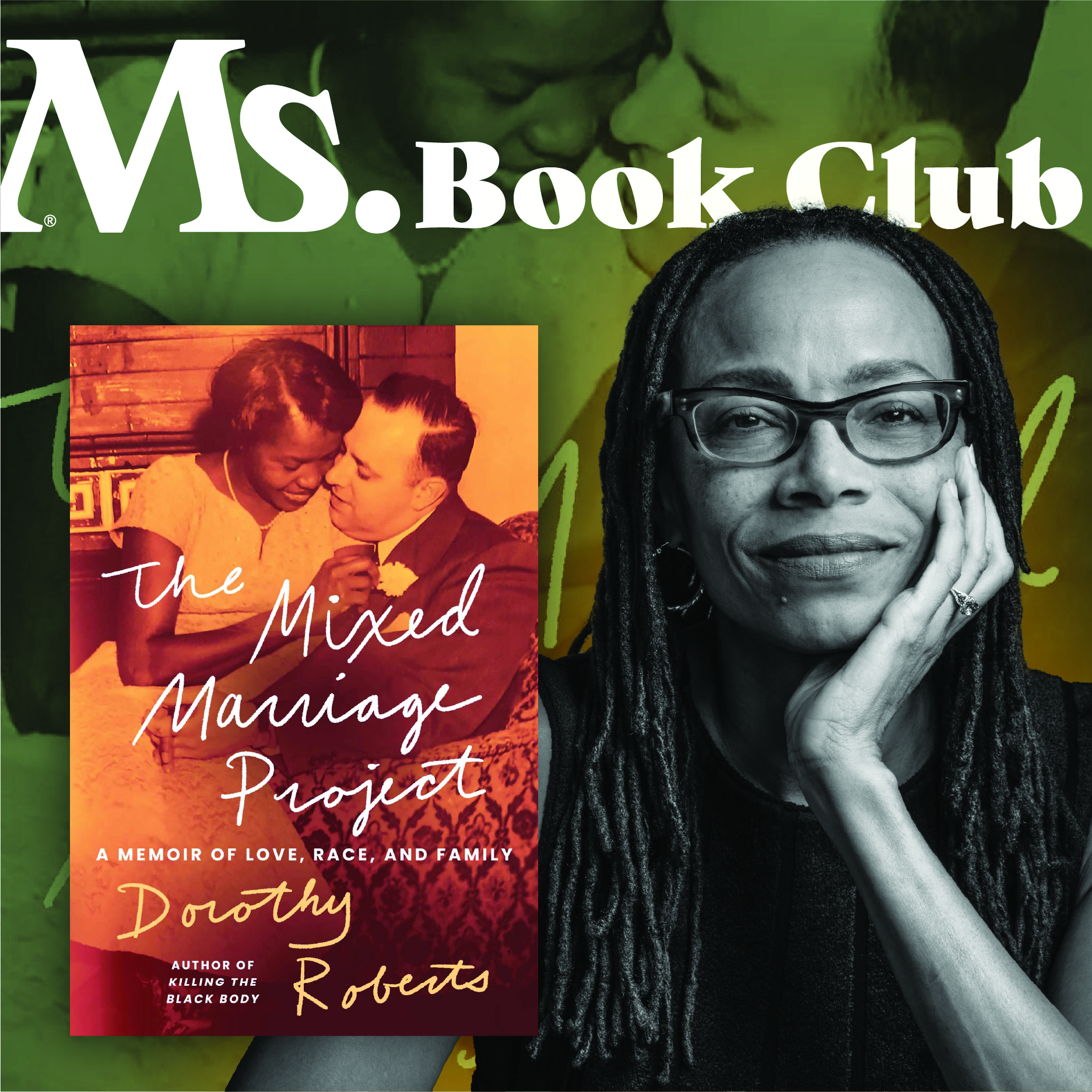
Today, we’re joined by Professor Dorothy Roberts, author of The Mixed Marriage Project, A Memoir of Love, Race and Family. The Mixed Marriage Project traces Roberts’ own childhood as the daughter of a white father and a Black, Jamaican immigrant mother in an era when relationships barely ever crossed the color line. It also follows the work of her anthropologist father, who spent her entire childhood working on a book about interracial marriages—a project he never finished but shaped every aspect of their family life.
Transcript
00:00:07
Michele Goodwin:
Fans and friends, welcome to The Book Club, part of Our on the Issues with Michele Goodwin at Ms. magazine platform. You know, we report, rebel, and we tell it just like it is.
Spring marks the launch of this special Book Club series at Ms. magazine and Ms. Studios, featuring four incredible authors, Professor Dorothy Roberts, Patricia Williams, Khiara Bridges and Keisha Blain. Their pioneering works span history, memoir, art, health, family politics, law and reproductive justice. We bring this special series together, highlighting the significant contributions of these four award winning authors, among whom are two MacArthur Fellows, otherwise known as MacArthur Genius Awardees. Their path-breaking research and storytelling showcase the hidden, forgotten, and overlooked, giving a breathtaking look at the unexamined and the under explored.
This Book Club series is one of our ways at Ms. Studios to reflect on the 250th anniversary of the Declaration of Independence through a lens that centers women and explores the experiences of Black women.
We present to you the Ms. Book Club Spring Edition.
00:01:42
Michele Goodwin:
Welcome to this episode of the spring 2026 Ms. Book Club featuring my conversation with Professor Dorothy Roberts, author of The Mixed Marriage Project, A Memoir of Love, Race, and Family. Let’s take it to the jacket.
Dorothy Roberts grew up in a deeply segregated Chicago of the 1960s, where relationships barely crossed the color line. Yet inside her own home, where her father was white and her mother a Black Jamaican immigrant, interracial marriage wasn’t just a part of her upbringing, it was a shared mission. Her father, an anthropologist, spent her entire childhood working on a book about Black/white marriages, a project he never finished, but it shaped every aspect of their family life.
She’s a great friend. I enjoyed this conversation, so very much, and I know you will, too.
So, I’m your host, Michele Goodwin, and in this episode, I speak with my good friend Dorothy Roberts about her parents, their collective research, growing up on the south side of Chicago, and picking up where her father left off.
Sit back and take a very close listen.
00:03:21
Dorothy, the book. It’s beautiful. This cover shows so much love. So, before we get to the nitty gritty of it, and this is nitty gritty, how did you choose this photo for the cover of The Mixed Marriage Project: A Memoir of Love, Race, and Family? This photo.
00:03:47
Dorothy Roberts:
Yeah, well, it’s my favorite photo from my parents’ wedding day. And you know how publishers are, they send you different design ideas. So, the first design idea was a lot of different photos. And I thought, wow, that’s the photo I like the best. It’s again, my favorite photo from their wedding day. And so, I thought, what if we just use that photo, instead of lots of lots of photos that would distract from the best one. And the art department came up with this way of adding the photo, and the title, and the colors, and all of that.
So of course, I passed it by my kids. They liked that one. So, I’m really happy, because you know, not every photo shows the warmth of the people in it. The connections. And that was clearly a candid photo that somebody snapped, you know, when they didn’t, they weren’t aware that anyone was looking at them, taken after the ceremony, at Anthropology House, where they had the reception on the Northwestern campus. And it just captures this moment of intimacy and love between them that I think is precious. So, I’m so happy that that became the cover of the book.
00:05:20
Michele Goodwin:
It’s such tenderness. And I think that this is part of the Memoir of Love, Race, and Family, because the way in which your father is looking at your mother is, it’s so beautiful. And it seems to me that, you know, part of this journey, and legacy, were just a year before the 60th anniversary of Loving, and when one looks at the arc of love in the in the United States, this is what was most taboo. This right here. That even though clearly white men were in the beds of Black women, and even Black girls, anything legitimate, anything that led to marriage, was something that was unlawful, that was banned, that was taboo. So, to see this, it’s almost revolutionary to see this of your parents, and your father looking at your mother in this way.
00:06:21
Dorothy Roberts:
Yeah, yeah. I think it is. It is very revolutionary. And I think often, as I write about in the memoir, we don’t think about relationships between white men and Black women, marital relationships, which involves a commitment, not to say it has to be marriage for two people to be committed to each other, but marriage is a form of commitment.
It’s a form of commitment. And I think we often, and this came out throughout the interviews my father conducted, that there was a demeaning of the relationships, the marital relationships between white men and Black women, like my parents’ marriage, and mainly because of this history of white men sexually exploiting Black women. But many of them twisted it to say that, well, it’s because Black women are licentious, and they don’t demand that the white men they’re sleeping with marry them. It’s their fault.
00:07:27
Michele Goodwin:
When, in fact, there are laws that explicitly ban these relationships.
00:07:31
Dorothy Roberts:
Exactly. It was very strange how that got flipped. But of course, it got flipped because of the long-standing stereotypes, and vilification of Black women’s sexuality and childbearing. And I saw those stereotypes coming out, even in contexts where there were mixed couples of Black men and white women. In fact, I write about a club that they formed, the Manassas Club, or Manassas Society, that was for interracial couples, but so many of the members of it spoke very unkindly, and disparagingly about Black women, and they were basically excluded from the club.
00:08:21
Michele Goodwin:
That is extraordinary. So, as we begin, and I’m already thinking, I want as much time with you as I can get, and if we need to make this a part two, part three, Part five, I’m all here for it. So, if you could start off by telling us about Iris and Bob. Who were they?
00:08:37
Dorothy Roberts:
Okay, yes. So, I’ll start with Bob, because he was born first. He was born in 1915 I’ve already mentioned white man born in Chicago, grew up in an immigrant neighborhood on the north side of Chicago. His father was from Wales, and his mother’s parents were immigrants from Germany. And he lived in the house with his German grandparents on the second floor, and he and his two brothers, and his mother and father, on the first floor. So, he was grew up in a bilingual, multi-ethnic home, but in a segregated white neighborhood.
And somehow, I explore this in the book, he became very interested in what he called the racial caste system. Even in college essays, I found, when he was only 16-17 years old, he was already writing about his white privilege, and contesting the professors he had, who believed in innate racial differences. I think that had a lot to do with the trip he made to India, where he lived in India with his grandmother and an aunt, who was a missionary there for six months.
But he went on to get a master’s degree at University of Chicago, and as soon as he got there, he began investigating interracial marriage, and going into the Black Belt of Chicago, because Black people, by then in the 1930s, were confined to this narrow corridor of segregated housing. A lot of you know, slum tenement housing there, and by mob violence, and other racially restrictive covenants, and that kind of thing. And he started interviewing Black/white couples. And you know, the mystery I tried to unravel in my memoir is how this white kid, basically, from a segregated neighborhood in Chicago, became so interested, not only in interracial marriage, but also in Black women, because I discovered he started dating Black women…
00:10:56
Michele Goodwin:
Because your mother was not the first.
00:10:58
Dorothy Roberts:
No, my mother was not the first. I thought she was the first. I thought he fell in love with my mother, and then got interested in interracial marriage. And I’m discovering, you know, a party where he brings not one but two Black women to the party.
And as far as I can tell from his notes, and you know, everything I know about him, he only dated Black women. He doesn’t mention dating anybody else. Now I don’t know the full story. I just know the notes that he wrote in the interviews he conducted. So, maybe he emphasized the Black women he was dating. I’m not sure, but it seems to me, he definitely had a preference for Black women. And he mentions, you know, my mother was a dark-skinned Black woman. He mentions the dark skin of women he’s dating.
So, I’m not sure exactly how that all happened, but it did happen. It did happen. Anyway, he went on to become a professor at Roosevelt University in Chicago. And while he was an assistant professor there, my mother came to Roosevelt.
Now she has a very interesting background story, too. She was born in Jamaica in 1922, and she grew up there. She went to a British school, free school, that was established, but you had to be, you had to take a test to get in. And she got in…
00:12:36
Michele Goodwin:
You had to be very smart.
00:12:37
Dorothy Roberts:
You had to be very smart. She was, yeah, and she always boasted about this education she got, how much better it was than what we got Chicago public schools, you know.
But she left Jamaica when she was 25, with her older sister, my aunt Violet, to travel to Liberia. And they became Liberian citizens. So, actually, when I was born, my mother was a Liberian citizen, and she lived there for a couple years, and then learned from a visitor about this scholarship to Roosevelt, where my father taught, and went to Roosevelt. Left Liberia, went to Roosevelt, met my father there, and they began, both dating, it’s kind of unclear, dating and doing research together, in the 1950s, and then they got married in 1954, and I was born in 1956.
My mother also was working on her PhD at Northwestern, when I was born, which I also think is pretty remarkable. And she gave it up when I was born, and my sisters, who are twins, came just a year and three months later. So, she had three, three kids in diapers, taking care of, and…
00:14:08
Michele Goodwin:
He had a lot going on within that period of time, and so much that this relationship with your father, he’s doing this research.
If I could just take one moment, just for our listeners, because it wasn’t as if you knew your father was always involved in this research. This was a discovery for you. Can you tell us a bit about how you came to discover this, and how long it took you before you began reading his papers.
00:14:41
Dorothy Roberts:
Yeah. So, I knew that my father was doing research on interracial marriage when I was growing up in the 1960s, in Chicago. You’d have to know it, because it really dominated our family life. He was working on the book up in his study on the third floor of our house.
00:15:01
Michele Goodwin:
Don’t bother me there. There’s the book. The book is happening on the third floor.
00:15:04
Dorothy Roberts:
Exactly. The book. Don’t bother Daddy. He’s up on, you know, he’s working on the book. I knew that he was going out to interview interracial couples, because many of them became friends of our family. So, my piano teacher, the family plumber, my parents’ best friends, were all interracial couples. And so, I absolutely knew about his research.
He also talked to me a lot about his research, trying to convince me that interracial marriage was the answer to racism in America. And so, I was absolutely aware of that. But I thought, again, I thought it started when he met my mother, and all this research was going on in the 1960s. So, when my father died, my sister packed up all his papers. You know, he had, he taught at Roosevelt from the late 1940s, all the way to the 1980s, so he had a very long career. And he was a meticulous note taker, and kept, you know, lots of papers.
So, she sent me 25 boxes of his papers, because I had…
00:16:24
Michele Goodwin:
Did you want those, as between the siblings?
00:16:28
Dorothy Roberts:
Yeah, I guess I wanted them. I didn’t, you know, I’m the professor among us. And of course, I wanted his papers. I just was too busy to look at them, so I just put them down in my basement. You know, I was writing my own books, I didn’t have time to look at his attempts at writing a book, because despite all that went into it, he never published this book.
So, yes, of course, I wanted the papers, but I just didn’t have time. So, what happened is, I was living at Northwestern, teaching at Northwestern, living in Evanston, when the papers arrived. I just put them in my basement. And then, when I got a position at University of Pennsylvania in 2012, I decided to have the papers all shipped to my sociology office. I was fortunate to have two offices at the law school at sociology. So, I had this extra office. And instead of putting more boxes in my basement…
00:17:36
Michele Goodwin:
Can I read from what you did? You say, so, it was that the boxes containing my father’s papers stayed stored away in my sociology office throughout the fall and spring semesters, while I spent most of my time working from my more comfortable office in the law school. When summer arrived, I finally had the time and emotional fortitude to deal with it.
00:18:05
Dorothy Roberts:
Yeah, yeah, yeah.
00:18:08
Michele Goodwin:
So, Dorothy, on that note, it does take, sometimes, an emotional fortitude. Can you describe what that was like for you, what you anticipated, which might have kept you away a little bit? I mean, you were writing your fabulous books, award winning books. You are a MacArthur Genius, after all. So, you were doing things. But at the same time, it strikes me, that there is a weight that can come, and as I mean weight, as in the heaviness, that can accompany looking to the past, looking to a relative’s papers, that there, it takes an emotional energy. So, can you tell us a little bit about what that was like confronting the boxes?
00:18:51
Dorothy Roberts:
Yeah. Well, I decided after the boxes were taking up my whole sociology office, I should at least look inside them, and when I looked inside them, I discovered that my father had been conducting these interviews from the 1930s. The first one I found was dated February 19, 1937.
Now I’m telling you this to explain the weight on me, because this completely upended what I thought I was going to find. I thought I was going to find the interviews my father conducted in the 1960s. I had no idea, until I pulled out that interview that he had been conducting this research from when he was 21 years old. And so, that added an extra weight, because I had to now figure out the meaning of that, the significance of that, for my family, and me.
And so, it was a combination of, oh, my goodness, I’ve got all these interviews from the 1930s. I’m so excited to read them.
00:20:05
Michele Goodwin:
You say that you were awestruck.
00:20:07
Dorothy Roberts:
Awestruck, absolutely awestruck. I don’t know that there is any other kind of source like this, of interviews of Black/white couples, hundreds of them, from the the 30s…
00:20:22
Michele Goodwin:
Probably some people who presumed that they didn’t exist at all.
00:20:27
Dorothy Roberts:
Exactly. Exactly. Well, that was, do people realize, even people who studied the Black Belt in Chicago realize that there were all these white people living in the Black Belt, you know. I mean, that struck me. I never thought about that before, and I’ve read lots about the Black Belt in Chicago, but the idea that the spouses of Black people who were white had to live there, too, you know, that hadn’t sunken in.
So, there was all of that, you know, in addition to the memories. When you go through papers, this is one reason why I, and I think many people, put off going through the old photographs and the papers, because you pause over each one, because each one brings back all these memories. You’ve probably had this experience, too, Michele, where you find some old photographs, like an old photograph out you can’t just flip through it.
00:21:25
Michele Goodwin:
No, you can’t. No, you can’t.
00:21:29
Dorothy Roberts:
It takes hours sometimes, right?
00:21:33
Michele Goodwin:
Yeah. The content and the context, right? So, you are writing about a story, you’re capturing a story that also is layered in Jim Crow, layered in segregation, and just what you said, which is that so many people would not know that there are white people living in the Black Belt. And that would, perhaps, not be anything critical to make a note of save for its Jim Crow. Save for there are states that literally forbid this, save for the fact that people get punished for this. So the fact that there are white people and these couples that are saying, I will defy what is, you know, what is the national norm? I’ll defy what happens to be the sort of language, the mystery of this country where, you know, we’re talking about people threatened with losing their jobs, being lynched, all these things to try to live with dignity amongst Black people.
I mean that, to me, is also part of being awestruck. I mean, there’s so many layers to this, but they’re not doing this within a space where people are saying, good on you, great that you’re breaking through these racial barriers. We celebrate this. It’s not that.
00:22:52
Dorothy Roberts:
Not at all, not at all. And let me just add one thing that’s also remarkable. This was Chicago. As my father said when he conducted these interviews, I’m investigating whether there’s a racial caste system in Chicago, like the one in Natchez, Miss. He believed that there was. I mean, he actually wrote in his master’s thesis that the taboo in Chicago, even though it was legal to marry across racial lines, had a very similar effect to the Anti-Miscegenation Law in Mississippi, and Virginia, and Alabama, and other southern states, because these couples had to endure and resisted all sorts of punishment for their marriages.
You already mentioned losing your job. They couldn’t, the white women couldn’t give their correct addresses, because if they did, their employers might say, wait a minute, that’s the Black Belt. And the assumption would be, you know, why would you be living in the Black Belt, as a white person, unless you were married to a Black man, and so they would be fired, immediately. And the women tell about all the times they were fired when they were found out where they were living. There were just so many.
Another one that’s really striking is a couple, or maybe more, of the white women say the problem came when I had to be in the hospital because my husband couldn’t visit me, because then either they would treat me poorly in the hospital, or they would report me to my employer, and I’d lose my job or, you know, reveal to relatives, or something. This was a secret that these couples kept because it was so taboo.
And even white men, this is another thing that was remarkable to me, even white men who own property in Chicago had to sell their homes when they married a Black woman, and move into the Black Belt. And one man talks about how, when his white wife died, he married a Black woman, he owned a building in Chicago, and the hoodlums came by, throwing rocks at the building at night, and he was forced to move into a Black neighborhood to protect his wife, and himself, from this violence. So, there was just so many levels of discrimination that the couples told my father about.
00:25:39
Michele Goodwin:
Dorothy, you have a chapter here, Finding Manasseh. So, you devote, and here, you know you start the chapter, Dr. Andrews, March 1, 1937, shortly after meeting with the Alberts, you say that your father walked into the South Side office of a physician named Dr. Andrews, a dark-skinned Negro of medium height, and with thinning Negroid hair who sported a small mustache. When my father told Dr Andrews that he was interested in quote, “a club”, which I understand had been formed by white and Negro couples who were intermarried, the doctor gave a helpful response. Yes, it is called the Manasseh Club, he replied, correcting my father’s Manassas pronunciation and spelling. That isn’t anything new. You mentioned just a little bit ago about this club. This club becomes very important in the story of intermix interracial marriage in Chicago. I’m wondering about your parents’ experience with regard to this club.
00:26:53
Dorothy Roberts:
Well, the club actually had disbanded by the time my parents were married. But the reason my father was so interested in it was, largely, because he knew if he could find a roster of its members, he would be able to be interview them. So, he again, remember here, here’s this 21-year-old trying to find interracial couples in the Black Belt of Chicago, couples who many of them were hiding their marriages. How do you find these people?
I mean, this is one of the miracles of my father’s study. He ends up interviewing over 500 couples over the course of his study, and at the very beginning in the 1930s, he had to devise all sorts of ways of even identifying them, locating them, getting them to talk to him. So, one was, if I could find the people who are members of this club, that’s a way I can identify interracial couples and interview them. I think he, also, had wanted to be a member of the club, but of course, he couldn’t have been a member because he’d have to already be married to a Black person.
00:28:09
Michele Goodwin:
Yes, and he wasn’t.
00:28:10
Dorothy Roberts:
And he wasn’t, but he, from the way he responds, it’s clear that he has in mind already marrying a Black woman. But so, the club, it turns out, you know, was very disturbing in the end, for me, because even though for the members, they found it to be a refuge from all the discrimination they endured in Chicago, and also a place where they could get together. They had balls. They had a cemetery plot where they their members could be buried because of the issue of segregated cemeteries that would…
00:29:02
Michele Goodwin:
Right, which people don’t even know about, like even in death, segregation.
00:29:04
Dorothy Roberts:
Exactly, exactly. And so, they found this a very helpful club, but my father discovers that almost all its members were white women married to Black men. And as I mentioned, the way that they explained it, you know, the white women explained this exclusion was, well, we don’t really like colored women, because their morals are loose, you know. And the evidence their morals are loose is they sleep with white men, and don’t demand that the white men marry them. In fact, this doctor, the very doctor that you you mentioned, said, well, if Black women, you know, he uses the term, colored women. And by the way, those terms, I’m quoting, the terms that were used at the time. And you know, if colored women would demand that white men put a ring on their finger, he uses that language, white men would become the biggest promoters of interracial marriage.
00:30:09
Michele Goodwin:
Like Beyoncé of the 1930s, right? But to your point, I will read the following passage. You say that one white wife candidly explained, quote, “most of the Manasseh women don’t want to have anything to do with colored women.” End Quote. She attributed the rarity of interracial marriages among white men to her own prejudiced belief that, quote, “the morals of colored women have been looser. They don’t have to marry them.”
Wow, and you say she wasn’t the only one to blame Black women for white men’s reluctance. Quote, “colored women especially are prejudice. They don’t like intermarriage, and yet they will have all sorts of white men,” stated another white woman. You know, it reminds me of the narratives that I’ve read out of the diaries of white women during the antebellum period when white men are raping the girls and raping the Black women. And you read in these diaries are these women, the white women who own the homes, are blaming the women, saying, well, if they just wore more clothes, as they’re out in the fields picking the cotton. And of course, this is the clothing that they’re providing.
00:31:40
Dorothy Roberts:
Exactly.
00:31:40
Michele Goodwin:
You see all of this bitterness and contempt, and it seems that centuries later, your father’s capturing it with regard to interracial marriage. Not much had changed.
00:31:55
Dorothy Roberts:
Yes, yes and centuries later, but also not that long as some of the people, the Black people my father interviewed, were born shortly after the end of slavery, and had parents who were enslaved. So, because he was interviewing couples in the 1930s, but some of them had been married in the late 1890s.
00:32:25
Michele Goodwin:
Well and Dorothy, if I could, just to wrap that that thought up, you right here, as if, well, just two things. I’m sorry. So, this is another one, this woman, I guess, named Mrs. Weld, saying that, many dark colored women have light babies, and don’t think anything of it. They like to have light children. And then you say, you write, as if her disparagement of colored women wasn’t enough, she went on to bemoan the greater affliction that white women endured. Quote, “who are the slaves of the South?” She asked dramatically. Her answer, quote, “a white woman and a colored man.”
00:33:13
Dorothy Roberts:
Yes, yes. They just…and the nerve that she has to say that it’s Black women who like light children. When many of the white mothers in the Manasseh Society wanted to have light children, and they married lighter skinned Black men, hoping that the children could pass as white. One woman says, similarly, our children have it worse than the full colored children. And my father questions that, and she says, well, because they don’t know that they’re colored, and then when they find out that society thinks they’re colored, it’s a terrible, distressing reality. And she says, oh, we had to tell our children they were colored, and it was terrible.
Just imagine that they’ve told their children, you know, you’re different from Black, you know, from full, as they say, full colored children, and then they find out that they’re treated like full colored children. And again, instead of blaming a racist society for that, they blame the inability of society to see how special, you know, their children were. And actually, there’s some Black men also who boast about how light their children are and they’re you know, I have a whole chapter called passing, because passing came up so much in those interviews in the 1930s. There was clearly among, not all of them, but among a significant number of people my father interviewed, a desire that their children would be able to pass.
00:35:06
Michele Goodwin:
Well, you know, when you read what were some of the comments of the intermixed couples where there were white women with Black men, it seems that that was pretty significant on folks mind to have lighter, complected children, and then if they could, be able to seamlessly weave their way into a white society, and not with the desire to dismantle the systems of oppression, or dismantle the racism embedded in law, but instead to just pass right on into it. And that’s a sadness.
I think, that that, you know, when, when thinking about what your father was capturing, you know, there’s this incredible, you know, beauty to this, these couples coming together, but also there’s something that’s also painful, in those that are looking to keep the systems, or not necessarily looking to keep the systems the same, but pass right into them.
00:36:09
Dorothy Roberts:
Yes. Oh, absolutely. There are so many examples of that, and it it brings to the fore, one of the aspects of these interviews is that there was no uniform approach to interracial marriage among the couples.
You know, there were some who did, bravely and courageously, cross the color line, the so-called Color Line, and the white spouses became part of the Black community where they were forced to live, but they didn’t begrudge it, you know. They accepted their community, and some fought against the racial hierarchy in Chicago, especially in the 50s and 60s.
But there were also those who whose marriages didn’t at all contest the racial hierarchy. I mean, they may cross this color line, but they weren’t trying to contest the hierarchy there, and they even thought that their children were better, you know, innately better because they had white ancestry.
I mean, so some of them talked about white, but there’s even a couple called the Everett’s, a Black woman and a white husband, living in the Black neighborhood, but they had a very nice house, and they owned a lot of property in the Black Belt. And the husband talks about how light-skinned Black people have a special pedigree, because it was mostly plantation owners that raped their, you know, enslaved women. And so, they actually have, you know this extraordinary pedigree, which his wife has, because she knows that her mother was raped by her father, and yet, she has this high regard for her father because he owned all these plantations in Louisiana, Mississippi and Tennessee. And at the end of the interview, my father asks if she would marry a, you know, a Negro or colored man, as she first says, no, I wouldn’t. And then she says, well, maybe if he was light. And then the the husband, Dr. Everett, says, well, I would not marry someone as dark as her mother. So, oh, this couple was a trip. I could not believe the things that they said and they were an interracial couple.
00:38:58
Michele Goodwin:
Right, living and dealing within all of these kinds of complexities. And what’s so brilliant about your book, and fascinating about your parents’ research, work that your dad was doing, and then, your mother, also the two of them doing interviews, is that it it just puts it out there, right? It’s pure law in society. It’s pure sociology. Like there it is. We get this window into the complexities of intermix, interracial couples at the time, where white women have a certain perspective of Black women that seems to linger back to the throes of slavery, and that even in some instances where you have Black women who, you know, see this as some form of cachet that you know, and cachet that may translate for their children in this, and the sense of also a bit…how would you describe it, Dorothy? Would you describe it as a bit of self-hate? Some of it. Like when you when you read about Black folks that…
Dorothy Roberts:
I ask about that whenever I see this desire to be whiter, you know, for their children to be whiter, or to want to date someone because they are white, and at the same time, reject Black women.
So, there’s an interview that my father conducts in the 1960s, with a man he calls, and by the way, these are all pseudonyms he made up for these people, Mr. Sussex, who I believe was my piano teacher, and Mr. Sussex talks about how, once he discovered he could date white women, which he calls forbidden fruit. He says he has an appetite for them, and they have an appetite for him. Those are his words. He stopped dating Black women. So, to him it wasn’t that, oh, okay, I can date white women. Now I have a broader spectrum of women I can date. It was, oh, I can date white women. So, I’m going to stop dating Black women. They’re no longer attractive to me because they’re just ordinary, whereas the white women are, as his words, forbidden fruit, so that makes them more attractive.
And I asked myself, you know, in the memoir, what did he think about himself then, as a black man, his mother, his aunts, his female relatives, who are Black. What was that saying about them? The Black men who were married to white women in the Manasseh club when they went to events, and they didn’t see Black women there, what did they think they must have known they were excluded. Did they think, well, they’re excluding a part of my own identity. And I just wonder. I don’t know.
00:42:09
Michele Goodwin:
It’s complicated. You know, your book opens the door to a conversation about these taboos, and what you’ve done throughout the arc of your career is to challenge us to deal with our histories, to challenge us to deal with how law is so deeply entangled in our histories, and what this means in terms of society, and also culture, and this work that your parents were doing and and, by the way, just as a side note, how interesting it is that your parents, what they birthed into you. It’s just like you are the one that completed the books with an S on it, right?
00:43:00
Dorothy Roberts:
Of course, of course. Yes, birth, it to be. It’s part of the lessons they taught me, which is something that I appreciated so much more in writing this memoir. You know, I knew they were very influential, but their influence, I realized, was even greater than I thought, because the way that I do my research, the issues I’m interested in, all of that. I hadn’t really thought…
00:43:31
Michele Goodwin:
You’re in a sociology department.
00:43:32
Dorothy Roberts:
Exactly. And you know, unfortunately, my parents both had died before I got that position at University of Pennsylvania, but my mother did see me get a position at Northwestern, where she had been doing her PhD work, and gave it up. And believe me, she was praising the Lord. This was divine intervention. And I got a position, even though it was in the law school, and not in the anthropology department. She was…
00:44:07
Michele Goodwin:
But there it is. But you know, given these raw honesties that you have in the book, that’s part of their research, actually reminded me, and I was just talking with a friend not long ago about an experience in college.
And this experience in college was, you know, University of Wisconsin, 43,000 students, but it had 741 Black students, including international. Remember those numbers. And there was this forum that almost seemingly like an emergency forum that was called, and it was about these questions with regard to dating. And I’ll never forget, and I sat in the back, and it was in this huge auditorium, and I’ll never forget, I think it was called by Black women who were concerned about Black men, not wanting to date them, you know. And this, you know, can matter on a college campus, when people are looking to, you know, find friendship, intimacy, etc.
And I remember one of the attendees, I think he was a football player, and he stood up and he said something to the effect of, we don’t want to date you, Black women, because we don’t like you. That part I forget, but I remember the response of Black women who were there who had called this, right. I wasn’t part of the group that called this. Frankly, I believe love conquers all. Find the people that will love you, right. So, these Black women who are just pressed hard for these Black men to love them, really pressed hard. And then, when he stood up and said, this guy, that we just don’t like you. And I just remember, everything exploded after that. Black women who who called it, they were crying, they were upset, they were angry, all of those things. But I remember feeling so hurt for them, you know, so hurt for them, because they felt locked in, and they saw that only, you know…any anyway, it just reminds me.
00:46:10
Dorothy Roberts:
Yeah. Well, it’s an interesting, very emotional, very political, very complicated question, I think because of these histories, and so, you know, I write after feeling very angry at Mr. Sussex, for what he said about forbidden fruit, and not wanting to date Black women…
00:46:33
Michele Goodwin:
Piano teacher.
00:46:37
Dorothy Roberts:
Yeah, I couldn’t find them attractive anymore. You know, I think it’s, that feeling is not that…anyone, no one, is entitled for someone else, to love them, or even find them attractive. You’re not entitled. But I think we do have to ask, if you exclude a whole group of people as potential, potentially attractive, because of stereotypes about them, or because of some, you know, political inequality or hierarchy, that’s very different.
And so, you know, ultimately, I don’t think we can even think about what it means to love across racial lines without taking this history into account and figuring out, how can we truly love each other as equal human beings, as you said, Michele, how can we just love somebody because we like, l we do, because we like them, you know, or because we find some connection with them that doesn’t rely on racial stereotypes, or racial hierarchies. How can we do that? That’s the ultimate goal, I think, to figure out how to love each other truly, you know, as equal people in a society that’s so seeped with racism and racist stereotypes.
You know, and of course, my concern has always been with Black women. You know, how do we get rid of these long-lasting negative stereotypes about Black women, especially when it comes to our bodies, our sexuality, our childbearing, which…you know, it’s so hard to say, how does that not get implicated in our relationships?
00:48:48
Michele Goodwin:
And it’s centuries long, Dorothy, you know. It’s your work, from Killing the Black Body to Torn Apart, just chronicles all of that in every kind of way.
So, Dorothy, I’m wondering, then, with this journey, what was this journey like for you, in going through your parents’ papers, your dad’s notes, the boxes? What was that experience?
00:49:18
Dorothy Roberts:
Yeah, well, it was mostly a very enjoyable experience, because I love my parents deeply, and just to be able to…
00:49:30
Michele Goodwin:
You even called your Kenwood home magical, a magical space.
00:49:33
Dorothy Roberts:
Yeah, it was magical. Just the physical details, like centric details of it, but even more so, the love and caring that my parents had for me and my sisters, and the messages they taught us.
So being able to read these papers I’d never read before where both my parents have their notes, their personal notes, their feelings, their reactions, interspersed in the interviews, that was just so deeply meaningful for me, and made it so enjoyable.
And also, I had to grapple with my feelings for my father. For my mother, it was mostly just the joy of unexpectedly, finding her voice throughout the interviews. Because I didn’t know she was conducting these interviews in the 1950s. I just thought this was my father’s project. So what a treasure to find my mother’s voice, which was so delightful in her notes, in the interviews. My father was more complicated because I had to grapple with this file that he kept on me, which I discovered, where he put in it, an essay I wrote largely about him, a paper I wrote in college, and a letter that he wrote to me about children, born to interracial couples, and it reminded me of a period I went through in college where I didn’t want anyone to know my father was white, and I deliberately hid any information about him. I didn’t talk about him. I’d let people assume my father was Black, and wouldn’t correct them, even if that was significant to what they were saying.
And I once, I didn’t lie, but once in a class, we were supposed to identify the ancestry of everyone in the class. It was an ethnicity course in sociology, and my freshman, my first year of college, and this white guy said, I think she’s got some European ancestry, you know. And then everybody turns to me, is that true, Dorothy? Of course, most Black people have some European, right. But anyway, all that wasn’t, you know, a lot of that information wasn’t available.
00:52:24
Michele Goodwin:
You can still recite, and I read it right here, you’re like, in German, certain things from your childhood, but there you were, looking over your shoulder, like, who? Who me?
00:52:35
Dorothy Roberts:
I know. So, what I said was, I have a German grandmother, but I’ve never met her. Okay, that was true. I do have a German grandmother I never met, but obviously, I was hiding the fact that my father was white.
Now I don’t feel, obviously, I don’t feel that way anymore. I’m writing a whole book that’s mostly about _______ 00:52:55, but that was a college experience, because I had joined this very close-knit group, immediately upon getting to college, of Black students, and I was afraid that if they knew my father was white, that somehow would interfere with my connection with them. Again today, I think that I, you know, I think that’s ridiculous. I can still feel the knot in my stomach when this white student, you know, outed me, but I…so I feel it, but I don’t recognize it, you know, as being a rational fear.
But I had to grapple with that, and the fact that even in much of my academic career, I shied away from my own identity as I, the way I describe it is, I’m a Black woman with a white father, and so I had to, you know, grapple with all of that. I write at the end I wish that I could slip a new message into that file for my father. If I could just go back in time and add, you know, I appreciate you so much. You’re part of me. You taught me so much. You loved me so dearly. I love you so dearly. You know, I think I, at the end of writing this memoir, I reconciled with the fact that my father, as much as my mother, both contributed to the Black woman I am today, and I I don’t want to have to hide that.
You know, I’ll tell you something I once, on Instagram, I wrote something about my memoir, and somebody wrote, no, you are not Black because you have a white father. I thought, okay, you can’t tell me. I didn’t respond. You know, sometimes on social media, it’s better not to respond because you get dragged into a back and forth. But I have come to a point where I believe I can identify as a Black woman, which I do, and also acknowledge that I have a white father, and acknowledge all that he contributed to the woman I am today.
00:55:38
Michele Goodwin:
Yes. Dorothy, I can’t find a better way for us to bring this interview to a close, save that there’s this short passage. It’s very, very short, that I want to read, that is about your father. And you say, still, when I was growing up, I had the impression that I had a closer relationship with my father than my friends had with theirs. In a letter Daddy wrote to Drake, dated June 20, 1956, when I was three months old, he complained of having difficulty concentrating on revisions of his dissertation. When and this is a quote, “whenever Iris goes out for lunch or shopping, I’m kept busy by the baby who doesn’t want to be left alone. She insists that Daddy hold her.” And I think that, and he’s talking about you.
00:56:39
Dorothy Roberts:
He’s talking about me interfering.
00:56:43
Michele Goodwin:
I mean, yeah, but you know, it seems like he’s also doing so as it’s a happy excuse. It’s a good excuse. Yes, that this baby wants him, and he wants this baby, and I think you are absolutely right. It’s written all over you, Dorothy, that this beacon that you were realized as, the aspiration that is held within you by so many, all of whom recognize the power of your voice as a Black woman and scholar, and so much more brilliantly, was also infused by who your father was, and what grace and support he gave to you for who you wanted to be.
00:57:31
Dorothy Roberts:
Yeah, yeah. That’s so, so true. I was so blessed to have these two remarkable parents who found each other, loved each other deeply. Stayed married for almost 50 years. They worked together for 50 years, a real blessing, and I’m so grateful that I could write about it in my memoir. I decided, I’m not going to write the book my father never finished, just about the couples. I want to write a book that tells the stories of the couples they interviewed, but focuses throughout on their story, and all that they contributed to me throughout my childhood, and as long as as they were alive so, and continue to now, in the papers that they left behind.
00:58:27
Michele Goodwin:
Well, and I can’t think of a better way of giving honor to them than what you’ve done with this book, The Mixed Marriage Project, A Memoir of Love, Race, and Family. It’s a beautiful book, a beautiful family. And thank you, so much, for spending time with me to talk about this wonderful memoir.
00:58:49
Dorothy Roberts:
Thanks, so much, Michele. I really appreciate it, and thanks for all your friendship, and support, and your brilliance.
00:58:57
Michele Goodwin:
Thank you, so much, Dorothy.
Fans and friends, thank you for joining us for this special Ms. Book Club spring edition. Be sure to check out the other books and authors that are being featured. The MS Book Club is a special feature of our Ms. Studios platform. Our executive producer is Michele Goodwin. Our producers are Allison Whelan, Roxy Szal, Oliver Haug and Mariah Lindsay. Our sound engineer is Natalie Hadland. Art and Design are by Brandi Phipps. Our assistant producer is Emerson Panigrahi.
About this Podcast
Welcome to the Ms. Book Club! Join authors as they delve into feminist books exploring topics ranging from the child welfare system to human rights to the intersections of race and the law.