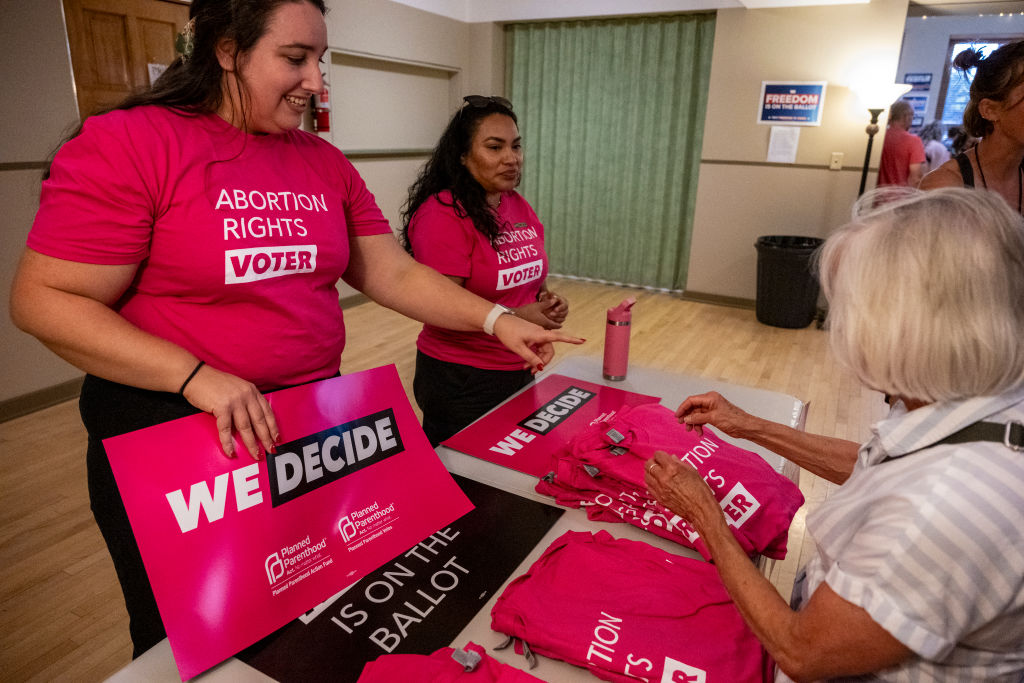
On Nov. 5, 2024, Montana voters decisively approved a ballot initiative enshrining the right to abortion up until fetal viability (about 24 weeks gestation) in the state Constitution.
On Monday, Feb. 24, Montana Republicans introduced a radical antiabortion “trafficking” bill that would have made seeking an out-of-state abortion after viability, or simply helping someone get one, a felony. Idaho and Tennessee have already criminalized the “abortion trafficking” of a minor in an effort to prevent them from accessing (legal) out-of-state abortions, and a handful of municipalities (mainly in Texas) have made it a civil offense to use local roads to access (legal) cross-border abortion care. But Montana’s proposed law would have broken new ground: Adding another level of state surveillance and control, the trafficking law would have made it a crime for a pregnant person to “transport an unborn child” across state lines “for the purpose of procuring an abortion” that is illegal in Montana; namely, a post-viability procedure. (As Jessica Valenti writes, “By only targeting those seeking post-‘viability’ care, Republicans get an easy messaging spin: ‘We’re not stopping women from leaving the state—we’re just ending “abortion up until birth!”‘) It would also have criminalized aiding or assisting “another person in transporting an unborn child,” presumably by driving them to their abortion appointment or perhaps even by filling the tank with gas or making sandwiches for the road.
Late on Thursday, Feb. 27, after intense and emotional committee hearings, eight Democratic lawmakers joined eight Republicans on the House Judiciary Committee to vote down the bill, HB 609. Four Republicans still voted in support of it.
“I think we need to address abortion in a wide variety of means,” said state Rep. Tracy Sharp, the Republican lawmaker who moved to table the felony abortion bill. “But some of these bills that we’ve been bringing up here, I just have to admit, I’m really uncomfortable with.”
“I’m thrilled that Montanans don’t have to worry about this bill—for now,” Valenti warns. “But everything that happened this week is a warning sign that we’re going to see more legislation like this. … HB 609 was just a warning shot. … That’s why every time one of these bills come up—no matter how unlikely it is to pass—we need to make as big of a fuss as possible. We need to make sure they know that we’re watching.”
Fetal Personhood Ballot Initiative
State Rep. Lee Deming (R) is still seeking to place a fetal personhood ballot initiative before voters in 2026 that would define legal personhood as starting at conception, thus presumably entitling a fertilized egg to equal protection under the law. Claiming that voters were confused when they voted in favor of constitutionalizing the right to abortion, he supports his initiative with the explanation that there is no “material difference” between abortion and “us[ing] a bullet to kill all those people 70 or older … since they’re generally a drain on their families and society and some are inconvenient to have around.”
Deeper Analysis of the Now-Tabled Extreme HB 609
Before the bill was tabled in committee, Martha Fuller, CEO and president of Planned Parenthood Advocates of Montana, condemned HB 609, calling it “an extreme criminalization of abortion seekers and their family members and others who support them. … This fall, Montanans overwhelmingly voted to protect our right to make personal medical decisions about abortion. When the response to that vote is the introduction of a outrageously draconian law seeking to criminalize those very decisions, it demonstrates how out of step with Montanans this is.”
In addition to being out of step with Montanans, this bill combined some of the most dangerous legal trends in the national post-Roe reproductive ecosystem.
Let’s start with the underlying premise that one can “traffic” a fetus. As Texas resident and rabid antiabortion extremist Mark Lee Dickson, the driving force behind the municipal travel bans, argues in support of these efforts, “The unborn child is always taken against their will.’” However, the notion that an unborn child can be taken “against their will” denotes that they have a will that can be overtaken. This, of course, leads ineluctably to the assumption that the unborn trafficking ‘victim’ is a legal person with enforceable consent rights whose permission must somehow be obtained before heading out on the road.
As I wrote in an earlier article, the idea of a fetus having a will that must be honored opens up the proverbial can of worms. Does this mean that a pregnant person must somehow consult with the fetus and secure its permission before engaging in conduct that might potentially present a risk, such as going skiing or indulging in that extra cup of coffee on the weekends? (Although seemingly absurd, this is the fraught landscape of fetal personhood at the core of Montana’s proposed trafficking law.)
A second alarming feature of the (now-tabled) Montana bill is that it would have punished abortion seekers as criminals for obtaining legal abortion care in another state. This is a significant departure from existing criminal abortion regimes that currently exempt pregnant persons from prosecution based largely on the view that women “are the innocent victims of a rapacious abortion industry which coerces them into killing their unborn children.”
The call in Montana’s bill to treat abortion seekers as criminal traffickers signals the growing influence of abortion abolitionists. Once “considered an extremist fringe of the antiabortion movement,” this male-dominated ideological faction renounces the “’heretical teaching … that women should be allowed to kill their own children with immunity and impunity because they themselves are victims of abortion,’” and demands they instead be punished as murderers. In some states, this would mean the death penalty. Although that is not being called for here, a shared ideological belief regarding the culpability of those who choose abortion drove the Montana trafficking bill.
Also concerning is the fact that by targeting post-viability abortion (since pre-viability abortions are permitted in Montana), the proposed law implicitly gave credence to the Trumpian false claim that wild-eyed “Democrats support ‘abortions after birth’ and ‘executing babies.’” However, third-trimester abortions are exceedingly rare and are sought in response to hardships, including “medical concerns such as fetal anomalies or maternal life endangerment, as well as barriers to care that cause delays in obtaining an abortion.”
By casting those who seek abortions late in pregnancy as the criminal traffickers of their unborn children, this extremist measure advances some of the most dangerous ideological convictions driving the antiabortion movement as a whole.
Montana lawmakers must respect the will of the people who voted to protect abortion as a constitutional right, rather than attempt to enact laws that elevate a fetus to the status of a legal person with enforceable consent rights while redefining abortion-seekers who obtain cross-border care as criminals deserving of punishment meted out by the state.