Forget the ‘Manosphere’—The ‘Meno-Sphere’ Is the Voting Bloc With Real Power

A recent report from centrist think tank Third Way predicts many of the “swingy, moderate, low-propensity young men” who supported Trump will sit out the midterms this year.

So who should progressive political strategists and hopefuls turn their attention to? The oft-forgotten, invisible aging woman, or, what we like to call the meno-sphere.

There are many good reasons to prioritize the electoral and mobilization potential of women over 50. Back in 1992, The New York Times published a piece called “Mighty Menopause,” which posited that the then-rise of Baby Boomer women in politics was a direct result of hormonal shifts and that the “biological changes wrought by menopause” ultimately bolster women’s “interest in power and increase their ability to use it.”

If ever there were a moment to prove that to be true, it’s now—as our daughters’ and granddaughters’ rights are rolled back, as communities are terrorized, as the power elite’s willful alignment with the rot becomes clearer by the day.

In Iran, Iraq and the U.S., Women Speak Out Against State Repression

Internationally acclaimed Iranian human rights attorney and women’s rights advocate Nasrin Sotoudeh has been arrested by the Iranian regime. Her whereabouts are currently unknown. Our hearts are with Sotoudeh and her family, including her husband Reza Khandan, who has been detained in Tehran’s notorious Evin Prison since December 2024 for supporting her work for women’s equality.

Meanwhile in Baghdad, an American freelance journalist has been kidnapped. Shelly Kittleson, who had built her freelance career reporting from the Middle East for years, is known among colleagues for her determined, on-the-ground reporting and willingness to go where others would not. On Tuesday, she was taken by two unknown men, after learning of threats to her safety from militias. 

Time and time again, it is women who speak out in the face of state repression—whether they are doing so as journalists speaking truth to power, lawyers fighting for the rights of the oppressed, or everyday women taking to the streets in defiance of regimes that seek to strip them of their autonomy and human rights.

I Want to Be Obsolete. Instead, I’m Afraid to Teach.

I want to be obsolete. I want to walk into a classroom full of students excited to learn feminist histories and begin by marveling at how far we’ve come—how unthinkable it now feels that a president once demeaned women, faced dozens of credible accusations of sexual violence, and still rose to the highest office in the country. I want that version of this story to feel distant, resolved, finished.

Instead, I walk into my gender, women and sexuality studies classes scanning for signs of hostility—wondering who might be recording, who might be there to report me, who might see my teaching not as scholarship but as something to punish.

Teaching about marginalized communities, especially through a feminist, anti-racist lens, now carries real risk: of being surveilled, doxxed, harassed or silenced. Books are banned, curricula are targeted, and the very act of naming systems of power is treated as a threat.

And yet, I keep teaching. I keep showing students that what they are experiencing is not individual failure but the result of structural forces—and that those forces can be challenged. I tell them their voices matter, their rage is justified, and their histories deserve to be known.

I would rather be obsolete. But as long as these attacks persist, our work is far from done.

Furious, Fearless and Defiant: Our Favorite Protest Signs From No Kings 3.0

On Saturday, March 28, 2026, millions showed up for the latest wave of No Kings protests, drawing an estimated 8 million people across more than 3,300 events worldwide.

The flagship event was held in Minneapolis-St. Paul, the site of a controversial immigration enforcement surge resulting in the deaths of two residents, Renée Nicole Macklin Good and Alex Pretti, at the hands of federal agents.

The Latest Cache of Epstein Files Haven’t (and Won’t) Spark Wall Street’s #MeToo Moment

In 2010, a 28-year-old woman working at the London branch of a Wall Street bank was leaving the office around 10 p.m. when a colleague pushed her against a wall and tried to forcibly kiss her. “A cab driver saw what was happening and physically pulled him off me,” the woman, who asked not to be named for fear of repercussions, told me. She reported the incident the next day to her manager, who told her she “should dress for the job I want” and not “like a stripper.” The women quit a month later. “I just wanted out,” she said. “I was mortified.”

What is notable about this story is how common it is. Even now, she said, you can speak to almost any woman who has spent time working in finance and she will know someone who has been harassed or assaulted. Often she has her own story.

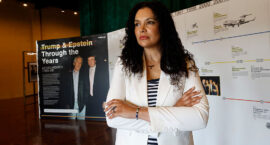
That culture, and Wall Street’s willingness to perpetuate it, is back in the spotlight after the latest release of emails linked to Jeffrey Epstein, which are reviving scrutiny of his extensive connections across the industry.

Keeping Score: Trump Attacks Iran, Pressures Senate Republicans to Pass ‘Show Your Papers’ Voter Registration Bill; States Expand Access to Childcare and Paid Leave

In every issue of Ms., we track research on our progress in the fight for equality, catalogue can’t-miss quotes from feminist voices and keep tabs on the feminist movement’s many milestones. We’re Keeping Score online, too—in this biweekly roundup.

This week:
—Dolores Huerta breaks her silence at 96: “I have never identified myself as a victim, but I now understand that I am a survivor.”
—Trump pressures Senate Republicans to pass the SAVE America Act, a “show your papers” policy that would require U.S. citizens to show a passport or birth certificate in order to register to vote.
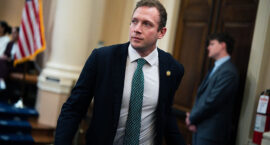
—A performative personnel exchange at DHS: from Kristi Noem … to Markwayne Mullin?
—The U.S. and Israel launched strikes on Iran, killing at least 1,332 people.
—March 10 is Abortion Provider Appreciation Day.
—DHS Secretary Kristi Noem was fired, as ICE reports 32 deaths in detention facilities in 2025.
—Access to early prenatal care is declining in the U.S., especially in states with abortion bans.
—A record one-third of American workers not have access to government-mandated paid leave.
—The U.S. deported a gay woman to Morocco, where her sexuality is illegal and she faces violence from her family.
—Texas Attorney General Ken Paxton claimed gender-affirming mental healthcare for trans youth is “child abuse.”
—New Mexico and New York take steps towards free universal childcare.
—Jessie Buckley took home the Academy Award for Best Actress in a Leading Role for her role in Hamnet. The film was directed by Chloé Zhao, one of nine women to ever be nominated for the award of Best Director and the only woman nominated this year.

… and more.

‘America’s Next Top Model’ Was a Microcosm of the Modeling Industry’s Power Problem

Modeling appears glamorous. Beautiful people, high end clothing and photo shoots in exotic locations. But the reality is far more bleak. 

I was ecstatic when I was selected to be on America’s Next Top Model. By the time I understood how little control I had, it felt too late to ask questions. Personal phones were gone. Contact with the outside world was restricted.

When Netflix released Reality Check: Inside America’s Next Top Model, my reaction was not shock. It was recognition.

From ‘Every Man’ to the ‘Epstein Class’: Misogyny in Male Peer Culture Cuts Across Class Lines

The rich men surrounding Jeffrey Epstein, and the working and middle-class men who were lured into Dominique Pelicot’s twisted fantasy, navigate the social world from very different sides of the class chasm.

But they share something in common, too: They’re all men who were socialized into a misogynous culture that dehumanizes women, turns them into sexual commodities and licenses men to mistreat them.

Misogynous exploitation is not rooted primarily in plutocratic privilege. The sense of unquestioned entitlement to women’s bodies that many observers have noted about “Epstein class” men is hardly confined to the wealthy.

The Epstein Files Reveal a System Built to Shield the Powerful

Jeffrey Epstein’s crimes were not carried out in isolation—they were enabled by a system that repeatedly narrowed investigations, shielded powerful figures and sidelined survivors.

Investigative journalist Julie K. Brown with the Miami Herald has extensively documented the mishandling of the Epstein case. Early reports and accusations were treated with skepticism; initial investigations were shut down; charges were narrowed; powerful actors were shielded; and even meaningful survivor notification of prosecutorial decisions was bypassed. Drawing on more than two decades working within the legal system on domestic violence and sexual assault cases, I see the Epstein files as a stark illustration of how institutions often fail those they are meant to protect.

The partial and selective release of the Epstein files only deepens these concerns. Survivors’ identifying information has been exposed while the names of powerful associates remain redacted. When victims are left vulnerable and power remains protected, accountability has not merely failed—it has been inverted.

This moment demands more than incremental disclosure: It requires full transparency, rigorous investigation and prosecution wherever the evidence leads, so that survivors’ courage is met with the justice they were promised.