Keeping Score: Voters Disapprove of Kristi Noem and ICE; Winter Olympics Nears Gender Parity; Challenges to State Abortion Bans Continue

In every issue of Ms., we track research on our progress in the fight for equality, catalogue can’t-miss quotes from feminist voices and keep tabs on the feminist movement’s many milestones. We’re Keeping Score online, too—in this biweekly roundup.

This week:
—“Kristi Noem sees immigrants like me as subhuman,” says Santiago Mayer, executive director of Voters of Tomorrow.
—A majority of U.S. voters think DHS Secretary Kristi Noem should be removed, and disagree with how ICE is operating.
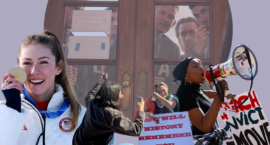
—Women are 47 percent of athletes at the Winter Olympics in Milan.
—California Gov. Gavin Newsom fired back at threats from Louisiana over abortion protections.
—President Trump appointed no women of color to federal judgeships in his first year in office.
—A new Kansas law introduces a “bounty hunter” aspect to transphobic bathroom bills.
—Some ICE detention facilities and prisons refuse to provide appropriate menstrual products.
—A Kentucky couple was arrested over a year after seeking care for a miscarriage.
—A wave of “common sense” candidates, more than half women, recently won competitive school board races in swing states. Sixty-two percent of “extremist” candidates lost their elections, showing that culture war tactics like book bans may no longer resonate with local voters.

… and more.

The Missing Voices in the Epstein Files’ Media Commentary: Sexual Assault Prevention Educators

The Epstein files scandal has all the elements of a gigantic media spectacle. It encompasses everything from true crime to political intrigue, and offers a peak behind closed doors into the lifestyles of the rich and famous. It has more than a little sex and violence. 

It’s a conspiracy theory come to life.

Media commentary has explored seemingly every angle. Or has it? On closer examination, something has been missing.

The Pathetic Price of Entry to Epstein’s World

The latest batch of Epstein files—over 3 million documents, only around half of what the Department of Justice reports to have amassed—has unleashed a new cast of characters, a list that includes tech titans, health influencers, litigation rainmakers, university leaders, sports executives, Hollywood moguls and international royalty. None of the those named in the latest tranche of Epstein files strike me as people I ever assumed possessed particularly stellar moral character, and their collective fall from grace doesn’t shock me.

But what does turn my stomach is how pathetically small the price of entry into Epstein’s world appears to have been.

The expressions of regret now surfacing—I am ashamed, this is not who I am!—read less like moral reckonings and more like the lament of those who simply got caught.

The emails reveal a tawdry economy of access: absurd favors, crude jokes, dating advice, shared handwringing about #MeToo, and giddy acceptance of gifts—Apple Watches, Prada bags, monogrammed sweatshirts—that these already powerful figures could easily have bought themselves.

Whether any individual named in the files participated in or witnessed Epstein’s crimes is only part of the story. Just as telling is the desperate desire to remain in his orbit—often long after his 2008 guilty plea for soliciting prostitution from girls.

That eagerness to maintain proximity, for so little in return, speaks volumes about how power protects itself—and what too many were willing to overlook to stay connected to it.

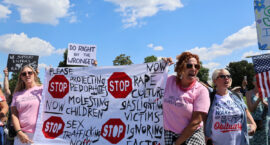
‘We Will Not Be Sidelined Again’: Survivors Respond After DOJ Releases Epstein Files With Unredacted Names and Personal Details

The Department of Justice has released more than 3 million pages of records related to Jeffrey Epstein. For decades, survivors have begged for answers and accountability. But they say the latest tranche of documents—many containing unredacted names, contact information and identifying details—have left them retraumatized, exposed and furious.

Some describe the release as careless. Others call it deliberate. Many say it confirms what they have long believed: that survivors are still not being centered, protected or heard.

Read survivors’ reactions, in their own words.

“My sister Maria Farmer filed a lawsuit against the government for negligence in this case, and really as I see it this is just further examples of that—of the ways that we have not been protected and that DOJ has not done their job.”

“I can’t help but wonder why the DOJ has once again failed us. Again. It feels like they’re ignoring our need for protection, especially when they’ve taken the time to redact the names of powerful individuals … but not ours. This double standard makes it even harder for us to trust them.”

We Know What We Saw in Minneapolis

For women who recognize the dynamics of abuse, the killing of Renee Nicole Good—and the official response to it—follows a chillingly familiar script.

To me, she doesn’t seem to be agitating or obstructing—she appears to wave the ICE vehicles through before masked men emerge from one van, bellowing, “Get out of the fucking car!” She seems to be a scared woman trying to flee violent men, a scenario that resonates acutely with me and many other survivors.

What followed was an Orwellian schema that every abuse victim will instantly recognize: Deny. Attack. Reverse victim and offender. With impunity. 

Sneak Peek: What’s in the Winter Issue of Ms.? Groundbreaking Reporting on Women’s Health and Power

Mifepristone has shown potential to treat a striking range of diseases and conditions, some life-threatening: fibroids, breast cancer, depression, endometriosis, Gulf War illness and maybe even other autoimmune diseases, such as chronic fatigue syndrome and multiple sclerosis. Research also suggests that mifepristone may help prevent some forms of breast cancer and can serve as an effective weekly contraceptive without the side effects of hormonal birth control.

Yet despite the drug’s promise, its development has been repeatedly stymied by abortion opponents who fear wider availability would weaken their attempts to suppress abortion access. 

The result? Women are left in needless pain and subject to invasive and unnecessary surgical procedures like hysterectomies.

The Best and Worst Quotes of 2025, By and About Women

A collection of this year’s most inspiring and infuriating things said by and about women. Some quotes hit like a shot, others a palate cleanser. Here they are in alternating fashion. 

“Let me just tell you, you are an obnoxious—a terrible, actually a terrible reporter.”

“Yes, this work will break your heart. Some days, it will exhaust you, and still, you must continue, because here’s what the research ultimately shows: When younger people lead, democracy doesn’t just survive, it thrives.”

“We are initiated into a sisterhood. We’re in a sorority that none of us asked to join, but we all stand here today, stronger together, because our collective voice is powerful.”