For women who recognize the dynamics of abuse, the killing of Renee Nicole Good—and the official response to it—follows a chillingly familiar script.

There are few things more terrifying to a young woman than confrontation by an angry man. Paralyzing fear leads to questions: What does he want? Will he hurt me? Which part of my body? How do I protect myself? Get me out of here.
I can’t know definitively that these thoughts crossed Renee Nicole Good’s mind in her final moments, but based on my work with female victims of domestic abuse, I wouldn’t be surprised.
We have limited confirmed facts about Renee Nicole Good’s killing by an ICE officer on Jan. 7, 2026. What we do have—bystander video, statements from her family, and sharply conflicting accounts from federal officials and Minnesota leaders—leaves key questions about whether deadly force was justified unresolved, pending federal investigation.
Good’s family has described her, 37, as a poet and devoted mother—and said she had just dropped off her 6-year-old son at school that morning. She was a Christian, her wife said, who believed we are here to love one another and keep each other safe.
In the bystander video, Good is seated in her SUV as multiple agents converge and shout commands to exit the vehicle. Moments later, an agent fires three shots through the driver’s-side window; the SUV then moves forward and collides with another car. A frame-by-frame analysis by The Washington Post raises questions about the government’s initial characterization of the vehicle’s movement and the positioning of the shooter at the moment the shots were fired.
To me, she doesn’t seem to be agitating or obstructing—she appears to wave the ICE vehicles through before masked men emerge from one van, bellowing, “Get out of the fucking car!” She seems to be a scared woman trying to flee violent men, a scenario that resonates acutely with me. What followed was an Orwellian schema that every abuse victim will instantly recognize: Deny. Attack. Reverse victim and offender. With impunity.
In this era of American history, women’s bodies are, paradoxically, both political symbols that authorize male violence and are targets of male violence themselves.
Protecting women’s bodies is often used to justify force—a trope dating back to ancient Rome, where the legendary rape of noblewoman Lucretia by Sextus Tarquinius, the dissolute son of the king, helped catalyze the revolt that overthrew the monarchy and ushered in the republic that would later inspire our own democracy. Women’s bodies also served as a powerful and effective political symbol in helping Trump win his first term in office (Some of the concerns invoked were real.)
But Trump’s second term has revealed that political ideal to be largely devoid of substance. The so-called “party of family values” is rife with infidelity, sexism, hollow principles and documented social and political ties to a now-deceased sex offender. Many politicians’ Christian morals evaporated quickly when it came to protecting women in any meaningful, actionable way, underscoring a harder truth: They do not genuinely care about women. For many women, safety in America has measurably declined.

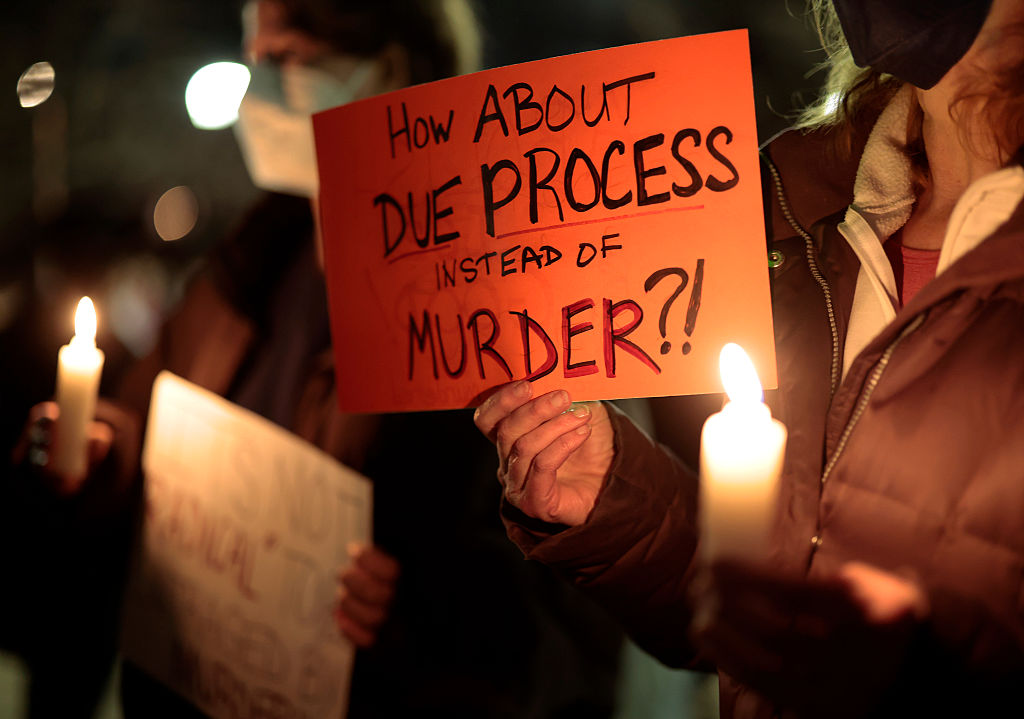
The administration has but one rhetorical device to justify violating its own principles of protecting women, a time-honored tactic seen in nearly every rape trial and domestic abuse case: Scrutinize and blame the victim. She provoked it. What did she do to make him do that?
They have no choice but to push this narrative. The alternative is a blatant violation of their “defender” role: the killing of an American citizen, a white Christian mother, the feminine ideal they valorize. Despite video evidence that, to me, shows not a calculating agitator, but a frightened woman, they insist emphatically that Renee Good caused her own killing.
Authoritarian dystopia is no longer a threat, but a reality.
Gaslight, 2026
After aggressively promoting a revisionist version of Jan. 6—complete with sweeping pardons for many who stormed the Capitol—Trump attacked Good as a “professional agitator.”
Vice President JD Vance described the shooting as “a tragedy … of the making of the far left,” doing so while key facts remain disputed and federal review is still underway.
Homeland Security Secretary Kristi Noem and other DHS officials cast the incident as “domestic terrorism” and framed the ICE agent’s actions as self-defense.
Fox News personality Jesse Watters led with the pronouns in Good’s social media bio—alongside her sexuality and relationship history—telegraphing an almost frantic need to villainize her; you don’t lead with that argument if you actually have damning evidence of bad character.
Too many patients—all women, all domestic or sexual abuse victims—have told me, “I see my abuser in our government.” I’ve become painfully familiar with the dynamics of coercive control, including psychological manipulation—rarely taken seriously, yet no less pernicious than physical abuse.
To me, as a trainee psychiatrist, the Trump administration’s Orwellian tactics align with the definition of “gaslighting,” a psychological term now in common parlance that is routinely misused, like all bastardized therapy speak—“traumatized,” “self-care,” “rejection-sensitive dysphoria” (which is not a thing). But I believe “gaslighting” is appropriate here—and not in the way Vice President JD Vance is using it.
I’m adamant that my medical students understand gaslighting properly, including its origins. The term derives from the 1938 play Gas Light, later adapted into a British film I have my students watch. The story centers on a woman whose husband deliberately manipulates and isolates her, systematically undermining her perception of reality in order to have her declared insane and gain control over her life.
Gaslighting does not mean “conflict” or “disagreement.” It refers to a systematic pattern of abuse over time within a power differential, where the abuser intentionally distorts their victim’s sense of reality, causing the increasingly confused, anxious and depressed victim to question their own perception, developing greater reliance on the abuser to define reality.
I think we can see those tactics at play as Trump actively rewrites Jan. 6—praising the insurrectionists as “peaceful” protesters while falsely suggesting that Capitol police provoked or enabled the violence. The revision doesn’t merely distort the facts; it fabricates a narrative that recasts philistine brutality as patriotism. Trump’s self-delusion about Jan. 6 is laughable: Peaceful protesters don’t steal police riot shields or organize armed contingents in support of overturning an election.
We can see a similar dynamic in the administration’s early, public portrayal of Good as a “domestic terrorist”—a characterization that has not been substantiated. Multiple video angles show Good gesturing from her vehicle before ICE agents approached, yet federal officials continue to frame the encounter in terms of culpability rather than uncertainty, even as the footage raises questions about that interpretation.
Trust Your Eyes, Hold The Truth
From a medical ethics perspective, informed consent and true autonomy are impossible without knowing all the facts. A slanted portrait of a slain woman awash with political disinformation prevents us from making an informed judgment about ICE’s use of force in our communities. The Trump administration’s gaslighting about Jan. 6 and Renee Good’s death distorts the narrative to suit their political agenda. It strips us of our autonomy to think independently, demanding that we blindly accept their version of events.
Raised conservative myself, I value diversity of perspectives and free thought. I don’t see these values in our government.
The administration appears to believe that anyone remotely critical of the government inherently hates law enforcement. False. Most people, myself included, don’t want to see law enforcement harmed and take no issue with federal agents doing their jobs with integrity. But we’re visibly not living in a time of integrity. They’ve created enemies out of political dissenters who may simply disagree with them, creating a vicious “us vs. them” climate of hypervigilance and reactivity without thought that validates political violence. It hurts Republicans and Democrats alike. This isn’t a Democrat vs. Republican issue. It’s humanity vs. inhumanity.
Each of my trauma patients sees me because a fragile, egotistical, often violent man once forced her into submission by making her question her experience of reality. I offer the same advice I offer them: “Your eyes weren’t lying to you. You know what you saw, and you know what you experienced.”
A woman—no matter her political affiliation—wanting to keep herself safe from male aggressors is not a criminal. Culpability lies solely with those who attack the vulnerable, as though assaulting another’s body and character were a God-given right. Trust your eyes. Hold the truth.
The views above reflect only those of the author, and are not necessarily shared by any institution with which she is affiliated.