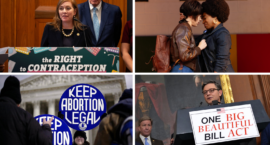
‘The Wrong Kind of Girl’: Feminists Warn of Fallout After Supreme Court Says States May Exclude Trans Girls From School Sports Teams

The Supreme Court ruled 6-3 on Tuesday, June 30, that states may prohibit transgender students from participating in school sports consistent with their gender identity, holding that the Equal Protection Clause of the 14th Amendment does not prohibit such bans. The decision leaves in place laws already enacted in 27 states and marks another major setback for transgender rights after months of escalating attacks on LGBTQ+ communities.

Feminist organizations, reproductive justice advocates, physicians, civil rights leaders and lawmakers swiftly condemned the ruling, arguing that it harms transgender youth, undermines Title IX’s protections against sex discrimination and fits into a broader campaign targeting marginalized communities.

Human Rights Campaign president Kelley Robinson argued the ruling would fuel suspicion and harassment not only toward transgender athletes but toward girls more broadly.

“When politicians convince the public that any girl could be ‘the wrong kind of girl,’ they invite harassment, intimidation, invasive questioning or even an inspection of their body by a total stranger. While we know this administration and other anti-equality politicians won’t stop obsessing over trans kids, we must all call on states to adopt inclusive policies so that no one gets left behind for being their authentic selves. We must show up in large numbers for every school board, local and state and federal election to be sure our communities are heard. We must continue this fight with full force until freedom, justice and equal opportunity are not flimsy promises but nationwide guarantees.”


Keeping Score: Feminists Denounce Supreme Court Anti-Trans Ruling; Trump Tries to Hijack America 250; Camp Mystic Will Not Reopen; Birthright Citizenship Safe for Now

In every issue of Ms., we track research on our progress in the fight for equality, catalogue can’t-miss quotes from feminist voices and keep tabs on the feminist movement’s many milestones. We’re Keeping Score online, too—in this biweekly roundup.

This week:
—The Supreme Court upheld birthright citizenship, but also allowed discrimination against trans student athletes. “When politicians convince the public that any girl could be ‘the wrong kind of girl,’ they invite harassment, intimidation, invasive questioning or even an inspection of their body by a total stranger,” warns Kelley Robinson, president of the Human Rights Campaign.
—Feminists mark four years without Roe.
—Trump continues to push voter suppression tactics through any means necessary.
—Young women who receive the HPV vaccine are at almost zero risk of dying from cervical cancer.
—A weekend of action on voting rights will take place from July 17-19.
—Olivia Rodrigo launches all-women music festival to raise money for organizations centered on women and girls.
Ninety-seven percent of single moms experienced housing hardships in the past year, and 85 percent reported food insecurity.
—Federal agents shot and killed Joan Sebastián Guerrero in Maine and Lorenzo Salgado Araujo in Texas, during traffic stops by ICE. Both men had been living in the U.S. for years with their partners and children.
—Feminist Majority Foundation president and publisher of Ms. Ellie Smeal won the National Organization for Women Lifetime Achievement Award, honoring her decades of feminist activism and organizing.
—The inhumane “Alligator Alcatraz” immigration detention center has closed.
Camp Mystic in central Texas won’t reopen this summer, a year after the tragic flood that killed 28 people, primarily young girls.
—Ahead of their wedding, Taylor Swift and Travis Kelce donated a total of $26 million to 20 charities, including food banks, children’s hospitals, Dolly Parton’s Imagination Library and other education nonprofits.
—Aviator Wally Funk died at age 87. She was the first female flight inspector for the Federal Aviation Administration and taught more than 3,000 people how to fly.

… and more.

The Biggest Threat to Women’s Sports Isn’t Trans Athletes. It’s the Trump Administration’s Failure to Uphold Title IX’s Promise of Equal Opportunity.

The politicians who have spent years claiming to “protect women’s sports” have been remarkably absent when it comes to enforcing the law that actually guarantees women equal athletic opportunities. W

hile the Trump administration has devoted enormous energy to policing transgender participation, Title IX complaints involving unequal opportunities, funding and treatment have languished. The result is a political performance that invokes women athletes while doing little to address the inequities they continue to face.

The real defenders of women’s sports are the athletes themselves.

This month alone, women at Christopher Newport University and California Lutheran University successfully used Title IX to force their schools to reverse decisions that eliminated athletic opportunities for women. Their victories are a reminder of what Title IX was designed to do: expand opportunity, not fuel culture wars.

If we truly care about women’s sports, we should celebrate the athletes and advocates who are making the law’s promise of equality a reality—not those who merely claim to speak in their name.

Women’s Sports Were Built by Letting Girls In

When the Supreme Court upheld West Virginia’s ban on transgender girls participating in girls’ school sports in West Virginia v. B.P.J., it said the ruling was about protecting the safety and fairness of women’s and girls’ sports. I hear that claim against everything I actually lived.

Thirty years ago, in United States v. Virginia, the Supreme Court held that generalizations about “the way women are” cannot justify denying opportunity to women whose talent and capacity place them outside the average description. That principle didn’t just build my generation of athletes. It built a generation of women: the litigators and judges, the surgeons, the CEOs and entrepreneurs, the senators and governors, the police officers and firefighters and fighter pilots, the women who were the first of everything. Every one of those doors was held shut by the same argument Virginia made: Most women wouldn’t want this, most women couldn’t do it.

Women of my generation didn’t fight to be seen as individuals—as athletes, as leaders, as whatever they had it in them to be—only to watch that principle eroded now, in their name and over their objection.

More than half a century ago, this country decided that girls who had been told they didn’t belong on the field belonged there after all. I got to live the proof of that promise. The work now is to keep that promise for every kid who wants to play.

The Supreme Court Decided Who Gets to Be a Girl. We Disagree. 

On Tuesday, June 30, in a complete distortion of federal laws requiring equal opportunities in education, the U.S. Supreme Court ruled to further the Trump administration’s political agenda to persecute, ostracize and erase transgender students. This decision allowing states to ban transgender athletes from girls’ sports, is not about Title IX or equal opportunities for girls. In fact, it is the exact opposite.

To enforce these bans, someone has to decide which girls look female enough to compete. Schools and athletic associations must actively investigate students who don’t fit a sufficiently feminine profile.

We have watched this machinery run before. It is the same machinery that told women they were too aggressive for the boardroom, too strong for the field, too mannish for the ballot box. It has always been used to shrink what women and girls are allowed to be.

Women’s rights and trans rights are not competing causes. They never were. They share a common enemy: the rigid gender hierarchy that has always used “protection” as a cover story for control.

None of us are free until the category of “woman” is big enough to hold all of us.

Keeping Score: Abortion Bans Cost $140B Per Year; Federal Courts Protect Trans Youth and Incarcerated Trans Women; Feminists React to FBI Raid on Ohio Voting Rights Organization

In every issue of Ms., we track research on our progress in the fight for equality, catalogue can’t-miss quotes from feminist voices and keep tabs on the feminist movement’s many milestones. We’re Keeping Score online, too—in this biweekly roundup.

This week:
—Rep. Lizzie Fletcher (D-Texas) is working to get Republicans on the record on the Right to Contraception Act.
—ICE has already reported the deaths of 18 detainees this year, on pace to surpass the highest number of deaths in decades.
—Abortion restrictions could cost the U.S. economy $140 billion annually in lost earnings.
—”I love the inflation,” says Trump.
—The EEOC will no longer require federal agencies to report on race, ethnicity, sex or gender identity.
—83 percent of American voters agree that emergency contraception should be easily accessible.
—Abortion ban states are slowly losing a generation of women medical students and doctors.
—More than 770,000 children have already lost access to SNAP benefits after last year’s funding cuts.
—A new study found trans women athletes have no significant physical advantages over cis women.
—Missouri has restored access to medication abortions after a Jackson County judge struck down key state restrictions, allowing clinics to resume providing the service and marking the first time medication abortion has been available in Missouri since 2018.
—Republicans passed a reconciliation bill that provides roughly $70 billion for ICE and CBP, sending it to President Trump’s desk. (This is on top of more than $140 billion Republicans already provided for those agencies last year.)

… and more.

The World Cup Is Here—But Who Is It For?

Soccer is one of the most beloved sports in the world, and the 2026 FIFA World Cup—the largest in the tournament’s history—has drawn millions of fans across the globe. This year, for the first time, the event is being jointly hosted by the United States, Canada and Mexico, with matches and related events taking place across North America.

FIFA stands to earn billions of dollars from the tournament.

But as the organization reaps record revenues, many host communities are bearing significant costs. Soaring ticket prices, displacement, labor concerns and aggressive immigration enforcement have raised questions about who truly benefits from the World Cup. For many working-class residents—and even lifelong soccer fans—the tournament is out of reach.

To better understand those impacts, I spoke with Jennifer Li, co-director of the Center for Community Health Innovation at the O’Neill Institute and director of Dignity 2026, a coalition of labor and human rights organizations working to protect communities most at risk during the World Cup.

Soccer “is very much an immigrant sport, let’s face it,” said Li, “and by extension, a sport for people of color, diverse communities. It is a sport that’s not expensive to play, but very expensive to watch, apparently. So, the question then becomes: Who is this for?”

Normalizing Entitlement: How Ordinary Moments Sustain Extraordinary Disrespect

Over the course of three days, three very different public moments involving Kristen Welker, Cardi B, Donald Trump, Charles Barkley and Jon Stewart left me thinking about the cultural permissions our society grants men—and the expectations it places on women.

The incidents were not identical, nor should they be treated as such. Yet each revealed a familiar dynamic: a woman doing her job became the target of insults, objectification, condescension or scrutiny that shifted attention away from the original behavior and onto the woman herself.

Whether it was Trump calling Welker “crooked” and “stupid” before ending an interview with “Thank you, darling,” Barkley reducing Cardi B’s halftime performance to jokes about her breasts, or Stewart questioning whether Welker responded appropriately to Trump’s treatment, the pattern was strikingly consistent: Women are often expected not only to endure disrespect, but to manage it in ways that make others comfortable.

These moments are not simply about the individuals involved. They offer a window into the broader cultural permissions that allow entitlement to flourish—permissions that are reinforced through humor, rationalized through frustration and sustained by the expectation that women will absorb the consequences with grace.

When we focus only on the personalities, we miss the larger system that makes these moments feel ordinary in the first place.

Trump’s White House UFC Fight Was a Master Class in Fake Populism

The White House UFC spectacle has come and gone—but the questions it raised about masculinity, power and political culture remain.

In a post-event column for The Guardian, writer Moira Donegan argued that the event reflected a governing style rooted in spectacle and domination, writing that Trump’s embrace of public displays of violence evokes “the dysfunctional Roman emperor” more than a democratic leader. Arts & Entertainment
National
Politics
Sports
Trump’s White House UFC Fight Was a Master Class in Fake Populism
PUBLISHED 6/9/2026 by Jackson Katz | UPDATED 6/15/2026 at 9:22 A.M. PT
Updated June 15 at 8:40 a.m. PT: The White House UFC spectacle has come and gone—but the questions it raised about masculinity, power and political culture remain.

In a post-event column for The Guardian, writer Moira Donegan argued that the event reflected a governing style rooted in spectacle and domination, writing that Trump’s embrace of public displays of violence evokes “the dysfunctional Roman emperor” more than a democratic leader.

Josh Hokit speaks with President Trump following his win in a fight during the UFC Freedom 250 event on the South Lawn at the White House on June 14, 2026, in Washington, D.C. (Chris Unger / Zuffa LLC)
The concern, she suggested, is not simply the fight itself but what it symbolizes: a vision of power that treats aggression, conflict and public humiliation as signs of strength.

The spectacle arrives amid continuing attacks on reproductive rights, gender equality initiatives and social programs that disproportionately affect women and families. In that context, the celebration of cage fighting on the grounds of the White House feels less like a harmless entertainment event than a cultural statement about whose values matter and which forms of power deserve public admiration.

The UFC event was never just about athletics—it was political symbolism. And for many observers, the image of fighters trading blows outside the executive mansion served as a stark reminder that authoritarian politics often rely on spectacles of strength, especially at moments when leaders have less to offer on the material concerns facing ordinary people.

Girls Are Telling Us Why They Quit Sports. Are Adults Listening?

Ted Lasso returns for its fourth season on Aug. 5. When the trailer for the new season dropped earlier this year, one moment landed harder than the rest. On his way to practice, Ted runs into his old nemesis, Mr. Mann, who welcomes him back with a backhanded jab: “Too bad you’re coaching a bunch of girls.”

It’s played for discomfort—and it should be. That attitude is not just an onscreen trope; it’s the ambient skepticism that millions of girls absorb every time they step onto a field or court. It points to a critical question in our current moment: What happens when the coach on the sidelines isn’t prepared to push back?