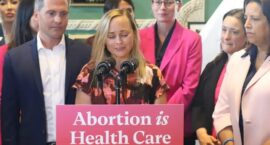
Tennessee Tries to Silence Women Nearly Killed by Its Abortion Ban: ‘We Will Have Our Day in Court,’ Pledges Lead Plaintiff

Tennessee was supposed to face nine women in court on April 27 in a closely watched trial over the state’s abortion ban—women who say they were denied emergency care, forced to flee the state for abortions, or pushed to the brink of death after suffering catastrophic pregnancy complications. After waiting nearly three years to testify publicly about what happened to them, the plaintiffs were prepared to finally take the stand.

Then, less than two business days before the trial was set to begin, Tennessee Attorney General Jonathan Skrmetti (yes, the same Skrmetti whose name is now attached to the Supreme Court’s landmark anti-trans healthcare ruling) filed an appeal invoking a newly enacted state law which prevents Tennesseans from suing over any state law that harms them. The move stripped the court of jurisdiction over the case, abruptly halting the proceedings and potentially delaying the trial for months or years.

“We should be in court today standing up to Tennessee’s abortion ban,” the Center for Reproductive Rights said in a statement after the cancellation. “These women deserve their day in court. But Tennessee politicians refuse to listen.”

Among the plaintiffs is Allie Phillips, who says she was forced to travel to New York for an abortion after learning her fetus had a fatal diagnosis and that continuing the pregnancy put her own life at risk. By the time she arrived for care, she learned the fetus had already died in utero, placing her at heightened risk of infection and blood clots.

Phillips shares her story and reaction to the canceled trial, in her own words.

“I would have testified about how I would have risked my future fertility and my life if I had stayed pregnant in Tennessee. … I already had a 6-year-old daughter, Adalie, to raise. She needed me to live and be her mom. …

“We’re appealing. We don’t know how it will take but even if it’s five years, we will have our day in court. I’m not going anywhere.”

Trump’s Budget Plunders Birth Control and Reproductive Health Programs—With Open Derision for Americans Who Need Them

Title X is the federal program that funds family planning and reproductive health services nationwide—and under President Donald Trump’s proposed budget for 2027, it would be effectively eliminated, reshaping access to care for women across the country.

What is perhaps most jarring, on close reading, is not only what the budget proposes, but how it speaks. The language throughout the administration’s budget and HHS documents departs from traditional bureaucratic norms, adopting a tone that is at times openly mocking and vilifying. Programs serving women, LGBTQ people and marginalized communities are described in terms that signal not just opposition, but disdain. It is a stark reminder that federal budgets do more than allocate resources—they reflect who this government is for, and who it is not.

(This essay is part of an ongoing Ms. series examining the real-world impact of President Donald Trump’s proposed fiscal year 2027 budget. Across sectors—from healthcare and childcare to immigration enforcement and food assistance—the series explores what the administration’s funding priorities reveal about who government serves, and who it leaves behind.)

The FACE Act Is Settled Law, Despite Efforts to Reframe It

At a House Judiciary Subcommittee hearing on the Freedom of Access to Clinic Entrances (FACE) Act on Tuesday, members of the House GOP—including Texas Reps. Chip Roy and Brandon Gill and Ohio’s Jim Jordan—attempted to rewrite or minimize the history of violence against providers and patients, recasting antiabortion clinic blockades as peaceful protest.

Jessica L. Waters, J.D., senior scholar in residence at American University, gave a forceful defense of the FACE Act and pushed back on efforts to recast clinic blockades as protected speech.

“People should be able to seek medical care, and medical professionals should be able to provide it, without fear of violence or intimidation. This is an issue that warrants a federal remedy.”

From Pennsylvania to Illinois to California: A Wave of Good News for Women

It is a relief to point to bona fide good news coming from the states, often some of the best laboratories for democracy.

In Pennsylvania, an appeals court struck down a decades-old law banning the use of state Medicaid funding to cover abortion. Truly remarkable is the majority’s decree that reproductive autonomy is enshrined in the equal protection provision of the Pennsylvania Constitution, guaranteed under its Equal Rights Amendment. ERAs can be game-changing for bolstering legal protection against a wide array of discrimination—including on the basis of pregnancy, age, disability, and immigration status—as well as for addressing adjacent issues such as pay equity and transparency and gender-based violence.

Upcoming judicial elections in Georgia are fast becoming a reproductive rights referendum, as happened last year in Wisconsin. Activists are raising funds in force. 

Idaho voters will likely get to weigh in directly on abortion rights in the November midterms.

… and more.

After Years of Silence, Texas Medical Board Issues Training for Doctors on How to Legally Provide Abortions

For the first time since Texas criminalized abortion, the state’s medical regulator has instructed doctors on when they can legally terminate a pregnancy to protect the life of the patient—guidance physicians long sought as women died and doctors feared imprisonment for intervening.

The new training from the Texas Medical Board was released nearly five years after the state passed its strict abortion ban in 2021, threatening doctors with severe penalties. Pregnancy became far more dangerous in the state after the law took effect: Sepsis rates spiked for women suffering a pregnancy loss, as did emergency room visits in which miscarrying patients needed a blood transfusion; at least four women in the state died after they didn’t receive timely reproductive care. More than a hundred OB-GYNs said the state’s abortion ban was to blame.

The new medical training, which ProPublica obtained under a public records request, assures doctors they can now legally provide abortions, even when a patient’s life isn’t imminently in danger, and goes over nine example scenarios, including a patient’s water breaking before term and complications from an incomplete abortion. 

But medical and legal experts who reviewed the training said the case studies represent only the most straightforward situations doctors encounter. The complications that women face in pregnancy are varied, complex and impossible to capture in a brief presentation, many cautioned. One attorney called the training “the bare minimum.”

Keeping Score: Pennsylvania ERA Secures Abortion Rights Win; Civil Rights Groups Investigate Trump Admin Delays in Childcare Payments; Senate Upholds Near-Total VA Abortion Ban

In every issue of Ms., we track research on our progress in the fight for equality, catalogue can’t-miss quotes from feminist voices and keep tabs on the feminist movement’s many milestones. We’re Keeping Score online, too—in this biweekly roundup.

This week:
—In a landmark ruling shaped by Pennsylvania’s ERA, a state court struck down a decades-old ban on using Medicaid funds for abortion.
—Trump continued to attack voting rights, threatening mail-in ballots and moving towards a nationalized registration database full of errors.
—An estimated 8 million people attended the latest “No Kings” protests.
—A Michigan court ruled that the state’s Pregnancy Exclusion law, which prevents providers from honoring pregnant women’s documented end-of-life decisions, violates a voter-approved 2022 constitutional amendment.
—A federal judge blocked RFK Jr.’s changes to routine vaccination schedules.
—The Supreme Court ruled against Colorado’s ban on dangerous “conversion therapy” for LGBTQ youth.
—Housing markets are declining in states with abortion bans as young people leave or avoid those areas.
—Senators demand the Trump Administration release lifesaving Title X funding.
—Twenty-five states received a failing grade on access to sexual and reproductive healthcare.
—High levels of contamination were found in braiding hair.
—Women are driven away from coaching college sports by pay inequities and other systemic barriers.

… and more.

Banned From Talking About Third-Trimester Abortion Care at a Texas Medical School: The Ms. Q&A with Dr. Shelley Sella

Texas Tech University Health Sciences Center (TTUHSC) cancelled Dr. Shelley Sella’s scheduled campus talk in January about her recent book Beyond Limits: Stories of Third-Trimester Abortion Care, which she had been invited to give by the Texas Tech chapter of Medical Students for Choice (MSFC) in collaboration with MSFC’s Board of Directors. The administration told right-wing outlet Texas Scorecard that it decided hosting her was “not in the best interest of the university.” The decision to ban Sella from campus was made after days of coordinated activism by the Turning Point USA chapter at Texas Tech in conjunction with two antiabortion activists: Mark Lee Dickson and Jim Baxa. 

The cancellation of Sella’s talk was not “an anomaly,” as Jessica Valenti of Abortion, Every Day writes, but part and parcel of the “antiabortion snitch culture” on college campuses—”part of the broader conservative attack on academia that’s gained steam over the last few years.”

“And it’s not just impacting a few schools or professors,” Valenti continues. “Antiabortion groups are determined to eradicate any iota of pro-choice speech on college campuses. Now is the time for us to make as much noise as possible and not back off one single inch.”

Taking seriously Valenti’s call to “make noise” rather than retreat in the face of escalating efforts to suppress pro-abortion speech, Ms. sat down with both Sella and Claire Surkis, a medical student in Connecticut who serves on MSFC’s Board of Directors, to explore the impact and implications of the university’s actions.

‘The Other Roe’ Film Shines a Light on Forgotten Abortion-Rights Case Doe v. Bolton

On June 24, 2026, we’ll reach the fourth anniversary of the Supreme Court’s infamous Dobbs decision that overturned Roe v. Wade in 2022. This year, which would have been Roe’s 53rd anniversary, also coincides with the United States’ 250th, reminding us that while the U.S. has been independent since 1776, American women are still far from having full rights and power over our own bodies.

Roe v. Wade, which passed in 1973 and stood for 49 years, gets most of the credit for establishing the national right to abortion. Many people think of Roe as the first big bookend ushering in the right to abortion in the U.S., with Dobbs as the other bookend taking that right away again.

However, Roe wasn’t the only groundbreaking case that paved the way for abortion rights in the U.S. 

Doe v. Bolton, Roe v. Wade’s lesser-known companion case, was argued before the Supreme Court in 1973 the same day as Roe and was equally crucial to abortion rights in the United States.

This Phoenix Dad, Husband and Doctor Just Helped Change Abortion Rules in Arizona

What kind of man would sue the state of Arizona on behalf of the women here? Dr. Paul Isaacson.

Thanks to his recent win court (with legal lead the Center for Reproductive Rights), women in Arizona are no longer forced to go through a 24-hour period between scheduling and getting an abortion, which is an outdated practice that suggests women can’t make rational decisions. They also no longer have to listen to state-mandated, antiabortion propaganda before ending a pregnancy.

“All of these requirements were done under the guise of improving healthcare for women, which they did not,” he says. “I can’t imagine a similar situation with anything to do with a man’s health. It felt like we were talking down to women. I think that’s been one of the major drivers for me in being active and challenging these laws, because they are so dishonest.”

Say Their Names: The Women Who Died After Being Denied Emergency Abortion Care

We know the names of nine women who have died after doctors denied them life-saving care because of fears they would be criminally prosecuted under abortion bans: Josseli Barnica, Yeniifer Alvarez-Estrada Glick, Amber Nicole Thurman, Candi Miller, Porsha Ngumezi, Taysha Wilkinson-Sobieski, Nevaeh Crain, Tierra Walker and Ciji Graham.

At least three least three more women—all unnamed at this time—died between October 2022 and July 2024 as a result of denied or delayed emergency abortion care, according to a March 2025 study released in academic journal CHEST.

In all, public health experts estimate that abortion bans have led to the deaths of at least 59 women—but we may never know their names.

In a lawsuit involving denial of emergency care to pregnant women, the National Women’s Law Center filed a brief documenting more than 100 cases of women almost dying when hospitals denied emergency medical care because of abortion bans—though “the true number [of cases] is likely significantly higher,” according to the brief.

Congress should move to pass two critical protections: The Women’s Health Protection Act, which would establish a statutory right for healthcare providers to offer abortion services and for patients to receive them; and the Equal Access to Abortion Coverage in Health Insurance (EACH) Act, which would ensure that every person who receives healthcare or insurance through the federal government will have coverage for abortion services.