

The Campus Free Speech Crisis We Don’t Talk About

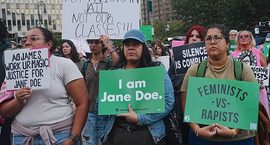
It’s not often that an article in a college newspaper becomes national news, but an explosive oped titled “Cornell Won’t, We Will,” has sparked front-page headlines, protests and demands for accountability across the country since its publication in The Cornell Daily Sun on Sept. 21. Authored by the newspaper’s editorial board, the piece highlighted the alleged gang rape of a female student, identified as Jane Doe, by members of the Chi Phi fraternity in October 2024. The op-ed denounced not only the actions of the alleged perpetrators but also what it described as the inaction of Cornell University in response to them.

The authors accused the university of failing to provide transparency and accountability in the wake of Doe’s assault, calling it part of a “morbid pattern” of institutional indifference to campus sexual assault. Despite a finding by Cornell’s own task force that incidents of sexual assault had increased by roughly 40 percent between 2023 and 2025, Cornell had provided “no concrete, feasible solutions beyond the usual passivities of ‘communication’ and ‘understanding.’” The editors argued that the failure to protect the physical safety of students constituted a betrayal of Cornell’s promise to “preserve a higher education community and residential campus where ‘any person’ in the community can pursue their education in a secure and nourishing environment.”

Just over a week later, another op-ed by a Cornell student criticizing the institution reached a national audience. “Cornell Fails Its Free-Speech Test,” authored by Cornell senior Jared Lederman, ran in the Wall Street Journal on Sept. 29. Lederman’s op-ed cited his recent personal experience of being criticized by fellow Cornell students for his views on gender equality as a demonstration of the university’s “culture of intolerance.”

Lederman recounts that after publishing an online essay titled “Men and Women Were Not Created Equal,” which condemned “modern feminism” for “trying to suppress masculinity” and insufficiently appreciating the “irreplaceable beauty in a woman creating the home to which her husband returns and in which her children grow,” his professional fraternity asked him to resign from a leadership position and his social fraternity expelled him. According to Lederman, his experience of “exile” is proof that “expressing heterodox views is socially suicidal” at Cornell, despite the institution’s claims in a recent report to value “‘rigorous deliberation and engaged discourse.’”

The gulf between these two op-eds speaks volumes about what is perceived as a campus crisis, not only at Cornell but across the country.

Sexual abuse is a free speech issue. A campus where students are pressured to stay silent about abuse, where students are doxxed, threatened and swatted for filing complaints, where victims are forced to share classrooms and living spaces with their abusers, is not a campus that respects physical safety or free speech.

The Witch Hunts of the 1600s Never Really Ended

An excerpt from Mary Anne Franks’ new book, Fearless Speech: Breaking Free From the First Amendment:

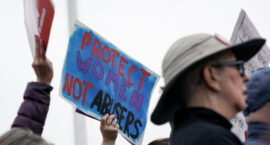
“Amber Heard was professionally blacklisted, constantly surveilled by the press and the public, and subjected to death threats and harassment. All of this happened because Heard wrote something that people did not like—the kind of speech that, according to American free speech orthodoxy, should be most robustly protected by the First Amendment. But in a decision that chilled the speech of sexual abuse and domestic violence victims everywhere, Heard was found liable for defamation and ordered to pay Depp $15 million. … As the Heard case revealed in excruciating detail, when it comes to women’s speech, the protection of the First Amendment is little more than hollow rhetoric.”

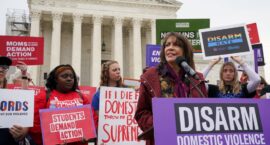
In U.S. v. Rahimi, Domestic Violence Victims Live to Die Another Day

Friday morning, the Supreme Court ruled 8-1 that a law restricting firearms access for a narrow class of individuals subject to a specific kind of domestic violence restraining order does not violate the Second Amendment. The ruling is a “win” in much the same way the Court’s ruling in the mifepristone case FDA v. Alliance for Hippocratic Medicine earlier this month is a win: The Court did the “bare minimum” necessary to cling to the last vestiges of its legitimacy.

The threat posed by violent abusers like Zackey Rahimi might be temporarily disarmed today, but the threat posed by the Supreme Court’s patriarchal agenda remains a loaded weapon.

Idaho’s EMTALA Challenge Has Got Women Dead to Rights

On April 24, the Supreme Court will hear oral arguments in Moyle v. U.S., a case that will determine whether individual states are allowed to exclude a single group from this basic protection: pregnant women.

The state of Idaho claims that it has the right to forbid pregnant women and girls—and only pregnant women and girls—from receiving emergency care that could save their lives.

The Abortion Pill and the Hypocritical Oath

The lead plaintiff in the mifepristone case heard before the Supreme Court this week is a shadowy organization calling itself the Alliance for Hippocratic Medicine (AHM). The group’s name is clearly intended to evoke the Hippocratic oath, popularly understood as the commitment of doctors to “first do no harm.”

To claim, as the Alliance for Hippocratic Medicine does, that forcing a woman or child to give birth against her will, even if childbirth will seriously injure or even kill her, honors the principle of “do no harm” is perverse, but also very revealing. It makes clear that the “harm” that AHM and other anti-abortion ideologues care about is wholly imaginary.

The Constitution as a Homicide Pact

The facts of U.S. v. Rahimi reveal the gendered and destructive reality of gun use behind the illusion of abstract, idealized self-defense.

Every 14 hours in the U.S., a man uses a gun to kill his intimate partner. Pregnant women are particularly vulnerable. But the Supreme Court’s conservative commitment to “life” is highly selective, to put it mildly, and tends to value women’s lives—including those of domestic violence victims—very little. We can expect the Court’s ruling to come down in June or July of 2024.