Update: On Thursday, May 14, the Supreme Court halted the extreme Fifth Circuit Court ruling from May 1 banning telehealth distribution of mifepristone, in direct response to the abortion pill makers’ emergency appeal. This means mifepristone is still accessible via telehealth and through the mail while litigation challenging the Food and Drug Administration’s 2021 decision to allow clinicians and pharmacies to mail medications to patients after a telehealth consultation rules, brought by the state of Louisiana, moves forward. The FDA is also currently reviewing the safety protocols for mifepristone, meaning access by mail could still be threatened in the future.
The decision is unsigned, but Justices Samuel Alito and Clarence Thomas were named in their dissents. Misreading the law and counter to a century of president, Thomas suggested mailing abortion pills violates the Comstock Act, a backdoor method of enforcing a national abortion ban by restricting the shipment of abortion drugs as well as medical equipment used in abortions.
The ruling to allow the mailing of mifepristone was met with relief from abortion rights advocates, but also with growing frustration, defiance and anger at what many see as an exhausting cycle of temporary protections and looming threats. Feminists and reproductive justice advocates say patients should not have to live week-to-week wondering whether a handful of judges will allow them basic healthcare access.
In a widely shared Instagram post following the ruling, Physicians for Reproductive Health wrote: “You deserve better than your rights resting upon the whims of a club of nine 400-year-old nerds who don’t know anything about you. You deserve the dignity of having an abortion in the way that works best for you, not just with the crumbs the courts will allow.” The post also directly rejected antiabortion claims about safety: “Anti-abortion extremists do not care about your safety, they care about controlling you.”
The sharper tone reflects a broader shift in reproductive rights messaging as advocates increasingly frame access to abortion pills not as a temporary privilege granted by the courts, but as healthcare people are entitled to regardless of political ideology or judicial intervention. And that’s not going away. (Here’s how to order abortion pills, regardless of what the courts decide.)
Medication Abortion Is Back Before the Supreme Court, and the Stakes Are National
The Supreme Court is forced once again to confront its post-Dobbs fallout.

This column originally appeared in Civil Discourse with Joyce Vance, “Mifepristone and the Court.”
The mifepristone case that has landed on the Supreme Court’s shadow docket is the new face of conservative efforts to impose a nationwide ban on abortion.
The Supreme Court claims it stays out of politics. Recently, Chief Justice John Roberts bemoaned people who view the justices as political actors. In granting a post-decision motion to immediately finalize its opinion in Callais, Justice Alito rejected Justice Jackson’s charge that the conservative majority was behaving in a fashion that would look partisan to the public.
Mifepristone is used in about 60 percent of abortions nationwide, so banning the drug is essential if conservatives want to curtail medication abortion. In the Louisiana case before the Court, the state argues it’s not able to enforce its ban because pregnant people can obtain the drug via telehealth and use it to induce an abortion.
One of the unexpected consequences of Dobbs has been the effect of medication abortion. And the decision itself continues to have toxicity for Republicans, even if Dobbs didn’t cost them the 2024 presidential election. Donald Trump himself pussyfoots around it, changing position as necessary.
That’s the context for the new mifepristone case we’ve been following. Justice Alito entered a temporary administrative stay to keep the Louisiana law banning telehealth and mail order from going into effect, which we noted Sunday evening in The Week Ahead, “ends on Monday. That means that unless the Supreme Court issues an order regarding whether the injunction should stay in place while the litigation proceeds, the Fifth Circuit’s ban on obtaining the abortion drug via telehealth goes into effect.”
Monday came. But the Court didn’t act. Instead, it just gave itself more time, with Justice Alito extending the stay until Thursday.
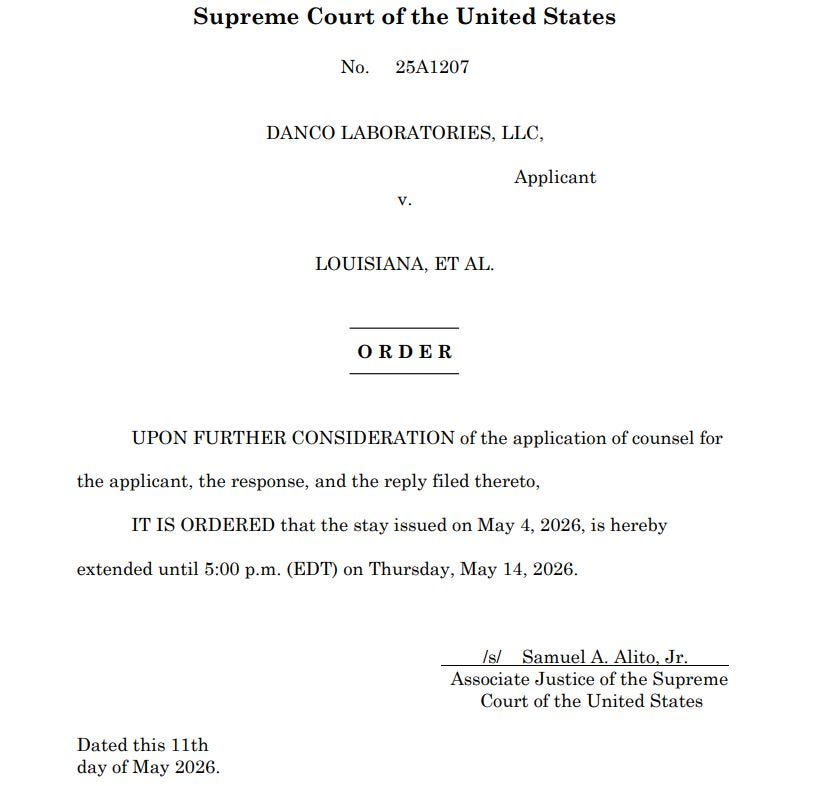
It’s possible that the Court is close and needs a little more time to reach a decision. There has been some thought it might set the case for argument on the merits as early as next month, or more realistically, next term, and decide it on the merits quickly, at least as courts count time.
But given the political weight of the issue in a midterm election year, the Court could also return to its history with mifepristone: kicking the can down the road. That’s what they did when the Texas case, Alliance for Hippocratic Medicine v. FDA, came before it in June 2024, deciding that the plaintiffs lacked standing and dismissing the case, instead of ruling on the substantive issue.
What will the Court do now? We don’t know for certain. On Thursday, May 14, we may learn whether it intends to find an off-ramp, like lack of standing, again or deal with the substance of the issues around mifepristone access post-Dobbs. There are a number of issues embedded in the case, including:
- Whether Louisiana has standing to challenge the FDA’s 2023 Risk Evaluation and Mitigation Strategy (REMS) for mifepristone
- Whether the FDA’s decision to eliminate the in-person dispensing requirement for mifepristone was arbitrary and capricious
- Whether Louisiana can, in effect, impose a rule that effectively changes mifepristone access nationwide
- And a question we looked at in the wake of Dobbs and the earlier mifepristone case, whether the Comstock Act can be resurrected toprohibit mailing abortion drugs and related materials?
We could see anything—from an unsigned decision permitting the law to go into effect while the litigation proceeds, to something more substantive.
But if the Court goes the latter route, it’s unlikely it would dig too deep without actually hearing the case, which is what it did in Alliance for Hippocratic Medicine, before it dismissed it.
The Court might decide to follow suit and play for time as well, staying out of the fray and letting the executive branch of government take this one on.

Louisiana isn’t the only state trying to challenge access to mifepristone in the run-up to the midterm elections. But despite the insistence of antiabortion activists, a 2023 poll showed 63 percent of Americans favored access to the drug, up from 50 percent in 2020.
It turns out, Republicans didn’t win the war when they got the Supreme Court to reverse Roe v. Wade. Many Americans want to maintain the ability to make their own choices about their own bodies and are continuing to find ways to do so.
One final note on what’s happening here: Last September, Trump’s FDA announced a “comprehensive review” of mifepristone, citing a “lack of adequate consideration” in prior approvals. That, of course, is bunk. Mifepristone has been on the market since 2000, safe, studied and successfully used to treat women in situations including miscarriage as well as abortion.
But likely because of the politics of the issue and the insistence of abortion foes that the drug be made unavailable, the Trump administration has the review underway.
In fact, the district judge stayed the case pending the outcome of the review. The Court might decide to follow suit and play for time as well, staying out of the fray and letting the executive branch of government take this one on.
There may be some hint of that in the ongoing FDA review process: Dr. Marty Makary has resigned after weeks of threats that Trump would fire him.
A tweet from Illinois Democratic Sen. Dick Durbin credited his forced departure to his anti-vape stance.
But The New York Times reported,
“Dr. Makary also faced repeated calls for his firing from abortion foes who accused him of dragging out the timetable for a study of the safety of mifepristone, an abortion drug, viewing the exercise as one that could support their efforts to restrict the drug’s distribution.”
Republican Sen. Josh Hawley from Missouri tweeted:
“This is welcome news. Dr. Makary was uniquely destructive to the prolife movement. He attempted to place pro-abortion lawyers in key positions. He slow walked a vitally necessary review of the abortion drug mifepristone. He used his discretion to approve a new abortion drug when the data shows it sends 1 in 10 women to the emergency room. He froze out prolife leaders and repeatedly stonewalled Congress. His resignation is an opportunity for the FDA to reset.”
Regardless of what the last straw for Makary was, Durbin’s words have force:
“I voted for Dr. Makary to head the FDA based upon his commitment to say ‘no’ if President Trump asked him to do something that would harm America.
“Dr. Makary kept his word. He resisted Trump’s plan to expose millions of kids to the dangers of vaping. I hope Dr. Makary will inspire others within the Admin to grow a spine & put the families of America ahead of blind loyalty to this President.”
We’ll find out on Thursday whether he has inspired any of the justices on the Supreme Court.
We’re in this together.
Look to these trusted groups if you or a loved one needs to know more about reliable abortion care:
- A one-stop-shop for abortion seekers: I Need An A
- Other websites to explore all your options for abortion care: Plan C Pills, Abortion Finder
- Safe websites to buy abortion medication: Aid Access, Massachusetts Medication Abortion Access Project, Hey Jane
- If you need help affording abortion care, tell your telemedicine provider or contact an abortion fund near you.
- To protect your digital privacy when planning your abortion, click here.
- For free legal help as a patient or doctor, call If/When/How’s Repro Helpline—844-868-2812—or contact Pregnancy Justice.
- For medical advice, contact the Miscarriage & Abortion Hotline: 833-246-2632.
- If you need to know the abortion law in your state, look to the Center for Reproductive Rights. or Guttmacher Institute.