Justice Sonia Sotomayor warns the Court has handed President Trump sweeping new authority while dismantling nearly a century of protections for independent federal agencies.

On the second-to-last day of its 2025-’26 term, the Supreme Court ruled 6-3 along party lines President Donald Trump can fire Rebecca Slaughter, who served as commissioner of the Federal Trade Commission (FTC) from 2018 until her dismissal in 2025. But the decision reaches far beyond one commissioner: By overturning nearly a century of precedent, the Court held that presidents may remove members of independent multimember agencies, which Congress deliberately structured to operate with some distance from partisan politics.
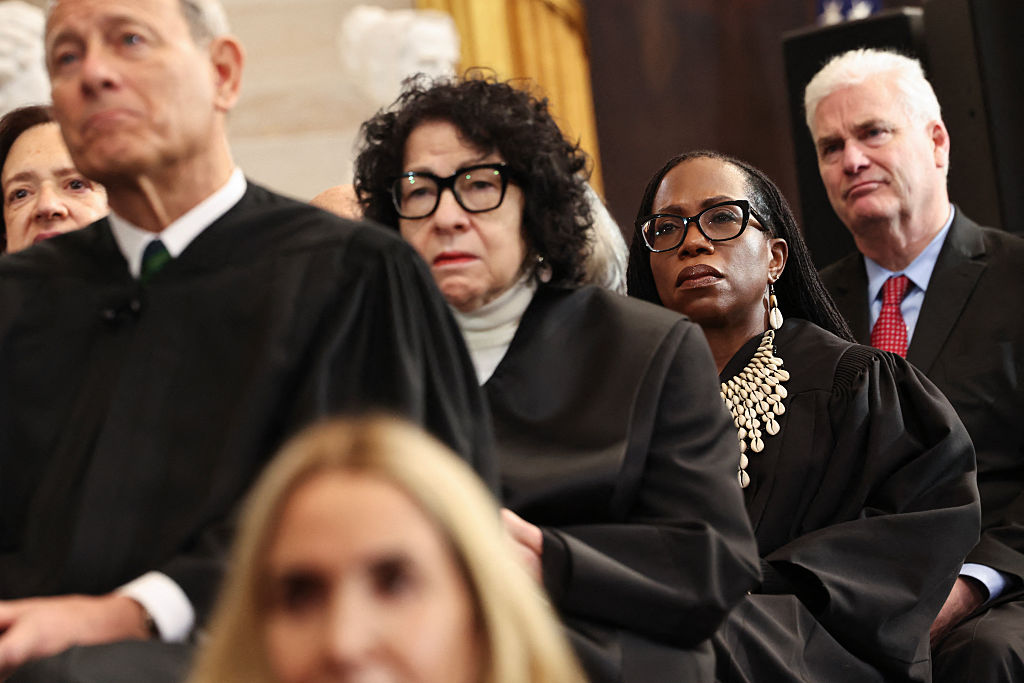
In a forceful dissent, Justice Sonia Sotomayor warned that the conservative majority’s decision in Trump v. Slaughter hands the president “unitary, total executive control” and fundamentally “reshapes our Government.” Joined by Justices Elena Kagan and Ketanji Brown Jackson, Sotomayor argued the Court had granted the president “a power unknown even to the English Crown against which the Founders revolted”—a striking warning in the nation’s 250th anniversary year.
Until this week, federal law permitted the president to remove FTC commissioners only for “inefficiency, neglect of duty, or malfeasance in office.” Trump did not allege that Slaughter had committed any of those acts when he fired her. Instead, the Court used the case to overturn Humphrey’s Executor v. United States, the landmark 1935 precedent that had long protected the independence of agencies like the FTC.
We read all 49 pages of Sotomayor’s urgent dissent and pulled out the most striking passages, so you don’t have to—though after reading them, you just might want to. (Emphasis added throughout.)
1. The opening:
“For most of this Nation’s history, Congress and the President together have decided that some Government functions should operate at a distance from partisan politics. Those include the management of nuclear energy; the security of the monetary supply; and the safety of American workplaces, consumer products, and chemical hazards. In these and many other areas, the wisdom of the centuries has taught that some decisions should depend not only on who is in office—much less on who is disfavored or owed a favor by those in office—but also on judgment, expertise, and the public good.”
2.
“Today, this Court undoes centuries of political practice and concludes that all three branches of Government have been acting in open defiance of the Constitution all this time. Its conclusion is wrong. The text of the Constitution, along with its history, the longstanding practices of the political branches, and the precedents of this Court, make clear that Congress may limit the causes for which the heads of Commissions like the FTC can be removed by the President. In holding otherwise, the Court gives the President a power unknown even to the English Crown against which the Founders revolted … ”
3.
“While the nomination of the President’s choice to replace the Chair was pending before the Senate in March 2025, he fired the two remaining Democratic Commissioners, including Slaughter, leaving only the two Republican Commissioners. He did not identify any ‘inefficiency, neglect of duty, or malfeasance in office’ on either removed Commissioner’s part. Instead, he simply asserted that these Commissioners were removed pursuant to the President’s ‘authority under Article II of the Constitution.'”
4.
“Thus, unlike in other recent cases, in which the Court considered agencies that it deemed ‘historical anomal[ies]’ with ‘no foothold in history or tradition,’ here history and tradition point in the opposite direction.”
5.
” … this case does not ask whether 50 years of practice can overcome plain constitutional text. It asks whether the Constitution privileges the majority’s flawed historical account as the final word on the subject, impervious to more than a century of later historical development. The answer is no. Although the majority suggests that its view reflects a settled construction of the Constitution, the opposite is true.”
6.
“Ninety years of precedent and 140 years of consistent political practice should have been more than enough to resolve this case. They are not enough, however, for the majority. Instead, the majority disregards ‘a venerable and accepted tradition’ after placing it ‘on the examining table’ and ‘scrutiniz[ing] its conformity to’ the majority’s own ‘abstract’ theory of unitary executive control.“
7.
“Recently, however, the Court has seized the issue from the political branches by fashioning a ‘general rule’ of mandatory, illimitable at-will Presidential removal. From the start, the majority’s theory rested on shaky ground. Over time, its arguments have grown weaker still, as historical evidence has undermined key pillars of its theory. Today, the Court faced a choice: plow ahead, or acknowledge that the foundations on which the ‘general rule’ of illimitable removal power rests are less stable than the Court has previously asserted. Unfortunately, the Court repeats and expands upon several prior errors that require correction.
8.
“Nor is there evidence that the Constitution was intended to give the President more expansive removal powers than those enjoyed by the Crown. For good reason: Doing so would have been inconsistent with the Constitution’s very foundation. The Framers ‘never intended’ to give the President ‘the complete set of powers’ that the English Crown held, let alone more.“
9.
“The majority can shut its eyes to this evidence and point back to its past mistakes as support for the new ones of today.”
10.
“If Myers is the ‘best’ support for the majority’s position, its theory is a castle built on sand.“
11.
“The majority is thus free to complain about the ‘shabby treatment’ Myers has received, but it has decades of precedent to blame for that, not this dissent. From Humphrey’s to Wiener to Bowsher to Morrison, Myers had been left on the sidelines long before today, at least until the Court reinvigorated a maximalist view of Presidential power a few years ago. Humphrey’s approval of removal protections for agencies like the FTC, to the contrary, has supplied the rule that governed the creation of the modern state over the course of the following century.”
12.
“The majority thus has very little support in text, history, or precedent. What it does have is a theory. As the majority sees things, ‘the buck stops’ with the President, who holds all executive power and thus can be ‘”blame[d]”’ or held ‘”responsib[le]”’ for all executive conduct. Yet the President cannot ‘execute the laws alone and unaided.’ To ensure that the President can carry out his job and remain responsible for all exercises of executive power, the majority says, his inferiors must ‘remain accountable to [him]‘. The only way for that accountability to exist, according to the majority, is for ‘those officers [to] be removable by the President’ at will, for any reason or no reason at all.”
13.
“In no way, then, does the FTC’s structure, in purpose or effect, do away completely with Presidential influence. Instead, Congress’s design (approved by many Presidents over decades) balances that influence with other values equally cognizable under the Constitution. The majority’s rigid, inflexible rule goes badly astray by declaring one side of this balance constitutionally irrelevant.“
14.
“Today’s decision profoundly undermines this reliance and, as a result, undercuts one side of the balance that the political branches struck. Put simply, today the majority reshapes our Government. Dozens of independent commissions are now likely to become purely executive agencies, shifting tremendous power over broad swaths of American life into the President’s hands … “
15.
“Seldom, if ever, has this Court worked such a profound bait and switch on a coequal branch: For more than 90 years, Congress believed, with this Court’s express approval, that it was allowed to create a workable Government, including by granting certain agencies tasked with certain responsibilities some independence from Presidential control. In rejecting that project, after decades of promising the political branches that structures like the FTC’s were permissible, the Court creates an Executive Branch that Congress never dreamed of establishing and that it now has little hope of ever reining in.“
16.
“Ordinary Americans and regulated firms alike have organized their affairs understanding that some Government decisions will depend not on political favoritism or partisan advantage (or at least not only on those considerations), but on expertise, adherence to law, judgment, and the public good. America’s economy works in large part due to the ‘stability’ and predictability fostered by such expectations. Today, by demanding unmediated, unmitigated Presidential control of agency decision making, the majority upends all of that.
“The majority responds by announcing, in short, that it knows best and that its abrupt destruction of a century and a half of precedent is broadly supportive of ‘constitutionally promised liberties.’ Never mind that the elected officials representing the American people (including over a dozen Presidents) have consistently understood the people to be best served, including in their liberty interests, by agencies that are not entirely subject to Presidential whim. Because today’s majority has come to believe that the American people are better off without independent agencies, it does not matter how much anyone has relied on that arrangement.”
17.
“The majority’s assertion that Humphrey’s has proved unworkable also blinks reality.“
18.
“When the Court fails to adhere to its own precedents in a principled manner, it is hard to expect consistency from the lower courts that must keep up with the Court’s rapidly shifting views. For decades before this Court upended the doctrine, however, Humphrey’s was a stable, easily understood precedent of this Court.”
19.
“The majority can feign ignorance and deem these terms devoid of meaning, but it cannot change the historical record: Independence has long been associated with, and accepted as to, executive officers who carry out functions like the FTC’s.”
20.
“The case for retaining Humphrey’s becomes even stronger when compared against the majority’s theory, which itself promises to unleash only chaos. With remarkable steadfastness, the majority simply refuses to explain where its theory leads or where it ends. Although declining to consider the consequences of its decision might make it easier for the majority to cast Humphrey’s aside, it leaves courts, agencies, and Congress with little guidance, and many new questions, on how they are supposed to assess removal questions going forward.”
21.
“Today, the majority replaces 90 years of proven, workable practice with a half-baked theory of executive power that is simultaneously all encompassing yet also subject to necessary but undefined exceptions. The one thing that does appear to be clear going forward is that chaos will follow.“
22.
“In this case, the Court takes one of the oldest debates in American history and decides that the six Justices in the majority, alone, ought to be the ones to settle it for all time. That decision does not just overrule precedent; it all but ignores that precedent exists. It does not just hamstring the political branches’ ability to respond to new challenges; it rewinds the clock nearly 150 years, holding that a common agency structure is, and always has been, forbidden.”
23.
“Will these transformations yield the benefits, sounding in responsiveness and accountability, that the majority touts? Or will they risk placing ‘in the hands of a bold and designing man, of high ambition, … an instrument of the worst oppression,’ which will ‘sacrific[e] every principle of independence to the will of the [President]’? Neither I, nor the majority, knows with certainty. That is exactly why the Constitution leaves decisions like this one, involving sensitive tradeoffs and difficult judgment calls, to those best positioned to make them, and then to be held accountable for doing so: the political branches.
24. The conclusion:
“Today, the Court discards that democratic regime in favor of one that distorts the structure of Government to fit the majority’s theory of unitary, total executive control. The result is a President who emerges with far greater power than ever before. It is a power, however, that neither the People, nor Congress, nor the Constitution bestowed upon him. In granting the President this unbridled authority, the Court upends its precedent, misconstrues our history, and sheds any pretense of judicial modesty. I respectfully dissent.”
Support more work like this article
The reporting you just read is possible because of readers like you. Since 1972, Ms. has delivered independent, feminist journalism that tells the stories too often overlooked by other news media, challenges systems of inequality and holds power to account. We have no corporate owners, no advertisers and no billionaires dictating what we cover. Instead, we answer to our readers and our mission. If you value reporting that centers women and girls—and covers the issues others leave out—please support Ms. today by making a tax-deductible donation, becoming a member to receive a magazine subscription, or gifting a membership to a friend. Together, we can continue reporting, rebelling and truth-telling.