MAGA’s embrace of domination abroad, and state violence at home, is rooted in a gendered project to restore white male power.

A version of this analysis was originally published on In the Arena With Jackson Katz.
A dizzying and dramatic series of events over the past few weeks provides additional proof—as if any were needed—that Trumpian populism is preoccupied with the aggressive reassertion of white male power and cultural centrality.
The connective tissue of Donald Trump’s takeover of Venezuela, his threats to invade Greenland, the killings of Renee Good and Alex Pretti by masked federal agents in Minneapolis, and the EEOC’s encouragement of white men to bring claims of discrimination against them is this: All represent increasingly desperate efforts by Trump and MAGA to forcefully put white men back in charge.
It’s an ambitious and largely quixotic agenda. Unfortunately—and tragically—they have access to the tools of coercive state power to help them achieve their goal.
That power has been on full display in Minneapolis over the past three weeks, where two incidents with deeply gendered undercurrents have stoked the flames of cultural division.
In the first, on Jan. 7, Good, a 37-year-old mother of three, was shot in the face by a federal agent in the midst of a confrontation. After he killed her, he allegedly called her “a fucking bitch.”
On Jan. 24, Pretti, a nurse who was also 37, was shot 10 times and killed by agents after he had come to the aid of a woman who a group of male officers had pushed to the ground.
The two horrendous killings have drawn widespread condemnation and inspired enormous and angry protests in Minneapolis and elsewhere. They have also prompted a torrent of false, victim-blaming statements by officials in the Trump administration and sparked a systematic campaign in right-wing media to paint the victims—and anyone else who openly defies ICE—as radical, violent lunatics who pose a dire threat to the country.
Street-level resistance has been mounting to the Trump administration’s increasingly brazen and violent rhetoric and actions at home and abroad. Meanwhile, activists and commentators in media have focused, rightly, on the many questions of legality and constitutionality that have arisen.

Not the least of these have to do—on the domestic side—with jurisdictional struggles between states and the federal government, and the degree to which states have the power to resist the imposition of repressive measures by the feds.
In the international arena, questions swirl about the extent to which presidents can conduct foreign policy with little to no congressional input or approval, not to mention the constraints of international law.
These are all urgent and important matters in this calamitous historical moment. But at times like these it’s also important to step back and examine some of the deep cultural and historical currents that shape these ominous developments.
State Violence Is a Gendered Phenomenon
White male backlash has played a central role in our culture and politics since the presidencies of Richard Nixon and Ronald Reagan. It was Reagan, after all, who first introduced the backward-looking slogan Make America Great Again. But recent events, on matters both foreign and domestic, have made the backlash—and the masculinity politics of MAGA—more visible than ever.
In fact, the gendered nature of right-wing politics has been on display in such a crude and naked fashion over the past couple of months that even mainstream pundits now comment regularly on it. Unfortunately, few seem to grasp the degree to which the dynamics of gender are marbled into the workings of power, from the level of interpersonal relationships all the way through to the behavior of states.
Moreover, few in the commentariat see fit to credit the feminist scholars, journalists and activists who built the framework for analyzing the deep masculine anxiety and anti-feminist grievance that has helped fuel the rise of right-wing authoritarianism over the past century.

The gendered nature of MAGA populism has been evident from the beginning of the Trump era. It could be seen in Trump’s reactionary Supreme Court appointments, and the Court’s subsequent rulings against women’s rights and in favor of unfettered presidential powers; the anti-feminist policy agenda of his first and second terms; and his naming of cartoonishly hypermasculine men to senior positions in government—some of whom have histories of credible sexual assault and domestic violence allegations.
It includes the aggressive, blustering and often misogynous comments that emanate regularly from the president and vice-president and their mouthpieces and apologists in the right-wing infotainment media complex.
And now it includes the Trump administration’s bellicose rhetoric and actions on Venezuela, Greenland and beyond, as well as the increasingly brutal—and lethal—violence it has authorized as part of its crackdown on brown-skinned immigrants.
In the future, feminist historians, political scientists, sociologists and cultural studies scholars, especially those that study the gender politics of right-wing populism in 21st century America, will have a treasure trove of material to sift through and analyze.
For my purposes here, I want to analyze briefly some of the ways in which Trump and his administration’s chest-beating assertions of American military superiority and prowess are connected to their vision of men’s power and prerogatives, and how that, in turn, has implications for interpersonal relationships.
Domination in the Public and Private Spheres
White House deputy chief of staff and top Trump advisor Stephen Miller made a statement earlier this month that not only went viral instantly, but also has the potential to live on for many years to come, when histories are written about this regressive period.
Talking to CNN’s Jake Tapper about Trump’s stated desire to control Greenland, Miller said “We live in a world in which you can talk all you want about international niceties and everything else, but we live in a world, in the real world… that is governed by strength, that is governed by force, that is governed by power. These are the iron laws of the world since the beginning of time.”
Let’s leave aside, for the moment, the fact that Miller’s blunt declaration brushed aside more than a century of progress—however partial—in the establishment of international law and social norms that seek to restrain nakedly self-interested power grabs by the world’s most powerful countries.
Miller’s comments also sound eerily like the rationalizations sometimes used by physically or sexually abusive men. Rachel Morrogh, CEO of the Dublin, Ireland Rape Crisis Centre, wrote that women and children suffer when the age-old credo of “might makes right” increasingly shapes public life.
In a culture that rewards domination, she wrote, one in which politicians, influencers and billionaires wield their entitlement like a weapon, “one of the first casualties is consent.”
“[Those of us] who do frontline services have been sounding the alarm bell for years. We see the consequences every day: people, especially women and girls, who carry lifelong impacts,” said Morrogh.
Manly Adventures in Venezuela and Greenland
Stephen Miller’s unapologetic defense of imperial aggression validated what feminist scholars of international politics have been saying for years—that gendered assumptions and material realities infuse state action on multiple levels.
“We live in a world governed by force … governed by power.“
The boldness of Miller’s statement—whether it was motivated by his personal will to power, or some other obsession—provided a textbook illustration of the way in which the Trump administration’s policy agenda endeavors to bolster men’s power at home while projecting traditional masculine “strength” abroad.
This gendered subtext is frequently glossed over—or is entirely absent—in mainstream and even progressive political punditry and analysis.
In my 2016 book Man Enough: Donald Trump, Hillary Clinton, and the Politics of Presidential Masculinity, I wrote about that gendered subtext in international politics:
“In brief, the conservative argument against multilateralism is that while international cooperation can be useful and beneficial, it is not in the interest of the U.S. to sign on to agreements that restrict its ability to act in the world, especially when it comes to the use of military force. This is particularly the case in the post-Cold War environment, a ‘unipolar’ moment of U.S. strength and influence.
Political scientists and commentators can debate the merits of conservative arguments against multilateral approaches to global problems, or progressive arguments for their necessity in an increasingly interdependent world. But there is an underlying gendered dimension to the multilateral/unilateral binary, which can be read as a direct proxy for feminine/masculine.
‘Multilateralism’ suggests a collaborative process of nations working together to craft solutions to common or shared problems. Because of its emphasis on partnership and cooperation, rather than competition, it is gendered feminine in the gender binary.
By contrast, ‘unilateralism’ embodies the rugged individualist ideal of a man—or country—who goes it alone, even in the face of daunting odds. When conservatives dismiss liberals’ faith in international treaties and conventions, the unstated implication is that multilateralism is a ‘feminine’ response to a problem—cutthroat competition between nations and nonstate actors—that requires a hardheaded ‘masculine’ response.”
In other words, “real men” go it alone; they’re nothing like those whiny, wimpy, rule-following libs!
“International Law Is Fake and Gay”
When it comes to public expressions of anti-feminism, or opposition to LGBTQ rights, Trump’s re-election has emboldened influential voices in right-wing media. Some, like The Daily Wire’s popular right-wing podcaster and documentary filmmaker Matt Walsh, now talk regularly about the need to roll back societal progress on gender and sexual equality.
In a social media post about Trump’s violent abduction of the Venezuelan president and his wife that generated well over two million views earlier this month, Walsh said the quiet part out loud:
I’m as reflexively non-interventionist as anyone can possibly be, but Venezuela appears to be a resounding victory and one of the most brilliant military operations in American history. As an unapologetic American Chauvinist, I want America to rule over this hemisphere and exert its power for the good of our people. If some shitty little tinpot third world dictator is harming our country or interfering with our national interests, we should do exactly what Trump did to Maduro. Why not? “International law” is fake and gay. The only international law is that big and powerful countries get to do what they want. It has been that way since the dawn of civilization. It will always be that way. And we are the most powerful country on the planet. It’s about time that we start acting like it.
This prompted a question from Bulwark editor and podcast host Jonathan V. Last about the rules governing the behavior of states. From the point of view of MAGA, Last wrote, “why would it only be international law that is ‘fake and gay’?
“Why would it not be true domestically, as well, that the biggest and most powerful people get to do what they want? After all… that has been the historical norm. Why, in America of 2026—or 2028—should people like Matt Walsh, Stephen Miller and Donald Trump live by any other principle? If they have the most guns—if they have the most power—why should they be constrained by some fake and gay laws about ‘elections’ or the ‘transfer of power’?
“Or shooting unarmed mothers,” Last said. “I’m not being rhetorical. This is a real question. What is the theological distinction which says that a rules-based order cannot and should not bind strong actors on the international stage, but must bind them domestically?”
And why stop there? If might makes right in politics, why not also in interpersonal relationships? Why not in marriages? Advocates and theorists in the domestic violence field have known for a half-century that this violence is often rooted less in impulsive actions than it is in the abuser’s need for power and control.
Isn’t it fair to assume that in a world governed increasingly by “strength, force and power,” those values are likely to permeate other realms as well, such as the private sphere of intimate partner relationships?
What Can Be Done?
The Trump administration is carrying out its radical, anti-democratic agenda on multiple fronts, which means the resistance has to be similarly multi-faceted: on the streets, in court and in the actions of governing bodies at the local and state level. Plans to mobilize massive turnout for the Democrats in the mid-term elections this fall are already well underway, despite widespread fears that Trump will try to suppress turnout, if not enact more extreme measures.
As anti-Trump efforts mount, it’s important to remember that his political success relies on his ability to intimidate the opposition. He does this in part by threatening and carrying out vengeful acts, such as firing or investigating individuals who defy him, or suing companies.
But his ability to intimidate others also relies on the image he has cultivated as a tough guy. This means that one way to oppose him is to expose, in the words of California Democratic Gov. Gavin Newsom, Trump’s “weakness that masquerades as strength.”
A wealth of polling data shows that despite Trump’s bluster, and the increasingly unhinged, aggressive statements by members of his administration, he is actually losing support.
In fact, the Democratic strategist and Substacker Simon Rosenberg points out a pattern: “We’ve seen… since Trump sent troops to Los Angeles in the spring—(that) when he goes strongman, the country recoils, his approval drops, he grows more distant to the electorate, and this failure/rejection/repudiation encourages him to further escalate, as he desperately and manically seeks to feel STRONG, POWERFUL, MIGHTY again.”
This is not the behavior of a strong man, or a strong leader.
So what more can be done? As detailed above, Trump and MAGA have long relied on cartoonish ideas about masculinity in order to generate support for their policies, and to attract foot soldiers for the cause. Along the way, they’ve attempted to purge the government of dissenting voices, which includes people in the military and the broader national security apparatus that are opposed in principle to the administration’s destructive policies, and who refuse to let themselves be bullied into compliance.
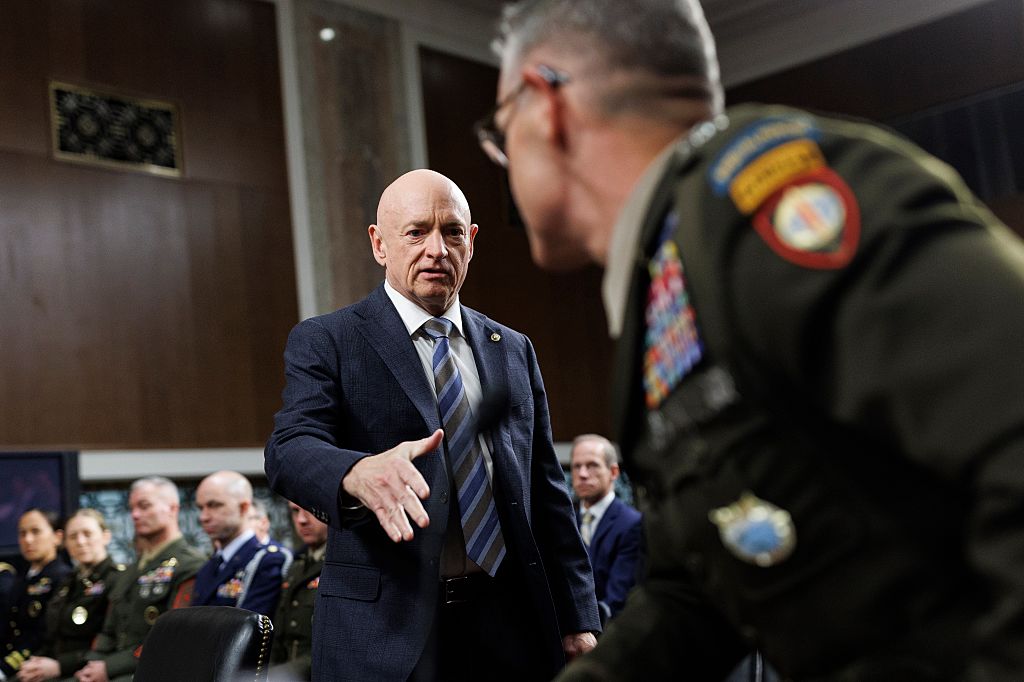
An exemplar of that sort of resistance is the veteran Navy pilot, former astronaut and Democratic U.S. Sen. Mark Kelly, who has publicly fought back against Defense Secretary Pete Hegseth’s attempts to punish him for appearing in an ad that reminded military personnel about their duty to disobey unlawful orders.
Kelly is a threat to Trump precisely because neither the president nor anyone else in his administration can credibly tarnish what might be the greatest currency in Trumpworld—his masculine street cred.
But few people have anything close to Mark Kelly’s glittering resume. One way that citizen-activists, organizers, journalists and influencers at all levels can do their part is to push back, whenever possible, on his and his supporters’ belief that “real men” share their goals and support them.
To the extent that opinion-makers are able to point out the absurdity of the idea that standing with insecure, fragile bullies makes men strong, they can undermine one of Trumpism’s central appeals. In so doing, they can diminish Trump and MAGA’s ability to do even more damage to vulnerable people—and to American democracy.