Every day on the road brings new miles, new faces and new momentum for the ERA.

Inspired by the 1916 suffrage road trip that helped win women the vote, activists behind Driving the Vote for Equality are traveling across the country in the restored Golden Flyer II to build support for recognizing the Equal Rights Amendment as the 28th Amendment. Each week, Ms. will share highlights from the road.
Every day on the road brings new miles, new faces and new momentum for the ERA. But Week 3 underscored something else: The campaign is reaching well beyond traditional activist circles, engaging people in everyday spaces—restaurants, museums, sidewalks and statehouses—across the South.
From Georgia to Tennessee to Alabama to Louisiana, the Golden Flyer II carried the legacy of the 1916 suffrage journey into direct conversation with the present-day push for constitutional equality. At each stop, the approach remained consistent: Meet people where they are, explain the stakes and invite them to take action.
The responses were often immediate and unscripted. A restaurant owner in rural Georgia signed on the spot. A mayor in Knoxville, Tenn. issued a proclamation and added her name. Visitors at civil rights sites in Montgomery, Ala. stopped to ask questions and sign. In Baton Rouge and Lafayette, La., passersby—from veterans to pedestrians on their daily routines—engaged with the campaign, many expressing surprise that gender equality is still not explicitly guaranteed in the Constitution.
Those interactions point to a broader dynamic driving the tour. Public support for the ERA is widespread, but awareness of its current legal status remains uneven. By turning brief encounters into conversations—and conversations into signatures—the campaign is translating passive support into visible, organized demand.
Week 3 offered a clear snapshot of that strategy at work: sustained, on-the-ground engagement building pressure for Congress to recognize the Equal Rights Amendment as the 28th Amendment.
March 15: Atlanta
From Heavy’s Barbecue to the Gold Dome, Through the Storm
Don’t let anyone tell you that rural America is allergic to change.

When Alice Burke and Nell Richardson rolled into the Atlanta area in 1916, they were met in nearby Decatur—before they even reached the city limits—by a surprise welcoming committee of about 75 local women driving 15 cars. Among them: the wife of the mayor of Atlanta and the president of the state suffrage organization. It happened to be Election Day in Decatur, and the crowds gathered at the old courthouse steps were in a highly receptive mood. Local political candidates made speeches on the suffragists’ behalf.
Burke and Richardson then headed into Atlanta for a big meeting that night, a luncheon the next day, and another meeting that evening.
One hundred and ten years later, the Golden Flyer II came to Atlanta through a tornado warning and a blinding snowstorm. The welcome was no less warm.
Augusta, Ga. had long faded into the distance and Atlanta was an hour and a half away when we decided it was time for lunch. We were in the South. Why not barbecue? Our GPS found Heavy’s Barbecue, taking us off the Interstate to a narrow country road. We nearly missed the restaurant—its faded sign from the ’50s, the muddy circular path, rusty farm equipment out front. The screen door flapped as we entered the dark, low-ceilinged building, and the smell of the real thing rose up to greet us.
As we sat there eating our lunch, we realized there was no sign for an eatery—or anything else for that matter—out at the Interstate. The only people who had any reason to know about it were the locals. We had entered another world just south of the Ogeechee River in deeply rural Crawfordville, Ga.
Lydia and Perry Grant had built the place 47 years ago, and Lydia served us the best fall-off-the-bone barbecued pork any of us had ever had anywhere. When we got up to leave, Lydia asked us what had brought us to their door, and when we told her, she was fascinated, asked for more information and enthusiastically signed the Sign4ERA.org petition.
Don’t let anyone tell you that rural America is allergic to change. Lydia and Perry, like so many other Americans, believe in the American dream: Work hard and do good work and you will succeed, if given a chance, if you are treated fairly.
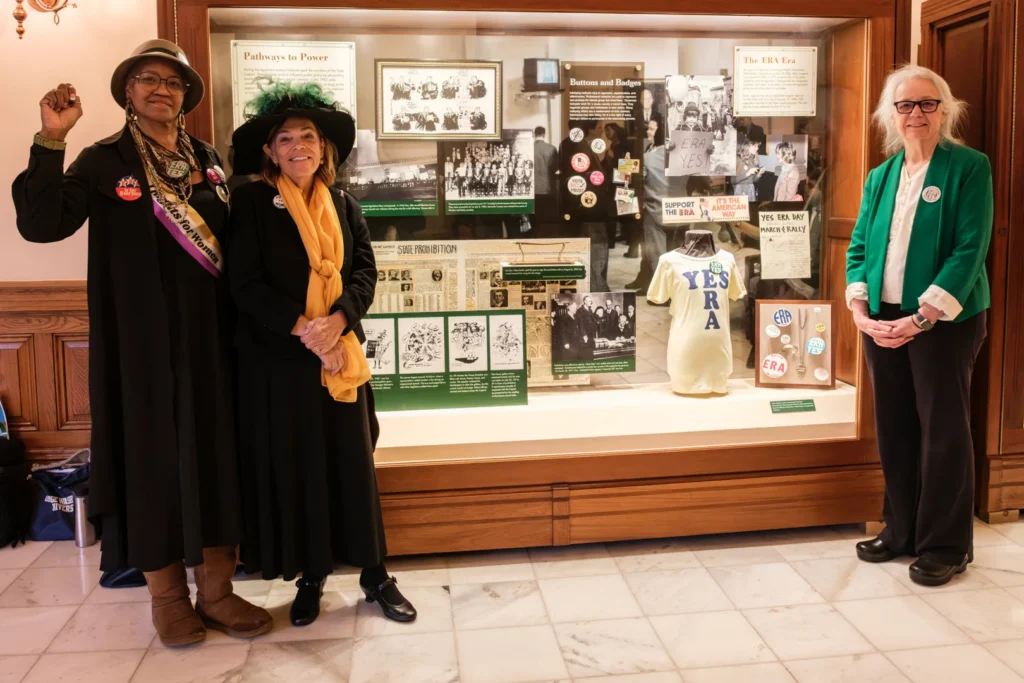
An hour and a half after we left Heavy’s Barbecue, we were in the heart of one of the great cities of the New South. That evening, we had dinner with Sharon J. Hill, who had agreed to orchestrate our visit to this great city. She joined us with ERA Now buttons, sharing her stories about working for civil rights, voting and the rights of all women. She recalled her work with Sen. Cynthia Ann McKinney and her growing involvement with the National Women’s Political Caucus and the National Black Women’s Political Leadership Caucus. Studying the careers of leaders like Dorothy Height, Hill committed herself to the unfinished work those women began—and to doing everything she can to make the ERA part of both the Georgia Constitution and the U.S. Constitution.
Affirming the validity of the ERA has been an uphill battle in Georgia. Though voters have made it plain they support the amendment, the state has not passed a resolution affirming it.

For the second year, joint resolutions have been filed in the Georgia General Assembly, but sponsors Sen. Sally Harrell and Rep. Lisa Campbell do not expect the bill to make it past a second reading. Still, they will not stop trying. “We can do this. We will do this,” Campbell said as she signed the Sign4ERA.org petition.
The next morning, amid warnings of tornadoes, hail and high winds, the team made it to the statehouse.
March 17: Knoxville, Tenn.
Hurrah, and vote for suffrage … Don’t forget to be a good boy.
Febb Ensminger Burn; Aug. 18, 1920
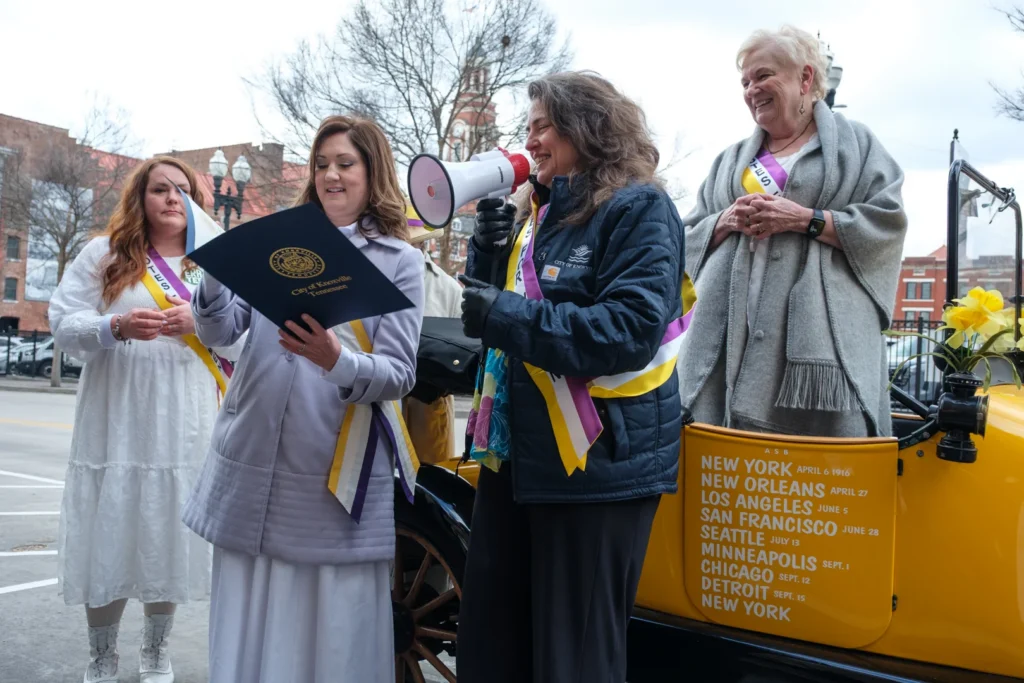
Knoxville, Tenn., was not on our original itinerary. But as we headed south and then west, we got a note from the Women’s Suffrage Museum in that city.
Knoxville has a special place in the history of women’s rights and the U.S. Constitution. In August 1920, the 19th Amendment needed only one more state to be ratified.
On the third vote, 24-year-old Harry T. Burn changed his position after receiving a note from his mother, Febb Ensminger Burn—“Hurrah, and vote for suffrage … Don’t forget to be a good boy.” He did as he was asked, putting the 19th Amendment into the Constitution. Tennessee had put it over the top.
That place in American history is about to be cemented with the opening of the Women’s Suffrage Museum, now under construction, intended to “preserve the suffrage legacy while at the same time propelling our mission forward for generations to come.” When they invited us to bring the Golden Flyer II to Knoxville for an event, we didn’t hesitate. Arriving the previous evening, we woke to a bright day in the 20s with a driving wind whipping around the corner. We could not imagine anyone turning out.
We were dead wrong. The area in front of the site for the new museum was crowded with 35 or 40 people—energized and freezing, but prepared with heavy coats, gloves and boots, and hand warmers provided by our hosts. Not only did they stay for the entire program, but when it was over, they would not let us go. Two local TV stations were there as well, cameras trained on Wanda Sobieski, president of the Women’s Suffrage Museum and Founder of the Suffrage Coalition, as she spoke about Knoxville’s women’s rights legacy and the future of the movement.
Mayor Indya Kincannon welcomed us, saying, “We are really excited to carry forward the torch of equality that these women started on this ride so many years ago.” She read a proclamation recognizing Alice and Nell’s 10,700-mile journey and the role it played in building momentum for the 19th Amendment, and she celebrated the return of that journey through the Golden Flyer II as part of the fight for the Equal Rights Amendment. The crowd erupted in applause as she honored the tour, and later signed the Sign4ERA.org petition herself.
Kathy Bonk spoke about the U.S. Conference of Mayors’ strong resolution supporting the ERA and presented the mayor with an ERA Champion Award. Wanda Sobieski reminded the crowd, “It’s still a man’s world out there, but we’re changing it.” And then, in a moment that captured the spirit of the day, Wanda removed her heavy coat to reveal a 1920s-style dress beneath—standing in the freezing cold, embodying the same determination and commitment as the women who came before. From frozen crowds to a mayor’s proclamation, Knoxville showed up for the ERA in every sense of the word.
March 18: Montgomery, Ala.
From the Freedom Rides Museum to NewSouth Books, the Movement Never Left

Montgomery, Ala., the state capital, is a city rich in American history and civil rights legacy—once the first capital of the Confederacy and, a century later, a central stage for the modern Civil Rights Movement. It is best known as the birthplace of the Montgomery Bus Boycott sparked by Rosa Parks in 1955, and as a home to leaders like Dr. Martin Luther King Jr. Today, the city blends historic landmarks like the Alabama State Capitol and Dexter Avenue King Memorial Baptist Church with a growing downtown, making it both a place of reflection and forward-looking civic life.
That forward-looking city was on full display at every venue we visited. At the Freedom Rides Museum, we were greeted by a reporter from WSFA and a photographer from the Montgomery Advertiser as the Saxon arrived and visitors gathered to ask questions and sign the Sign4ERA.org petition. Asked about the purpose of the Driving the Vote for Equality Tour, Mary Ann Gorman broke it down simply: E is about Economic Equality, Equal Pay and pocketbook issues; R is about Rights, Reproductive Justice and personal decision-making about health care; A is for All people—women and men, daughters and sons.
The Saxon remained parked at the museum, drawing in visitors like Carol Rapport-Sommer and Martin Sommer from New York, both eager to learn about the ERA and sign the petition. From there, we headed to the Rosa Parks Library and Museum, where people engaged with the car, climbed in for photos and heard about the ongoing push to recognize the ERA as the 28th Amendment. At the Legacy Museum—an immersive experience with America’s history of racial injustice—nearly everyone walking by stopped to sign.
As the Saxon was parked across the street, a woman carrying shopping bags ran over, saying, “I know this car. I’ve been reading about it.” She had just left the museum but couldn’t resist crossing the street to see it. She climbed into the car for a photo, explaining she has three daughters and wants the ERA in the Constitution, then left with a copy of Ms. magazine, a button and a petition to share—what had been a one-minute interaction turning into another link in the chain of the movement.
The Golden Flyer II then made its way to Dexter Avenue King Memorial Baptist Church, where Dr. King once preached and helped organize the Montgomery Bus Boycott, before heading to an evening event at NewSouth Bookstore near Court Square—where, in 1916, Alice Burke and Nell Richardson had spoken from their original roadster at an open-air suffrage rally. Inside the bookstore, a hub for progressive activists, community members gathered to hear about the tour, the history of the suffrage movement and the strategy to secure the ERA’s recognition.
As the evening unfolded, Charlene Thomas reminded the crowd that Zonta was one of the first organizations to support the ERA, adding, “together we can move mountains.” Kathy Bonk outlined the need for a joint resolution in Congress, while Mary Ann Gorman urged attendees to take action—signing and sharing the petition, and bringing it to upcoming events. When it ended, no one seemed eager to leave. The conversations lingered, the connections held, and the sense was unmistakable: In a city defined by its history, the work of equality is still very much alive.
March 19: Baton Rouge and Lafayette, La.
Taking the ERA to the Streets, One Signature at a Time
When Alice Burke and Nell Richardson arrived in Baton Rouge on the evening of April 28, 1916, they had just survived a broken leaf spring in the middle of a stream. Undeterred, they parked the Golden Flyer by the curb in front of the Istrouma Hotel, stood up on the car’s seat, and delivered suffrage speeches to a large, engaged crowd—moviegoers who had been tipped off by an announcement flashed on local theater screens. When one man threatened to become boisterous, the police intervened and removed him so the women could finish in peace.
One hundred and ten years later, the Golden Flyer II came to Louisiana with the same spirit and a similar strategy: take the message to the streets and talk to regular people—not just the core of ERA activist groups. In Baton Rouge, the team gathered signatures at the Old State Capitol, home to Louisiana’s first marker on the National Votes for Women Trail, and at the East Baton Rouge Public Library, where the Alice and Nell story landed with the easy authority of someone who has been living inside it for weeks.
A stop along the Mississippi River produced one of the day’s quieter but more resonant moments. Two men—both veterans, one Marine Corps, one Air Force—were staging for a local event when the Golden Flyer II rolled up. After learning about the ERA and the Joint Resolution before Congress, both took a break, asked questions, and signed the petition before returning to their work. The ERA is for all people, women and men. They got it.
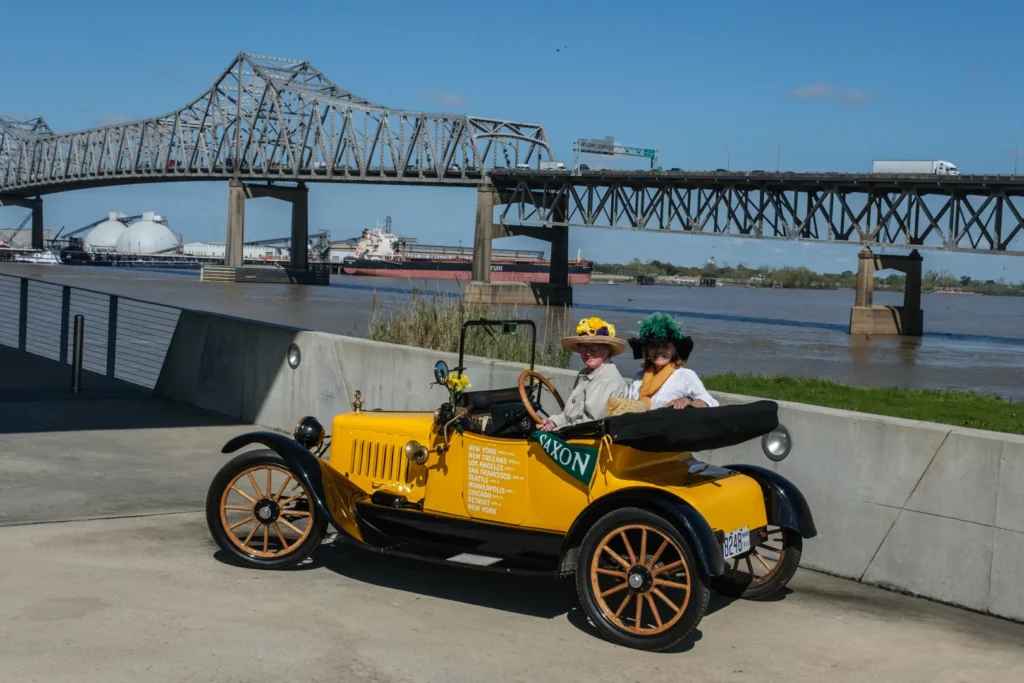
In Lafayette the next day, the team set up on a busy corner near the local post office. Passing cars honked in support. Pedestrians stopped to listen, ask questions, and sign—many surprised to learn that gender equality is still not explicitly guaranteed in the Constitution. One man paused and said simply, “I’m sorry we don’t have equality yet.” That’s the reaction this tour has been producing at every stop—not just among committed activists, but among people who simply didn’t know.
That moment points to a larger truth behind the tour. Petitioning is not a new tactic; it is a proven strategy used from the founding of the country through the original suffrage movement to secure constitutional change. From the First Congress to Seneca Falls to the million-signature campaigns of the 1910s, petitions have never been symbolic—they have been a way to force elected officials to confront issues they might otherwise avoid.
Today, Sign4ERA applies that same strategy. More than 80 percent of Americans support the ERA, but polling alone does not move Congress—constituents do. A petition signature identifies a voter, creates accountability, and transforms passive support into active demand. At scale—hundreds of thousands, ultimately millions of signatures across all 435 congressional districts—that demand becomes visible, organized and impossible to ignore.