In This Edition:
Weekend Reading on Women’s Representation is a weekly compilation of stories about women’s representation in politics, on boards, in sports and entertainment, in judicial offices and in the private sector in the U.S. and around the world—with a little gardening and goodwill mixed in for refreshment! Published every Friday.
Milestones this week in history: The Equal Pay Act was signed into law (1963), and Kay Bailey Hutchison became the first female senator from Texas (2017).
Birthdays this week: Barbara Bush, former first lady (1925); Ida McKinley, former first lady (1847); Kathy Spillar, executive editor of Ms. magazine; Louise Duggan, Vote Mama Foundation; Celia Nicholson, actor; Katie Shewfelt, organizer for grassroots movements; Claire Sleigh, mixed-methods researcher; Mayah and Micah Nicholson; Ruby Coleman, Initiative 83 organizer; Andrea Campbell, first Black woman attorney general of Massachusetts; Lindsey Drath, Forward Party; Jeannette Rankin, first woman elected to Congress (1916); Liz Abzug, daughter of former U.S. Rep. Bella Abzug; Julia Addington, possibly the first woman to hold elected office (1829); Marie Cope Nicholson; Miriam A. Ferguson, 29th and 32nd governor of Texas; Martha Washington, former first lady (1731); Lisa Wood, Sophon Consulting; and Teresa Younger, CEO of the Ms. Foundation.
As D.C. Holds Its First Ranked-Choice Voting Primary, a Bigger Story Emerges: Election Reform Can Expand Women’s Path to Political Power
On Tuesday, Washington, D.C., will hold its first-ever ranked-choice voting election in its primaries. I have lived and worked in the Washington area for most of my adult life, and I have been working toward moments like this one for just as long. It has been a long time coming—and long overdue.
It follows Maine’s primary this past Tuesday, in which voters used ranked-choice voting to decide their nominations, and it comes at a point in the 2026 election cycle when the primaries are no longer an abstraction on the calendar. They are happening week after week, and the data they produce is starting to tell a clear story about where women stand, which systems are opening doors, and which are keeping them shut.
This is what brought us together this week for our latest Democracy Solutions Series webinar. Our communications director Alana Persson led a conversation on the primaries and women’s representation with three remarkable guests: Beth Hladick, policy director at Unite America, who has spent years documenting the national “primary problem”; Bianka Emerson, president of Colorado Black Women for Political Action, who brought decades of campaign experience and the perspective of a candidate navigating the election cycle in real time; and Sila Avcil, executive director of NM Voters First, who helped carry New Mexico’s semi-open primary over the finish line after a decade of organizing.

What the three of them laid out together was something I think about constantly: the primary is often the real election. According to coverage from Unite America, 92 percent of U.S. House seats nationwide are considered safe for one party, not the November general—it is where representation is won or lost.
And in 2026, already 40 percent of the House has been determined by just 3 percent of Americans voting in those primaries. When the meaningful election happens in a low-turnout and, in many states, in a closed-party contest, the barriers compound in ways that fall hardest on women, on candidates of color, and on anyone who hasn’t spent years accumulating the kind of insider networks and institutional support that our current system rewards.
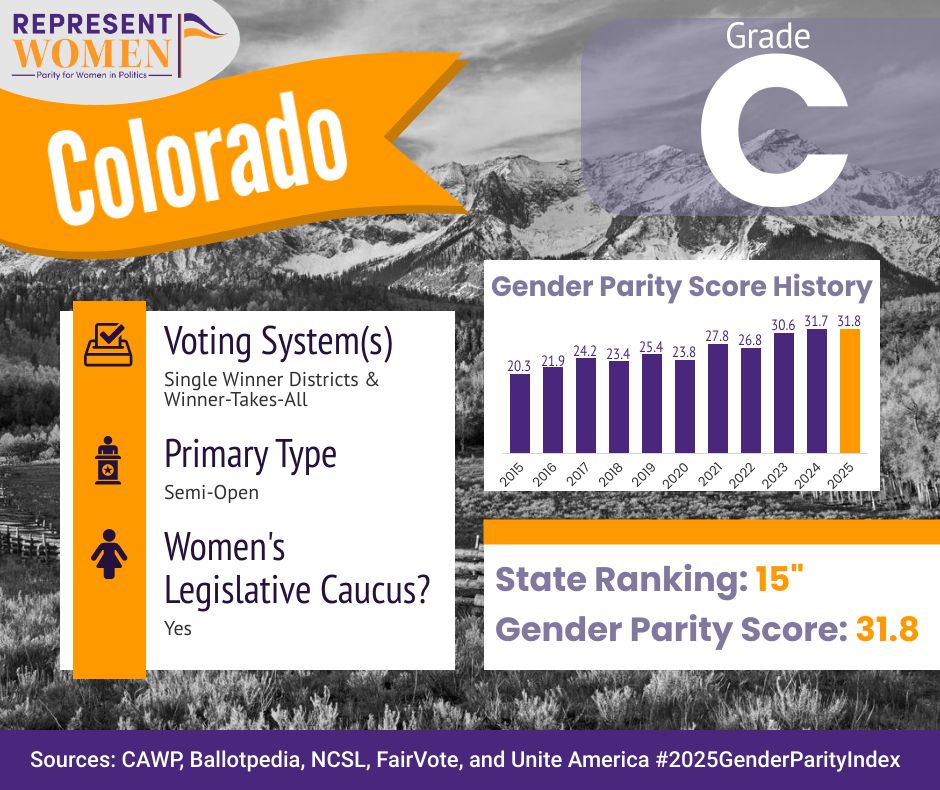
What struck me the most, listening to Emerson, was something I don’t think gets said enough: In Colorado, 47 percent of women are registered independents, and those women are effectively locked out of the ballot access process entirely. They can’t sign the petitions candidates need to qualify, and they can’t participate in the party assemblies.
The path to the ballot was simply not built with their participation in mind—and you can see it in our Gender Parity Index data: Colorado scores just a 5.6 out of 30 for Congress.
That is not an accident—it is a design problem.
Avcil’s story from New Mexico was one I found myself holding onto long after the conversation ended. New Mexico is already one of only five states where women hold a majority of seats in the lower chamber—54 percent as of 202—and this cycle is building on that momentum in remarkable ways.
Former interior secretary and sitting U.S. Rep. Deb Haaland, won the Democratic gubernatorial nomination, and if she is successful in November, she would become the first Native American woman governor in United States history.
I was also heartened to hear about the ongoing work to expand ranked-choice voting across the state, including efforts to bring it to Albuquerque, where Santa Fe and Las Cruces have already adopted it and seen it work. Our own data show that women hold 55 percent of city council seats in cities that use ranked-choice voting, compared to roughly 25 percent nationally. New Mexico is already demonstrating what is possible when women are at the center of the political scene, and it was heartening to hear that Avcil believes, as do I, that ranked-choice voting would only accelerate it.
And then there is Alaska—Hladick’s home state, and she spoke about it with a sense of pride and enthusiasm that only comes from watching something actually work in a place you love. Alaska’s primary isn’t until Aug. 18, but after adopting an all-candidate primary paired with a top-four ranked-choice voting general election, more women ran for statewide office in 2022 than the previous five election cycles combined. And the trend has continued since. What Alaska has shown us is that when voters are given a real choice, they choose women. I have believed that for a long time, and Alaska is proving it.
What I took away from our conversation this week—and what I find myself returning to as I watch D.C. prepare for its first RCV primary—is that the rules are never neutral. They shape everything: who runs, who wins, and ultimately, whose voices get heard. Changing them is slow and often unglamorous work, but it is the work. And I am grateful every day to be doing it alongside people like Hladick, Emerson and Avcil, and the thousands of advocates across the country who refuse to accept that the system we inherited is the best that we can do.
Jeannette Rankin Knew Election Rules Matter
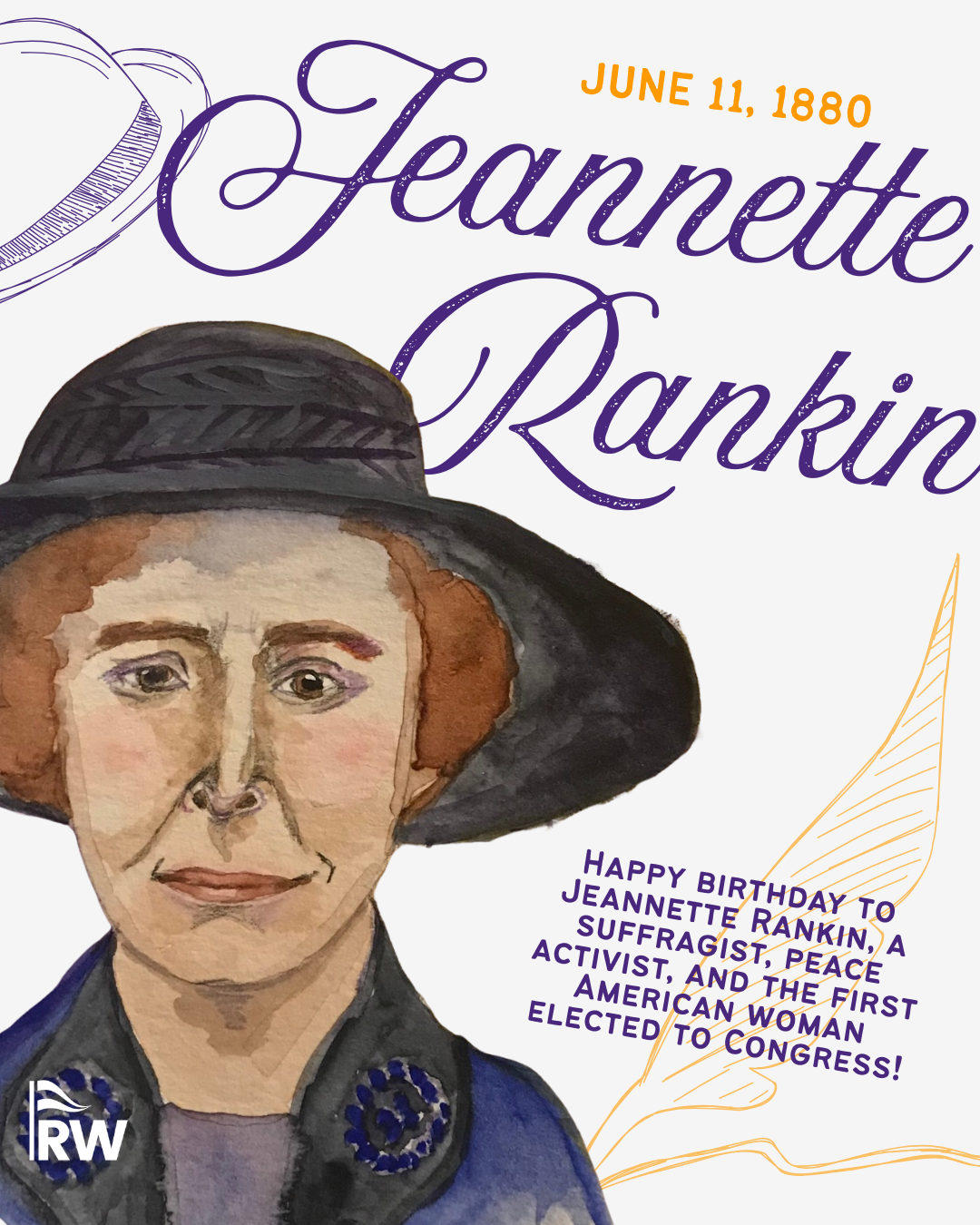
June 11 marked the birthday of former U.S. Rep. Jeannette Rankin, the first woman elected to federal office in the U.S. As a Republican from Montana, Rankin served two terms in the House of Representatives in 1917 and 1941. During her time in office, she helped pass the 19th Amendment, stood in strong opposition to war, and was a staunch supporter of electoral reform.
Rankin was first elected in 1916 to a multi-member district. However, she only served one term because Democrats switched to a single-winner system while she was in office, making it nearly impossible for her to secure reelection. A trailblazer in her own right, Rankin campaigned by listening to voters and local communities. As a suffragist, Rankin knew how to talk to people and she understood the importance of an electoral system that places voters at the forefront.
At RepresentWomen, we’re working to continue the groundwork that Rankin laid. Her election is evidence that women’s political power is built by design. We’re working to break down the barriers that prevent women from running and winning elections, the same barriers that Rankin fought over 100 years ago.
Join us in celebrating Jeannette Rankin’s legacy as she continues to inspire us to defy the odds, to speak up, and to never stop advancing women’s representation.
If you’re interested in learning more about Jeannette Rankin, consider reading Lorissa Rinehart’s Winning the Earthquake, the first major biography of Jeannette Rankin.
Will Ranked-Choice Voting Elect a Second Straight Woman as Maine Governor?

Maine elected Janet Mills as its first woman governor in 2018 after Mills emerged as the winner of Maine’s first ranked-choice voting gubernatorial primary despite being outspent in the seven-candidate Democratic field.
This week, voter turnout soared from 2018 in a hotly contested five-candidate primary where a man led in first choices, but those forecasting outcomes believe that either former House Speaker Hannah Pingree (second in first choices with 23 percent) or Secretary of State Shenna Bellows (fourth in first choices with 21 percent) will emerge on top because they are by far the strongest candidates when measured as securing second-choice support.

Pingree’s mother, Chellie Pingree, is also well-positioned to stay in Congress after her primary win in the 1st Congressional District.
Here was FairVote’s post-primary analysis, followed by a chart showing Bellows and Pingree as being strong coalition builders:
“Despite Shah’s narrow first-choice lead, Pingree, Bellows, or Jackson could “come from behind” to win. The three candidates cross-endorsed in May, telling their voters to rank the other two highly to increase the chances one of them could win a majority. Come-from-behind victories are rare in RCV elections, occurring in about 9% of elections that have no first-choice majority winner. However, when come-from-behind victories occur, it is RCV working how it is supposed to – that is, preventing vote-splitting and/or rewarding candidates with deep and broad support over those who win only a small plurality…
Overall turnout is already 39% higher than the last open-seat gubernatorial primaries in 2018, and is expected to increase as additional ballots are counted. Democratic primary turnout is up 60% compared to 2018, and Republican primary turnout is up 12%.”
Washington, D.C., Primaries Approach with Ranked-Choice Voting; Maryland Gathering Steam to Support RCV
On June 16, Washington, D.C., will hold its first primary elections with ranked-choice voting, with women having real chances to secure wins in a special election for D.C. City Council and in Democratic primaries for mayor, congressional delegate and open City Council seats. See analysis of a poll showing City Council member Janeese Lewis George well-positioned to win the mayoral primary,
Led by RepresentWomen board chair Michelle Whittaker, RCV Maryland has been doing terrific work building support for RCV and proportional RCV in neighboring Maryland. Here was an encouraging update sent out by email:
“The results are in, and they’re remarkable. Our 2026 Stronger Voices Candidate Survey received responses from over 300 candidates running for Maryland offices ahead of the June primaries. The finding? More than 70% support local and statewide efforts to adopt ranked-choice voting.
This is a watershed moment. Ranked-choice voting isn’t just supported by grassroots voters anymore—it’s becoming a mainstream position among Maryland’s political candidates across the spectrum. From local council races to statewide elections, candidates recognize that RCV leads to more representative outcomes and ensures winners have broad community support.
This groundswell of support reflects years of education, relationship-building, and proving that RCV works. Maryland Comptroller Brooke Lierman said it best: “Ranked-choice voting is an investment in the future of our democracy. It’s a smart reform that will strengthen democracy and trust in government across the country.”
With candidates and voters both embracing RCV, now is the time to accelerate our efforts. We’re organizing in Annapolis, College Park, Hyattsville, Frederick, and Rockville. We’re supporting Takoma Park’s 2026 election and Greenbelt’s implementation for 2027. We’re building the infrastructure to make RCV accessible across Maryland!”
June 9 Primary Rundown: Nevada, South Carolina and North Dakota
The Center for American Women in Politics (CAWP) released a comprehensive post-primary analysis following the June 9 primaries, which will be updated as new results come in. Here are highlights:
Nevada
- Women are 4 of 8 (50%) major-party nominees for U.S. House in Nevada, including 3 of 4 (75%) Democrats and 1 of 4 (25%) Republicans. Both incumbent women U.S. representatives from Nevada are Democratic nominees for re-election to the U.S. House in November. U.S. Representative Susie Lee (D) will compete in a general election contest currently rated as “Lean Democrat” by Cook Political Report. U.S. Representative Dina Titus (D) will face Nevada state Senator Carrie Buck (R) in an all-woman general election contest that is currently rated as “Likely Democrat” by Cook Political Report.
- Women are 4 of 10 (40%) major-party nominees for statewide elective executive office in Nevada, including 3 of 6 (50%) Democrats and 1 of 4 (25%) Republicans. Three women candidates remain in the Republican primary for secretary of state, which is too close to call.
- A woman is all but assured to win in the all-woman, open-seat contest for attorney general between Nevada state Senate Majority Leader Nicole Cannizzaro (D) and Adriana Guzmán-Fralick (R). If successful in her bid for state treasurer, Democratic nominee Tya Mathis-Coleman (D) will be the first Black woman elected to statewide elective executive office in Nevada. Nevada state Assemblywoman Sandra Jauregui (D) won the Democratic nomination for lieutenant governor. She will challenge incumbent Lieutenant Governor Stavros Anthony (R) in November.
- No women advanced to the general election for governor. No woman has served as governor in Nevada.
North Dakota
- Incumbent U.S. Representative Julie Fedorchak (R) is strongly favored to win re-election to the U.S. House in November.
- Women are 3 of 14 (21.4%) major-party nominees for statewide elective executive office in North Dakota, including 0 of 6 (0%) Democrats, 2 of 6 (33.3%) Republicans, and 1 of 2 (50%) nonpartisans.
South Carolina
- Lieutenant Governor Pamela Evette (R) has advanced to the runoff election for the Republican nomination for governor.
- Annie Andrews (D) won the Democratic nomination for the U.S. Senate in South Carolina. She will challenge incumbent U.S. Senator Lindsey Graham (R) in a contest currently rated as “Solid Republican” by Cook Political Report. If successful, she would be the first woman in the U.S. Senate from South Carolina.
- Of the 4 (3D, 1R) women nominees for U.S. House in South Carolina, only incumbent U.S. Representative Sheri Biggs (R) is currently favored to win in November. Incumbent U.S. Representative Nancy Mace (R) will not return to the U.S. House; she was unsuccessful in her bid for governor.
Los Angeles Mayoral Election Will Be an All-Woman Runoff
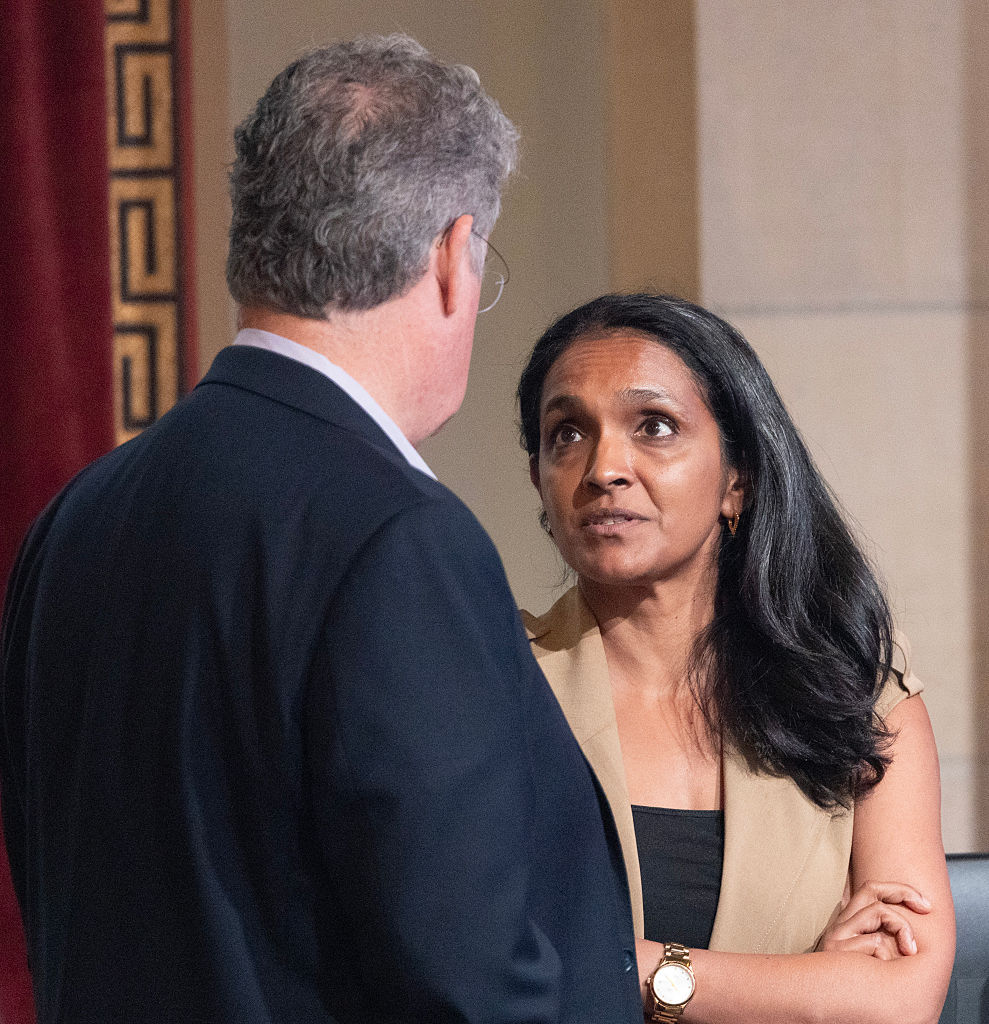
In 2022, Karen Bass became the first woman elected to be mayor of Los Angeles. After this month’s primary, Los Angeles is sure to keep a woman as mayor, after City Council member Nithya Raman secured a spot in a runoff, currently holding 29 percent of the vote compared to Bass’ 34 percent. The New York Timescovered the contest:
“Nithya Raman, a progressive Democrat who has drawn comparisons to New York’s mayor, Zohran Mamdani, will face Mayor Karen Bass of Los Angeles in a two-person race in November, The Associated Press determined on Monday. Ms. Raman, 44, a City Council member and former Bass ally, was behind in the initial vote count but came back in later returns to edge out Spencer Pratt, a Republican reality TV star…
The race between Ms. Raman and Ms. Bass, 72, sets up a generational contest between the center-left Democratic establishment that has shaped the city for years, and the young, restive progressives who have charged that baby boomers’ housing policies have systematically priced them out of Los Angeles.
Political experts pointed out that the general election turnout will be significantly larger and more progressive compared with the primary electorate, an advantage for Ms. Raman. Polls show that she has captured the imagination of a younger and more progressive generation of constituents, and that she will pose a formidable challenge to Ms. Bass in a one-on-one matchup.”
Four Women from San Francisco Are Poised to Dominate California’s Statewide Ballot
California’s June primary produced a striking result where four women from San Francisco are leading races for statewide office, potentially reshaping Sacramento’s leadership in November.
Former San Francisco supervisors Fiona Ma, Jane Kim and Malia Cohen are front-runners for lieutenant governor, insurance commissioner, and state controller respectively. Incumbent Lt. Gov. Eleni Kounalakis, a San Francisco resident and former diplomat, is leading the race for state treasurer. If the results hold through November in heavily Democratic California, all four are well-positioned to win.
The San Francisco Standard reports:
“Susannah Delano, executive director of the California-based nonprofit Close the Gap, which recruits and supports women running for office, said women’s representation in statewide offices is at a historic high.
“Thanks to these San Francisco women, we’re definitely in a position to maintain [that representation] after November and maybe even build on it,” Delano said.”
The results underscore San Francisco’s long track record as a launching pad for women’s political careers, including Kamala Harris, Betty Yee, and now potentially a historic sweep of statewide offices.
As former San Francisco Democratic Party chair Mary Jung put it: “These candidates have to have it all: intelligence, diligence and a commitment to public service.”
The Young Conservative Women Who Helped Elect Trump Are Starting to Have Doubts
Less than six months from the midterms, some of the young conservative movement’s most prominent voices are warning that those women could sit out November entirely. Politico attended Turning Point USA’s Women’s Leadership Summit in San Antonio and spoke with influencer Savanna Faith Stone and other prominent figures about this shift:
“Promises that were made have not been delivered on at all, and I think young women are realizing that,” Stone said in an interview with POLITICO. “They’re realizing, ‘Hey, you promised lower gas prices. You promised the economy would be better. Like, that’s why we voted for you.’”
… But bubbling under the surface are divisions within the GOP that have enveloped the online voices of the young right and a budding disillusionment among young women with the politics of the second Trump administration. It’s all part of a growing divide between being “MAGA” in 2026 and being “America First.”
Trump is “not America first,” Stone said. She voted for a president who promised no new wars, who was pro-family and would bring down costs. “It’s harder than ever for a young couple to be able to buy a home,” she added.”
Why Women Politicians Still Can’t Have It All And What It Takes For Change

A new study in Politics & Gender surveyed national and state legislators in Germany and found that women parliamentarians consistently perceive combining politics and parenthood as more difficult than their male colleagues do regardless of party.
However, shared experience doesn’t automatically produce shared political will. When it comes to reforming parliamentary workplaces to accommodate parents, party ideology matters more than gender. Women in socially traditionalist parties join their male counterparts in opposing family-friendly reforms even while reporting that the current system is harder on them.
As the authors wrote it in the conclusion:
“Strikingly, our survey indicates that shared gendered experiences do not produce shared policy preferences. Among our survey respondents, being a woman is associated with the common perception that combining politics and parenthood is difficult. This perception holds regardless of party ideology. But when it comes to improving the situation, party ideology becomes influential. Notably, we still see a gender gap, with women more supportive of accommodations than men, but here we also see a gap between women in progressive versus traditionalist parties. Indeed, men in progressive parties are more supportive of policies to accommodate parents than are women in traditionalist parties. Thus, a key contribution of our study is to identify where party ideology matters less, that is, in how women perceive and experience politics and parenthood, and where it matters more, that is, in supporting reforms that would benefit women.”
The accommodations at stake should be the standard. Workplace baselines should include protected parental leave for members of parliament, the ability to bring infants onto the chamber floor, flexible childcare, and proxy voting for when a child is ill. These provisions are often viewed as fundamental, yet most parliaments and legislatures, including in Germany, still lack these basics.
The structural barriers documented in Germany have their American counterpart. The Vote Mama Foundation is working to break down the barriers moms face while running for office and normalize moms running with young children.
As the only organization tracking the number of mothers with young children serving in state legislatures across the country, Vote Mama Foundation is producing the only publicly available demographic dataset of all women state legislators in the U.S.
The German study’s core insight that institutional reform is what makes political participation sustainable for mothers is precisely what Vote Mama Foundation champions.
Liberation: Tony for Best Play Is First for an American Woman Since 1989

I was moved to have seen the play Liberation on Broadway, and it’s so deserving for winning the 2026 Tony Award for best new play in the wake of securing a Pulitzer Prize for Best Play. Shockingly, its playwright Bess Wohl is the first American woman to win the Tony for Best Play since 1989.
Votes for women! Bess Wohl’s Pulitzer-winning “Liberation” has won the Tony Award for best play. This is the first win by an American woman in the category since Wendy Wasserstein won for “The Heidi Chronicles” in 1989.
A mordant, tender memory play, “Liberation” takes place both in the early 1970s as a frustrated young journalist, Lizzie (Susannah Flood), forms a consciousness-raising group, and in the present day as Lizzie’s daughter (Flood again) tries to reckon with her mother’s life and achievements. The play is both deeply personal (it was inspired in part by Wohl’s mother, Lisa Cronin Wohl, a writer for Ms. Magazine) and a broad, heartbreaking exploration of how the gains and losses of second-wave feminism resonate today. It also contains a gentle and surprising nude scene.
“The miracle of this play is that the circle feels as if it is extending to embrace us all,” Elisabeth Vincentelli wrote in The New York Times.
And don’t miss the beautiful words honoring women from Tony Award winner Shoshana Bean as an actor in the musical Lost Boys. Here’s the text of what she said:
This is for the mamas. This is for the single mamas. This is for my single mama. You are the wild heroes. This is for the incredible army of women that surround and uplift me. This is for every woman who ever felt like she was too much or not enough. I beg you not to wait for permission to be all of who you are. Take up space. Make your own path, make mistakes, make messes, make new things. Be free, be loud, be brave.”
A Night That Reminded Me Why This Work Matters
Thursday, I joined the NEW Leadership Networking Reception, Dinner, and Panel Discussion, and left feeling more grateful than I expected to—for the honor of receiving the Minding the GAP Leadership Award, and even more so for getting to spend the evening with some of the RepresentWomen team. Moments like that remind me why this work matters and who I get to do it with.

It was such a lovely night spent with Ellie Smeal, the former president of NOW, co-founder and president of the Feminist Majority Foundation, and my boss on the ERA campaign I ran in Iowa in 1992. I was also so grateful to be joined by our “D.C. delegation” of RepresentWomen staff members, including Courtney Lamendola, Tamaya Dennard, Tori Wyman and Peng Gao.