Only the most jacked-up soldiers can fulfill his military fever dream. But if we’re going to talk about hormones…
Originally published by The Contrarian.
The Trump administration has gotten rather … hormonal. As someone who cares deeply about the science and politics of all kinds of bodily matters, including and especially hormonal health and treatments, it is a truly bizarre exercise to unpack the latest news.
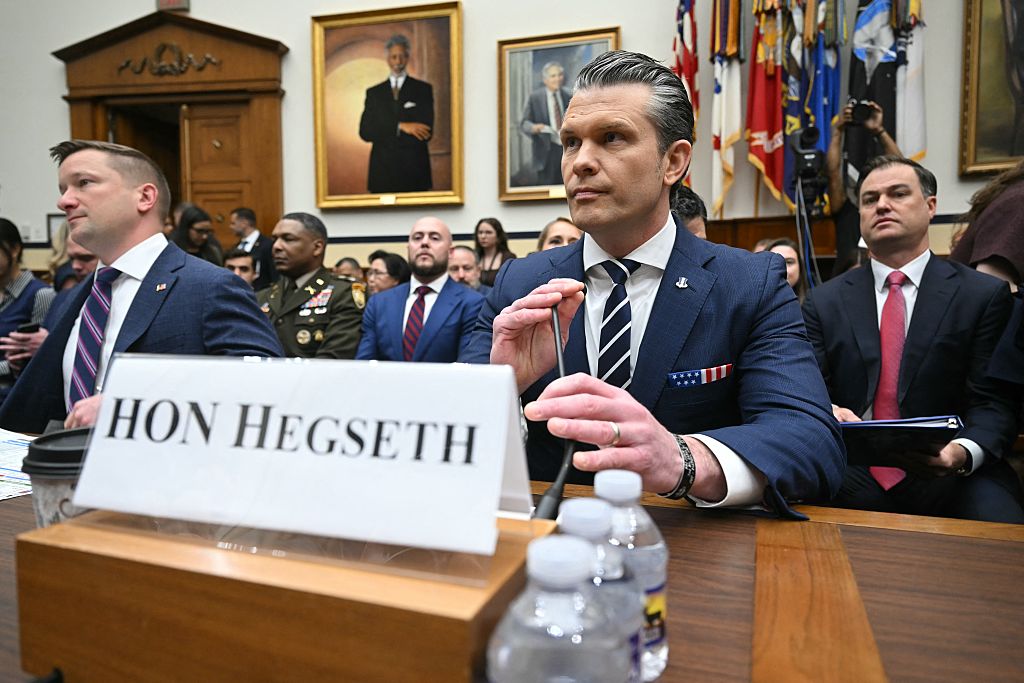
Last week, the defense secretary took to the airwaves to announce new mandatory screening of testosterone levels for all military members over 30, arguing the need to “optimize performance,” “combat Operator Syndrome” (a physical and behavioral condition uniquely attributed to soldiers who undergo intense training) and “maximize mission readiness.” Anyone deemed testosterone-deficient will be offered hormone therapy, presumably including the 230,000 women in active-duty service—who presumably may seek access to estrogen, progesterone and/or testosterone. (Hard to say, given women were not mentioned.)
… I am taking the moment to chime in with my own preferred proposal for testosterone: Approve its usage for women, pronto.
The announcement’s optics and the proposed policy itself smack of manosphere influence and Pete Hegseth’s hyper-macho obsession with a “High-T Department of War.” Earlier this year, the Trump administration bragged about the president’s off-the-charts testosterone levels—according to Dr. Oz, the highest he has ever seen in a man over 70.
A group of Democratic senators, in a Monday letter, demanded details and raised red flags:
“Coupled with the Department’s recent repeated efforts to redefine military culture around an exaggerated conception of masculinity, this initiative risks undermining years of work to ensure that women servicemembers are evaluated and valued based solely on their ability to perform the mission.”
Endocrinologists and military veterans also responded to Hegseth’s video, making the case that testosterone treatment is not for everyone and that hormonal levels alone don’t measure the performance skills—leadership, bravery, precision, judgment—vital to military combat.
But of course, debate over optimal hormonal health is hardly the point. Only the most jacked-up soldiers fulfill Hegseth’s military fever dream—which he has made clear is devoid of women, whom he wants removed from combat roles altogether. (He also has continued to block promotions of active-duty female Naval officers.)
The Trump administration has already banned transgender soldiers, at least based in part on the theory that their hormone treatments—though, in this case, they’d call it gender-affirming care, with a sneer—would be challenging to sustain.
To be clear, managing testosterone is a legitimate concern for millions of adults. Hegseth’s plan comes on the heels of a public memo issued by the Department of Health and Human Services that seeks to:
- revise limits on the use of testosterone products in men with age-related low testosterone, and
- direct the Food and Drug Administration (FDA) to revise related product warning labels. (Last November, the FDA did something similar for menopause hormone treatments with estrogen.)
It is not easy for me to put aside Hegseth’s distorted recasting of testosterone. That said, it happens to be true that federal regulatory guidelines for its usage are in need of an update and upgrade. As a menopause advocate, I fight hard for a world in which accessible, affordable hormonal care and treatment is a priority for all.
… Which is why I am taking the moment to chime in with my own preferred proposal for testosterone: Approve its usage for women, pronto. (See this excellent New York Times Magazine series about why and how more midlife women are using testosterone as part of their menopause regimen.)
Testosterone is currently only FDA-approved for men, making the United States an outlier; Australia, New Zealand, South Africa and the U.K. all have women’s versions on the market. For women, including those in the military, this means having to find an experienced clinician willing to prescribe it off-label and then either microdosing a prescription formulated for men or settling for a compounded and (therefore not FDA-regulated) product.
Since testosterone is generic (translation: cheap to produce), drug companies are going to be hard-pressed to invest in a women-dosed version without slapping a pink tax on it or dramatically jacking up the price.
… Which leads to another worthwhile reform at the ready: Make sure it remains affordable and fully covered by insurance. State legislatures in Illinois, Louisiana, Maryland, New Jersey, Oregon, Utah and Washington have enacted laws to mandate insurance coverage of estrogen treatments—the start of what should be a nationwide trend.
Access matters too. Ever since the FDA revised the label on menopause hormone treatments, manufacturers are claiming the resulting surge in demand is making it impossible to keep up. (Have you tried to get an estradiol patch lately? The chase is real.) But the so-called “patch shortage” is actually the product of a broken insurance system. (Read more at the expose I co-wrote about it for the Los Angeles Times.)
Improving transparency in pharmaceutical supply chains is poised to be another much-needed intervention that will benefit all who are prescribed hormone treatments.
In this political environment, it is a tall order to find any silver linings. In this case, I’ll take the opening to make the case for better access to hormonal care—for all.
*
A note from Ms. editors: We want to hear from you for The Majority, a new campaign collecting stories about how reproductive freedom has enabled readers to build the lives they want and need.
Poll after poll shows a majority of Americans support reproductive healthcare access. Yet public debate overlooks the lives shaped by abortion access, contraception, IVF, miscarriage care, maternal healthcare or comprehensive sex education—countless women who chose to pursue an education, have children, not have children, protect their health and chart their own future. What’s your reproductive freedom story? Add your voice. Together, these stories will help show not only why reproductive freedom remains a majority value, but also what it makes possible.