August 2026 Reads for the Rest of Us

Each month, Ms. rounds up some of the most exciting new books by writers from historically marginalized communities—authors whose work too often gets overlooked in a publishing landscape still dominated by white, cisgender, heterosexual men. The hope is not only to amplify these voices and the independent presses championing them, but also to encourage readers to seek them out, whether by buying, borrowing or recommending them.

This August’s list grew beyond the usual 10 selections because there were simply too many remarkable books to leave behind. From novels in translation and groundbreaking histories to feminist resistance, gender, incarceration and contemporary fiction, these 15 titles offer fresh perspectives, unforgettable storytelling and urgent ideas.

Whether you’re looking for literary fiction, political analysis or thought-provoking nonfiction, there’s something here to add to your late-summer reading stack.

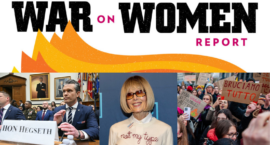
War on Women Report: Hegseth Blocks Promotions of Women in Navy; Trump Finally Pays E. Jean Carroll; Colorado Police Pray With Abortion Clinic Harassers

MAGA Republicans are back in the White House, and Project 2025 is their guide: the right-wing plan to turn back the clock on women’s rights, remove abortion access, and force women into roles as wives and mothers in the “ideal, natural family structure.”

We know an empowered female electorate is essential to democracy. That’s why day after day, we stay vigilant in our goals to dismantle patriarchy at every turn. We are watching, and we refuse to go back. This is the War on Women Report.

Since our last report:
—Celebrity women are 3.5 times more likely than men to be deepfaked.
—The Department of Health and Human Services abruptly canceled $68 million in federal grants under the Teen Pregnancy Prevention Program.
—Planned Parenthood clinics regained access to millions of dollars in essential federal funding. The temporary ban was originally approved in July 2025 as part of the One Big Beautiful Bill Act. The denial of federal funding over the past year forced Planned Parenthood to close nearly 30 health centers nationwide, impacting roughly 40,000 patients. Despite regaining an estimated $800 million in annual federal funding, ongoing financial uncertainty at both the state and federal levels means the shuttered clinics will not reopen.
—Maine U.S. Senate candidate Graham Platner has suspended his campaign after a former girlfriend accused him of raping her nearly five years ago.
—For the first time in a decade, no active-duty women naval officers will be promoted to admiral this year.
—Police officers in Boulder, Colo., were photographed pausing to pray with antiabortion protestors harassing the RISE Collective, an all-trimester abortion clinic, after concerned RISE Collective staff alerted the police of the protestors’ presence.
—Abortion-rights organizers in Idaho have been working to collect signatures for a proposed ballot measure that would restore abortion rights in the state, revoking Idaho’s total ban. On July 2, volunteers gathered in Boise to turn in over 110,000 signatures they collected for the initiative (called the Reproductive Freedom and Privacy Act). About one-quarter are from registered Republicans, demonstrating support for abortion rights is widespread even in deep red states.

… and more.

Who’s Paying the Price for Trump’s Medicaid Cuts? Communities of Color and People Living With HIV.

President Trump and his Republican backers have been determined to gut the Affordable Care Act (ACA) and expanded Medicaid coverage ever since his first term in office. This year he is finally getting his way, putting the health of tens of millions of Americans at risk.

It is racial minorities and the chronically ill who will be the most harmed.

A year ago, Congress passed the so-called One Big Beautiful Bill Act, putting in place onerous new eligibility requirements for Medicaid coverage, including work requirements. Medicaid enrollees ages 19 to 64 must complete at least 80 hours a month of work, community service, job training or education to maintain coverage, unless they qualify for an exemption. All states must comply with the new rule by Jan. 1, 2027.

The combination of ACA cuts and new barriers to Medicaid enrollment will likely cause historic coverage losses across the United States for years to come, according to new research: Nearly 16 million people stand to lose coverage by 2034.

Domestic Violence Is a Men’s Issue

Nearly one in two women has experienced domestic violence (DV) in their lifetime, yet accountability remains limited, as nearly half of survivors never report their abuse to law enforcement. Out of fear of retribution, survivors often minimize harm and shield their perpetrator’s behavior, shifting responsibility away from them: “That’s just how men are,” or “He didn’t mean it.” DV affects almost everyone—directly or indirectly. Nearly half of people know someone who has experienced it, through personal experience, witnessing it in childhood, seeing loved ones endure it or encountering it in public spaces. 

DV has taught me about silence. The silence of victims who feared retaliation or shame. The silence of witnesses like me who did not know how to intervene. And the silence of communities that preferred to avoid conflict and not to disrupt the image of a functional family. Silence does not protect anyone; it allows the harm to continue. 

In America, toxic masculinity thrives in that silence. It discourages men from seeking help, discourages women from speaking out and discourages bystanders from stepping in. Over time, domestic violence becomes predictable as patterns emerge—slammed doors, raised voices, a tension that fills rooms before anyone speaks.

Over time, beneath their rage, I’ve come to understand that many male abusers are suffering too or have suffered. The problem is, intimate partner violence will not end by ignoring men. This raises essential questions beyond how did we get here, in a nation that champions violence and spends more on its military than on education and social services. For example, who is intervening to address husbands and boyfriends who batter? What tools are needed to support men in building lives free from violence? Let’s be clear, addressing these challenging concerns will not only benefit men, but also their families and society more broadly. Families deserve to heal from domestic violence, and men should be part of that equation.   

Hegseth’s Testosterone Bit Isn’t About Health

The Trump administration has gotten rather … hormonal. As someone who cares deeply about the science and politics of all kinds of bodily matters, including and especially hormonal health and treatments, it is a truly bizarre exercise to unpack the latest news.

Last week, the defense secretary took to the airwaves to announce new mandatory screening of testosterone levels for all military members over 30, arguing the need to “optimize performance,” “combat Operator Syndrome” (a physical and behavioral condition uniquely attributed to soldiers who undergo intense training) and “maximize mission readiness.” Anyone deemed testosterone-deficient will be offered hormone therapy, presumably including the 230,000 women in active-duty service — who presumably may seek access to estrogen, progesterone and/or testosterone (hard to say given that women were not mentioned).

But of course, debate over optimal hormonal health is hardly the point. Only the most jacked-up soldiers fulfill Hegseth’s military fever dream — which he has made clear is devoid of women, whom he wants removed from combat roles altogether (he also has continued to block promotions of active-duty female Naval officers). The Trump administration has already banned transgender soldiers, at least based in part on the theory that their hormone treatments (though, in this case, they’d call it gender-affirming care, with a sneer) would be challenging to sustain.

It is not easy for me to put aside Hegseth’s distorted recasting of testosterone. That said, it happens to be true that federal regulatory guidelines for its usage are in need of an update and upgrade. As a menopause advocate, I fight hard for a world in which accessible, affordable hormonal care and treatment is a priority for all.

Documentary ‘State of Firsts’ Follows Sarah McBride’s Historic Journey to Congress

A new documentary, State of Firsts, released during Pride Month, chronicles Rep. Sarah McBride (D-Del.)’s historic path to Congress amid growing anti-transgender rhetoric. It is now showing in select theaters across the country.

Directed by trans filmmaker Chase Joynt, the documentary offers a behind-the-scenes look at McBride’s journey to becoming the first openly transgender elected official in the U.S. Congress.

What Happens When a Dancer Is Forced to Become a Refugee? ‘Born to Dance, Forced to Run’ Captures Life Under the Shadow of Deportation

Born to Dance, Forced to Run is a powerful new documentary that follows Steeven Labady, a queer Haitian dancer whose relentless pursuit of his artistic dreams is continually upended by displacement, asylum battles and the constant threat of deportation. Through his extraordinary journey, filmmaker and Haitian feminist activist Pascale Solages reveals the human cost of migration policies, transforming an abstract political debate into an intimate story of resilience, survival and hope.

At a moment when the Trump administration is dismantling Temporary Protected Status for Haitians and escalating immigration enforcement, the film’s message could not be more urgent. It’s a deeply human portrait of what it means to live undocumented under the shadow of deportation.

Born to Dance, Forced to Run premieres in New York on Saturday, July 25, at 6 p.m. at the Brooklyn Children’s Museum, where audiences will have an opportunity to experience this moving documentary on the big screen, followed by a Q&A.

‘The Wrong Kind of Girl’: Feminists Warn of Fallout After Supreme Court Says States May Exclude Trans Girls From School Sports Teams

The Supreme Court ruled 6-3 on Tuesday, June 30, that states may prohibit transgender students from participating in school sports consistent with their gender identity, holding that the Equal Protection Clause of the 14th Amendment does not prohibit such bans. The decision leaves in place laws already enacted in 27 states and marks another major setback for transgender rights after months of escalating attacks on LGBTQ+ communities.

Feminist organizations, reproductive justice advocates, physicians, civil rights leaders and lawmakers swiftly condemned the ruling, arguing that it harms transgender youth, undermines Title IX’s protections against sex discrimination and fits into a broader campaign targeting marginalized communities.

Human Rights Campaign president Kelley Robinson argued the ruling would fuel suspicion and harassment not only toward transgender athletes but toward girls more broadly.

“When politicians convince the public that any girl could be ‘the wrong kind of girl,’ they invite harassment, intimidation, invasive questioning or even an inspection of their body by a total stranger. While we know this administration and other anti-equality politicians won’t stop obsessing over trans kids, we must all call on states to adopt inclusive policies so that no one gets left behind for being their authentic selves. We must show up in large numbers for every school board, local and state and federal election to be sure our communities are heard. We must continue this fight with full force until freedom, justice and equal opportunity are not flimsy promises but nationwide guarantees.”

Keeping Score: Feminists Denounce Supreme Court Anti-Trans Ruling; Trump Tries to Hijack America 250; Camp Mystic Will Not Reopen; Birthright Citizenship Safe for Now

In every issue of Ms., we track research on our progress in the fight for equality, catalogue can’t-miss quotes from feminist voices and keep tabs on the feminist movement’s many milestones. We’re Keeping Score online, too—in this biweekly roundup.

This week:
—The Supreme Court upheld birthright citizenship, but also allowed discrimination against trans student athletes. “When politicians convince the public that any girl could be ‘the wrong kind of girl,’ they invite harassment, intimidation, invasive questioning or even an inspection of their body by a total stranger,” warns Kelley Robinson, president of the Human Rights Campaign.
—Feminists mark four years without Roe.
—Trump continues to push voter suppression tactics through any means necessary.
—Young women who receive the HPV vaccine are at almost zero risk of dying from cervical cancer.
—A weekend of action on voting rights will take place from July 17-19.
—Olivia Rodrigo launches all-women music festival to raise money for organizations centered on women and girls.
Ninety-seven percent of single moms experienced housing hardships in the past year, and 85 percent reported food insecurity.
—Federal agents shot and killed Joan Sebastián Guerrero in Maine and Lorenzo Salgado Araujo in Texas, during traffic stops by ICE. Both men had been living in the U.S. for years with their partners and children.
—Feminist Majority Foundation president and publisher of Ms. Ellie Smeal won the National Organization for Women Lifetime Achievement Award, honoring her decades of feminist activism and organizing.
—The inhumane “Alligator Alcatraz” immigration detention center has closed.
Camp Mystic in central Texas won’t reopen this summer, a year after the tragic flood that killed 28 people, primarily young girls.
—Ahead of their wedding, Taylor Swift and Travis Kelce donated a total of $26 million to 20 charities, including food banks, children’s hospitals, Dolly Parton’s Imagination Library and other education nonprofits.
—Aviator Wally Funk died at age 87. She was the first female flight inspector for the Federal Aviation Administration and taught more than 3,000 people how to fly.

… and more.

The Biggest Threat to Women’s Sports Isn’t Trans Athletes. It’s the Trump Administration’s Failure to Uphold Title IX’s Promise of Equal Opportunity.

The politicians who have spent years claiming to “protect women’s sports” have been remarkably absent when it comes to enforcing the law that actually guarantees women equal athletic opportunities. W

hile the Trump administration has devoted enormous energy to policing transgender participation, Title IX complaints involving unequal opportunities, funding and treatment have languished. The result is a political performance that invokes women athletes while doing little to address the inequities they continue to face.

The real defenders of women’s sports are the athletes themselves.

This month alone, women at Christopher Newport University and California Lutheran University successfully used Title IX to force their schools to reverse decisions that eliminated athletic opportunities for women. Their victories are a reminder of what Title IX was designed to do: expand opportunity, not fuel culture wars.

If we truly care about women’s sports, we should celebrate the athletes and advocates who are making the law’s promise of equality a reality—not those who merely claim to speak in their name.