Keeping Score: Trump Disapproval Hits a New Low; Continued ICE Violence; AOC on Freezing Her Eggs: ‘Don’t Be Weird About This’

In every issue of Ms., we track research on our progress in the fight for equality, catalogue can’t-miss quotes from feminist voices and keep tabs on the feminist movement’s many milestones. We’re Keeping Score online, too—in this biweekly roundup.

This week:
—Rep. Alexandra Ocasio-Cortez (D-N.Y.) is freezing her eggs and documenting the process on social media to normalize this facet of women’s reproductive healthcare.
—The top brands donating to members of Congress trying to expand ICE’s power include SpaceX, Home Depot, UPS and Walmart. 
—Organizations speak out after Lorenzo Salgado Araujo and Johan Sebastián Durán Guerrero were shot and killed by federal agents, and Jesús Manuel Arenas-Silva died in ICE custody.
—Epstein survivors warn the Senate not to confirm Todd Blanche as Attorney General.
—The Trump administration continues its attacks on immigrants, students, disabled people, gun control and more.
—Pete Hesgeth blocked the promotion of women Navy officers.
—Nicole Tung won the IWMF’s Anja Niedringhaus Courage in Photojournalism Award.
—Rep. Max Miller (R-Ohio) has been accused of abusing his ex-wife and their young daughter.
—President Trump finally paid E. Jean Carroll $5.6 million for sexually abusing and defaming her.
—84 percent of women’s organizations working in crisis-affected countries say the need for humanitarian services has increased since January 2025, but almost 90 percent don’t have the funding to meet those needs.
—The United States is unique among similar countries, with single mothers participating in the workforce more often than partnered mothers.

… and more.

War on Women Report: Hegseth Blocks Promotions of Women in Navy; Trump Finally Pays E. Jean Carroll; Colorado Police Pray With Abortion Clinic Harassers

MAGA Republicans are back in the White House, and Project 2025 is their guide: the right-wing plan to turn back the clock on women’s rights, remove abortion access, and force women into roles as wives and mothers in the “ideal, natural family structure.”

We know an empowered female electorate is essential to democracy. That’s why day after day, we stay vigilant in our goals to dismantle patriarchy at every turn. We are watching, and we refuse to go back. This is the War on Women Report.

Since our last report:
—Celebrity women are 3.5 times more likely than men to be deepfaked.
—The Department of Health and Human Services abruptly canceled $68 million in federal grants under the Teen Pregnancy Prevention Program.
—Planned Parenthood clinics regained access to millions of dollars in essential federal funding. The temporary ban was originally approved in July 2025 as part of the One Big Beautiful Bill Act. The denial of federal funding over the past year forced Planned Parenthood to close nearly 30 health centers nationwide, impacting roughly 40,000 patients. Despite regaining an estimated $800 million in annual federal funding, ongoing financial uncertainty at both the state and federal levels means the shuttered clinics will not reopen.
—Maine U.S. Senate candidate Graham Platner has suspended his campaign after a former girlfriend accused him of raping her nearly five years ago.
—For the first time in a decade, no active-duty women naval officers will be promoted to admiral this year.
—Police officers in Boulder, Colo., were photographed pausing to pray with antiabortion protestors harassing the RISE Collective, an all-trimester abortion clinic, after concerned RISE Collective staff alerted the police of the protestors’ presence.
—Abortion-rights organizers in Idaho have been working to collect signatures for a proposed ballot measure that would restore abortion rights in the state, revoking Idaho’s total ban. On July 2, volunteers gathered in Boise to turn in over 110,000 signatures they collected for the initiative (called the Reproductive Freedom and Privacy Act). About one-quarter are from registered Republicans, demonstrating support for abortion rights is widespread even in deep red states.

… and more.

Hegseth’s Testosterone Bit Isn’t About Health

The Trump administration has gotten rather … hormonal. As someone who cares deeply about the science and politics of all kinds of bodily matters, including and especially hormonal health and treatments, it is a truly bizarre exercise to unpack the latest news.

Last week, the defense secretary took to the airwaves to announce new mandatory screening of testosterone levels for all military members over 30, arguing the need to “optimize performance,” “combat Operator Syndrome” (a physical and behavioral condition uniquely attributed to soldiers who undergo intense training) and “maximize mission readiness.” Anyone deemed testosterone-deficient will be offered hormone therapy, presumably including the 230,000 women in active-duty service — who presumably may seek access to estrogen, progesterone and/or testosterone (hard to say given that women were not mentioned).

But of course, debate over optimal hormonal health is hardly the point. Only the most jacked-up soldiers fulfill Hegseth’s military fever dream — which he has made clear is devoid of women, whom he wants removed from combat roles altogether (he also has continued to block promotions of active-duty female Naval officers). The Trump administration has already banned transgender soldiers, at least based in part on the theory that their hormone treatments (though, in this case, they’d call it gender-affirming care, with a sneer) would be challenging to sustain.

It is not easy for me to put aside Hegseth’s distorted recasting of testosterone. That said, it happens to be true that federal regulatory guidelines for its usage are in need of an update and upgrade. As a menopause advocate, I fight hard for a world in which accessible, affordable hormonal care and treatment is a priority for all.

Public Health Under Fire: Military Flu Outbreak Illustrates the Danger of Politicizing Vaccine Policy

Few medical advances have saved more lives than vaccines. Yet the Trump administration continues to undermine that success by politicizing public health and discrediting decades of scientific evidence. The recent flu outbreak at Lackland Air Force Base—which sickened nearly 300 service members after Defense Secretary Pete Hegseth ended the military’s longstanding flu vaccine requirement—offers a stark reminder of what happens when ideology replaces evidence.

This is not an isolated incident. From weakening federal vaccine recommendations under Robert F. Kennedy Jr., to fueling distrust in routine immunizations, the administration’s anti-science agenda is already contributing to preventable outbreaks and declining vaccination rates.

Public health should never be a partisan project, and the costs of treating it as one are measured in illness, lost readiness and lives put at unnecessary risk.

A (Brief) History of Women’s Rights, 1600 to Present

From the Haudenosaunee women who successfully challenged warfare in the 17th century, to today’s feminist organizers defending democracy, reproductive freedom and civil rights, the struggle for women’s equality has never been a straight line. It is a story of persistence, resistance and collective action spanning centuries.

Compiled by editors at Ms. and researchers from the National Women’s History Alliance, this women’s history timeline traces the interconnected histories of feminism, abolition, labor organizing, civil rights, reproductive justice, LGBTQ+ liberation and democratic participation.

No timeline can fully capture more than 400 years of feminist history, let alone every movement, leader, victory and setback that has shaped the ongoing fight for equality. Rather than offering a comprehensive account, this chronology highlights pivotal moments and turning points that help tell the story of how women have expanded the boundaries of freedom, democracy and human rights in the United States and beyond.

The timeline is part of Ms. magazine’s FEMINIST 250: Founding Feminists project, a multimedia essay series marking the 250th anniversary of the Declaration of Independence by examining the women and feminist movements that have worked to make the nation’s founding promises more fully realized. Through reported features, essays, interviews and historical analysis, FEMINIST 250 explores not only where we have been, but where we must go next to achieve true equality.

FEMINIST 250’s Parts 2 and 3—Feminist Lessons and Feminist Futures—drop this month on MsMagazine.com.

Remembering War’s Impacts on Women and Girls on Memorial Day

As we pause to mark Memorial Day on Monday, I’m thinking about the women affected by war—whether they’re fighting on the front lines, working in the service as nurses, or civilians saddled with the consequences of wars started by men living in far-off lands who barely know they exist.

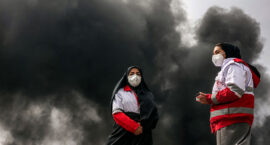
Research shows that women and girls face unique and acute impacts in armed conflict situations. For women on the ground in Iran, who are already subject to increased policing at the hands of their own government, these impacts are multiplied. Since 165 girls were killed by an American missile in the bombing of an elementary school earlier this year, thousands more women and girls have continued to be displaced and killed in airstrikes. And as the Georgetown Institute for Women, Peace and Security points out, women also face increased environmental tolls from the bombing of oil and gas infrastructure—which causes pollution that can lead to health issues and reproductive complications.

Women in the Military Put Their Lives on the Line. The Trump Administration Is Stripping Their Rights

As the war in Iran rages on another week, 13 United States armed service members have been killed, three of them women. Nearly 20 percent of those currently serving across the entire U.S. military are women—who also represent the fastest-growing segment of the veteran population, more than 2 million strong today.

Not surprisingly, women who serve are also a direct target of the misogyny of the Trump administration.

Keeping Score: Trump Attacks Iran, Pressures Senate Republicans to Pass ‘Show Your Papers’ Voter Registration Bill; States Expand Access to Childcare and Paid Leave

In every issue of Ms., we track research on our progress in the fight for equality, catalogue can’t-miss quotes from feminist voices and keep tabs on the feminist movement’s many milestones. We’re Keeping Score online, too—in this biweekly roundup.

This week:
—Dolores Huerta breaks her silence at 96: “I have never identified myself as a victim, but I now understand that I am a survivor.”
—Trump pressures Senate Republicans to pass the SAVE America Act, a “show your papers” policy that would require U.S. citizens to show a passport or birth certificate in order to register to vote.
—A performative personnel exchange at DHS: from Kristi Noem … to Markwayne Mullin?
—The U.S. and Israel launched strikes on Iran, killing at least 1,332 people.
—March 10 is Abortion Provider Appreciation Day.
—DHS Secretary Kristi Noem was fired, as ICE reports 32 deaths in detention facilities in 2025.
—Access to early prenatal care is declining in the U.S., especially in states with abortion bans.
—A record one-third of American workers not have access to government-mandated paid leave.
—The U.S. deported a gay woman to Morocco, where her sexuality is illegal and she faces violence from her family.
—Texas Attorney General Ken Paxton claimed gender-affirming mental healthcare for trans youth is “child abuse.”
—New Mexico and New York take steps towards free universal childcare.
—Jessie Buckley took home the Academy Award for Best Actress in a Leading Role for her role in Hamnet. The film was directed by Chloé Zhao, one of nine women to ever be nominated for the award of Best Director and the only woman nominated this year.

… and more.

Three Women Veterans on the Devastating Reality of the VA Abortion Ban

The Trump administration is no longer providing abortion care for veterans relying on VA healthcare, even in instances of rape and incest.

Through firsthand accounts, veterans describe the fear, medical risk and loss of autonomy created by the policy.

“Abortion is my right, if that was what I deemed I needed.”

“No patient in America should have to go back and forth with their providers … and for damn sure not with no politicians about what medical care they are allowed to have.”

“We are all people who volunteered. We raised our hands and said, ‘yes send me.’ Healthcare is our right as veterans.”

Senate Blocks Effort to Restore Abortion Access for Veterans

In the final days of 2025, under the cover of the holidays, Trump’s Department of Veterans Affairs (VA) instated a total ban on abortion and abortion counseling.

The new policy applies to all VA healthcare facilities across the U.S., including in states where abortion remains legal. As a result, the VA now has “one of the strictest abortion bans in the country,” according to the Center for Reproductive Rights.

In late January, Sens. Patty Murray, Richard Blumenthal, Chuck Schumer and Democratic members of the Senate Veterans’ Affairs Committee introduced a joint Congressional Review Act (CRA) resolution—an oversight tool through which Congress can overturn rules issued by federal agencies, by a simple majority—to nullify the administration’s abortion and abortion counseling exclusion.

Garnering a same-day endorsement by an array of veterans’, medical, women’s, and reproductive health and rights organizations, they urged “both chambers to act swiftly to overturn this extreme policy that puts veterans’ health and safety at risk.”