Weekend Reading on Women’s Representation is a compilation of stories about women’s representation in politics, on boards, in sports and entertainment, in judicial offices and in the private sector in the U.S. and around the world—with a little gardening and goodwill mixed in for refreshment!
In This Edition:
Opportunities Narrow for Women as Hegseth Blocks More Promotions

One area of emerging equality for women in leadership has been the country’s shift away from the previously all-male military, which has an outsized influence, both in its immediate impact and in the role its veterans play in electoral politics. Defense Secretary Pete Hegseth, however, is systematically rolling back progress.
“Defense Secretary Pete Hegseth recently blocked the promotions of seven senior Navy officers, five of whom are women or people of color, to two-star admiral rank, current and former defense officials said. The highly unusual move means that for the first time in more than a decade, no female active-duty naval officers are likely to be promoted to admiral this year, officials said.
“The initial list consisted of 22 officers who were chosen by a promotion board made up of senior admirals. The board determined that the two-star nominees were among the Navy’s highest performers over careers spanning more than 25 years.
“Among those removed was Rear Adm. Amy Bauernschmidt, who was chosen in 2020 to be the first woman to command the crew of one of the Navy’s 11 nuclear-powered aircraft carriers, the officials said, speaking on the condition of anonymity to discuss sensitive personnel matters. Mr. Hegseth did not provide a rationale for pulling Admiral Bauernschmidt or the other officers off the promotion list. But he has claimed in recent years that the military has focused too much on promoting people of color and women, at the expense of white men…
“Women make up 21 percent of the active-duty Navy, but account for only about 7 percent of active-duty admirals. Mr. Hegseth has fired or sidelined more than two dozen generals and admirals, including Adm. Lisa Franchetti, the first woman to lead the Navy, whom he dismissed last year. He has also removed about 40 senior officers, selected by boards made up of peers, from promotion lists. More than half of those fired or removed by Mr. Hegseth from promotion lists have been female or Black.”
You may also like: Profiles in Courage, a Ms. series honoring the extraordinary women and men who have transformed American institutions through principled public service. At a time when trust in government is fragile, these stories offer a powerful reminder of what ethical leadership looks like—from those who litigate for civil rights and resign on principle, to those who break military barriers and defend democracy on the front lines.

Lindsey Graham’s Sister Adds to Ranks of Women in U.S. Senate
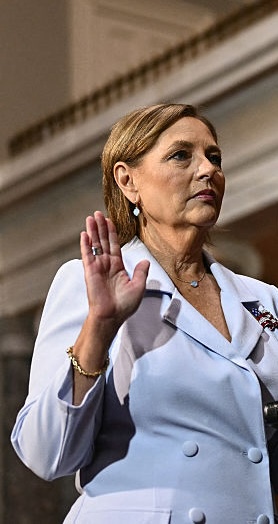
Darline Graham Nordone, the younger sister of the late South Carolina Rep. Lindsey Graham, was appointed by the state’s governor to complete his U.S. Senate term. The Center for American Women and Politics reports that this brings the number of women in the U.S. Senate to 27. That’s 25 more than when Clarence Thomas was confirmed to serve on the U.S. Supreme Court in 1991, but still barely halfway to parity.

The Guardian reports on Graham Nordone’s appointment:
“When Lindsey Graham was in college, his parents died, just over a year apart. But he worried most about his sister, who, at 13, was suddenly an orphan. Graham became her legal guardian – and later adopted her so she could receive his benefits through his service as an air force lawyer.
On Tuesday, following Graham’s sudden death, that sister, Darline Graham, was sworn in to serve the remainder of her late brother’s Senate term. “Lindsey took care of his little sister in years long departed,” Henry McMaster, South Carolina’s Republican governor, said at a press conference on Monday convened at the state capital in Columbia. “It’s my honor to ask his little sister, Darline Graham, to finish his work for him now.”
Graham died on Saturday night, aged 71. With the backing of Donald Trump, Darline Graham was swiftly appointed to serve the remaining months of his Senate term, which ends on Jan. 3.”
The Long Road to Gender Parity Starts With Measuring It
“There has never been a ‘Year of the Woman.’ There has never even been a minute of the woman. Our vision is simple: We will not settle for anything less than parity.”
—Marie Wilson
Those words came from Marie Wilson, founder of the White House Project, who offered them as a testimonial for our Gender Parity Index back in 2014. I have never forgotten them, because they capture something I have believed for my entire career: that women’s political power is not something we wait for or hope will arrive on its own. It is something we build by fixing the system itself, a system that was never designed with women in mind in the first place.
The rules of American democracy were written by men, for a country in which women could not vote, let alone run for office, and we are still living, in many ways, inside the architecture they left behind. Changing that architecture, not simply asking women to work harder within it, has been my life’s calling.
That conviction took root most concretely during my years working alongside my husband Rob Richie at FairVote, the organization we co-founded together more than 30 years ago.
I watched ranked-choice voting go from a fringe idea, a concept almost no one outside our small corner of the reform world had ever heard of, to a popular movement taking hold across the country, as city after city adopted it, and eventually entire states followed: Maine, then Alaska, and most recently, Washington, D.C., and somewhere along the way. I started noticing something beyond the majority winners and the more meaningful elections the system was designed to produce. I noticed more women were winning under ranked-choice voting.
It was happening internationally too, from Ireland’s presidency to Australia’s House of Representatives; systems built differently were producing something our winner-take-all system was not: real gains for women.
The trouble was, I could not tell you with any real precision how much of a difference ranked-choice voting, or any legislative modernization effort, was actually making. I didn’t even know the baseline we were working from, so I had no way of knowing whether the progress I thought I was seeing was incremental, or a rapid jump, or in some places, backsliding entirely. Worse, so few people seemed to think women’s underrepresentation was a problem worth solving in the first place.
I knew, the way you know something in your bones long before you can prove it, that it was—and my husband, Rob, felt it too. To us, it seemed obvious: Women are half the population, yet they have never come close to holding an equal share of seats in our government. From where we sat, it was clear as day that the United States had a serious gender representation gap. However, we also recognized that knowing something intuitively and demonstrating it statistically are two different things. And unfortunately, neither of us had any year-over-year data or a consistent methodology to show, in black and white, that this was a real and urgent gap that demanded our collective attention.
This is where I want to give Rob a special shout-out, because his determination to track down the data is the reason we have a methodology for the index at all. If there is one thing you should know about my husband, it is this: If he cannot find the data he is looking for, he does not shrug and decide it would be impossible to calculate. He always finds a way, even if it takes some trial and error to get there. In truth, Rob has quietly built much of the methodology used throughout the political world today—work so foundational you would be shocked to learn it came from his mind, and he has never once asked for credit. He simply figures out how to measure what needs measuring, then hands it off.
That’s exactly what happened here and is a core part of the index’s origin story. He cracked the code, gave the Gender Parity Index its life, then handed it to me to keep building.
And keep building is precisely what has been done.
To us, it seemed obvious: Women are half the population, yet they have never come close to holding an equal share of seats in our government.
For those less familiar with it, the Gender Parity Index (GPI) is our annual measure of women’s political representation across the country. Every state receives a score, a letter grade, and a ranking based on how well women are represented in national, state, and local offices. Put together, those scores tell you how close any given state is to gender-balanced governance, and how far it still has to go.
But what has always mattered most to me is that the GPI was never meant to be a single snapshot; it is a longitudinal record, tracking the same numbers with the same methodology, every year since 2013. This consistency in our annual measurement is what lets it show something a one-time count never could: whether progress is actually happening, where it has stalled, and where, quietly, it has begun to slide backward.
Now in its 13th year, the data tells a compelling, albeit sobering story. So sobering, in fact, we let the numbers speak for themselves. Since launching the index, I wanted it to function as a tool, not a thesis supporting a single argument or promoting a narrow conclusion. I wanted this data to become the baseline that anyone who cares about advancing women’s political power could use to build their case and further support our collective efforts, whether that was a legislator citing it in testimony, an advocate building a campaign around it, or a supporter utilizing it when someone suggests representation is no longer a real problem. At RepresentWomen, we use it in service of the structural, policy-based solutions proven to reduce the barriers women face in politics. But we build it each year so that others can use it in service of whatever cause they are making, wherever they are making it, because reaching parity in our lifetime will take all of us pulling together.
That’s why I’m so glad to share that we’re releasing the 2026 Gender Parity Index edition next Wednesday, July 22, and I could not be more grateful for the team that made it possible. Our research director, Courtney Lamendola, and her teammates Jackie Crespo and Tori Wyman, have spent months ensuring this year’s Index carries forward the same rigor and consistency we have held ourselves to since the very beginning.

I can think of no better way to honor that work than to put it to use, and there is no clearer place to start than next Wednesday evening, from 7 to 8 p.m. ET, for our next Democracy Solutions Series conversation, 2026 Gender Parity Index: Examining the Status of Women’s Representation. I would love to see that Zoom room full, so we can celebrate the team’s work, hear straight from Courtney what this year’s data shows, and get to work putting it to use. As I say so often, if we want to achieve gender balance in our lifetime, we have to build toward it together, and there is no better time to start than next Wednesday evening.
This Week’s Feminist Birthdays and Landmark Moments in Women’s History
Feminist Birthdays
- Jane Hamilton, American novelist
- Amanda Hunter, executive director of the Barbara Lee Family Foundation
- Mary Attea, chef
- Edda Collins Coleman, vice president at Common Sense Media
- Rebecca Smith, senior United States district judge
- Kelly Born, Packard Foundation
- Cecile Richards, former president of Planned Parenthood
- Ileana Ros-Lehtinen, former U.S. representative
- Julie Tagen, staff director at House Judiciary Committee
- Ida B. Wells, journalist, educator and civil rights activist
- Dr. Cynthia Enloe, author and research professor
- Jean Parvin Bordewich, playwright and nonprofit-sector advisor on democracy
- Ann Fothergill; Jessamyn West, Quaker author of The Friendly Persuasion (1902)
- Liz White, executive director of UpVote Virginia

Milestones
- Sixteen National Women’s Party members were arrested while picketing the White House, demanding universal women’s suffrage (1917).
- The first women’s rights convention was held in Seneca Falls, N.Y., in 1848 and the Declaration of Sentiments was published, proclaiming that all men and women are created equal.
Ranked-Choice Voting Progress from Congress to Cities Across the U.S.

RepresentWomen has reported extensively on how ranked-choice voting (RCV) is a structural reform that creates incentives for more positive, coalition-based politics in which women can thrive, including winning more than half of local races decided by RCV in recent years.
It’s been a busy week on the RCV front, including a new pro-RCV bill in Congress. Additionally, the city councils of Irvine, California, and Longmont, Colorado, are set to vote to put RCV on the November ballot, the release of scholarly research suggesting RCV may mitigate the impact of money in campaigns, and a case for RCV in Maryland elections by RepresentWomen board member Michelle Whittaker. The following are excerpts on this progress:
The Voter Choice Act in Congress as introduced by Minnesota’s Kelly Morrison:
“Today, U.S. Representative Kelly Morrison (MN-03) introduced the Voter Choice Act, which makes it easier for states and local governments to implement ranked choice voting.
Ranked choice voting has been proven to lower election costs, reduce polarization, and drive voter turnout across the country — and more and more cities, states, and counties are choosing ranked choice voting in their elections.
In Minnesota, five cities (Bloomington, Minneapolis, Minnetonka, St. Louis Park, and St. Paul) have already implemented ranked choice voting for their elections, and have seen historic voter turnout since switching to ranked choice voting.”
Irvine puts ranked-choice voting on the November ballot (LAist):
“Irvine voters will have an important question at the ballot box in November: Do you want ranked-choice voting? Late Tuesday, the City Council agreed to place a measure that would switch council and mayoral elections to the system in 2028, as long as the cost stays within certain parameters. Mayor Larry Agran and council members James Mai and Mike Carroll voted no.
If passed, Irvine would be one of two Orange County cities to have the system. It comes as a judge recently ordered Huntington Beach to use the method. Several California cities, like Redondo Beach in L.A. County, have implemented ranked-choice voting in recent years.”
Longmont city council votes 6-1 to put RCV on ballot (RCV for Longmont):
“Longmont City Council voted 6-1 to advance a ranked choice voting charter amendment! Just after 12:30 late last night, Longmont City Council voted 6-1 as the first official step of referring RCV to the ballot. After nearly 5.5 hours the chambers were still packed with people and RCV signs! This would not have happened without this turnout.”
Michelle Whittaker – Our primaries make the case for ranked-choice voting (Bethesda Magazine):
“Ranked-choice voting lets voters fully express their preferences instead of picking one candidate and hoping for the best. Even if a field splinters, the outcome is a candidate (or candidates) with the broadest support, rather than a fragmented plurality. It’s worked successfully in Takoma Park for two decades. Washington, D.C., used ranked choice voting for the first time in its June primary – delivering majority winners in crowded fields. Voters in the Prince George’s County cities of Greenbelt and Berwyn Heights have approved ranked choice voting for upcoming elections.”
Ranked-choice voting, campaign spending, and independent expenditures (SSRN):
“We find that campaign spending is a weaker predictor of electoral performance under IRV [RCV with one winner] than under plurality voting across multiple metrics. In IRV elections, spending correlates most strongly with first-choice rankings, a measure of strong candidate support, and progressively less with broader measures of voter support such as ballot mentions (i.e., being ranked in any position). Most strikingly, spending is only weakly correlated with vote transfers to the final two candidates between the first and final rounds, the metric most directly capturing IRV’s distinctive mechanics.”
New Study: Online Toxicity Hits Women Politicians Harder
The Center for American Women and Politics (CAWP) published a translation piece explaining a new study from the American Political Science Review. The study, titled Gendered Perceptions and the Costs of Political Toxicity: Experimental Evidence from Politicians and Citizens in Four Democracies, puts rigorous experimental evidence behind something many already know — online hostility directed at women politicians is perceived as more severe, more threatening, and more likely to be designed to push them out of office than equivalent attacks on men.
Authors Gregory Eady and Anne Rasmussen conducted large-scale experiments across four democracies, the United States, Denmark, Belgium, and Chile, showing participants identical toxic social media messages directed at either male or female politicians. The results were consistent across all four countries, across genders, and across political affiliations. Respondents overwhelmingly judged toxic messages targeting women as more severe than the same messages targeting men.
The effect intensified under two specific conditions. First, when the toxic message explicitly referenced the politician’s gender, and when the sender was a man. A second experiment probed why and found that attacks on women politicians were far more likely to be attributed to prejudice or a desire to push women out of politics, rather than to genuine policy disagreement or personal dislike.
The study frames this as a “double burden.” Women politicians may not only face higher rates of toxic behavior, but the toxicity they do face is understood by both themselves and the public as more threatening in its intent, something researchers describe as a structural feature.
Sri Lanka Women Parliamentarians’ Caucus Calls for 33 Percent Quota in Local and Provincial Elections
I recognize that establishing gender quotas in the United States would be an uphill battle, but they continue to be widely used and discussed around the world. Here’s an instructive story from Sri Lanka in Newswire:
“The Sri Lanka Women Parliamentarians’ Caucus has stressed the urgent need for legal reforms to ensure a minimum of 33% women’s representation in Provincial Council and Local Government elections.
At a caucus meeting held in Parliament under the chairmanship of Minister of Women and Child Affairs Saroja Savitri Paulraj, members discussed proposals to be submitted to the Special Parliamentary Committee tasked with reviewing women and youth representation in Provincial Council elections and determining the electoral system under which they should be conducted.
The caucus emphasized the importance of introducing legal provisions to guarantee women’s representation both in nomination lists and among elected members, with discussions also planned with the Election Commission to advance these proposals.
Options under consideration include ensuring representation through nomination list requirements, mandatory seat allocation, or a mixed electoral system.
Members also highlighted challenges such as prevailing social attitudes, high election expenses, and the need for political party cooperation in raising women’s participation. The caucus underscored the importance of public awareness programs to promote women’s political engagement.”
Why Sweden’s Political Gender Gap is Growing
With a general election approaching in September, Sweden, a country that has long defined itself by gender equality, is watching its male and female voters move in sharply different political directions.
A new survey shows that twice as many men as women support the far-right Sweden Democrats, a party with neo-Nazi roots now polling in second place nationally behind the more left-leaning Social Democrats. The Social Democrats are led by Magdalena Andersson, Sweden’s first female prime minister in 2021-2022, who has campaigned this year on smaller school class sizes, more housing, and free dental care for young people. The Sweden Democrats, led by Jimmie Åkesson, have pledged lower taxes, improved public safety, and treating “anti-Swedishness” as a hate crime.
The two parties together are expected to capture more than 50% of the vote in September, but voter turnout is breaking along gender lines in ways that echo patterns across Europe and the U.S. Young men are moving toward the populist right; young women are moving toward the left and center-left. The Guardian writes:
“If only women voted, the left-leaning bloc, led by Andersson’s party, would gain 64% of the vote, the survey found. If only men voted, the right-leaning parties, with the current prime minister, Ulf Kristersson, of the Moderates at the helm, would get 51%. Why, in Europe’s supposedly most gender-equal country, does gender play such a big role?
Lena Wängnerud, a political science professor at the University of Gothenburg, said the move leftward of women and rightward of men had been happening since the 1970s, but that in recent years the Sweden Democrats had replaced the centre-right Moderates as the main choice for men.
Her research showed that men in the private sector were most inclined to vote rightwing, driven by support for lower taxes, a smaller public sector and less immigration, she said. “The fact that women have not shifted to the right to the same extent, regardless of whether they work in the public or private sector, stems from their greater reliance on a well-functioning welfare state, given that they still bear the primary responsibility for caregiving in the private sphere.”
Kazakhstan’s “Saltanat Law” Is Working, but the Infrastructure Has to Catch Up
In November 2023, Saltanat Nukenova was murdered by her then-husband, Kuandyk Bishimbayev, a former government minister in Kazakhstan. The trial became the first live-streamed murder trial in Central Asia, drawing hundreds of thousands of daily viewers and forcing domestic violence to the center of national politics. Within weeks, parliament passed sweeping new legislation.
“Saltanat’s Law,” signed in April 2024, reversed a 2017 decision that had decriminalized battery and reclassified domestic abuse as an administrative offense, a framework under which more than half of cases were terminated without consequence. The new law reintroduced criminal liability and prohibited repeated reconciliation in cases involving minors or repeat violence.
The early data is encouraging. Domestic violence reports dropped 21.3 percent in the first quarter of 2025 compared to the same period in 2024, with serious offenses falling 29 percent and particularly grave offenses by 44 percent. However, a vast majority of Kazakhstan’s districts still lack access to infrastructure to help. Deanna Ridzuan for Borgen’s Magazine notes:
“Despite these gains, structural support for survivors remains inadequate. At the time of the law’s adoption, 49 crisis centers operated nationwide. By mid-2025, that number grew to 69, yet 85 percent of districts still lack access to a shelter. Shymkent, a city of more than 1.2 million people, has only one center despite receiving 11,000 violence-related complaints, and the Abay and Kyzylorda regions have none. Funding remains unstable: in spring 2025, the largest crisis center in the Turkestan region nearly closed due to unpaid utility bills, and no stable government funding mechanism for these centers currently exists.
Beyond domestic violence, the World Economic Forum’s 2025 Global Gender Gap Index placed Kazakhstan 92nd out of 148 countries — a significant drop from 76th in 2024 — highlighting continued deficits in political empowerment and economic participation. The gender wage gap stood at 25.2 percent in favor of men as of the most recent available data…
… The story of women’s rights in Kazakhstan is one of a country navigating between genuine legislative progress and deep-rooted structural resistance. The Saltanat Law arrived because hundreds of thousands of ordinary people in Kazakhstan demanded it — and because women’s rights groups, legal advocates and international partners had spent years building the case. The early data on declining violence offers genuine ground for optimism.
The work ahead — funding crisis centers, closing the wage gap, increasing women’s representation in government and protecting activist organizations — requires sustained political will and continued public engagement. But the momentum Kazakhstan’s women have built, often against considerable institutional resistance, shows that change in this country does not arrive quietly. It arrives because people refuse to stay silent.”
A Few Things Bringing Me Joy
A few final notes—from homemade preserves to exciting news about our partnership with Murmuration.

Sometimes the most incredible partnerships seem to come out of thin air, and then, in the blink of an eye, become a core part of how you see the world. For us this year, that partner has been Murmuration, and we are so grateful to be working so closely with them on critical research projects.
I had the joy of spending time with the Murmuration team in New York City this week, which was especially timely, as we were just mentioned in The New York Times in conjunction with new data from a research study we conducted together, set to be released at the end of the month.

I’m excited to share more about our partnership with Murmuration in the coming weeks, so stay tuned!

It was a wonderful event on Thursday evening!
*
A note from Ms. editors: We want to hear from you for The Majority, a new campaign collecting stories about how reproductive freedom has enabled readers to build the lives they want and need.
Poll after poll shows a majority of Americans support reproductive healthcare access. Yet public debate overlooks the lives shaped by abortion access, contraception, IVF, miscarriage care, maternal healthcare or comprehensive sex education—countless women who chose to pursue an education, have children, not have children, protect their health and chart their own future. What’s your reproductive freedom story? Add your voice. Together, these stories will help show not only why reproductive freedom remains a majority value, but also what it makes possible.