Conversations over Lupita Nyong’o portraying “the most beautiful woman in the world” suggest a broader discomfort with depictions of dark-skinned Black beauty in Hollywood.
This article contains spoilers for The Odyssey.
Now that Christopher Nolan’s The Odyssey is closing in on $1 billion at the box office in just two weeks, it has become thus far the most successful movie of 2026, leaving behind much of its pre-release controversies over diversity in casting. Here at Ms., we even applauded Nolan’s efforts at reclaiming the diversity of the ancient Mediterranean world.
However, the conversations over a Black actor like Lupita Nyong’o portraying the iconic Helen of Troy—“the most beautiful woman in the world”—suggest a general discomfort with depictions of dark-skinned Black beauty in Hollywood. This extends beyond the overblown race- and rage-baiting “debates” spearheaded by right-wing conservatives and white nationalists.
In a biting critique by Emily Wilson, whose translation of Homer’s The Odyssey inspired Nolan’s adaptation and who veered from the mostly positive reviews of the film, she notes how Nyong’o’s dual roles—as both Helen and her sister Clytemnestra—were “hugely underwritten” within a “set of brief tableaux of female victims.” Incidentally, other moviegoers lamented how Nyong’o’s beauty was undercut with the decision to depict a post-Trojan War Helen with half her face covered in scars.
… What does it mean to depict a Black Helen of Troy within an abusive storyline, versus one in which her beauty is deified and glorified?
This representation highlights the realism of Nolan’s film, in keeping with a modernist take on the ancient tale, that emphasizes the brutal repercussions of war over the presence of the gods. (Even the appearance of the goddess Athena, portrayed by Zendaya, invites a modern dismissal that she is merely the figment of the hero Odysseus’ guilt-ridden imagination.) Nolan gestures toward humanism while downplaying the supernatural, signaled by the divine beauty of the demi-god Helen.
In a Western context, however, Black people’s humanity is never taken at face value—given the anti-Black racism spawned over centuries from the transatlantic slave trade, chattel slavery, Jim Crow segregation and colonization on the African continent. Moreover, Black women’s sexualities serviced these systems of oppression through the devaluation of both their productive and reproductive labor.
Against such a history, what does it mean to depict a Black Helen of Troy within an abusive storyline, versus one in which her beauty is deified and glorified?
Nyong’o’s depiction barely departs from her Oscar-winning debut portrayal as the similarly scarred slave Patsey in 12 Years a Slave—the same film in which Michael Fassbender’s abusive enslaver Edwin Epps lavishes her with praise as “Queen of the fields.” The similarities are jarring, between the gesture of Epps possessively touching Patsey’s face in this scene and Jon Bernthal’s aggrieved Menelaus possessively grabbing Helen’s face in mockery of her famed beauty.
This scene in Nolan’s The Odyssey is quite the departure from ancient Greek versions, in which Helen’s otherworldly beauty is powerful enough to stop a rage-filled Menelaus in his tracks, thus preventing him from subjecting her to violence because of her elopement with the Trojan prince Paris that triggered the Trojan war. In an enchanted tale, a woman’s beauty is her protection.
Of course, in more realist settings, beautiful women are also victimized by intimate partner violence, and some men may even disfigure their faces to prevent other men from desiring their spousal “possessions.” Nolan chose realism over enchantment, which makes sense for the direction of his storytelling. It is nonetheless a missed opportunity for the rare depiction of melanin-rich desirability on Hollywood’s big screen, which Nyong’o is more than capable of embodying, since her own otherworldly beauty could shut down bigoted haters and bedazzle movie audiences.
Given longstanding anti-Black tropes and stereotypes, this begs the question: Does portraying Helen of Troy as a Black woman make it easier to mark her for abuse? Does her Blackness help to dilute the shock of witnessing an ancient beauty symbol in ruins?
Interestingly, in Nyong’o’s other role as Clytemnestra—the wife of Agamemnon, who avenged the sacrifice of their daughter by murdering her husband—film stills depicting her anguish and rage were altered online by bigots and bots in uglification memes to undermine her casting as the beautiful Helen of Troy.
Whether Nolan intended to or not, Nyong’o’s dual roles reinforced the white feminine ideal, since her Helen does not threaten whiteness as the beauty status quo, nor does her Clytemnestra establish her as sufficiently feminine.

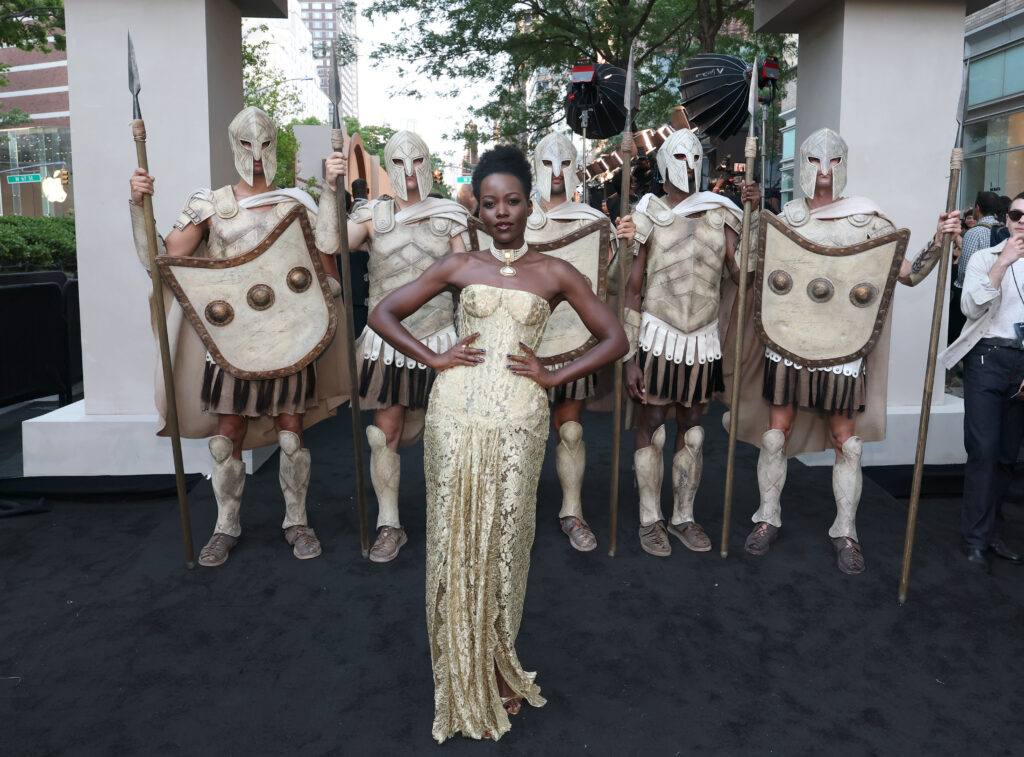
As gorgeously styled as Nyong’o appeared on red-carpet events during the film’s premiere, her beauty was muted on screen (and on IMAX no less). For all the outrage over her casting, naysayers didn’t need to worry that her portrayal would upend white beauty standards (or Western civilization itself). No wonder the controversy dissipated.
Does portraying Helen of Troy as a Black woman make it easier to mark her for abuse? Does her Blackness help to dilute the shock of witnessing an ancient beauty symbol in ruins?
This is not to disparage Nolan’s artistic choices in going for realism over the “apparent magic” of the ancient world. We may nonetheless speculate that his selection of Nyong’o as Helen of Troy served his goals of subversion. Still, Nyong’o has expressed in interviews her own appreciation to move beyond an icon’s beauty to find something more substantive for her performance. And she has made quite the impression for some moviegoers.
Despite her brief screen time in a near three-hour movie, enough audience members have articulated their desire to see more of her, while some have even suggested she needs to star in her own ancient story, perhaps as the Queen of Sheba. While a “Black Helen of Troy” amplified the filmmaker’s subversive plot, Nyong’o’s on-screen presence made Black beauty cinematically legible for others.
This dovetails with a concern expressed by writer Karen Attiah, who argues that we don’t need a Black Helen so much as we need more “Black mythologies.”
As she rightly posits:
“We don’t need Black Helens of Troy. We need more Wakanda women. We need more Women Kings. We need more Queens of Katwe. It is precisely in this moment of historical erasure and rejection of even the most nominal forms of Black inclusion that Black writers and thinkers, and especially Black women, should be focusing on building out the civilizational myths, histories, and heroines we already have.”
… Some have even suggested [Nyong’o] needs to star in her own ancient story, perhaps as the Queen of Sheba.
Beyond Greek and Roman myths and histories, we have stories of Black queens, warriors and everyday women.
Imagine an epic movie about Amanirenas, the Kandake queen who prevented the conquest of the ancient kingdom of Kush from the powerful Roman army circa 25 B.C.E.
Or Queen Nzinga, who fought against the Portuguese seeking to enslave her people during the transatlantic slave trade era circa 1600s.
We can hardly visualize the kingdom of Haiti in existence between 1811 and 1820 during the era of Bridgerton, as historian Marlene Daut argues, let alone tell the story of its king and queen (instead of reclaiming the British Queen Charlotte as a Black royal).
Imagine Lupita Nyong’o cast in any of these majestic roles.
And these roles need not be historical. Imagine the same actor reprising her role as the spy “war dog” Nakia from the Black Panther franchise in her own movie spin-off, traipsing James-Bond style around the world without the need to replace James Bond himself.
The last time we saw Nyong’o on the big screen was in 2024’s A Quiet Place: Day One. Sadly, her character did not survive. (One scene of her holding a copy of Octavia Butler’s Dawn suggests other possibilities that a sequel of that franchise could explore down the line.) We do not know if Nyong’o has other projects lined up, and it’s rather telling that she has appeared in few films (some of them behind the scenes as a voice actor), despite her celebrated beauty and talent.
Most of her live-action films were directed by filmmakers of color: Mira Nair’s Queen of Katwe, Jordan Peele’s Us, Ryan Coogler’s Black Panther films, and Beyoncé’s Black Is King.
Contrast this to her Odyssey co-stars: Both Zendaya and Anne Hathaway are starring in seven different movies between them this year, aside from The Odyssey. Charlize Theron appeared in Apex earlier this year and is set to appear in another film. If we must wait until 2028 to witness Nyong’o on our big screens again (when the third Black Panther film is scheduled), then this moment in The Odyssey is a misuse of her talents.
When Viola Davis, another dark-skinned actor, became the first Black woman to win an Emmy Award in 2015 for Best Leading Actress in a Drama Series, she reminded audiences that Black women cannot win awards for “roles that are simply not there.” Fortunately, Davis is set to appear in next year’s Children of Blood and Bone (directed by Gina Prince-Bythewood and co-written by its author Tomi Adeyemi) along with an all-star Black cast, despite some controversies already brewing.
The world of storytelling is vast, complex and multifaceted enough to generate films and roles where the talents of Black women like Davis and Nyong’o deserve to be cast beyond reductions of “diversity and inclusion.”
Support more work like this article
The reporting you just read is possible because of readers like you. Since 1972, Ms. has delivered independent, feminist journalism that tells the stories too often overlooked by other news media, challenges systems of inequality and holds power to account. We have no corporate owners, no advertisers and no billionaires dictating what we cover. Instead, we answer to our readers and our mission. If you value reporting that centers women and girls—and covers the issues others leave out—please support Ms. today by making a tax-deductible donation, becoming a member to receive a magazine subscription, or gifting a membership to a friend. Together, we can continue reporting, rebelling and truth-telling.