With 63 state supreme court seats up for election in 2026, the midterms could shape the future of abortion rights, voting rights and civil liberties for years to come.

Across the U.S., recent federal rollbacks of rights have led to a rising awareness and importance of state courts—meaning these once under-the-radar races are increasingly attracting attention within and beyond state borders, bringing in significant outside spending.
North Carolina
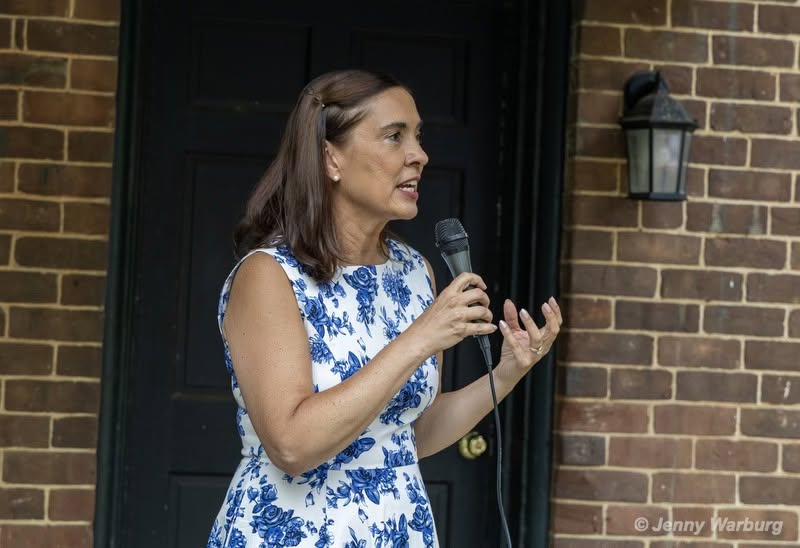
In the pivotal electoral battleground state of North Carolina, Justice Anita Earls’ campaign to hold onto her state Supreme Court seat has been called “one of the most important races in the state” by the North Carolina AFL-CIO, and “one of the most-watched statewide races in this year’s midterm elections,” per Axios.
Earls is currently the only Black justice on the North Carolina Supreme Court. Before beginning her tenure in 2019, she was a civil rights attorney focused on voting rights, education, employment, criminal law and First Amendment issues.
Research shows judges’ backgrounds have bearing on how they think about and rule on the cases before them.
The Brennan Center’s annual report on state supreme court diversity notes that, while state supreme courts often “serve as the final word in interpreting state constitutions … and laws,” many are lacking “in terms of their justices’ race, ethnicity, gender, and professional background.”
In 2025, half of state supreme courts had no women of color, and 24 states had no Black justices at all, while 79 percent of seats on the courts were held by white justices and 57 percent occupied by men.

When Earls spoke publicly about such inequities in her own state’s justice system in 2023, the North Carolina Judicial Standards Commission opened an ethics investigation based on her comments, accusing her of violating North Carolina’s Code of Judicial Conduct.
In response, Earls sued in federal court, arguing that the oversight board had restricted her right to free speech by threatening disciplinary proceedings that could ultimately lead to her removal from office. Earls’ supporters accused Republicans of weaponizing the judicial complaint process against the state’s only Black female Supreme Court justice and using it to suppress criticism of racial inequities.
(The immediate dispute ended in January 2024, when the North Carolina Judicial Standards Commission dismissed the ethics complaint against Justice Anita Earls and recommended no discipline to the state Supreme Court. Earls then voluntarily dismissed her federal First Amendment suit because the threat of punishment was gone.)

In this year’s midterm contest, Earls faces state Rep. Sarah Stevens, formerly a member of Republican leadership in the North Carolina legislature, from which she resigned in June to focus on her campaign to unseat Earls, a Democrat, for an eight-year term. The progressive group North Carolina Voices has criticized Stevens’ support for major Republican-backed voting restrictions and gerrymandered maps during her nearly two decades in the legislature.
No matter who prevails in the 2026 contest, the court will maintain its Republican majority, which has held since 2022. In 2028, three Republican justices are up for reelection.
Earls’ endorsements from EMILY’s List and former U.S. Attorney General Eric Holder point to her campaign’s elevated profile, as does the fundraising advantage she holds over Stevens: Earls raised over 13 times more than her opponent, according to campaign finance reports filed in July.
State Courts, National Stakes
North Carolina is one piece of a much larger national fight.
Each state has its own constitution and high court to interpret it, giving state courts enormous influence over individual rights. More than 100 million cases are filed in state courts annually, constituting 95 percent of all cases filed in the U.S.
The Brennan Center has been tracking spending in state supreme court elections for 25 years and found the most recent cycle of judicial elections the most expensive ever. They attribute this largely to abortion rights reshaping races, as advocates turned to state courts for protections after Roe v. Wade was overturned in 2022, among other factors, “like state high courts’ role in determining voting rules in the lead-up to national elections.”
Alliance for Justice, a progressive advocacy organization focused on federal and state courts, has identified seven states in advance of the 2026 midterms—Michigan, Ohio, North Carolina, New Jersey, Wisconsin, Pennsylvania, New York—at “pivotal turning points,” where upcoming judicial elections and major cases could reshape the balance of power on issues including voting rights, redistricting and civil liberties.
In total, 32 states are holding state supreme court elections in 2026, with 63 of the 344 seats on state supreme courts up for election. The outcomes could incrementally alter the ideological makeup of courts in states currently in play and lay the groundwork for future shifts in control.
In the wake of recent efforts to further weaken the Voting Rights Act and as state courts take on a larger role in voting-rights disputes, civil rights protections are increasingly being shaped at the state level.
Montana
Montana is the only state where the supreme court election in 2026 could actually flip the ideological balance of the court, according to Ballotpedia. In the past, the Montana high court has clashed with the state’s conservative legislature and governor over decisions protecting abortion and voting rights and supporting environmental protections.
Over $12 million was spent on supreme court races in Montana during the last election cycle, which, as in six other states, proved to be its most expensive judicial elections ever.
Wisconsin
The two most expensive supreme court elections in American history both took place in Wisconsin within the last several years.
The first, in 2023, featured a record $51 million in spending—five times that of the previous race in 2020—and flipped the ideological balance of the Wisconsin court when liberal circuit court judge and former prosecutor Janet Protasiewicz prevailed over Dan Kelly, a former Wisconsin Supreme Court justice who had ties to election deniers and far-right groups.
That record was broken in 2025: Wisconsin’s $100-million judicial race famously included $19 million of support from Elon Musk for conservative candidate Brad Schimel via his political action committees (PACs), America PAC and Building America’s Future PAC.
PACs accounted for the majority of spending for both candidates, and each received donations from all 50 states . But liberal candidate Susan Crawford—who had worked on reproductive rights and voting rights as a private attorney and was endorsed by former President Barack Obama, labor unions and reproductive rights organizations—outraised Schimel by over $12 million, with 10 times as many donors, and won the election by 10 points.
Notably, the contest also set a record for voter turnout, with 2.3 million voters—51 percent of the eligible population—and a surge of 500,000 voters over the last cycle, with Crawford turning 10 counties that had previously aligned with President Trump. The race was seen by many as a test for Trump, who endorsed Schimel, in the fight for the ideological majority on the court.
Virginia
In May, the Virginia Supreme Court invalidated a voter-approved constitutional amendment that would have allowed mid-decade congressional redistricting. The amendment had won support from roughly 52 percent of voters in an April special election, but the court ruled 4-3 that lawmakers had failed to follow the state constitution’s procedural requirements in putting the measure before voters. The U.S. Supreme Court later declined to revive the plan. The Democratic-backed redistricting effort had been designed in response to Republican-led mid-decade redistricting in other states.
Kansas
On Aug. 4, Kansas voters rejected a Republican-backed constitutional amendment that would have replaced the state’s system for appointing Supreme Court justices with direct elections.
The proposal followed years of Republican frustration with the state Supreme Court, including its 2019 recognition of a constitutional right to abortion. With 61 percent of voters opposing the amendment, Kansas will retain its existing system.
Georgia
In Georgia’s primary elections this year, Stephen Fowler of NPR reported Republicans dominated spending and Democrats drove record turnout. Though Republican-endorsed incumbents held onto their seats on Georgia’s highest court in May’s ostensibly nonpartisan election, strong challenges were mounted by liberal opponents after the U.S. Supreme Court significantly weakened the 1965 Voting Rights Act through its landmark Louisiana v. Callais ruling in April.
Money, Turnout and the Road to November
Nationally, Republicans enter the fall campaign with a substantial financial advantage across major party committees and super PACs, while Democrats have shown unusually strong primary turnout—including in Republican-leaning districts. Neither is necessarily predictive of what will happen in November.
But recent state Supreme Court contests offer a reminder that record-breaking spending does not necessarily determine the outcome. Wisconsin’s 2025 race shattered spending records and also produced record voter turnout, with Susan Crawford ultimately winning by 10 points despite enormous outside spending supporting her opponent.
This November, those same forces—money, turnout and heightened attention to once-obscure judicial races—will collide across the country. The outcomes will help determine who interprets state constitutions and, increasingly, the reach of abortion rights, voting rights, redistricting rules and other civil liberties for years to come.
*
A note from Ms. editors: We want to hear from you for The Majority, a new campaign collecting stories about how reproductive freedom has enabled readers to build the lives they want and need.
Poll after poll shows a majority of Americans support reproductive healthcare access. Yet public debate overlooks the lives shaped by abortion access, contraception, IVF, miscarriage care, maternal healthcare or comprehensive sex education—countless women who chose to pursue an education, have children, not have children, protect their health and chart their own future. What’s your reproductive freedom story? Add your voice. Together, these stories will help show not only why reproductive freedom remains a majority value, but also what it makes possible.
Look to these trusted groups if you or a loved one needs to know more about reliable abortion care:
- A one-stop-shop for abortion seekers: I Need An A
- Other websites to explore all your options for abortion care: Plan C Pills, Abortion Finder
- Safe websites to buy abortion medication: Aid Access, Massachusetts Medication Abortion Access Project, Hey Jane
- If you need help affording abortion care, tell your telemedicine provider or contact an abortion fund near you.
- To protect your digital privacy when planning your abortion, click here.
- For free legal help as a patient or doctor, call If/When/How’s Repro Helpline—844-868-2812—or contact Pregnancy Justice.
- For medical advice, contact the Miscarriage & Abortion Hotline: 833-246-2632.
- If you need to know the abortion law in your state, look to the Center for Reproductive Rights. or Guttmacher Institute.