Young Black girls are particularly targeted by the biases of AI, culminating in even more ostracized groups of women remaining undereducated about their bodies.

“Why would I Google it when I can just ask ChatGPT for exactly what I am looking for?”
A 16-year-old asked me this during a recent conversation with Black adolescents about where they turn for health information. Her answer was striking but hardly surprising.
As traditional sex education faces cuts in schools and reproductive health services become harder to access—particularly for young people of color in underserved communities—adolescents are increasingly looking elsewhere for answers. AI chatbots offer something schools, clinics and even trusted adults often do not: information that feels immediate, private and judgment-free.
ChatGPT and other AI tools are quickly becoming an unexpected—and largely unregulated—source of sexual and reproductive health information for teenagers. But what happens when the answers they provide are biased, inaccurate or incomplete?
For Black girls, the risks are especially serious. Many already face persistent barriers to comprehensive, affirming sex education. Some attend schools that offer abstinence-only curricula or instruction centered exclusively on heterosexual relationships, leaving LGBTQ+ students out altogether. Others navigate healthcare systems shaped by medical racism and adultification—the tendency to perceive Black children, particularly Black girls, as older and less innocent than they are.
I work with Black girls every day to help them feel safe, informed and confident about their bodies, health and voices. So I understand why AI can be appealing. Too often, the alternatives are curricula that omit crucial information, providers who do not take their concerns seriously or environments where asking questions feels unsafe.
AI tools like ChatGPT are not neutral. They are trained on massive datasets from websites, social media, online publications, academic literature and news articles that reflect the biases of the world we live in. As a result, they can generate responses that reinforce stereotypes, spread misinformation or leave out the cultural nuance necessary to serve diverse users.
One Black teenage girl recently told me she avoids asking clinic staff questions because she worries they will judge her or tell her parents. Instead, she turns to AI with what she calls the “questions I cannot say out loud.”
That is the vacuum AI is filling. But just because it feels safer does not mean it is actually safe.
A recent Washington Post report highlighted studies showing that popular AI chatbots provided incorrect answers to health questions nearly half the time, with some responses judged potentially dangerous if followed. This is especially troubling when it comes to sensitive topics like birth control, consent or sexually transmitted infections.
The consequences of misinformation can be serious, such as unintended pregnancy, delayed treatment for reproductive health issues, increased shame and anxiety about normal sexual development and misinformation about consent.
Some may argue that any information is better than none. But providing flawed or biased answers to Black girls is not a solution—it is a continuation of the same neglect they already experience in schools and clinics.
Building Better AI for Young People
Now is the moment to act. As AI adoption accelerates across all sectors, we still have an opportunity to shape how these tools are used and what values guide their development.
First, AI developers and public health leaders must co-create culturally responsive, bias-audited tools for sexual and reproductive health education. These tools should not be designed for young people; they should be designed with them. That means working in partnership with adolescents, especially those most often excluded, including Black girls. When we build systems that center the most marginalized, we improve outcomes for everyone.
Second, schools and health systems must incorporate digital literacy and online safety into sex education. Adolescents need to be able to recognize the limitations of AI, evaluate the quality of online health information and know where to go for support. Technology is not going away and neither is the need for critical thinking in the digital age.
I believe that technology can help expand access to health knowledge and make it easier for young people to get answers they might not seek elsewhere. But we have to ask: Are we expanding access to reliable information or simply making misinformation more accessible? If AI is going to serve as a sex educator, we need to ensure that it is not just fast and private, but also accurate, affirming and accountable.
Black girls need to be at the center of this work. When AI works for Black girls, when it reflects their lived realities, respects their dignity and delivers accurate, affirming information, it becomes more effective and equitable for all adolescents. Designing with those most often harmed in mind makes systems more resilient and responsive for everyone. What supports Black girls supports all girls.
By creating AI that is culturally grounded, bias-aware and community-informed, we are not just reducing harm. We are building a stronger foundation of care, one that honors the right of every young person to seek answers about their health and bodies without fear, shame or distortion.
This is not just a niche issue. It is a public health concern and a matter of justice. What we allow AI to become today will shape how the next generation navigates some of the most important decisions of their lives.
We have a choice: Allow biased systems to take root; or design technology that reflects our highest commitments to care, equity and truth.
Let’s choose wisely.
*
A note from Ms. editors: We want to hear from you for The Majority, a new campaign collecting stories about how reproductive freedom has enabled readers to build the lives they want and need.
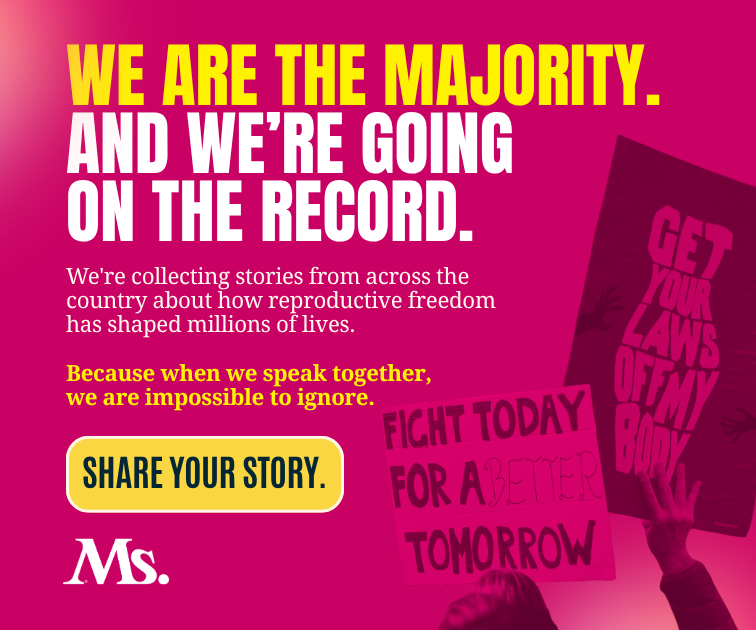
Poll after poll shows a majority of Americans support reproductive healthcare access. Yet public debate overlooks the lives shaped by abortion access, contraception, IVF, miscarriage care, maternal healthcare or comprehensive sex education—countless women who chose to pursue an education, have children, not have children, protect their health and chart their own future. What’s your reproductive freedom story? Add your voice. Together, these stories will help show not only why reproductive freedom remains a majority value, but also what it makes possible.
Look to these trusted groups if you or a loved one needs to know more about reliable abortion care:
- A one-stop-shop for abortion seekers: I Need An A
- Other websites to explore all your options for abortion care: Plan C Pills, Abortion Finder
- Safe websites to buy abortion medication: Aid Access, Massachusetts Medication Abortion Access Project, Hey Jane
- If you need help affording abortion care, tell your telemedicine provider or contact an abortion fund near you.
- To protect your digital privacy when planning your abortion, click here.
- For free legal help as a patient or doctor, call If/When/How’s Repro Helpline—844-868-2812—or contact Pregnancy Justice.
- For medical advice, contact the Miscarriage & Abortion Hotline: 833-246-2632.
- If you need to know the abortion law in your state, look to the Center for Reproductive Rights. or Guttmacher Institute.