


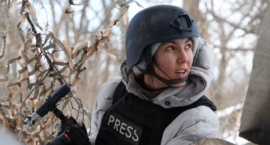
Russia’s War on Ukraine, Recorded by the Women and Queer Journalists Living Through It

The city of Kharkiv lies 19 miles from Russia’s western border. Nestled within this historic and cultural urban center is a small news outlet that symbolizes so much of what Putin intends to erase: the truthful recounting of Russian war crimes and the lived experiences of everyday Ukrainians. The journalists of Gwara Media are determined not to let that happen.

As world leaders gather for the U.N. General Assembly, Ukrainian President Volodymyr Zelenskyy is in New York seeking support against Russia’s attacks. In Kharkiv, Gwara’s journalists are documenting the war as they contend with danger, discrimination and dwindling funds.

This is the story of how a small, award-winning independent media platform supports the diverse identities of their reporters who—in the words of Gwara’s mission statement—“ask uncommon questions, and listen to voices of the unheard.”

Interviews with three of the publication’s journalists reveal how the “voices of the unheard” have affected the journalists’ own lives and why what they have to say resonates far beyond Ukraine’s own borders.

Dispatches From Ukraine’s Frontlines, Where Feminist Organizing Has Become an Act of Survival

A lecture and discussion were about to begin in a local public library. It could have been a scene in New York, London or Melbourne. Yet this event was in Zaporizhzhia, Ukraine, just 25 kilometers from invading Russian forces, where most of the attendees had fled from Russian occupied cities and villages.

The meeting was one of many organized by Natalia Lobach and the Ukrainian LGBTQ+ human rights group, Insight. Lobach said these events aim to create “safe community spaces for people from different age and social groups,” but they are especially “a good way for vulnerable groups to socialize.”

“Putin’s military is trying to destroy us not only physically, but psychologically as well—to take away our identities,” she said. “We are surviving physically, but we are also preserving our identities and our pride. … Isn’t that a kind of miracle, what we continue to do despite the pressure of such a brutal enemy?”