


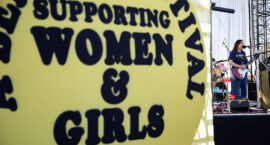
Dispatches From Daisy Chain: Olivia Rodrigo’s Feminist Festival Brought Together Music, Reproductive Freedom and the Power of Women

On Saturday, Aug. 29, more than 45,000 music fans traveled to Irvine, Calif., for the first-ever Daisy Chain Fields music festival, organized and headlined by Olivia Rodrigo, where 100 percent of the proceeds went to organizations supporting women and girls. Under the sweltering SoCal sun, an all-women lineup—including sets from Mitski, Doechii, Garbage, Chappell Roan and others—fundraised for 10 nonprofits: Baby2Baby, Black Mamas Matter Alliance, Center for Reproductive Rights, FreeFrom, Jhpiego, Johns Hopkins Center for Indigenous Health, National Domestic Workers Alliance, National Institute for Reproductive Health National Women’s Law Center and Planned Parenthood.

The all-day festival, inspired by Sarah McLachlan’s Lilith Fair of the 1990s, raised $10 million in ticket sales. Then, during her set at the end of the day, Rodrigo announced (to massive applause) that Melinda French Gates was matching every dollar raised—bringing the festival’s total donation to $20 million for diverse nonprofits supporting sexual and reproductive health, children in need, Black mothers, gender-based violence survivors, Indigenous communities and more.

I was lucky enough to go to Daisy Chain Fields and cover the festival for Ms. In the “Daisy Chain Reaction Village,” I spoke with several of the organizations that will receive Daisy Chain Fields funds.

“We wanted to come to the festival because we feel really passionately about connecting with new audiences on the issue of reproductive rights, particularly younger audiences who may not be as aware or knowledgeable about the national and international state of reproductive rights and bodily autonomy,” said Esme Lowe from the Center for Reproductive Rights. “It’s just super exciting because we’re engaging with people we might not [otherwise] even get to talk to.”

In line outside the Daisy Chain Reaction Village, sisters Madison and Mackenzie Wong said they were excited to attend the festival in their home city of Irvine, and happy to see a lot of younger fans of Olivia Rodrigo there to learn about the causes Daisy Chain Fields was supporting. 

“I think it’s important for big artists who have a platform to use their voice,” Mackenzie said. “They have so much influence anyway, so no matter what they say, it’s going to have a broader impact.”

Keshia Golden’s Plea Deal Kept Her Out of Prison—But Don’t Mistake It for Justice

Keshia Golden’s attorneys say that in October 2022, while she was eight-plus months pregnant, her then-boyfriend Calvin Sidney hit her, grabbed her hair and slammed her head against a kitchen counter. Golden grabbed a kitchen knife and stabbed Sidney in the leg. Golden only intended to make him stop, she has always insisted. But she hit the femoral artery. Sidney died at a Chicago hospital.

Keshia Golden was charged with first-degree murder and held in jail, where, weeks from giving birth, she was transferred to the medical unit to recover from her injuries. Four years passed.

Then, on Aug. 24, 2026, just before Golden’s trial was to begin, the Cook County state’s attorney Eileen O’Neill Burke offered Golden a last-minute deal: If she pled guilty to involuntary manslaughter and underwent two years of community service, drug testing and probation, she would serve no prison time.

All evidence points to the fact that Golden acted in self-defense and should never have been charged in the first place.

Nonetheless, she accepted the plea.

Her acceptance of this lesser charge is not an admission of guilt. It’s also not justice.

Golden is a single mother who was forced to make an impossible choice to ensure she would be able to raise her 3-year-old daughter. “All she has is me,” Golden said in court. 

Now, the only remaining path to justice for Golden is a pardon from Gov. JB Pritzker. Such a pardon would send a clear message: No woman should have to die to prove that she was a victim. No one should be punished for surviving abuse, defending themselves or protecting their child.

‘If We Didn’t Do It, Who Would?’: Meet the N.C. College Students Leading the Fight for Campus Voting Access

Republicans on the Wake County Board of Elections voted 3-2 earlier this summer to remove North Carolina State University’s Talley Student Union as an early voting site. The student center had served as an early voting location during the 2012, 2018, 2020 and 2024 general elections.

This year, early voting will instead take place at the Business Services Center, about 1.7 miles from campus. Republican board member Donna Williams says the new location is “very easily accessible for everybody.” But turnout data suggests the student union was far more convenient for voters: During the 2020 and 2024 presidential elections, more than 21,000 people voted early there, compared with about 11,000 at the Business Services Center.

The move is the latest in a series of decisions eliminating on-campus polling locations across the state.

One of the schools losing their on-campus polling location, North Carolina A&T State University, has a long history of activism: Four NC A&T freshmen launched the Greensboro sit-in movement in 1960, helping ignite a wave of nonviolent civil rights protests across the South. 

When election officials refused to approve an early voting site on campus ahead of the 2026 primary, students drew on that history—packing government meetings, organizing transportation and ultimately leading a march to an off-campus polling place.

Kennedy Bozeman, Khadijah Barry and Tatiana James were among the women at the center of that student organizing. They spoke with Ms. about the difference between nominal and meaningful access to the ballot, what political leaders misunderstand about young voters, and why they see their work as part of a much longer fight.

“Having a polling site on campus makes everything 10 times easier and more accessible.”

“This work can be emotionally draining. But there is joy in it, too, because I am fighting for what my ancestors fought for …”

“A big part of my motivation is John Lewis. He was 21 when he began his fight for civil rights, and we are all around that same age. That shows me I’m in the right place and doing what the leaders who came before me did.”

MAGA Is Using Kai Trump and Usha Vance to Soften Trump’s Anti-Woman Image. Don’t Be Fooled.

The public image of the MAGA woman is fast changing. Increasingly, the Trump administration is spotlighting women who don’t fit the “Mar-a-Lago face” mold. Women like Kai Trump and Usha Vance—who appear nontraditional and apolitical—are helping soften the administration’s image and make it more approachable to new audiences.

Through social media and personal stories, these women create a sense of intimacy and relatability that belies the administration’s deeply anti-woman agenda. On the surface, there is nothing overtly political about a teenager filming golf videos with her grandfather or a second lady reading stories to children. They may seem harmless—even comforting. But they are doing real political work.

Whether or not it’s a deliberate strategy, the effect is the same: Audiences who say they don’t care about politics still end up trusting the people behind deeply political policies. Don’t be fooled. Democracy depends on evaluating governments by what they do—not by how relatable or comforting we find them.

Rest in Power, Dolly Parton: Feminist Country Icon, Advocate for Women and Children, Philanthropist and Gifted Songwriter

Dolly Parton understood the power of being underestimated. Beneath the rhinestones, towering blond hair and self-deprecating jokes was a gifted songwriter, a shrewd businesswoman and a philanthropist whose work transformed the lives of millions of children and families.

Parton left behind a body of work that stretches far beyond the songs and films that made her one of the most beloved performers in American life. She sang about the dignity of working women. She placed hundreds of millions of books in the hands of children. She supported healthcare, disaster relief and lifesaving medical research. And she repeatedly used her enormous cultural influence to affirm the humanity of people who were too often marginalized, including Black and LGBTQ+ Americans.

Parton’s concern for women and children was expressed not only through her art, but in what she did with the wealth and influence her art created. We heard her legacy in the songs that made working women feel seen. We saw it in the books delivered to children, the families supported after disaster and the medical research that saved lives.

May Dolly Parton rest in power. May her legacy live on in every child who discovers a new world inside a book, every woman who demands dignity in the workplace and every person who chooses compassion when indifference would be easier.

Beyond Abortion: How the ERA Could Transform Pregnancy, Work and Family Life

On March 31, 1776, Abigail Adams wrote a letter to her husband, John, beseeching him to “remember the ladies” as he and his peers were drafting the Declaration of Independence. She warned, “All Men would be tyrants if they could” and urged him to “not put such unlimited power into the hands of the Husbands.”

He ignored her warning when she wrote: “If particular care and attention is not paid to the Ladies we are determined to foment a Rebellion, and will not hold ourselves bound by any Laws in which we have no voice, or Representation.”

Now, 250 years later, women are still fighting for inclusion.

The potential for state ERAs to advance the rights of women and girls is tremendous, but only if we have the will—and the resources—to push for favorable state supreme courts and to use ERAs to challenge discriminatory government policies.

While we fight for a Congress that will publish the federal ERA and a U.S. Supreme Court that will robustly interpret it, feminists are building an ERA jurisprudence that will one day achieve Abigail Adams’ dream: for women to finally, truly, be equal citizens and live freely, safely and empowered throughout the United States.

Girls Have Always Had ADHD. We Just Weren’t Looking.

A teenage girl watches a 30-second TikTok video by @Clairebear describing “a day in hell” in her life, “ADD edition”:

“I get up and go to work and realize I don’t have gas in my car. I get to the gas station and reach for my credit card and remember that I don’t in fact have my card because I keep thinking it will turn up at some point.”

She continues explaining her day and reveals that these are all symptoms and signs of attention deficit hyperactivity disorder (ADHD).

The teenage girl in question sees much of herself in that scenario, goes to the doctor and is evaluated and diagnosed.

Welcome to modern medicine.

Back to School Means Back to Sex Ed. Fathers Need to Be Part of the Conversation.

For generations, patriarchy has conditioned women to view motherhood as their ultimate calling and primary responsibility, placing the burden of raising healthy, mature adults squarely on their shoulders. Despite hard-won progress toward gender equality and a more equitable division of domestic labor, we know that society still disproportionately places the weight of parenting onto mothers. 

While modern fathers are more involved than previous generations, the equity gap remains: In most heterosexual partnerships, men shoulder significantly less of the daily labor of parenting. This persistent imbalance has led to high rates of maternal burnout.

As families settle into the back-to-school season—and teenagers encounter new classes, friendships, relationships and pressures—the work of guiding adolescents through questions about sex, consent and relationships becomes especially visible. Too often, that work still falls primarily to mothers.

To disrupt this gendered imbalance and foster healthy sexual development for adolescents, we must actively engage fathers in the work of talking to their teens about sex, consent and relationships.

Don’t Let AI Become the New Sex Educator for Adolescents

“Why would I Google it when I can just ask ChatGPT for exactly what I am looking for?” 

A 16-year-old asked me this during a recent conversation with Black adolescents about where they turn for health information. Her answer was striking, but hardly surprising.

As traditional sex education faces cuts in schools and reproductive health services become harder to access—particularly for young people of color in underserved communities—adolescents are increasingly looking elsewhere for answers. AI chatbots offer something schools, clinics and even trusted adults often do not: information that feels immediate, private and judgment-free.

Who Gets Healthcare and Who Gets Handcuffs?

A teenage girl and her boyfriend are facing criminal charges in North Carolina after allegedly attempting to self-manage her abortion using pills. She was reportedly 31 weeks pregnant when she took the medication. At that stage of pregnancy, the medication induced labor, and she ultimately delivered a living baby, presumably without medical assistance. The state charged her with “assault with a deadly weapon,” treating the abortion pills as the “deadly weapon.”

I won’t repeat the girl’s name here. It’s already been plastered across headlines and social media, and that exposure is part of her punishment. 

When I first read the details of this case, I felt an immediate rush of empathy—and dread. Our work at Patient Forward focuses on eliminating barriers to abortion care later in pregnancy so no one feels forced into situations like these because they lack clinical options.

I know what it feels like to need an abortion later in pregnancy and fear that time is running out. However when I needed an abortion at 31 weeks, I had the resources and support that made it possible for me to get one safely. Even after learning third trimester abortion care was banned in my state, my obstetrician still referred me to a safe clinic in Colorado. My mother withdrew $10,000 from her retirement savings so I could pay for it. My husband handled flights, hotels and other logistics.

In the end I didn’t just receive safe, supported care. I also received privacy. My story became public only because I decided to tell it.

The teenager in North Carolina received neither. The difference between us wasn’t the complexity of our pregnancies. It was access.