The Supreme Court just put every girl who runs too fast or looks too butch on trial. That’s not protection—that’s a witch hunt.

On Tuesday, June 30, in a complete distortion of federal laws requiring equal opportunities in education, the U.S. Supreme Court ruled to further the Trump administration’s political agenda to persecute, ostracize and erase transgender students. The decision allowing states to ban transgender athletes from girls’ sports, is not about Title IX or equal opportunities for girls. In fact, it is the exact opposite.
Let me tell you about some girls in Utah.
In the fall of 2022, a state commission launched a secret investigation to determine whether a cisgender high school girl was actually transgender. Her crime: She won first place in a competition “by a wide margin.”
In January 2024, another cisgender girl was confronted at a basketball game because a parent in the stands decided she looked suspicious. She had short hair. She wore baggy clothes. She could play. Her family received threats, and a school board member put her name on social media. She had done nothing but compete.
The Supreme Court just allowed states to do that to anyone, with impunity.
We have watched this machinery run before. … It has always been used to shrink what women and girls are allowed to be.
Anyone celebrating this week’s decision in West Virginia v. B. P. J. and Little v. Hecox (argued separately but addressed with one opinion) to uphold state bans on transgender athletes in women’s sports should sit with those two girls for a moment—because this ruling doesn’t protect them. “Gender verification testing” puts every girl who doesn’t perform femininity to someone else’s satisfaction directly in the crosshairs. And we know exactly who gets scrutinized most: Black and brown girls who don’t conform to white-centric norms, who have faced elevated suspicion in athletics for generations.
This is not an unintended consequence—it is the design.
To enforce these bans, someone has to decide which girls look female enough to compete. Schools and athletic associations must actively investigate students who don’t fit a sufficiently feminine profile.

Equal Rights Advocates joined an amicus brief before this Court documenting exactly how that process works, and who it harms. As litigators who have spent decades fighting sex discrimination in schools, we are not speculating about the downstream consequences. We have watched this machinery run before. It is the same machinery that told women they were too aggressive for the boardroom, too strong for the field, too mannish for the ballot box. It has always been used to shrink what women and girls are allowed to be.
Here is what the ruling does not address: the actual crises facing women and girls in sports.
Nearly 21 percent of women and girls globally have experienced sexual abuse in sports—roughly twice the rate of male athletes. A 2016 USA Today investigation documented 368 gymnasts sexually assaulted over a 20-year span. The Trump administration’s Office for Civil Rights, the federal office charged with enforcing Title IX, resolved zero sexual violence cases in 2025. Zero.
Meanwhile, the same administration devoted significant resources to ensuring a statistically invisible population of transgender students cannot run track or play volleyball with their classmates.
Women’s rights and trans rights are not competing causes. They never were. They share a common enemy: the rigid gender hierarchy that has always used ‘protection’ as a cover story for control.

The truth is, trans women continue to be massively underrepresented in high school, college and professional sports. And those who do compete aren’t usually dominating their fields. Indeed, transgender student athletes represent less than 0.002 percent of U.S. college athletes. The West Virginia governor who signed his state’s ban into law could not name a single transgender student in school sports when he did so.
There is also the matter of money, opportunity, and the structural inequities that actually determine whether girls get to play at all. Around 1 million fewer team spots are open to high school girls than boys. In 2025, the Trump administration rolled back regulations requiring schools to distribute student-athlete revenues proportionately between men’s and women’s programs, leaving women’s sports with 5 percent or less of those payments.
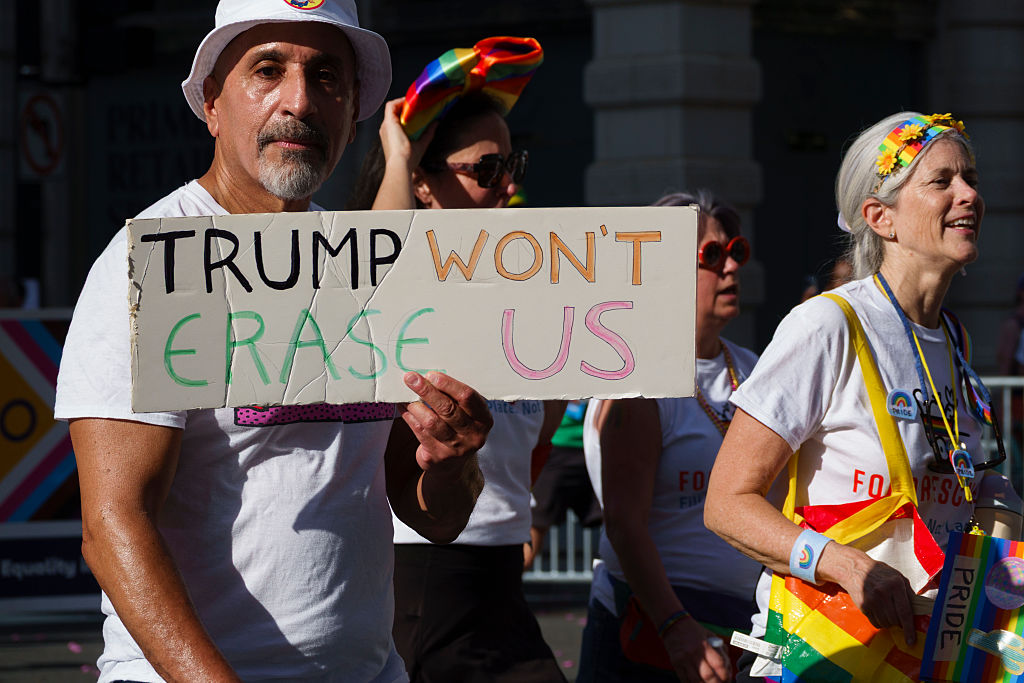
These are the crises that needed this Court’s attention. Instead, the Court spent its time sorting girls.
Women’s rights and trans rights are not competing causes. They never were. They share a common enemy: the rigid gender hierarchy that has always used “protection” as a cover story for control.
The same ideology that polices trans girls’ bodies also decides that Black women athletes are too masculine to be celebrated, that girls who throw too hard must be checked, that women who don’t perform femininity correctly are fair targets. None of us are free until the category of “woman” is big enough to hold all of us.
Title IX, which turned 54 this year, was built on a radical premise: that every student deserves the opportunity to learn, compete, and grow as their full selves. That promise was not on the Court’s docket today, but it is on ours. Equal Rights Advocates will keep fighting it in courts and in Congress, because to the question this case really asks—who gets to be a girl?—we have always had the same answer:
All of them.