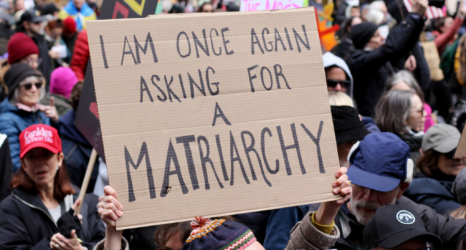
The People’s Bill of Rights 250 is inviting Americans to weigh in on constitutional protections for equality, reproductive freedom, healthcare and more.
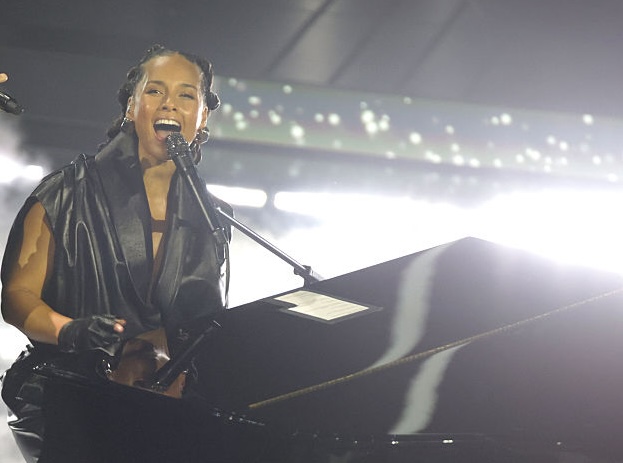
On Saturday, Sept. 26, Alicia Keys will use a special performance at the Global Citizen Festival in New York City’s Central Park to amplify the People’s Bill of Rights 250, a civic initiative asking Americans to help define the rights the Constitution should protect during the country’s next 250 years. (Keys joins Lauryn Hill and Wyclef Jean, who will celebrate the 30th anniversary of the Fugees’ The Score, Victoria Monét, John Legend, Lenny Kravitz and others; tickets to the festival are free on the Global Citizen app.)
During her “Alicia Keys & Friends” performance, Keys will bring the People’s Bill of Rights’ message—“WE THE PEOPLE. AGAIN.”—to tens of thousands of festivalgoers.
“The People’s Bill of Rights 250 is about … passing the mic,” says Keys, “making sure every voice gets heard, and giving people the power to shape what comes next.”
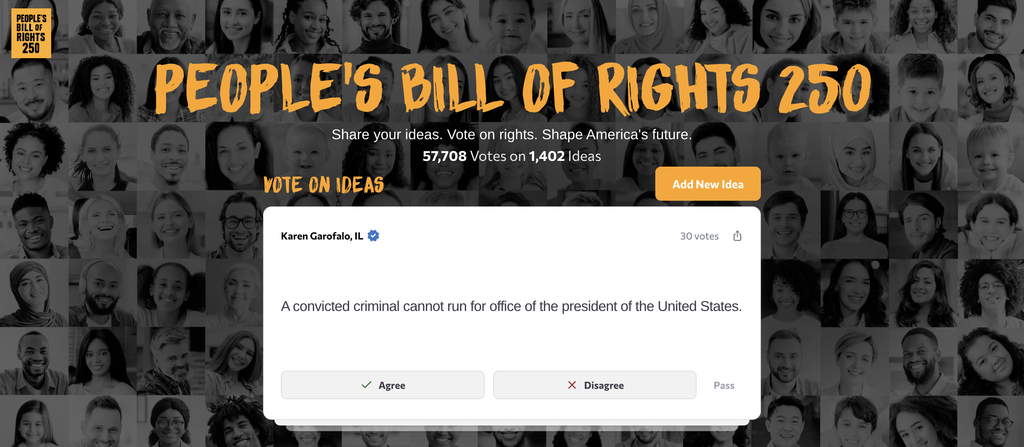
The initative asks Americans to participate in small online deliberations and ultimately vote on which ideas should move forward. Current deliberations ask Americans to consider whether healthcare, reproductive freedom, equality for women and girls, housing, education and environmental protections should be constitutional rights. You can add your own idea (if you feel like typing), or just swipe right or left on others’ ideas.
Leigh Blake, a longtime activist who has spent decades using music and culture to mobilize people around social causes, co-spearheaded of the People’s Bill of Rights 250. The project is an extension of a decades-long philosophy of activism: that ordinary people have more in common than they are told, that rights are inseparable from human dignity, and that meaningful changes come through collective action and service.
Blake is a lifelong activist. A British-born immigrant, she came to the U.S. after finding success in the arts and through Red Hot + Blue, her first AIDS benefit, sponsored by the Red Hot Organization and featuring more than 20 contemporary artists, including U2 and David Byrne. She eventually became a U.S. citizen, a distinction she speaks about with affection: “I fought to be a citizen of the United States.”
From her perspective as someone who grew up outside the United States, some aspects of American political life can be difficult to understand. Why, for example, does getting sick come with a bill?
But her criticism of America comes from a place of investment, not detachment: “I really love Americans.”
Blake rejects the idea that the country is hopelessly divided, and cites research from Stephen Kull at the University of Maryland. The research (part of the Voice of the People’s National Common Ground project) surveyed a demographically representative cross-section of Americans on 112 issues and found broad areas of agreement across Democrats, Republicans and independents.
In all, Americans agreed on 88 of the 112 issues examined.
The significance, for Blake, is not that political differences don’t exist. (They do.) It’s that Americans have been encouraged to view those differences as larger and more irreconcilable than they actually are.
“There’s always going to be people on the fringes,” she says, “but I don’t think we’re divided as a country in the way we’ve been led to believe we are.”
We are so awake right now. It’s unbelievable, and that is a gift.
Leigh Blake
A Bill of Rights Built From the Ground Up
Blake describes the initiative as operating almost like “politics without politicians.” Instead of waiting for elected officials to decide which issues deserve attention, Americans can propose their own ideas and vote on the proposals of others.
And they don’t need to be political insiders to participate. Anyone can still participate in the project from home—“from your couch,” she says—in about 90 seconds. For Blake, that accessibility is essential: Participation should not require a political degree, campaign organization or hours of free time.

The platform is for sharing, discussion and consensus-building among citizens, not for directly ratifying ideas in the Constitution. Under Article V of the Constitution, there are two ways to begin the amendment process: Congress can propose an amendment with a two-thirds vote in both the House and Senate, or two-thirds of the state legislatures can call for a constitutional convention. From there, an amendment must be ratified by three-fourths of the states—38 states today—to become part of the Constitution.
The ideas emerging from the People’s Bill of Rights 250 are not amendments themselves. Rather, the initiative creates a pathway for Americans to identify the rights and protections they believe should be guaranteed, build public support around those ideas and bring the most widely supported proposals to Congress.
The Unfinished Fight for Women’s Equality in the Constitution
For all of the constitutional language surrounding the People’s Bill of Rights 250, Blake’s own definition of rights is strikingly simple. When asked about what the word rights means to her—not as a constitutional concept, but as a human one—she answered with a single word: “dignity.”
The answer reflects the international scope of her activism. After decades of work in different parts of the world, particularly in India and Africa, Blake said she has seen a common desire for dignity emerge across cultures and political systems.
For women, that distinction is particularly important. One of the campaign’s current equality deliberations asks directly whether “full and equal rights for women and girls” should be named and protected explicitly in the Constitution. The Equal Rights Amendment also connects the PBOR 250 to a feminist movement that has spent generations arguing that equality should not depend on shifting political majorities or judicial interpretation.
The Equal Rights Amendment, first proposed in 1923, reads, “Equality of rights under the law shall not be denied or abridged by the United States or by any State on account of sex.” It would guarantee equality of rights under the law for all regardless of sex. The ERA passed Congress in 1972 with the needed two-thirds vote of the U.S. House and Senate. The required three-fourths of the state legislatures then ratified the ERA when Virginia became the 38th state to ratify in 2020. It still has not been added to the Constitution.
“Did you know it’s been 100 years since the Equal Rights Amendment was introduced?” said Alicia Keys on social media. “And now, still, women do not have an explicit guarantee to equal rights under the U.S. Constitution. Let’s turn outrage into authorship,” and directed viewers to the People’s Bill of Rights 250.

There is, however, a significant distance between identifying a right and enshrining it in the Constitution. A vote on the PBOR 250 platform cannot itself produce an amendment. Even overwhelming public support would still have to be translated into the formal Article V process. The campaign is testing whether sustained public deliberation and demonstrated popular support can create the political pressure necessary for constitutional change.
That is where her decades-long philosophy of service comes back into the picture.
For Blake, activism is not simply a profession or a political identity. It is a way of living.
“The road to true happiness is service,” she says. “It’s available to everyone.”
That belief may ultimately be the most important idea behind the People’s Bill of Rights 250. The project’s constitutional ambitions are enormous, but its immediate ask is much more modest—and much more concrete: Participate. Add an idea. Join a deliberation. Listen to people with different experiences. Help turn broad aspirations into specific rights. Then vote on what should move forward.
At a moment when so many people feel politically exhausted, disillusioned and powerless, she sees participation itself as a form of hope.
“We are so awake right now,” she says. “It’s unbelievable, and that is a gift.”
For Blake, the 250th anniversary of the United States is therefore not simply an occasion to look backward. It is an invitation to ask who “we” are now—and what it would mean to build a democracy in which everyone has a meaningful voice, everyone is entitled to dignity, and everyone has a role in serving one another.
The test for the People’s Bill of Rights 250 will be whether an invitation can become something more than a digital exercise. Can a conversation that begins on people’s couches produce rights that can survive the much harder journey through Congress, state legislatures and the constitutional amendment process?
The Constitution may have been written without everyone in mind. But, 250 years later, Blake believes that people can still decide what “we the people” should mean.
Readers can join the People’s Bill of Rights 250 and share the rights they believe the Constitution should guarantee. They can also take part in small online discussions to shape those ideas, then vote on which proposals the campaign should advance.