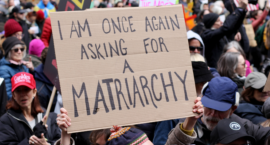
May 21 Virtual Event: Tackling Patriarchy and Power (With Anna Malaika Tubbs, Aisha Becker-Burrowes and Danielle Robay)

The Feminist Majority Foundation and Ms. have partnered with Women’s Foundation California to invite you to a national virtual conversation with Dr. Anna Malaika Tubbs that turns our attention toward the system that has kept us from achieving true democracy for the last 250 years: patriarchy. 

Drawing from her latest book (and New York Times best-seller) Erased: What American Patriarchy Has Hidden from Us, Tubbs traces the ruthless logic that has organized American life for 250 years—always bound to race, always rooted in a binary that decides who counts and who does not.

The event is Thursday, May 21, 2026 at 5:30 p.m. PT / 7:30 CT / 8:30 ET. RSVP today!

Tubbs will be joined in conversation by Aisha Becker-Burrowes, co-founder and co-executive director of FEMINIST—a nonprofit media company serving a global community of over 6 million—and interviewed by TV host, journalist and content creator, Danielle Robay.

There Is Danger in Silence: How to Mobilize Your Friends and Neighbors Into an ‘I Will Not Be Quiet’ Chapter

In 2016, just after Donald Trump was elected to his first term, a small group of women gathered in a Brooklyn apartment to talk through what they had been afraid to say out loud. Sitting cross-legged on the floor, balancing mugs in their hands, they created a space not for debate, but for listening. What emerged from those conversations became —a growing network of talking circles designed to help people find their voice in uncertain political times.

“It felt like a dam had been broken, and all this fear and anger was pouring out into the open,” said co-founder Adrianne Wright. “But underneath all of that noise, I noticed that there was something else: this impenetrable silence. It was a silence of people who didn’t feel safe enough to say I don’t really know, or I don’t know everything about this topic.” Over time, the circles expanded across the country, from Seattle to Atlanta, creating spaces where people could process political fear, connect with others and channel those conversations into action—from voter outreach to rallies supporting survivors of gender-based violence.

Wright says the idea behind the circles is rooted in a long history of collective organizing. “From Black churches during the Civil Rights Movement, to women’s groups in the 1960s, these spaces helped people name what they were living through and turn that into collective action,” she explained. “There’s a real pattern there: When people are given the space to speak truthfully about their lives, movements begin.” Today, the organization encourages anyone to start a local chapter using its free toolkit. “If we don’t feel like we belong, we can’t speak up,” Wright said, “and if we don’t speak up, it’s very hard for us to realize our power.”

Civil Rights Groups Launch Southern Voting Rights Mobilization Following Supreme Court’s Callais Decision

Civil and voting rights organizations across the South are launching a wave of rallies, trainings and grassroots mobilizations in response to the Supreme Court’s recent decision in Louisiana v. Callais, which decimated one of the last meaningful protections against racially discriminatory voting maps.

Over the next two months in Missouri, Alabama, Mississippi and Louisiana, as well as online, organizers will mobilize against the top-down national assault on Black political representation and multiracial democracy itself.

The actions come amid growing fears that the Court’s ruling will make it dramatically harder for Black voters and other voters of color to challenge discriminatory district maps in federal court.

Civil rights groups are calling for mass organizing and voter engagement, laying a groundwork for rebuilding the country through “sustained effort over time.” They also urge states to adopt their own Voting Rights Acts to help fill the vacuum left by the weakening of federal protections.

Upcoming actions include rallies at the Missouri Supreme Court, a National Day of Action in Alabama featuring events at the Edmund Pettus Bridge and the Alabama State Capitol, and the nationwide “John Lewis Good Trouble Lives On” mobilization planned for July.

FAQs About the SAVE America Act and Its Impact on Voters

As the SAVE America Act heads toward a Senate showdown, Republican leaders are preparing marathon debate sessions that could stretch late into the night. The legislation, backed by Trump, would require Americans to present documentary proof of citizenship, such as a passport or birth certificate, in order to register to vote in federal elections.

As the political fight intensifies, confusion about what the bill would actually require has spread widely online and across social media. Supporters describe the measure as a simple election-integrity policy, while critics warn it could create sweeping new barriers for millions of eligible voters who do not have ready access to the required documents—including many women whose current legal names may not match the names on their birth certificates after marriage.

To cut through the noise, Ms. has put together this guide to the SAVE America Act, answering common questions about what it would do and how it could affect your right to vote, including: Does a Real ID count? What if I can’t find my passport? And why are Trump and Republicans pushing so hard for this bill?

Iranian Feminists Urge World to ‘Join Hands With Us’

A powerful call from a collective of Iranian feminists in the diaspora:

“‎‎We, a group of Iranian feminists, at a time when the Islamic Republic has cut off the internet and all channels of communication with the outside world while carrying out a brutal massacre of protesters, extend our hands to feminists around the world. We call on the global civil society and feminists to stand with the people of Iran and to use all available independent national and international mechanisms to stop the regime’s machinery of killing and repression.”

What the Backlash Against Women’s Leadership Tells Us About Young Men

At this year’s Reykjavík Global Forum in November, where 500 global leaders from public and private sectors convened in Iceland, the mood around gender equality was both urgent and reflective. Progress that once felt inevitable now looks fragile. The Reykjavík Index for Leadership reveals concerning declines in how women are perceived for leadership roles across major economies, while conversations about young men and boys have become more heated, polarized and emotionally charged.

While at the forum, I spoke with Richard Reeves, an author and researcher focused on boys and men, and Michelle Harrison, the founding force behind the Reykjavík Index for Leadership, about what’s really going on—and what comes next. Their insights help clarify the current backlash, the urgency of centering young people, and why gender equality must remain a shared project—one that includes all of us.

For Women Spending the Holidays in Prison or a Shelter, You Can Make a Difference

Women and girls are the fastest growing incarcerated population in the United States today. The women now in prison are often there because of circumstances that might have put you or me there, too. 

We at Ms. magazine want women in prison to know they are seen and valued. And because domestic violence shelters can be almost as isolating as prisons—and often lack reading material, just as many prisons do—we want to support women in those shelters, too. 

For a tax-deductible donation of just $30, you can help send Ms. to a woman in prison or a domestic violence shelter for a year. And for just $10 more ($40 total), you can get a year’s worth of Ms. for yourself as well.

The Politics of ‘Audit’: How Texas Is Using Bureaucracy to Erase Gender Studies

Professor Melissa McCoul was dismissed in September after teaching LGBTQ+ themes in her children’s literature course at Texas A&M. Just this week, a faculty council determined McCoul’s firing violated her academic freedom.

But politicians and activists who oppose what they call “woke gender ideology,” are galvanized and doubling down, using this Texas A&M case to push for curricular reviews aimed at eliminating women’s, gender and sexuality studies from public colleges and universities across Texas.

Framed as bureaucratic oversight, conservatives seek to eliminate gender studies and related fields through procedural mechanisms that evade public scrutiny. The assaults on gender studies in Texas are not just a local issue; they are a national bellwether. They signal a coordinated effect to dismantle feminist and queer inquiry and remind us that silence, in the face of repression, is complicity.

Memory, Medicine and Law: Reflecting on the 20th Anniversary of Hurricane Katrina @ Washington, D.C., Sept. 11-13

This fall marks 20 years since Hurricane Katrina devastated New Orleans and the Gulf Coast, leaving more than 1,800 people dead and hundreds of thousands displaced. Katrina was not just a natural disaster—it was a political, legal and public health catastrophe that exposed deep inequities in the United States. Women, low-income communities and communities of color were hit hardest, and the failures of government response left lasting scars that continue to shape policy and memory today.

To reflect on these legacies, Georgetown University will host a three-day symposium, “Memory, Medicine and Law: Reflecting on the 20th Anniversary of Hurricane Katrina,” from Sept. 11-13, 2025, at its Capitol Campus and adjoining Law Center, located at 125 E Street NW in Washington, D.C.

The symposium is free and open to the public, but registration is required.

Trump’s Stunts Hide His Real Agenda: Rigging Elections and Gutting Safety Nets

Trump’s latest antics—from patrolling D.C. with border agents, to announcing a White House “UFC cage match”—are meant to generate headlines and distract from the real story. Behind the spectacle, his budget slashes SNAP, Medicaid and other lifelines for women and children, while Republicans escalate redistricting schemes to rig the 2026 elections.

Don’t let the chaos fool you: These moves will have devastating, lasting consequences for our democracy and our lives.