


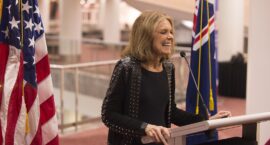
Gloria Steinem in Her Own Words: On Trump, Roe v. Wade, and the Birth of the Modern Women’s Rights Movement

As we grieve the passing of Gloria Steinem, Ms. founder and feminist visionary, we’re looking back at some of our favorite quotes from Steinem’s 50+ years of speaking and activism across the U.S. and throughout the world. She was sharp, funny and infinitely quotable, and many of her interviews from over the years combine deep feminist insight with some snappy one-liners.

The two most famous quotes attributed to Steinem are possibly, “A woman needs a man like a fish needs a bicycle” and, “If men could get pregnant, then abortion would be a sacrament.” However, while Steinem said and popularized both, she made it clear that neither quote originated with her; the first is attributed to Australian writer and activist Irina Dunn, and the second, according to Steinem, was originally said by her speaking partner Florynce Kennedy.

Steinem still had no end of wise, funny, inspiring sayings of her own that other feminists will keep quoting for years after her death. Below are some of our favorites.

The People’s Bill of Rights 250 Invites Americans to Reimagine the Constitution

A new online public platform—The People’s Bill of Rights 250—invites Americans to propose, discuss and vote on ideas they believe belong in the Constitution. As the U.S. marks 250 years, the bold, interactive project asks Americans not only to reflect on the nation’s founding, but to help shape its future.

The nonpartisan organization The People and executive director Katie Fahey, alongside a coalition of civic, advocacy and cultural leaders, spearheaded the People’s Bill of Rights 250. It invites Americans to answer a simple question: What freedoms, rights and protections should every person in the country be guaranteed over the next 250 years?  

From now until Friday, July 31, Americans are encouraged to vote and share their own ideas at the People’s Bill of Rights 250’s website.

‘La Operación’: The Hidden History and Forced Sterilization of Puerto Rican Women

In 1937, the U.S. began one of the largest sterilization campaigns in modern history in its colony of Puerto Rico. By the 1970s, one-third of all Puerto Rican women of childbearing age had been sterilized, most without being properly informed that the procedure was permanent. 

The decades-long campaign has haunted Puerto Rican families for generations and remains one of the clearest examples of the United States’ ugly history of reproductive coercion. 

That history is the focus of “Declared Unfit to Reproduce – Eugenics,” the newest addition to episode 3 of BC Voices’ docuseries Speak UP, Speak OUT, which explores how ever-changing reproductive policies have shaped the lives of women throughout the past half-century. 

Can You Believe They Put This in Writing? The Wildest Quotes From Heritage’s ‘Project 2026’

The Heritage Foundation has once again taken it upon itself to craft a plan for how to supposedly save America. The report—”Saving America by Saving the Family: A Foundation for the Next 250 Years”—focuses on marriage, family and the American Dream, and has become widely known as “Project 2026,” a follow-up to Heritage’s infamous Project 2025 blueprint.

Project 2025 clocked in at 900 pages; the sequel is around 150. We read the whole thing and pulled out the passages that gave us chills, made us laugh out loud, compelled us to suddenly need to take a long walk and hug our dogs, or inspired another donation to our local abortion fund.

This isn’t intended to be a fact-check or a line-by-line rebuttal. It’s intended to show you how some of the country’s most influential conservative thinkers are talking about feminism, contraception, abortion, LGBTQ+ people, higher education, marriage, motherhood and the role government should play in all of it—because you’re probably too busy to read hundreds of pages of anti-feminist slop.

And because, as former Vice President Kamala Harris famously said about Project 2025: “Can you believe they put that thing in writing?” They did—twice now!

This is the roadmap they’re offering. These documents tell us how their authors understand the country, the family and women’s place in both. We should know what it says.