‘If We Didn’t Do It, Who Would?’: Meet the N.C. College Students Leading the Fight for Campus Voting Access

Republicans on the Wake County Board of Elections voted 3-2 earlier this summer to remove North Carolina State University’s Talley Student Union as an early voting site. The student center had served as an early voting location during the 2012, 2018, 2020 and 2024 general elections.

This year, early voting will instead take place at the Business Services Center, about 1.7 miles from campus. Republican board member Donna Williams says the new location is “very easily accessible for everybody.” But turnout data suggests the student union was far more convenient for voters: During the 2020 and 2024 presidential elections, more than 21,000 people voted early there, compared with about 11,000 at the Business Services Center.

The move is the latest in a series of decisions eliminating on-campus polling locations across the state.

One of the schools losing their on-campus polling location, North Carolina A&T State University, has a long history of activism: Four NC A&T freshmen launched the Greensboro sit-in movement in 1960, helping ignite a wave of nonviolent civil rights protests across the South. 

When election officials refused to approve an early voting site on campus ahead of the 2026 primary, students drew on that history—packing government meetings, organizing transportation and ultimately leading a march to an off-campus polling place.

Kennedy Bozeman, Khadijah Barry and Tatiana James were among the women at the center of that student organizing. They spoke with Ms. about the difference between nominal and meaningful access to the ballot, what political leaders misunderstand about young voters, and why they see their work as part of a much longer fight.

“Having a polling site on campus makes everything 10 times easier and more accessible.”

“This work can be emotionally draining. But there is joy in it, too, because I am fighting for what my ancestors fought for …”

“A big part of my motivation is John Lewis. He was 21 when he began his fight for civil rights, and we are all around that same age. That shows me I’m in the right place and doing what the leaders who came before me did.”

Can You Believe They Put This in Writing? The Wildest Quotes From Heritage’s ‘Project 2026’

The Heritage Foundation has once again taken it upon itself to craft a plan for how to supposedly save America. The report—”Saving America by Saving the Family: A Foundation for the Next 250 Years”—focuses on marriage, family and the American Dream, and has become widely known as “Project 2026,” a follow-up to Heritage’s infamous Project 2025 blueprint.

Project 2025 clocked in at 900 pages; the sequel is around 150. We read the whole thing and pulled out the passages that gave us chills, made us laugh out loud, compelled us to suddenly need to take a long walk and hug our dogs, or inspired another donation to our local abortion fund.

This isn’t intended to be a fact-check or a line-by-line rebuttal. It’s intended to show you how some of the country’s most influential conservative thinkers are talking about feminism, contraception, abortion, LGBTQ+ people, higher education, marriage, motherhood and the role government should play in all of it—because you’re probably too busy to read hundreds of pages of anti-feminist slop.

And because, as former Vice President Kamala Harris famously said about Project 2025: “Can you believe they put that thing in writing?” They did—twice now!

This is the roadmap they’re offering. These documents tell us how their authors understand the country, the family and women’s place in both. We should know what it says.

America’s Roman Holiday: Prime Day and the Price of Convenience

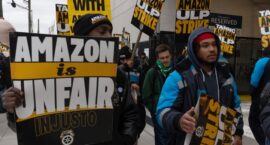
Amazon Prime Day has become one of the biggest shopping events in the country, but its success tells a story far bigger than discounts.

In an economy where families are struggling with the cost of groceries, rent, healthcare and childcare, the appeal of lower prices is understandable. Yet the massive scale of Prime Day also raises a harder question: What does it mean when one of America’s defining consumer rituals depends on a labor system that workers, regulators and advocates have repeatedly described as dangerous, underpaid and deeply unequal?

Amazon’s influence extends far beyond its own warehouses. By normalizing ever-faster delivery, constant surveillance and relentless productivity, the company has helped reshape expectations across the retail economy.

As billionaire wealth continues to soar and labor protections face renewed political pressure, Prime Day reveals the growing divide between those who profit from convenience and those whose labor makes it possible.

The FIFA World Cup and the Art of Looking Away

When the Federation Internationale de Football Association (FIFA) unveiled the first wave of celebrity promotions for the 2026 FIFA World Cup, the messaging was familiar: unity, celebration and global connection through sport.

Held every four years, the world’s largest international soccer (also known as football) tournament brings together national teams from around the globe to compete for the championship title. The right to host the World Cup is awarded through a competitive FIFA bidding process, with the 2026 tournament being awarded to a joint bid from the United States, Canada and Mexico.

But beneath the glossy advertisement campaigns and official anthems lies an institution repeatedly tied to corruption scandals, labor exploitation and human rights controversies that cannot be danced away by celebrity performances and spectacle marketing.  

Loving the game should not require ignoring the systems surrounding it. Because behind every glittering opening ceremony is an uncomfortable question FIFA would rather audiences not ask: Who is paying the price for the spectacle?

Too often it is people whose labor, rights and well-being are treated as expendable.

‘A Warning Shot’: DOJ Indictment of Southern Poverty Law Center Sparks Outcry Across Civil and Women’s Rights Movement

The U.S. Department of Justice’s criminal case against the Southern Poverty Law Center marks a stunning escalation in the federal government’s attacks and aggression toward civil rights organizations. A grand jury has indicted the SPLC on charges of wire fraud, bank fraud and money laundering—allegations the organization has called false and politically motivated.

The charges are rooted in bad-faith characterizations of payments SPLC made to informants in extremist groups like the Ku Klux Klan. Trump’s DOJ is attempting to argue these payments counted as financial support. In reality, the SPLC’s work helped dismantle some of the country’s most prominent white supremacist groups.

For feminist and civil rights groups, the indictment is the clearest sign yet of an escalating campaign to intimidate the nonprofit sector, criminalize civil rights advocacy and silence dissent. In their view, the administration is not only attacking outcomes or messages, but working to turn the machinery of government itself against advocacy groups: criminal law, regulatory scrutiny and national security frameworks.