After Republican election officials eliminated on-campus early voting sites, three student organizers at the nation’s largest HBCU mobilized their classmates, carrying on their university’s long tradition of civil rights activism.
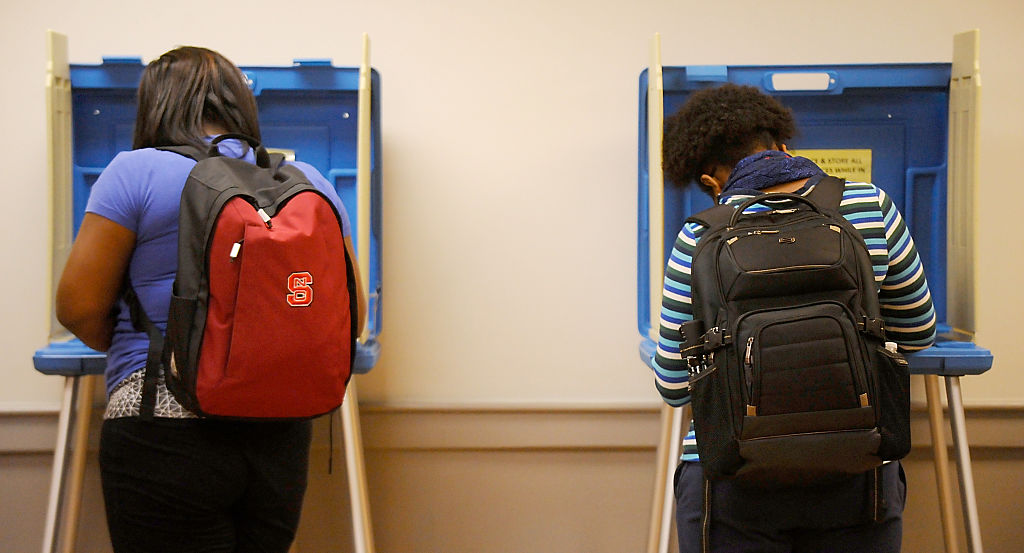
Republicans on the Wake County Board of Elections voted 3-2 earlier this summer to remove North Carolina State University’s Talley Student Union as an early voting site. The student center had served as an early voting location during the 2012, 2018, 2020 and 2024 general elections.
This year, early voting will instead take place at the Business Services Center, about 1.7 miles from campus. Republican board member Donna Williams says the new location is “very easily accessible for everybody.” But turnout data suggests the student union was far more convenient for voters: During the 2020 and 2024 presidential elections, more than 21,000 people voted early there, compared with about 11,000 at the Business Services Center.
The move is the latest in a series of decisions eliminating on-campus polling locations across the state—following similar removals at North Carolina Agricultural and Technical State University (the nation’s largest historically Black university), the University of North Carolina at Greensboro, and Western Carolina University.
Democrats and voting rights advocates say moving polling places farther from campuses makes it harder for students to cast a ballot. “The most significant barrier to students voting is typically accessibility to voting sites,” Will Cowan, an NC State graduate student who previously worked on voter engagement, told NC Newsline. “Talley addressed that problem.”
College-student voting has already fallen sharply in recent years: According to CIRCLE’s National Study of Learning, Voting and Engagement, 53 percent of college students voted in 2024, down from 66 percent in 2020.
Who Gets Heard in November?
These decisions will reverberate far beyond campus. In closely divided North Carolina, they will help determine who can meaningfully exercise the right to vote in November, and whose voices are heard in contests up and down the ballot.
For feminist and voting rights advocates, the same questions of access and representation are also at stake in a proposed constitutional amendment that would expand the state constitution’s photo ID requirement from in-person voting to every method of casting a ballot. (State law already requires absentee-by-mail voters to provide a copy of an acceptable ID or complete an exception form.) The League of Women Voters of North Carolina opposes the amendment and is urging voters to reject it, warning that placing the broader requirement in the Constitution without protecting existing safeguards could create additional barriers for military, student, rural and older voters.
Voters will also choose a replacement for Republican Sen. Thom Tillis, who is not running for reelection. Former Gov. Roy Cooper hopes to flip the seat to Democrat. Cooper’s Republican opponent, former Republican National Committee Chair Michael Whatley, trails him by 11 points.
North Carolina A&T State University Students Wage Fight Over Campus Voting Access
One of the schools losing their on-campus polling location, North Carolina A&T State University, has a long history of activism: Four NC A&T freshmen launched the Greensboro sit-in movement in 1960, helping ignite a wave of nonviolent civil rights protests across the South.

When election officials refused to approve an early voting site on campus ahead of the 2026 primary, students drew on that history—packing government meetings, organizing transportation and ultimately leading a march to an off-campus polling place.
Kennedy Bozeman, Khadijah Barry and Tatiana James were among the women at the center of that student organizing. They spoke with Ms. about the difference between nominal and meaningful access to the ballot, what political leaders misunderstand about young voters, and why they see their work as part of a much longer fight.
This conversation has been edited for length and clarity.
“A Long-Lasting History of Fighting for Our Rights”
Claire Masquida: For someone unfamiliar with NC A&T, how would you describe the culture of the university?
Kennedy Bozeman: North Carolina A&T State University is the largest HBCU in the nation, and we are located in Greensboro, N.C. We are one of several HBCUs in Greensboro, but we are the largest public HBCU in the country.
Our campus has a long history of fighting for our rights and of activism in our community. Community service and activism have been part of our history and continue to stay with us. The Greensboro Four [Ezell Blair Jr., later Jibreel Khazan; Franklin McCain; Joseph McNeil; and David Richmond] went to our school. They are role models for us and make us want to be better as people and students—and to represent our university well.

When Election Officials Took Away A&T’s Polling Site
Masquida: For someone who doesn’t know what happened at A&T, can you walk me through the story from the beginning?
Khadijah Barry: I first learned that the Board of Elections was considering taking away A&T’s polling site in fall 2023. A&T has a long history of having an early voting location on our campus, going back to the 2004 presidential election.
In November 2025, we heard from local elected officials that the Board of Elections was preparing to discuss which schools would not have polling locations. Knowing our longstanding history, we knew this was important: They were taking away voting access from us. Tatiana, other student leaders and I mobilized more than 60 students to attend the Guilford County Board of Elections meeting.
We knew they would say no. Our next step was to get students to see that and carry that emotion and anger—knowing that these officials seemed to view voting not as our right, but as a privilege.
In January, with help from the Andrew Goodman Foundation, we arranged shuttles to take students all the way to Raleigh for a State Board of Elections meeting. The room was packed; I would say close to 100 students attended. They rejected our proposal for an early voting site.
It wasn’t just our school. Other schools in the Greensboro area and across North Carolina were also denied sites.
That January meeting made it blatant. Students watched election officials disregard our rights and the importance of allowing us to vote on our college campuses. Viral clips circulated of the chairman threatening to call the police if students did not leave the room. It was like something you would expect to have happened decades ago—but it was happening to us. The same battle the A&T Four fought is the battle we continue to fight.
That was the call to action.
We had a lot of support from people in the community and nonprofit organizations. The response was: “If you don’t have a polling site on your campus, let’s make voting accessible.”
Tatiana and I mobilized students on the first day of early voting and led a March to the Polls. It went viral and caught the attention of Kamala Harris, which gave us the opportunity to have a private conversation with her on our campus. She came and motivated students to vote.
Students watched election officials disregard our rights and the importance of allowing us to vote on our college campuses. … That was the call to action.
Khadijah Barry
Why an On-Campus Polling Location Matters
Masquida: At the core of this story is the loss of a polling location on a large college campus. What makes an on-campus location so important to democracy?
James: The alternative for students was the Guilford County Courthouse, where our March to the Polls ended. That is about a 30-minute walk from campus, and it could easily take longer. If you don’t have transportation—or if you’re a first-year student, who generally isn’t allowed to have a car without special permission—you have to carpool or find time outside of class to make the trip. The polls are not open around the clock, so students don’t have much leeway. In my opinion, that is not really an alternative.
We also think the ease of early voting played a role in the decision. It is easier for students to participate during early voting than on Election Day, and students can register and vote on the same day during the early voting period.
Our polling place was in Dudley Memorial Building. Dudley is monumental to us because the A&T Four statue is in front of it. That is where students went to vote.
We had a great turnout in the presidential election. We were able to bring a lot of people in on the last day of early voting because we could register them that day. That speaks to why having the site there is so important.
The shift at A&T is part of a much wider erosion of access. More than one in five U.S. polling places closed between 2012 and 2022: The number fell from more than 116,000 to fewer than 89,000. Those closures have had an especially pronounced effect on communities of color. Texas—where the population is about 40 percent Latino and 13 percent Black—closed 750 polling places between 2013 and 2019. Georgia, whose population is roughly one-third Black, closed more than 200 during that period.
For individual voters, the practical effect can be stark. Georgia resident Wanda Jenkins said the relocation of her polling place required her to drive an additional seven miles to vote. “It would’ve been better served in my community if [the polling place] had stayed here,” she said.
The shift at A&T is part of a much wider erosion of access. More than one in five U.S. polling places closed between 2012 and 2022 …
Tatiana James
‘Technically Accessible’ Is Not Actually Accessible
Masquida: What do you wish people understood about the difference between something being technically accessible and actually accessible to students?
James: Is it technically possible for us to walk 30 minutes to the courthouse? Absolutely. But it is a substantial inconvenience for students.
For many people, this is their first time living away from home. There is a meaningful difference between walking five minutes to a polling place in the center of campus and having to leave campus altogether—which, if we are being honest, can also pose a safety risk. I don’t think the off-campus location is feasible.
Bozeman: Another layer is the effect on students with disabilities. Our campus does a good job of maintaining accessible routes, but the city of Greensboro does not offer that same accessibility everywhere.

Masquida: Have you personally seen students struggle with voting access?
Barry: I think everyone on our campus does. It comes back to our motto: “Aggies do.” We’re always doing something—and at the end of the day, we’re college students. Having a polling site on campus makes everything 10 times easier and more accessible.
What is especially hard to grasp is that we are the nation’s largest public HBCU. I cannot see a valid argument for why we shouldn’t have a polling place on campus. Our campus is not small, and it sits in the middle of Greensboro, so the site also serves community members who are not students.
It felt like a deliberate move, not an oversight. It’s a modern-day poll tax on students.
Moving polling places farther from the communities they serve imposes added costs in time, transportation and money—and can depress participation even when voters remain technically free to cast a ballot. With youth turnout already falling, the accessibility of polling locations is central to protecting broad participation in elections.
What Politicians Get Wrong About Young Voters
Masquida: What do people misunderstand about young voters or college students in the voting process?
Barry: At the local and state Board of Elections meetings, we constantly heard: “Y’all didn’t turn out. Turnout is low.” But low student turnout does not give officials the right to take away our polling location. I never understood that argument.
I also think they are doing it because they know our vote is extremely powerful. People ages 18 to 25 are the new generation. They see that young people tend to vote in a more liberal way, and they are trying to keep themselves in power. When we vote, we can shift the direction of our government. I believe the decision was very deliberate.
James: At the second Board of Elections meeting, officials raised the availability of people to work at the polls. We explained that this would not be a problem: A group of students was right there, willing to be trained and work the polls. We also had the Greensboro community behind us—more than 300 community members rallied in support, and people who attended the March to the Polls would have gladly volunteered their time.
When officials talked about staffing and accessibility, it felt like another excuse. I also spoke with someone from the NAACP Legal Defense Fund. The reason officials gave for removing the site, of course, was low turnout. But LDF investigated and concluded that this explanation was a cover and not the true reason the site was taken away. They understand that young people on this campus have a history of turning out around civil rights issues and generally voting in a liberal direction.
Bozeman: There has always been a stigma that young people don’t care about politics or what is going on in the world—that we’re naive. I think that’s the farthest thing from the truth. People may not always be educated about the specifics of what is happening politically, but they are not uninterested. They know political decisions affect how we live every day.
Reproductive rights affect people in our age group. Federal policy changes affect student loans. We have a housing shortage, and there is not enough housing for the number of students here. Then there is the job market: We are in college so we can eventually go out and get jobs.
It’s wrong to label young people as people who don’t care about politics. We show up because we see firsthand how these decisions affect us. We are the people being affected by laws passed by politicians who are elected to represent us but have not shown that they care. It’s disheartening.
Barry: Young voters are issue-driven, not candidate-driven. We care about what a candidate can do for us. We want people running for office to say: “These are the issues I know you care about. This is what I will do once I get into office”—and then follow through on that promise.
I think candidates need to realize we are issue-driven, and they need to be vocal and honest about the issues they care about and support. We truly do care. We just care more about the issues than the candidate.
Black Women’s Leadership and the Feminist Connection
Masquida: Women leaders often face resistance when advocating for their communities. Have you experienced that kind of pushback, and how does this work connect to feminism?
Bozeman: Definitely. I also work on reproductive rights, and that is something we face constantly. Reproductive rights are deeply misunderstood, especially when young people are involved. There are countless cases in which abortion is medically needed. But regardless of whether it is medically needed, seeking an abortion is a person’s right and their choice.
This summer, I went to Washington, D.C., to speak with legislators about this issue. There are so many times when they want to slam the door in your face because they don’t see it as important or life-changing.
When you advocate as a woman, people often don’t want to listen because of preconceived stereotypes. They think you’re emotional or only care about yourself. They see that you’re a woman, and they try to minimize you and put you in a box. That is not OK.
But that is also the beautiful thing about womanhood: We are persistent when people doubt us. Women—especially Black women—have long been at the forefront of this country’s political movements, and we will not stop.
James: This movement at NC A&T has been led predominantly by women. I have not personally received pushback or had my leadership questioned, but I think that is because the three of us have already established ourselves in these roles. I have seen other women leaders face resistance and people refusing to listen to them. But here, it has been us leading the movement.
Bozeman: I also think our experience is partly due to the culture at our university. Outside the bubble of our campus, it is very real to see women shut down simply because they are women.
Women are so often the ones who step up, speak out and advocate for everyone. But when it is our turn to be considered, it’s crickets. We’re not only fighting for ourselves; we’re fighting for everyone else, too.
‘The Same Work Our Ancestors Once Fought’
Masquida: On a personal level, why is this issue important to you? What gives you hope as you continue the work?
Barry: When I was a senior in high school applying to A&T, the question was: “Why A&T?” I wrote about North Carolina’s history of gerrymandering and the importance of the Greensboro Four to the civil rights movement.
I wanted to study political science and run for office one day. Then I was put in a position to stand up for the entire student body, talk about this issue and get students to vote—to show them: “Hey, they don’t actually want us to vote.” It felt like a calling to do what I had always known I should be doing. A&T’s history was why I wanted to come here, and I wanted to become part of that history.
James: I knew the historical significance of A&T and the A&T Four, and I wanted to be part of something greater. Being here and joining the same fight our ancestors and those who came before us once fought made it real to me that there is still work to be done.
People sometimes act as though the struggle for civil rights ended in 1965. Unfortunately, we live in a time when the same barriers are simply dressed up differently.
This work can be emotionally draining. But there is joy in it, too, because I am fighting for what my ancestors fought for, leading students and helping people who cannot speak up for themselves. If we didn’t do it, who would? I want to be a lawyer, and I think every good lawyer starts in grassroots organizing. That is what this is.
Bozeman: My hope comes first from the fact that I attend an HBCU. Our institutions are alive because of the people who fought and died for them. We stand on the shoulders of giants. Going to an HBCU ignites a fire in you to be like those who came before you.
When I first came to college, I was focused on becoming a physician assistant. I knew I wanted to work clinically and help make people’s lives better. But over time, I began to understand that healthcare isn’t black and white. It is one thing to be a provider; it is another to be a good provider who cares. And so much of it starts at the top. It starts in our politics.
Barry: A big part of my motivation is John Lewis. He was 21 when he began his fight for civil rights, and we are all around that same age. That shows me I’m in the right place and doing what the leaders who came before me did.
I always live by his call to get into “good trouble, necessary trouble.” That is what we have done all year. It lets me know we’re on the right path, doing the necessary work.
*
A note from Ms. editors: We want to hear from you for The Majority, a new campaign collecting stories about how reproductive freedom has enabled readers to build the lives they want and need. Poll after poll shows a majority of Americans support reproductive healthcare access. Yet public debate overlooks the lives shaped by abortion access, contraception, IVF, miscarriage care, maternal healthcare or comprehensive sex education—countless women who chose to pursue an education, have children, not have children, protect their health and chart their own future. Add your voice and complete the sentence: “Access to reproductive choices gave me the freedom to….” Together, these stories will help show not only why reproductive freedom remains a majority value, but also what it makes possible.