Jewett’s stories centered independent women and their networks of care.
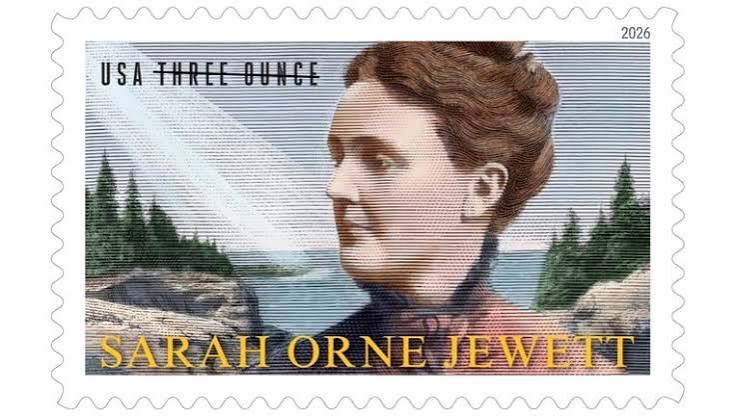
The U.S. Postal Service (USPS) issued a new stamp late last month honoring 19th-century writer Sarah Orne Jewett—putting a woman whose work centered on female independence and unconventional lives, into mailboxes and collection books across the country.
The stamp, the 35th in USPS’ Literary Arts series, was unveiled in Jewett’s hometown of South Berwick, Maine. Its portrait of Jewett appears against the Maine coast, a reference to her best-known work, The Country of the Pointed Firs. USPS says renewed interest in Jewett’s writing has been driven partly by her strong female characters.
Born in Maine in 1849, Jewett became one of the most prominent American regionalist writers of her era, publishing hundreds of stories, essays and poems. Her fiction documented the people and communities of New England, but it also repeatedly placed women at the center of their own stories: Female friendships, professional ambition and lives built outside traditional marriage appear throughout her work. In A Country Doctor, her heroine chooses a medical career over marriage. The Country of the Pointed Firs revolves around a community in which independent women, including writer and herbalist characters, hold much of its knowledge and authority.
Calling Jewett a feminist requires some historical nuance. Writing before contemporary feminism existed, she nevertheless created work that scholars have increasingly returned to for its feminist undertones: her insistence on women’s freedom, her attention to relationships between women, and her resistance to the idea that marriage and domesticity represented the only meaningful paths available to them. Jewett herself never married and built a long partnership with writer and publisher Annie Fields.
In 2025, Ms. selected Abortion Stories: American Literature Before Roe v. Wade, edited by Karen Weingarten, as one of the most anticipated feminist books of the year. The published collection brings together literature documenting abortion before Roe v. Wade, including an excerpt from Jewett’s The Country of the Pointed Firs.
Jewett never explicitly writes the word “abortion” in the published passage. Instead, one of the novel’s central characters, Mrs. Todd, is an herbalist who gathers plants and receives women who arrive privately at her door seeking remedies and whispered instructions.
Weingarten said she included the passage because abortion exists in its subtext, reflecting a period when reproductive knowledge could be encoded in language about women’s networks of care.
That history makes the timing of Jewett’s stamp particularly striking. More than four years after the Supreme Court overturned Roe v. Wade, abortion remains banned outright in 13 states, with additional states enforcing early gestational limits. Battles over reproductive healthcare continue at both the state and federal levels—from access to medication abortion, to funding for family-planning services.
The Postal Service itself is at the center of Trump’s war on mail voting. In response to a Trump executive order, USPS developed a rule that would have required states to submit voter information through a new portal and could have allowed the agency to refuse certain mail ballots. On Sept. 14, the Supreme Court left an injunction in place, blocking key parts of the rule through the November election. The postmaster general said days later that USPS had stopped work on the computer system central to the plan.
Jewett’s face is now traveling through a postal system caught up in that debate, across a country still contesting reproductive freedom. The stamp itself makes no claim about voting or reproductive rights. But there is something notable about a federal institution commemorating a woman whose work has become part of the literary history of abortion at the same moment reproductive autonomy is again being fiercely contested.
Nor would Jewett be the first woman connected to struggles for equality to appear on American postage. USPS has commemorated Susan B. Anthony, Rosa Parks, Shirley Chisholm and feminist scholar and activist Anna Julia Cooper, among many others. In 2020, the agency issued a “Women Vote” stamp for the centennial of the 19th Amendment, and in 2022, a stamp adorned with silhouettes of athletes was issued celebrating Title IX protections.
Stamps are tiny pieces of public history: They reflect choices about which people and stories the country considers worthy of remembering.
In 2026, Sarah Orne Jewett’s image is traveling across a country still debating many of the same questions her writing raised more than a century ago: who gets independence, whose knowledge counts and how much control women should have over the course of their own lives.
*
A note from Ms. editors: We want to hear from you for The Majority, a new campaign collecting stories about how reproductive freedom has enabled readers to build the lives they want and need.
Poll after poll shows a majority of Americans support reproductive healthcare access. Yet public debate overlooks the lives shaped by abortion access, contraception, IVF, miscarriage care, maternal healthcare or comprehensive sex education—countless women who chose to pursue an education, have children, not have children, protect their health and chart their own future. What’s your reproductive freedom story? Add your voice. Together, these stories will help show not only why reproductive freedom remains a majority value, but also what it makes possible.