


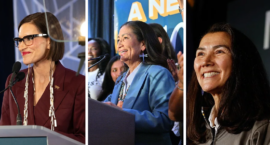
On Tuesday, Nov. 3, after winning New Mexico’s gubernatorial race, Deb Haaland—a citizen of the Pueblo of Laguna—delivered her victory speech at the Route 66 Hotel west of Albuquerque.
“Just off this road, my grandmother was taken away to boarding school, and along with my grandfather, survived through a time where the federal government attempted to strip them of their languages, traditions and identities. Yet … we are still here. And tonight, in our nation’s 250th year, I stand before you as the first Native American woman elected governor in U.S. history!”
Haaland was one of more than 100 Indigenous women elected to public office in this year’s elections.
In addition to Haaland becoming the nation’s first Indigenous woman governor, two Indigenous women will serve in the U.S. Senate for the first time in history: Peggy Flanagan, a member of the White Earth Band of Ojibwe, will represent Minnesota, and Mary Peltola, a Yup’ik woman, will represent Alaska.
On their paths to breaking these political glass ceilings, Haaland, Flanagan and Peltola have built impressive track records, particularly in advancing Indigenous rights.
Peggy Flanagan echoed Haaland’s themes of resilience, patriotism and historical reckoning in her own victory speech.
“Do not be disheartened that it took 250 years for one of us to get here,” said Flanagan. “Be inspired by the fact that with grit and determination and the resilience of our people, whichever one of you is next, you’re going to get here a lot faster. Because if Auntie Peggy can do it, you can do it too.”