Shout Your Abortion Short Films Seek to Normalize Keeping Abortion Pills at Home: ‘You Always Have Options’

The grassroots abortion-stigma-busting juggernaut Shout Your Abortion has released two new powerful public service announcements urging people across the U.S. to order abortion pills in advance to have on hand, in case they have an unwanted pregnancy.

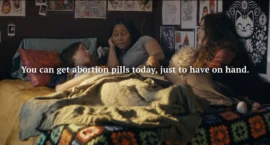
Made by Detroit-based filmmaker Na Forest Lim, the short films follow two women—a teenager named Dani and a single mother in her 30s named Poppy—who find out they are pregnant and use abortion pills at home, supported by friends and family.

Both of the main characters have easy access to abortion pills: Dani’s friend arrives with pills in her backpack, and Poppy keeps a pack tucked away in her top dresser drawer.

Building on that vision of easy access, the Dani PSA shows what it looks like when abortion pills are already part of teenagers’ lives and a pregnancy never has the chance to become a crisis.

Inside the Global Network of Abortion Doulas Supporting Self-Managed Care

As barriers to clinic-based abortion care have increased in recent years, an increasing number of women are self-managing their abortions: finding and using abortion pills independently of the formal medical system. They are obtaining abortion pills through online abortion pill services, community networks sharing pills for free and websites selling pills.

To support self-managed abortion, feminists are creating a global network of online abortion doulas—trained companions who offer one-on-one support by phone, email and text to people using abortion pills. A leader in this effort is the organization Rouge Doulas, which runs the Rouge Abortion Doula School.

International Telehealth Provider ‘Women on Web’ Vows to Keep Abortion Pills Flowing to the U.S., No Matter What

As Republicans push the FDA to restrict mifepristone, the international online abortion service Women on Web is reassuring Americans that they will continue to support access to abortion pills in all 50 states, no matter what. Women on Web has served over 130,000 people worldwide since 2005 and began serving the U.S. in July 2024.

Venny Ala-Siurua, executive director of Women on Web, was recently named to the Top 100 Canada’s Most Powerful Women by the Women’s Executive Network Academe. Ms. spoke with Ala-Siurua about how their service connects people with pills, how they’re removing medical gatekeeping, and how they’re defending abortion access against digital censorship.

“We’ve always focused on countries where there are high restrictions on abortion. Unfortunately, the situation in some of the states in the U.S. qualifies now. … Many pharmacies and providers have stepped up internationally to support the U.S. and found ways of dispensing and shipping medicines really, really fast. …

“We are receiving around 30 requests per day from people in the U.S., though that number can rise during major political moments—for example, when Trump was elected or took office. Our U.S. care seekers live primarily in states with abortion bans. Globally, we currently handle approximately 4,000 requests each month.”

Repro Groups Sue Michigan Over Law Denying Pregnant Women Control of Their Bodies in End-of-Life Decisions

Bodily autonomy shouldn’t vanish with a positive pregnancy test—yet in Michigan, it can.

On Oct. 23, a coalition of Michigan women, physicians and patient advocates filed a lawsuit, Koskenojo v. Whitner, challenging the constitutionality of Michigan’s pregnancy-exclusion law that forces life support on pregnant women by denying incapacitated pregnant patients the right to refuse life-sustaining treatment. The case relies on a voter-approved 2022 constitutional amendment that explicitly protects “the right to make and effectuate decisions about all matters relating to pregnancy.”

One plaintiff—Nikki Sapiro Vinckier of Birmingham, Mich.—explained her objections to Michigan’s pregnancy exclusion law. “As a woman and a mother, it’s infuriating to know that my body can still be regulated more than it’s respected. As a trained OB-GYN physician assistant, I know this law protects no one—it only punishes those who can get pregnant. The pregnancy exclusion clause isn’t about safety or care. It’s about control. There is no place for a law that discriminates against pregnant people in a state that claims to trust women.”

Texas Attorney General Ken Paxton Foiled in Scheme to Extend Texas Abortion Ban to New York

The battle over abortion rights crossed state lines last week when a Hudson Valley judge refused to enforce a Texas abortion ban in New York state. On Friday, Oct. 31, the judge dismissed a lawsuit filed by Texas Attorney General Ken Paxton against a New York clerk who refused to accept papers to enforce a Texas judgment against Dr. Margaret Carpenter, a New York doctor who provided telehealth abortion services to a Texas woman.

“The New York judge’s dismissal of Texas Attorney General Ken Paxton’s frivolous lawsuit is welcomed but expected,” said the Abortion Coalition for Telemedicine.

“Our shield law exists to protect New Yorkers from out-of-state extremists, and New York will always stand strong as a safe haven for healthcare and freedom of choice,” said Attorney General Letitia James.

Fighting MAGA Medical Disinformation: States Must Confront Trump’s War on Science and Reproductive Health

Backed by Robert F. Kennedy Jr. and Mehmet Oz, Trump’s attacks on safe, widely used medications are part of a larger strategy: sowing fear, undermining trust in science, and exerting political control over people’s most intimate health decisions.

The administration’s disinformation campaign extends far beyond Tylenol. Officials are questioning the safety of mifepristone despite decades of evidence to the contrary and spreading the falsehood that birth control causes abortion—all while defunding Planned Parenthood and funneling taxpayer dollars to crisis pregnancy centers that mislead and manipulate patients. Together, these actions threaten to upend decades of progress in reproductive health and put millions of women at risk.

It’s time for a coordinated response. Just as states have joined forces to counter anti-vaccine propaganda, public health leaders must now unite to defend reproductive healthcare. State and local governments can share strategies, strengthen protections for evidence-based medicine, and push back—loudly and collectively—against the Trump administration’s dangerous campaign of medical disinformation.

Judge Rules FDA Abortion Pill Restrictions Unlawful, Citing Political Interference

Following eight years of litigation, a federal trial court in Hawaii ruled the FDA violated federal law by imposing medically unnecessary restrictions on mifepristone, which is used for early abortion. Ruling in Purcell v. Kennedy, the court held that the FDA has a legal obligation to fairly evaluate and weigh the decades of extensive research affirming mifepristone’s safety, noting the agency had failed to justify its restrictions on access to mifepristone.

The court’s ruling requires the agency to consider the peer-reviewed evidence proving mifepristone’s safety, including its use via telemedicine, and to assess how the agency’s restrictions burden patient access. The ruling does not immediately change access to the medication, but it puts pressure on the FDA to follow the science rather than be swayed by political pressure.

“The FDA’s needless restrictions on mifepristone make our jobs harder without any safety benefit,” said Dr. Lisa Folberg, chief executive officer of the California Academy of Family Physicians. “We appreciate that the court recognized how FDA failed to consider the toll its restrictions take on physicians trying to provide a safe and effective medication to their patients.”

‘Mife No Matter What’: Community Abortion Providers Pledge to Continue Sharing Free Abortion Pills, Even if FDA Imposes Restrictions

Since 2022, community providers have built a nationwide network discretely mailing free abortion pills to those in ban or restricted states.

People can find community providers through several platforms that research and share information about abortion pill access, including Plan C, I Need An A and Red State Access. On these sites, visitors can search for options by their state or territory. Once the client reaches out, community providers typically respond within 24 hours and mail the pills within 48 hours. The medication typically arrives within seven days, and are shipped in an unmarked, discrete package.

More than 100 people are involved in community provision across the United States. One provider told Ms. why she stepped in to become a community provider: “I saw a great need and I could do it,” noting she is single with no children and is white, making her less vulnerable to police surveillance. “I love helping people. It’s rewarding.”

A recent client wrote back to her community provider with a message of gratitude: “I would like to extend my gratitude and appreciation. What you guys are doing is saving lives and giving us a choice when we don’t have the means of money or the resources. Thank you so much. I received the package and it worked as intended. Thank you for being here for me and millions of other girls that are in need.”

The New York Times’ Recent ‘Abortion Pollution’ Story Serves the Antiabortion Agenda

For the last three years, Students for Life of America (SFLA) has sought to use environmental concerns to attack abortion rights, claiming—without scientific evidence—that the medication mifepristone contaminates U.S. water supplies and threatens wildlife, the environment and potentially human health.

A recent New York Times article amplified this antiabortion effort, presenting these claims without substantial context. The article does not include interviews with anyone informed about the politics behind the campaign or the science of mifepristone in wastewater. Only a brief mention—seven paragraphs in—notes that environmental experts have dismissed SFLA’s claims, before returning to treating the claims as a legitimate concern. 

“There is absolutely no evidence that this is an environmental issue,” said Nathan Donley, the environmental health science director for the Center for Biological Diversity. “Pharmaceutical waste can be a big issue when we’re talking about widely used drugs, but to somehow point to mifepristone as a bad actor here is completely disingenuous.”

Jack Vanden Heuvel, a molecular toxicologist at Pennsylvania State University, agreed: “Most wastewater treatment plants are very effective at getting rid of any mifepristone that is there.” He described SFLA’s position as “a pretty weakly supported argument.”

America Is an Increasingly Dangerous Place for Women and Girls 

In America’s hyper-macho, gun-drenched culture, growing up female has never been safe. But under the Trump administration, America is becoming a much more dangerous place for women and girls.

America is dangerous for women and girls because our leaders choose to make it so. The Trump administration has already begun blocking access to abortion and Medicaid coverage for reproductive health, as well as targeting the rights of pregnant people within the 2023 Pregnant Workers Fairness Act.

Already, the macho culture of the U.S. has steadily made women’s safety in the nation decline. Around 41 percent of women in the U.S. have experienced sexual violence, while a third of women reported severe assault by a husband or boyfriend. The normalization of gun violence and violent pornography have also run rampant across the country, making America more dangerous day by day.