Despite growing legal threats to the accessibility of abortion pills, national networks of volunteers are working to distribute the medication, discreetly and without cost to patients.

Since Roe fell, a community-led network of care has grown into a nationwide system with the promise of “mife no matter what.”
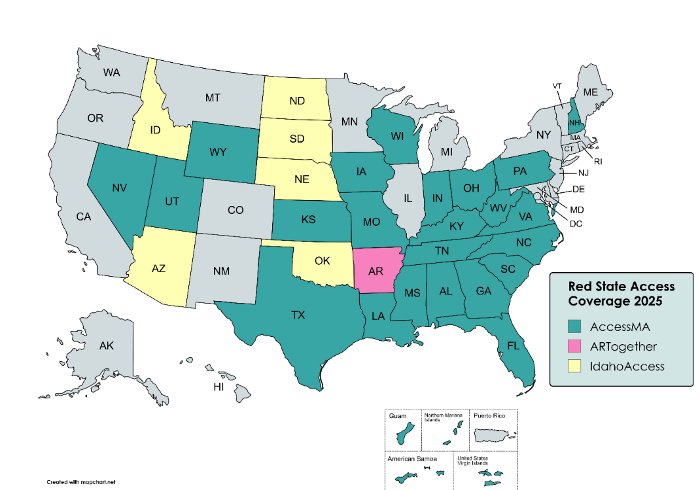
In June 2022, after the Supreme Court overturned Roe v. Wade and over half of states banned or restricted abortion, grassroots activists across the country organized mutual aid groups to share free abortion pills with people living in restrictive states. Today, community providers distributing free abortion pills operate in every U.S. state and territory that bans or restricts abortion.
In practice, providers fulfill their mifepristone promise with a simple, accessible framework. Community providers source generic mifepristone and misoprostol from vetted overseas suppliers and ship them domestically to clients for prompt delivery. They serve people across all ages and gestational stages, providing adjusted protocols for later pregnancies. Up to 18 weeks gestation, clients receive one mifepristone tablet and 16 misoprostol tablets. After 18 weeks gestation, the dosage increases to two mifepristone and 16 misoprostol. However, the vast majority of clients are under 10 weeks.
Beyond the service of providing medication at home, other support includes trained companions offered to all clients throughout the abortion process, with a companion specifically assigned to anyone over 10 weeks of pregnancy. Companions are also assigned when clients disclose addiction, homelessness, are a minor, or if they are survivors of sexual or domestic violence. As discretion is essential, communication with companions is recommended via encrypted text or email.
People can find community providers through several platforms that research and share information about abortion pill access, including Plan C, I Need An A and Red State Access. On these sites, visitors can search for options by their state or territory.
These organizations also provide guidance on ensuring digital security for those seeking abortion pill information, including the use of encrypted email providers like ProtonMail, encrypted chat services like Signal, and privacy-enabled browsing services like DuckDuckGo, Firefox and Brave.
To receive pills, people living in states with abortion bans or restrictions complete a simple intake form with their name, address, the first day of their last period and the date of their positive pregnancy test. No identification is required and no credit card is needed because the service is free. Community providers use encrypted platforms and don’t save any information.
In the confirmation email, clients receive instructions for using the medications and clear steps about how to contact a trained companion to guide them through the process 24/7 by secure text through The Doula Project. Clients are also provided information about the Miscarriage and Abortion Hotline, which offers free and confidential medical support from volunteer clinicians with decades of experience in miscarriage and abortion. The hotline operates from 8 a.m. to 1 a.m. EST by phone or text.
Once the client reaches out, community providers typically respond within 24 hours and mail the pills within 48 hours. The medication typically arrives within seven days, and are shipped in an unmarked, discrete package.
Abortion pills are safer than some over-the-counter medications, with less than 1 percent of patients having serious complications that require follow up care. However, as a precaution, the websites of I Need An A and Red State Access list supportive aftercare providers in many locations served by community providers. Both websites note that vaginal use of misoprostol may be detectable during aftercare, so people often take the pills by mouth, which is undetectable.
More than 100 people are involved in community provision across the United States. One provider told Ms. why she stepped in to become a community provider: “I saw a great need and I could do it,” noting she is single with no children and is white, making her less vulnerable to police surveillance. “I love helping people. It’s rewarding.”
She explained she has a special ritual when she mails abortion pills. “When I drop it off to ship, I say, ‘I love you. You are going to be okay.’”
The community provider mentioned she has helped many people and receives heartfelt feedback. “We get lots of requests. There is a great need for the service that we are providing. Many folks comment that they don’t have another option due to their income or circumstances.”
A recent client wrote back to her community provider with a message of gratitude:
“I would like to extend my gratitude and appreciation. What you guys are doing is saving lives and giving us a choice when we don’t have the means of money or the resources. Thank you so much. I received the package and it worked as intended. Thank you for being here for me and millions of other girls that are in need.”
The community provider said that she believes her service saves lives and preserves the bodily autonomy of her clients. “I’m a huge advocate for free healthcare for all. That is actually what we are doing as a community provider. Abortion is healthcare and healthcare should be free.”
Community providers volunteer their time, while donors support and cover the purchase of the medications and mailing costs. Mifepristone costs 78 cents per tablet and misoprostol costs 14 cents per tablet—less than $3 for the medication, with postage making up the largest expense.
“We would love to be able to serve more people and we would love to offer advance provision abortion pills. But it would take a lot more money to do that. More funding would allow us to ship faster as well.”
Community providers will continue mailing mifepristone even if the FDA tries to restrict access or if the Department of Justice tries to misuse a nineteenth-century anti-vice law, the Comstock Act, to block the mailing of abortion medications. While misoprostol alone works well to end a pregnancy, the combination of mifepristone and misoprostol is the gold standard treatment because there are fewer side effects, and the combined regimen is slightly more effective than misoprostol alone.
“Community providers are determined to continue providing the highest standard of care with protocols of both mifepristone and misoprostol, despite whatever unjust laws come to pass. We will provide mife no matter what.”
According to Plan C, research has shown that hundreds of thousands of people have received and used pills by mail over the past few years with no legal problems. But, in rare cases (less than 1%), people have gotten in legal trouble, even though most states don’t have laws against doing your own abortion. Even if something isn’t a crime, people can still be targeted by law enforcement. The Repro Legal Helpline provides free, confidential information that can help people better understand legal risk.