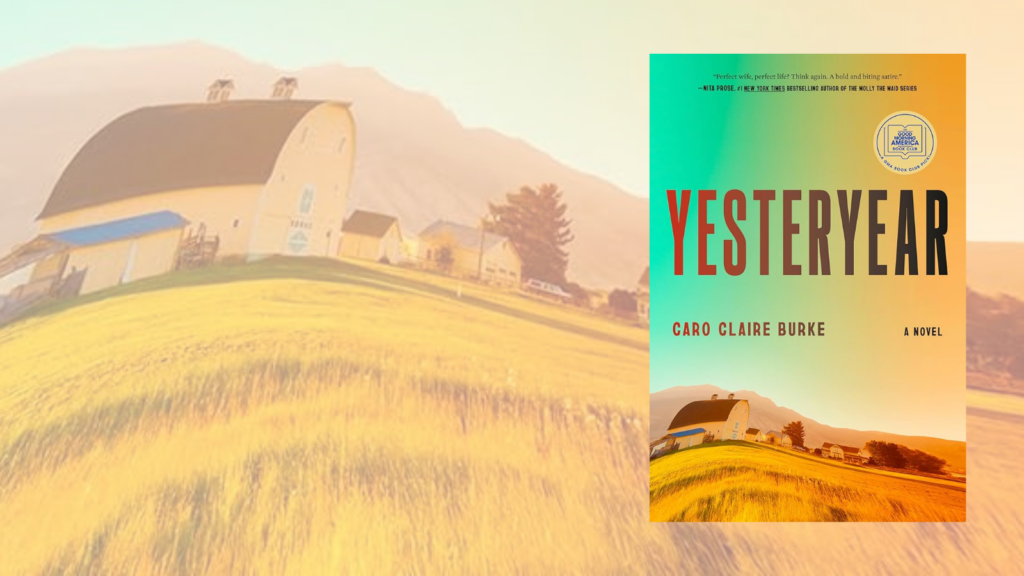
What if women really went back? That question sits at the center of Caro Claire Burke’s 2026 debut novel and viral summer read Yesteryear.
At a moment when tradwife influencers are building massive audiences by romanticizing domesticity, submission and “traditional” gender roles, Burke asks readers to imagine what life inside those arrangements actually looks like for the women who lived them—and what rights and freedoms were sacrificed along the way.
Yesteryear follows wealthy, polished (at least on the outside) tradwife influencer Natalie Heller Mills, who has built a carefully curated online brand around nostalgic femininity. But as the fantasy unravels, Burke exposes the gap between aestheticized womanhood and women’s lived experience.
Read through a feminist lens, Yesteryear critiques how ideas about motherhood, labor and submission are sold online, while examining the steep costs women bear when their identities are shaped by performance and expectation.
Tradwives, or “traditional wives,” are an online female persona popularized by influencers who promote a cozy, blissful lifestyle centered on domesticity and submission to their husbands. The influencers are often graceful and feminine, molding themselves perfectly to the traditional male gaze and presenting dependence on a husband not as a limitation but as an aspirational choice. Their content is often filled with images of homemade meals, spotless kitchens, flowing dresses and a gaggle of smiling children.
… Who gains power when women are encouraged to relinquish it?

Online tradwife culture often frames a woman’s economic dependence as a personal lifestyle choice—yet women’s dependence has never been politically neutral. Historically, women’s economic dependence has always benefited systems relying on their unpaid labor and limited autonomy, going hand in hand with restricted access to education, employment, property ownership and political influence. The tradwife aesthetic often reframes such sacrifices as desirable, inviting women to romanticize the surrender of rights generations have fought to secure.
But who gains power when women are encouraged to relinquish it?
Project 2025 offers one answer. Backed by The Heritage Foundation, a conservative think tank funded by hundreds of thousands of independents, the initiative repeatedly emphasizes the importance of traditional family structures, portraying nuclear families as the cornerstone of social stability.
Quoting from page 258 of Project 2025, “Families are the basic unit of and foundation for a thriving society. Without women, there are no children, and society cannot continue.”
Fittingly, this philosophy becomes the organizing principle of Yesteryear protagonist Natalie Heller Mills’ life. The artificial tradwife lifestyle she creates for herself on the Yesteryear Ranch values female homemakers, motherhood as a woman’s primary calling, and clear distinctions between feminine and masculine roles. Yet even the ranch itself is largely a performance: Behind the scenes, the family’s attempts at self-sufficiency are plagued by financial losses, dying livestock and reliance on the very modern conveniences and chemicals Natalie downplays for her audience. Of course, the followers who consume her content never see these failures. Throughout the novel, Natalie knows it is her duty to produce more children, despite the reader’s discovery of her personal neglect of them. Her understanding is that, even though she may hate her children most of the time, it is her job to perform the role of a baby-making machine.
In this way, Project 2025 and tradwife culture send a similar message: A woman’s highest purpose lies within the home.
The emphasis on motherhood in both conservative policy and tradwife culture extends to reproductive autonomy. Project 2025 advocates for policies that would further restrict abortion access and promote fetal rights, reflecting a broader belief that women’s primary social role is singularly tied to childbearing: “Contrary to current publicity, this problem [maternal and infant mortality] is not solved by abortion. Families genuinely cherish children.”
Burke explores this tension in Yesteryear through Natalie, whose views on abortion are initially shaped by her conviction that motherhood is a woman’s ultimate purpose. Her disgust at the thought of her sister obtaining an abortion creates a rift that alienates Natalie from her mother and sister. Yet as the novel progresses, Natalie is forced to confront the realities of a world in which women have far fewer reproductive choices—including whether, when and under what circumstances they bear children. At one point, she seriously considers ending a pregnancy herself, revealing the gap between the rigid beliefs she espouses and the complicated realities women face when those beliefs become personal.
Even when confronted with the physical and emotional burdens women face with pregnancy and childrearing, Natalie continues to measure her value through her ability to produce children. By linking female identity so closely to reproduction, both Project 2025 and Natalie’s worldview reveal how expectations surrounding motherhood can limit women’s ability to define their own futures.
Many real-life tradwife influencers—including Nara Smith (24), Hannah Neeleman (35) of Ballerina Farm (dubbed the “Queen of Tradwives”), and Solie White (26)—portray a similar mindset on their platforms. None has fewer than three children, and each portrays a carefully curated glowing life full of making food from scratch, performing seemingly effortless household labor, and childrearing that is displayed as endlessly fulfilling. Smith, constantly pregnant for the past four years, speaks in a soft voice in her social media videos, giving off a submissive housewife vibe. Neeleman, arguably the most well-known tradwife on the internet, has turned a curated domestic fantasy into a lucrative social-media business. Neeleman, who reportedly earns nearly $40,000 a month from Instagram, presents a highly curated life. White believes she is living a “countercultural” lifestyle by “preparing our sons to be married by 18.”
Missing from these videos and images, however, is any acknowledgement of what is being traded away: economic independence, legal protections and the ability to define one’s own future.
Yesteryear also underscores a reality often obscured by the genre itself: Most tradwife influencers are not unemployed stay-at-home mothers, but working content creators whose livelihoods depend on the substantial labor required to film, edit and market the very lifestyle they present as effortless. Through Natalie, the novel reveals how little time remains for the woman at the center of the performance—and how much work goes into sustaining the fantasy.
Natalie recognizes the artificiality of the world she has created, describing her life as “playdough husband, playdough children, playdough life,” yet spends nearly the entire novel trying to convince herself that she is happy in the narrative she has forced upon her own reality.
Soon into the book, Natalie is thrust into the 19th century and forced to live the life she has long romanticized. The fantasy quickly begins to unravel. Even as she washes filthy clothes by hand on a washboard, endures physical labor with a broken foot, and lives without access to modern medicine, Natalie continues trying to transform hardship into an aesthetic. She insists, “‘This is fun,’ I would shout at them in the darkness, ‘Don’t you realize we’re having fun?”
This moment captures the central critique of both tradwife culture and the political ideologies that celebrate it. Romanticizing the past often requires ignoring the costs that came with it—especially for women. Financial independence, reproductive autonomy and legal equality were not inevitable features of modern life. Women fought for them. By forcing Natalie to live without those freedoms, Yesteryear reveals how much the fantasy of traditional womanhood depends on overlooking its realities.
Tradwife influencers and conservative policy efforts are working in tandem to roll back generations of feminist progress. By forcing Natalie to live inside the reality behind the fantasy she sells online, Burke transforms Yesteryear into both a gripping thriller and a warning about the costs of romanticizing a past that denied women power over their own lives.
Look to these trusted groups if you or a loved one needs to know more about reliable abortion care:
- A one-stop-shop for abortion seekers: I Need An A
- Other websites to explore all your options for abortion care: Plan C Pills, Abortion Finder
- Safe websites to buy abortion medication: Aid Access, Massachusetts Medication Abortion Access Project, Hey Jane
- If you need help affording abortion care, tell your telemedicine provider or contact an abortion fund near you.
- To protect your digital privacy when planning your abortion, click here.
- For free legal help as a patient or doctor, call If/When/How’s Repro Helpline—844-868-2812—or contact Pregnancy Justice.
- For medical advice, contact the Miscarriage & Abortion Hotline: 833-246-2632.
- If you need to know the abortion law in your state, look to the Center for Reproductive Rights. or Guttmacher Institute.