U.S. abortion doulas are turning to decades of Latin American feminist expertise to make second-trimester medication abortions safer, less painful and more accessible.

Across the world, women living in countries that ban licensed clinicians from performing abortions have always found ways to access abortion outside of the medical system. Today, abortion pills have made it much safer.
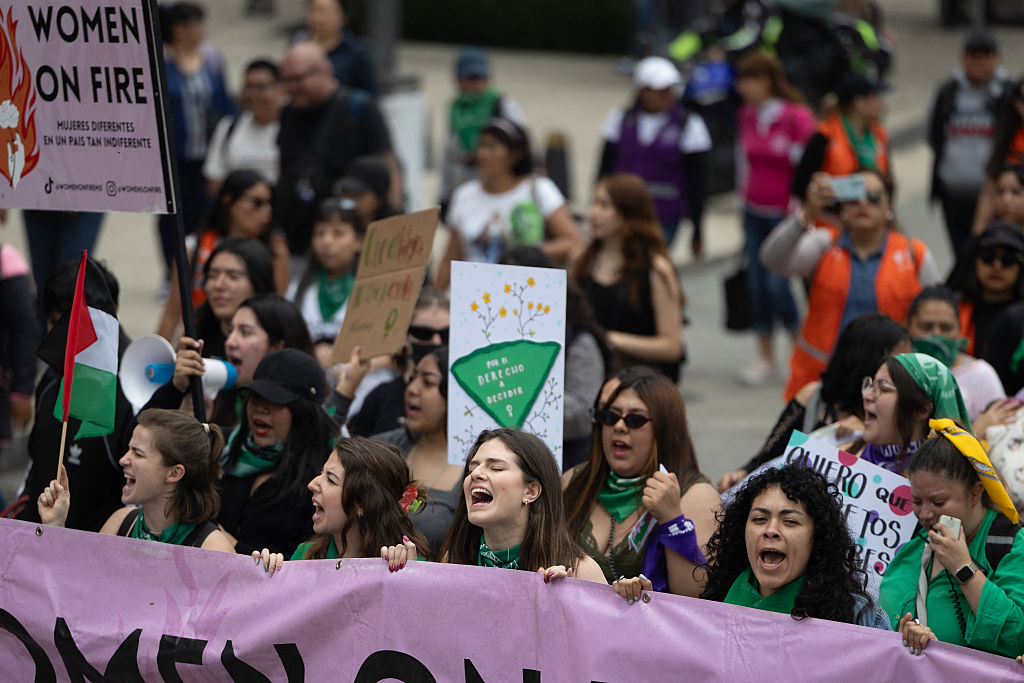
When the Supreme Court overturned Roe v. Wade and many states banned abortion, U.S.-based activists turned to Latin American feminists who have run collectives supporting women seeking abortions outside of the medical system for decades.
With their guidance, U.S.-based activists have created their own feminist collectives that now serve thousands of women and girls each month in 38 states that ban and restrict abortion access, including the entire Southeast and much of the Midwest of the country. These collectives provide free abortion pills and the doula support to see them through.
As Republicans create ever higher barriers to abortion that push abortion seekers later into pregnancy, U.S.-based activists are learning from Latin American feminists who have developed protocols to make second-trimester medication abortion easier and safer.
With training and guidance from Latin American feminists, U.S.-based collectives are now using a double-dose mifepristone protocol for pregnancies 17 weeks of gestation and longer.
… Even though I’m going to be here walking with you, you’re going to do this with your strength, with your own body, with your mind, and with our little guidance, our little medical medication, and our little accompaniment.
Mora, a Latin American abortion expert
The protocol works in three steps:
- one 200 mg mifepristone tablet taken orally, then waiting 24 hours;
- taking another 200 mg mifepristone tablet orally and waiting another 24 hours;
- then taking 400 mg of misoprostol (two tablets) under the tongue every three hours until expulsion of the pregnancy is complete.
Mifepristone blocks the absorption of progesterone in the uterus, preparing the uterus to shed the pregnancy. Misoprostol then causes contractions to expel the pregnancy tissue.
For second-trimester abortions, taking two mifepristone means needing less misoprostol, which eases painful contractions and shortens the time to uterine expulsion, explained one Latin American expert, Mora, who supports people having abortions, called accompaniers. (Real name withheld to protect privacy.)

Describing how mifepristone helps separate a pregnancy from the uterine lining, Mora said: “Mifepristone detaches the gestational sac from the inner side of the uterus, which is less painful than if the detachment comes from contractions caused by misoprostol.”
Whereas mifepristone’s side effects are mild—mainly headaches and some nausea that can be treated with medications—misoprostol causes diarrhea, chills and vomiting, which are much harder to experience.
“The side effects of the miso are very high in comparison to mife,” said Mora. “After taking mife you can go about life [and normal activities], but starting miso is what gets you home in bed.”
Using two mifepristone also significantly reduces the period of painful contractions—from 15 to 18 hours, to often less than six hours, which is critical for women who have to work or care for children or relatives.
“Some people have to take care of their siblings or their kids, or they are nursing their mom or their mother-in-law because we know that women care for other people. This is a reality worldwide. So women can’t be away for a long time,” said Mora.
People supporting self-managed abortion offer a range of pain management options, including medications, hot water bottles, herbal teas, exercises, positioning and other strategies. They also provide emotional support, walking them through the process of self-managing abortions with empathy and encouragement.
“The main thing for us is to empower them and to let them know that even though I’m going to be here walking with you, you’re going to do this with your strength, with your own body, with your mind, and with our little guidance, our little medical medication, and our little accompaniment,” said Mora.
Throughout 2025, Latin American accompaniers and U.S.-based doulas safely and successfully assisted over 250 U.S.-based clients who were 17+ weeks gestation using the two-dose mifepristone protocol.
Supported women have expressed great satisfaction with the process.
“I’m feeling good physically and also emotionally,” said one woman from the U.S., whom Mora assisted. “I’ve moved on with my life, went back to school. I think of this experience as something I had to go through. It was less painful than I thought it would be, and it all happened very quickly. I’m at peace with the decision I made, and I’m glad to know that other girls can have the same opportunity I had to continue their lives safely by having a self-managed abortion at home.”
For the supporters, this work is as meaningful as it is for the women they support.
“The thing that moves me is social justice,” said Mora. “Worldwide, living as a woman, I know we’re not getting the justice we need. There’s a lack of access in a lot of ways to getting what we need or deserve. If I have a tool that can help, whatever this may be, I’m gonna use it.”
The Science of Self-Managed Second-Trimester Abortion
Research has long shown people can safely self-manage second-trimester medication abortions, following the World Health Organization guidelines for the medical management of abortion. Self-managed second-trimester medication abortion with accompaniment network support and linkages to the formal health system in the event that complications arise has been done for years in legally restricted settings in Latin America and can be effective and safe.
Recent research on the double-dose mifepristone protocol has documented faster pregnancy expulsion than the single-dose mifepristone protocol.
- One study found that taking two mifepristone before misoprostol decreased the induction-to-expulsion interval by two and a half hours—compared to a single dose—for pregnancies of 13 to 20 weeks.
- In other research, the induction-to-abortion interval decreased by over three hours in one study and close to two hours in another study for second-trimester abortions.
Both studies also showed that the two-mifepristone dose regimen markedly reduced the necessary misoprostol dosage and the side effects that come with it.
Research on community networks in Argentina, Chile and Ecuador using the double-dose mifepristone regimen beyond 17 weeks with in-person accompaniers has confirmed its success. The study drew on in-depth interviews with 28 accompaniers from feminist abortion collectives in Latin America, who have developed a feminist, rights-based model of care that attends to the physical and emotional needs of women having abortions. Their goal is to “minimize the harm to abortion-seekers from embedded sexism and patriarchy that is present in the formal healthcare system and, often, the law.”
Taking two mifepristone is very safe for the body. The FDA has approved mifepristone for daily use at much higher doses for treatment of Cushing syndrome and for the treatment of benign brain tumors (called meningiomas). Doctors in the U.S. also widely prescribe mifepristone off-label to manage miscarriage, support cervical dilation during childbirth and induce labor. In China, daily use of mifepristone has been used for treatment of fibroids for over a decade.
“Self-managed abortion later in pregnancy is safe, it’s effective, and it’s more common than people think, but it does come with a greater risk of criminalization,” said Erika Christensen, cofounder of Patient Forward, which works to eliminate barriers to abortion care later in pregnancy and provides resources on how find later abortion care. According to If/When/How, 87 percent of the 61 cases of criminalization of self-managed abortion between 2000 and 2020 happened in the second and third trimesters.
“The other thing to know is that the later into pregnancy that someone is self-managing, the more likely it is that they will need medical care,” said Christensen. “This doesn’t mean it’s unsafe, but it means that they might need to interact with a healthcare provider, which increases their risk of criminalization, because many are reported to the police by a healthcare provider.”
Having someone to talk to like a doula or the Miscarriage and Abortion (M+A) Hotline, which provides free and confidential support from experienced medical professionals, cuts down on unnecessary ER visits, which decreases legal risk, said Dr. April Lockley, medical director of the hotline. “When people have the correct information and support, they are less likely to need or think they need in person medical care.”
Why Do People Have to Self-Manage Second Trimester Abortions?
Telehealth abortion providers in the U.S. serve patients up to 14 weeks of pregnancy, so people past that point who live in states banning abortion have to travel out of state—often hundreds of miles—in order to obtain in-clinic abortion care.
But over half of women who have abortions live in poverty and another quarter are low-income. The majority already have children. Many cannot afford to leave their jobs and pay for childcare and travel out of state for second trimester abortions, which are more expensive than first trimester abortions. While abortions funds such as the Brigid Alliance are trying to step in to cover these costs, not everyone will want or be able to travel out of state.
In addition, some antiabortion governments are imposing abortion travel bans, tracking abortion seekers and seeking the private medical records of patients seeking abortions out of state. And then there are the women who can’t leave the state because of their probation or immigration status. For all these reasons, women might choose to self-manage a second trimester abortion with medications.
People seek abortion care later in pregnancy for the same reasons they do early in pregnancy, said Christensen, but many are not able to access care as soon as they would like. “This could be because they learned a piece of new information later in their pregnancy, like a health threat to themselves or to the fetus, a new extenuating life circumstance, or it could be the new information could be that they’re pregnant.”
According to the Turnaway Study, many women do not realize they are pregnant until second trimester due to irregular periods, the use of hormonal birth control, a lack of typical symptoms or having health conditions that mask pregnancy.
“Later recognition of pregnancy is far more common than people think, particularly for low-income folks, young people and people without access to regular healthcare in general,” said Christensen.
When I think of later abortion seekers, I think of folks that are navigating really hard circumstances, and they’re doing the best they can with what is available to them at the time.
Erika Christensen, cofounder of Patient Forward
Delays in obtaining abortion care also result from legal, financial and logistical barriers, including abortion bans and restrictions, the high cost of care, which goes up with each week of pregnancy, and limitations on many people’s ability to travel to medical providers offering this care. “Many people might know that they need abortion care early in pregnancy, but because of barriers outside of their control, they’re pushed later,” said Christensen.
But even in areas where abortion is not legally restricted, people are self-managing their abortions after 13 weeks pregnant. “Some people do not feel comfortable in clinical spaces due to a past negative experiences,” said Dr. Lockley.
These barriers often compound one other to delay abortion care. “When I think of later abortion seekers, I think of folks that are navigating really hard circumstances, and they’re doing the best they can with what is available to them at the time,” said Christensen.
As abortion bans and restrictions have pushed care later into pregnancy, second-trimester medication abortion with accompaniment is more than harm reduction to counter the dangers of states banning clinicians from providing this care. It is central to women’s fight for reproductive autonomy and self-determination.
The knowledge is here, and so is the will to use it. “It’s time to offer proven, global best practices to the U.S., without concern for cost, for the best outcome for the client,” said one U.S.-based community provider.
Resources for Abortion Seekers
To learn about these services, people are using the Plan C website. The organization has researched several community networks over the years, and there are now five listed on their website.
See INeedAnA.com for more information about second-trimester abortions with medications.
Contact the Miscarriage and Abortion (M+A) Hotline to speak to a volunteer medical provider anonymously and for free for questions during an abortion or miscarriage, including self-managing an abortion in the second trimester.
Second-trimester self-managed abortion may increase legal risks. Repro Legal Helpline offers free legal support.