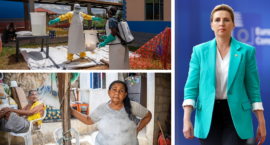
Ms. Global: Genocide in Sudan, Withdrawal of HIV Funding in South Africa, Two Killed in Protests in Afghanistan Over Arrests of Women

The U.S. ranks as the 19th most dangerous country for women, 11th in maternal mortality, 30th in closing the gender pay gap, 75th in women’s political representation, and painfully lacks paid family leave and equal access to healthcare. But Ms. has always understood: Feminist movements around the world hold answers to some of the U.S.’s most intractable problems.

Ms. Global is taking note of feminists worldwide.

This month: news from Sudan, South Africa, Afghanistan and more.

Ms. Global: Women Make Up Two-Thirds of Ebola Cases in DRC, Families Mourn Fishers Killed in Trump’s Boat Strikes and More

The U.S. ranks as the 19th most dangerous country for women, 11th in maternal mortality, 30th in closing the gender pay gap, 75th in women’s political representation, and painfully lacks paid family leave and equal access to healthcare. But Ms. has always understood: Feminist movements around the world hold answers to some of the U.S.’s most intractable problems.

Ms. Global is taking note of feminists worldwide.

This month: news from the Democratic Republic of the Congo, India, Denmark, Mexico and more.

Latin American Feminists Train U.S.-Based Doulas on New Mifepristone Protocol for Second-Trimester Abortions

As Republicans create ever higher barriers to abortion that push abortion seekers later into pregnancy, U.S.-based activists are learning from Latin American feminists who have developed protocols to make second-trimester medication abortion easier and safe: using a double-dose mifepristone protocol for pregnancies 17 weeks of gestation and longer.

For second-trimester abortions, taking two mifepristone means needing less misoprostol, which eases painful contractions and shortens the time to uterine expulsion.

Whereas mifepristone’s side effects are mild—mainly headaches and some nausea that can be treated with medications—misoprostol causes diarrhea, chills and vomiting, which are much harder to experience. Using two mifepristone also significantly reduces the period of painful contractions—from 15 to 18 hours, to often less than six hours, which is critical for women who have to work or care for children or relatives.

Supported women have expressed great satisfaction with the process.

People seek abortion care later in pregnancy for the same reasons they do early in pregnancy, said Erika Christensen, cofounder of Patient Forward, which works to eliminate barriers to abortion care later in pregnancy and provides resources on how find later abortion care—but many are not able to access care as soon as they would like. “This could be because they learned a piece of new information later in their pregnancy, like a health threat to themselves or to the fetus, a new extenuating life circumstance, or it could be the new information could be that they’re pregnant.”


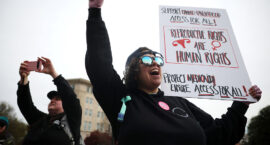
War on Women Report: Meta Removes Abortion-Related Accounts; Louisiana Tries to Extradite California Abortion Provider; Fatal ICE Shootings

MAGA Republicans are back in the White House, and Project 2025 is their guide—the right-wing plan to turn back the clock on women’s rights, remove abortion access, and force women into roles as wives and mothers in the “ideal, natural family structure.” We know an empowered female electorate is essential to democracy. That’s why day after day, we stay vigilant in our goals to dismantle patriarchy at every turn. We are watching, and we refuse to go back. This is the War on Women Report.

Since our last report:
—Kentucky Attorney General Russell Coleman has tried to remove pro-abortion ads from Mayday Health, an organization that shares information about abortion pills, birth control and gender-affirming care.
—The FDA withdrew a rule requiring cosmetics companies to test their products made with talc for asbestos, alarming public health advocates.
—Two Pennsylvania hospitals told the state they may not provide emergency contraception to sexual assault survivors because of religious objections.
—Some good news out of Wyoming: The state’s supreme court started the new year by striking down Wyoming’s two abortion bans.

… and more.

Seven Ways the Trump Administration Has Made Pregnancy More Dangerous

Trump has been in office for less than a year. The Supreme Court killed Roe v. Wade less than three years ago. And today, if you are a woman in the United States, your rights change when you cross state lines—men’s rights do not. 

It’s easy to lose sight of just how debilitating this administration has been for reproductive rights, because they are doing so much else so loudly. (Apologies to Greenland.) But this administration has quietly attacked abortion rights from just about every angle. A new report from the Center for Reproductive Rights makes clear just how aggressive they’ve been. 

Here are seven quiet moves from the Trump administration that are costing women and girls their lives.

RFK Jr. Wants to Scrutinize the Vaccine Schedule—But its Safety Record Is Already Decades Long

The U.S. childhood immunization schedule, the grid of colored bars pediatricians share with parents, recommends a set of vaccines given from birth through adolescence to prevent a range of serious infections. The basic structure has been in place since 1995, when federal health officials and medical organizations first issued a unified national standard, though new vaccines have been added regularly as science advanced.

Vaccines on the childhood schedule have been tested in controlled trials involving millions of participants, and they are continuously monitored for safety after being rolled out. The schedule represents the accumulated knowledge of decades of research. It has made the diseases it targets so rare that many parents have never seen them.

But the schedule is now under scrutiny.

Inside the Global Network of Abortion Doulas Supporting Self-Managed Care

As barriers to clinic-based abortion care have increased in recent years, an increasing number of women are self-managing their abortions: finding and using abortion pills independently of the formal medical system. They are obtaining abortion pills through online abortion pill services, community networks sharing pills for free and websites selling pills.

To support self-managed abortion, feminists are creating a global network of online abortion doulas—trained companions who offer one-on-one support by phone, email and text to people using abortion pills. A leader in this effort is the organization Rouge Doulas, which runs the Rouge Abortion Doula School.

The Ripple Effects of the U.S. Retreat from International Reproductive Care

The U.S. withdrawal of international reproductive health funding is already having devastating effects around the world. Clinics are closing, health workers go unpaid, and essential medications and contraceptives sit unused in warehouses while millions of women and families lose access to life-saving care.

These abrupt cuts are not just administrative—they are a direct attack on decades of global health progress, putting children, pregnant women and marginalized communities at heightened risk of preventable disease, unintended pregnancy and death.

Yet there is still a path forward. The infrastructure to deliver reproductive and public health services remains in place, and health workers are ready to act. If funding is restored, we can prevent the worst outcomes, safeguard global health, and ensure that the fundamental human rights to health, life and bodily autonomy are protected.

The global community must act urgently to reverse the harm and prevent a full-scale public health and human rights crisis.

Leading Health Groups Slam Trump and RFK’s Claims Linking Tylenol to Autism: ‘Irresponsible and Misleading’

Doctors and autism researchers stress that acetaminophen remains safe during pregnancy and warn that Trump and Kennedy’s claims risk spreading harmful misinformation.

American Academy of Pediatrics (AAP): “Today’s White House event on autism was filled with dangerous claims and misleading information that sends a confusing message to parents and expecting parents and does a disservice to autistic individuals.”

American College of Emergency Physicians (ACEP): “Emergency physicians must align around clear, evidence-based guidance for patients. The data from numerous studies have shown that acetaminophen is safe and effective.”

Female Genital Mutilation in Infancy Still Common, Gambian Mothers Say

Hulay Damba, 55, spent years performing female genital mutilation on girls in her community. Her role as a practitioner was passed down from her grandmother. “It was what I was taught,” she explained. 

Despite years of steady advocacy in the Gambia, rates of female genital mutilation remain high, even among younger generations. According to 2021 data, almost three quarters of girls aged 15 to 19 have been subjected to female genital mutilation, roughly the same proportion as women a generation older than them (aged 45 to 49). 

Surveys of mothers also show mixed progress: When women with daughters aged 25 and under were asked whether their daughters had been been subjected to female genital mutilation, 54 percent said no. But 22 percent said that their daughters had not only undergone the practice—they had experienced it by their first birthday.