Misogyny, Racism, Power: Connecting the Dots in the Violent Far Right

In Part 2 of the Q&A between Jackson Katz and Cynthia Miller-Idriss, the author of Man Up discusses the link of misogynists and mass shooters: “The fact that so many domestically violent extremist attacks have both gendered and racialized dimensions shows that racism and misogyny are inseparable in the minds of many perpetrators.”

Miller-Idriss explains the key role online gaming and chat spaces play within the radicalization of young men and boys.

Misogyny is no doubt threaded through nearly ever mass shooting, and feminists are used as a scapegoat for taking away men’s opportunities.

‘This Is the Blind Spot in Extremism Research’: Cynthia Miller-Idriss on Misogyny, Gender and Violence

Cynthia Miller-Idriss, director of the Polarization and Extremism Research & Innovation Lab (PERIL) at American University, makes the connection between gender policing, misogyny and far-right extremist violence, which for many years was not a connection scholars were willing to make.

Jackson Katz and Miller-Idriss discuss her book, Man Up, on misogyny, gendered violence, the MAGA movement and far-right extremism. Miller-Idriss says political violence coming from the far-right includes gender policing and exploitation.

“These aren’t just opportunistic elements of extremism—they are deliberate, organized and large-scale forms of gendered violence aimed at increasing pain and humiliation of victims, witnesses and family members. … I’m still blown away by how few people will acknowledge the connection.”

What Boys Learn When Powerful Men Face No Consequences

For decades, Donald Trump has modeled a version of masculinity rooted in entitlement, impunity and the casual degradation of women—and he has done so from one of the most visible platforms on Earth. That visibility matters. When the most powerful man in the country repeatedly evades consequences for misogynous acts, it sends a potent cultural message to boys and young men about what manhood looks like and what women’s lives are worth.

This is why the stakes of the Epstein files extend far beyond Trump’s personal exposure. His ability—or inability—to finally face accountability is inseparable from the broader crisis of male socialization and the normalization of men’s violence against women.

At the same time, focusing solely on Trump risks missing the larger system that made Jeffrey Epstein’s predation possible. As feminists have long argued, these abuses were not aberrations but expressions of a patriarchal network that exploited girls and women with impunity. The Epstein saga is not simply a story of individual bad actors; it is an indictment of the cultural, financial and political institutions that protected them. Whether the public and political leaders confront that reality—or once again look away—will reveal as much about our collective values as it does about the men at the center of this scandal.

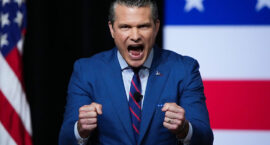
Pete Hegseth Doubles Down on His Culture War Against Feminism

Many of the military officers who sat through Pete Hegseth’s and Donald Trump’s speeches about not tolerating “fat generals” and the need for “male standards” of physical fitness, are men who have not only served with highly capable, talented and accomplished women; many of them have mentored and promoted them as well. They know how vital and indispensable women are to functioning militaries in the modern era.

Secretary Hegseth’s speech was more than an announcement of new Pentagon priorities. It was, in many ways, a performative declaration of what is a much wider right-wing culture war against feminism.

The Kirk Assassination Exposes Media’s Reluctance to Confront Violent Masculinity

The assassination of Charlie Kirk is a major sociocultural event and media spectacle that has generated a tremendous amount of media commentary and social media discourse. 

Unfortunately, much of the analysis suffers from the same blind spot that typically characterizes media narratives about violence: It is de-gendered.

Imagine if women committed the overwhelming majority of political violence, and over 98 percent of mass shootings. Would anyone commenting about the latest violent incident talk about the “shooter,” and fail to mention it’s a woman, and seek to explore the ways in which cultural ideas about femininity might factor in?

From Limbaugh to Rogan: The Rise of the Conservative ‘Brocast’

In the wake of Trump’s reelection—America’s first “podcast election”—commentators pointed to his surprising success with young male voters, driven in part by appearances on popular “brocasts” like The Joe Rogan Experience and Bussin’ With the Boys. These shows, often focused on comedy, sports and self-improvement, gave Trump a platform to project masculine authenticity and connect with disaffected young men. As UFC CEO Dana White put it, podcasters like the Nelk Boys and Adin Ross played a pivotal role in Trump’s victory.

Conservative media has created a space where right-wing ideas feel rebellious and “real men” vote Republican. These podcasts offer not just political messaging but a sense of belonging during a “loneliness epidemic.” Unless Democrats figure out how to enter these spaces and shift the narrative, they risk losing another generation of young male voters.

Ms. on Men: Rethinking Masculinity in the Wake of the 2025 Election

When the editors of Ms. asked me to guest-edit “Ms. on Men,” a feature section in the latest print issue highlighting key issues related to men and masculinity, I knew this was more than a symbolic gesture—it was a necessary intervention.

In the wake of the 2025 election, with a growing number of young men embracing right-wing populism, we need a pro-feminist vision of masculinity rooted in justice, not grievance. This section brings together voices committed to that vision, offering both critique and possibility.

The first piece from the feature—going live on MsMagazine.com early Friday, July 25—will answer the question we’ve all been pondering: Why is the vice president sitting like that?

Trump’s History of Misogyny Was Obvious Long Before the Epstein Files Scandal

The Trump administration’s handling of the Epstein files has rattled his MAGA base unlike any other issue, and caused the president a major political headache. It remains to be seen whether he or the Republican Party he leads will suffer any lasting damage.

But for the many millions of Americans who are not fans of the current president, one of the truly astounding features of this scandal is how long he has been able to evade meaningful accountability for his history of misogyny—as well as serious scrutiny of his long friendship with the late sex trafficker Jeffrey Epstein. Trump’s close association with the disgraced pedophile has been a matter of public record for more than two decades.

What’s even more tragic is that despite all of this, Trump has managed to get elected president of the United States not once, but twice. He has then used the awesome power of the presidency to roll back feminist gains in a number of different ways. His administration’s regressive agenda has included, during the early months of his second term, a dramatic reversal of progress in federal support for sexual assault prevention initiatives.

Trump’s Cartoonish Performance of Masculine Strength, from Los Angeles to Washington, D.C.

Donald Trump’s decision to mobilize the military in Los Angeles was made against the reasoned judgment and expressed wishes of LA Mayor Karen Bass and California Governor Gavin Newsom. The recent actions of the president present yet another opportunity to observe, in real time, how the Trump era continues to be shot through with destructive and antiquated ideas about masculine strength – along with growing pushback against them.  

It might or might not be coincidental, but the fact that Trump called in the National Guard and a contingent of Marines into downtown L.A., just the week before the president’s expensive and ostentatious celebration of military prowess for his 79th birthday and the Army’s 250-year anniversary.

Against the Normalization of Trump’s Misogyny

In just over two weeks, an emboldened and angry Donald Trump, restored to power, has plunged the federal government into chaos and threatened the rule of law, separation of powers, and other core tenets of American democracy.

It’s important for people to stand up and take action in real time, and do whatever they can—through lawsuits, legislative action and public protest—to block the implementation of immoral and illegal policies. But let’s take a moment to step back and ponder a broader question: Trump’s legitimacy as the nation’s leader, and what that means in terms of social norms, or what effect Trump’s behavior has on what it means to be normal.