‘It’s About Who Gets to Decide’: Massachusetts Will No Longer Impose a Gestational Limit on Access to Abortion Care

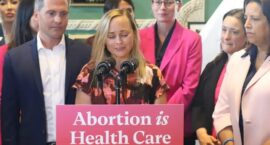
Gov. Maura Healey signed the Prioritizing Patient Access to Care Act into law last month, making Massachusetts the 10th state, together with Washington, D.C., that does not impose a gestational limit on access to abortion care.

In so doing, Healey stressed the “heartbreaking stories” she heard “from women and families who were preparing to welcome a healthy baby into their family, only to receive devastating news later in their pregnancy. Instead of being able to rely on the doctors they knew and trusted at home, they were forced to travel hundreds of miles and pay out of their pockets while navigating unimaginable grief.”

I recently had the privilege of talking with Kate Dineen who shared her tragic experience of being denied abortion care in Massachusetts because of the state’s “24-week ban with very difficult to access exceptions.” 

Here is her story.

Massachusetts Decriminalized Later Abortion, No Health Emergency Required

Massachusetts law no longer imposes a gestational-age limit on abortion—meaning for the first time, a woman in the state can choose to end her pregnancy at any point, without a prosecutor looking over her doctor’s shoulder.

Gov. Maura Healey (D) last month signed the Prioritizing Patient Access to Care Act, joining nine other states—Alaska, Colorado, Maryland, Michigan, Minnesota, New Jersey, New Mexico, Oregon and Vermon, plus D.C.—in trusting patients and medical professionals to make abortion decisions throughout pregnancy, rather than politicians, police and prosecutors.

In Massachusetts, the legislative hearings focused on women who experienced a severe fetal diagnosis or a threat to their own health and had to travel out of state for medical care, which are very sympathetic stories that were able to win over many supporters.

While it’s certainly important that states like Massachusetts have made later abortion more accessible to people experiencing health emergencies, the Prioritizing Patient Access to Care Act is important for everyone seeking later abortion care, whatever the reason.

Massachusetts Could Be the Next State to Give Abuse Survivors a Pathway Out of Prison

In June, Karen Edwards testified via video from MCI Framingham, Massachusetts’ only women’s prison, where she is serving a sentence of 15 years to life for the death of her abusive husband. Speaking through tears, Edwards described years of isolation, surveillance and threats—how her husband controlled her movements, cut her off from loved ones and warned that if she left, he would kill her and her children. She urged legislators to pass the Massachusetts Survivors Act, a bill that would allow judges to reduce sentences or offer alternatives to incarceration when a person’s conviction is directly tied to their experience of abuse.

The proposed legislation mirrors resentencing reforms adopted in a handful of other states and could dramatically change Edwards’ future, potentially reducing her life sentence to a term she has already served. Advocates say the bill would offer a long-overdue pathway home for survivors whose actions were shaped by violence, coercion and survival.

As lawmakers consider the measure during the current legislative session, formerly incarcerated survivors and those still behind bars are watching closely—some, for the first time, allowing themselves to imagine a future beyond prison walls.

‘Giving Women a Chance to Choose When the World Didn’t’: Massachusetts Doctors Provide Telehealth Abortion in States with Bans

As abortion bans have swept the country, Massachusetts doctors are stepping up by providing thousands with lifesaving telehealth abortion care, regardless of their ability to pay. 

On July 12, reproductive health advocates and local office holders filled the common room of a Northampton, Mass., co-housing community to celebrate and support the vital work of The Massachusetts Medication Abortion Access Project (The MAP). Based in Cambridge, the MAP is one of a handful of medical practices in the U.S. providing telehealth abortion care to patients in states with abortion bans or severe restrictions. Each month, MAP provides abortion pills to 2500 patients—nearly a third from Texas—using an asynchronous telemedicine platform built to provide prompt, private and convenient abortion care that is affordable to all.

“I want to thank The MAP from the depths of my soul,” one patient said. “You have saved me.”

‘Women Here Are Going to Have Access to Abortion’: How Gov. Maura Healey Made Massachusetts into a Beacon for Reproductive Freedom

In the second episode of Looking Back, Moving Forward—a Ms. podcast exploring the history of the magazine and the feminist movement—Gov. Maura Healey talked about how Massachusetts prepared for the Trump administration’s attacks on abortion, what other states can do to protect and enshrine abortion access, and how her Title IX story led her to the governor’s mansion.

Listen to the second episode —”Inside the Feminist Fight to Reclaim Our Reproductive Freedom (with Renee Bracey Sherman, Michele Goodwin, Angie Jean-Marie and Amy Merrill, Susan Frietsche, and Gov. Maura Healey)”—on Spotify, Apple Podcasts or wherever you get your podcasts.

Weekend Reading on Women’s Representation: Elected Leaders Should Be Able to Serve Without Fear; Honoring Opal Lee, Grandmother of Juneteenth

Weekend Reading for Women’s Representation is a compilation of stories about women’s representation. 

This week:
—new research on the importance of women’s leadership
—how Opal Lee became known as the Grandmother of Juneteenth
—No matter who wins the race, Virginia’s next governor will be the first woman to ever hold the office.

… and more.

Class-Action Lawsuit Against Crisis Pregnancy Center and Groundbreaking Massachusetts Law Regulating Ultrasounds: ‘A Chink in the Armor’

Antiabortion crisis pregnancy centers (CPCs) across the United States receive state and federal funds but have operated with little or no government oversight. CPCs use unsterilized transvaginal ultrasounds wands inside of patients, delay access to lifesaving care by misdiagnosing serious medical conditions and steal patient data from real medical clinics, according to investigative reporting and lawsuits filed against them. Advocates have been stymied in their efforts to obtain any sort of CPC accountability. But that may be changing.

Massachusetts Abortion Provider Serves Patients Living in States Banning Abortion

Since Dobbs, an increasing number of abortion providers are providing telemedicine abortion services to women living in states banning abortion. 

Today there are four practices with over two dozen providers that provide telehealth abortion services to people in restrictive states. One of them is the Massachusetts Medication Abortion Access Project, called The MAP for short. Ms. spoke with the medical director of The MAP: Dr. Angel Foster, a Harvard-trained obstetrician/gynecologist and health sciences professor at the University of Ottawa, where she leads a large research group that’s dedicated to global abortion work. 

Massachusetts Attorney General Andrea Campbell: A Reproductive Justice Champion

This image has an empty alt attribute; its file name is image-13-1024x683.png

Shortly after taking office last year, Massachusetts Attorney General Andrea Joy Campbell created a Reproductive Justice Unit that has worked tirelessly to protect and expand reproductive health, rights and justice. This Unit has focused on eliminating disparities in maternal health, combatting anti-abortion crisis pregnancy centers, working across state lines to respond to national attacks on reproductive health care, and defending and enforcing Massachusetts’ strong legal protections for reproductive rights.

Massachusetts Gov. Maura Healey Signs Coercive Control Bill Into Law

Massachusetts just became the seventh state in the country to pass legislation classifying coercive control as a form of domestic violence.

Attorney Jamie Sabino of the Massachusetts Law Reform Institute said the survivor and expert testimony that influenced legislators “spelled out the lifetime and generational harm caused by coercive control. Non-physical abuse like revenge porn, which is a form of technology abuse, is typically a precursor to more serious and violent acts, including sexual and physical assault or homicide.”