After a catastrophic fetal diagnosis at 33 weeks, Kate Dineen was forced to travel 10 hours and pay $10,000 for care—an ordeal that helped change Massachusetts law.
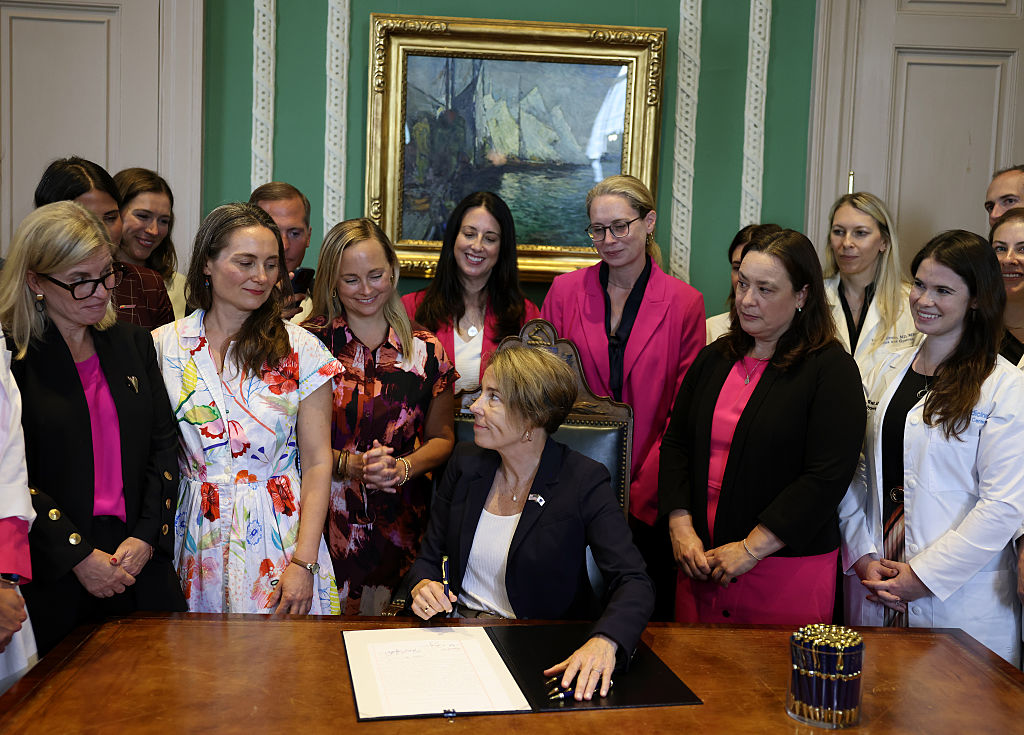
Last month, Gov. Maura Healey signed the Prioritizing Patient Access to Care Act into law, ensuring Massachusetts does not impose a gestational limit on access to abortion care. It joined nine states and Washington, D.C. in expanding access to abortion at any point during pregnancy.
Healey stressed the “heartbreaking stories” she heard “from women and families who were preparing to welcome a healthy baby into their family, only to receive devastating news later in their pregnancy,” according to a press release. “Instead of being able to rely on the doctors they knew and trusted at home, they were forced to travel hundreds of miles and pay out of their pockets while navigating unimaginable grief.”

I recently had the privilege of talking with Kate Dineen, who shared her heartbreaking experience of being denied abortion care in Massachusetts because of the state’s “24-week ban with very difficult to access exceptions”:
“I was about 33 weeks into a deeply wanted pregnancy. I had an almost 18-month-old son at home, and everything was progressing really well. I went in for an ultrasound. It was the first time my husband could come with me due to Covid restrictions and we were really excited.
“The ultrasound detected something called ventriculomegaly, a widening of one of the brain ventricles, which can be very, very devastating. We then got a fetal MRI.
“I’m on Zoom with the pediatric neurologist who told us the MRI showed our son suffered a catastrophic stroke and would either die in utero, or live for some period of time with a spectrum of devastating outcomes. The doctor told us, ‘You may still be able to explore termination if you’re able to travel.’ I was floored.
“We were petrified. Our trusted providers told us their hands were tied by state law because the exception at the time was lethal fetal anomaly and since there was a chance that our son might survive for some period of time, they could not use this exception to provide care.
“We got family to come and watch our son. We had a car, and savings, and my husband drove me 10 hours overnight. We stayed in a hotel multiple days, and paid $10,000 out of pocket to access care.”
That Dineen was denied care even in a state known for protecting abortion rights underscored the need for reform. As Healey said, what happened to her and other Massachusetts patients should “never happen.”
As contributing editor Carrie Baker recently wrote for Ms., “Later abortion is one of the most stigmatized and least understood aspects of reproductive health … Some of the voices perpetuating that stigma come from inside the reproductive rights movement itself.”
“There are clear consistencies in why people seek abortion care, regardless of gestation,” a recent study by Katrina Kimport, Ph.D., a researcher at Advancing New Standards in Reproductive Health (ANSIRH), found. Pathways to abortion care throughout pregnancy “are enabled and constrained by institutions, policies, culture, and personal experience.”
Kimport accordingly argues for a “social conceptualization of abortion…as care that can be needed throughout pregnancy” to “shift discussion away from normative expectations about when people should seek abortion … to instead, highlight how and when pregnant people’s reproductive and bodily autonomy is supported and compromised.”
To this end, Patient Forward, launched the project “Who Not When.” Under the banner “Who We Are Matters, Not When We Got Our Abortions,” the project zeros in on the deep inequities of gestational limit bans.
“People seek abortions later in pregnancy for the same reasons they do earlier in pregnancy, but many are not able to access care as soon as they would like due to compounding delays. They are more likely to have discovered their pregnancy late and then have difficulty overcoming legal, financial, and logistical barriers in trying to obtain an abortion.”
Further, these barriers have a “disproportionate impact … on women of color, especially Black women, women who are young, have limited financial resources, who have to travel farther to reach care and who have discovered their pregnancy later.”
With this background in mind, we now turn back to the hard-won victory in Massachusetts as narrated by five key players in this legislative effort. We begin with Kate Dineen, whose abortion experience catapulted her into activism.
Kate Dineen, abortion storyteller, activist and Reproductive Equity Now board member:
“As I started to physically and emotionally recover… I tried to wrap my head around, what is the law in Massachusetts? What needs to change to ensure no one else has to go through something like I did?
“I started to grapple with the real-life consequences of a ban with seemingly well-intentioned exceptions that does not always result in patients being able to access the care they need when needed.
“I was fortunate to have the resources, and the support system, to travel, and I felt like I barely survived the trauma of a catastrophic fetal diagnosis, and grieving the loss of a deeply wanted pregnancy, coupled with added trauma of a profound sense of abandonment, and the fear of traveling across many states to get this care that could have been provided in Massachusetts.
“And there are patients who are denied this care and are not able to travel. There are also many patients who were forced to make rushed decisions before this arbitrary 24-week cutoff.
“What I’ve learned is that at no point in pregnancy is a politician who writes the law better positioned to make a deeply personal medical decision than the patient and their provider. Bans with exceptions don’t work in Texas, and they don’t work in Massachusetts.
“It’s not about number of weeks pregnant. It’s about who gets to decide. It is barbaric for the state to force somebody to stay pregnant against their will, at any point in pregnancy.
“It’s vital we are to fighting to expand access, and not shutting the doors of our world-class hospitals on patients, but opening them.
“We are not going to be quiet, and we’re not going to apologize for the law that we just passed, which aligns with our values as a state.”
Taylor St. Germain, interim executive director/deputy director, Reproductive Equity Now:
“This recent legislative session was the first one in which the Prioritizing Patient Access to Care bill was introduced in the legislature. But this was our third bite at the apple.
“In 2020, when Massachusetts passed the Roe Act [codifying the right to abortion and removing key access barriers], exceptions were added to our 24-week ban. We wanted to eliminate the gestational limit, but only succeeded in adding predetermined exceptions.
“In 2022, we tried again. By then, we had heard the story of Kate Dineen, and others who had been forced to leave Massachusetts to access care, but only succeeded in getting the word ‘grave’ added to the existing lethal fetal anomalies exception.
“Subsequently, in the hostile post-Dobbs landscape with increasing threats to patients seeking abortion care across state lines, REN made it a legislative priority to ensure no one would have to leave Massachusetts where they have their trusted community and providers to access later abortion care.
“We finally succeeded because of the patient storytellers and the providers who courageously came forward and shared their stories. This moved the hearts and minds of lawmakers and got them to understand why these decisions should remain between a patient and their doctor.
“Later abortion has long been stigmatized by the antiabortion movement, which has worked to ensure this care is treated outside the normal realm of healthcare. So we did a lot of work to get folks to understand it is part of healthcare that people need to access in a difficult moment in their life.
“Massachusetts has been a leader in the post-Dobbs landscape, and we’re going to keep going to ensure reproductive equity for every person.”
State Rep. Christine P. Barber (D), sponsor of the act, Prioritizing Patient Access to Care:
“This bill was the next step in what we have accomplished already to protect reproductive rights in Massachusetts. I filed it because I heard the harrowing stories of patients who had been forced to leave the state due to our strict legal framework.
“We had tried previously to write a law with specific exceptions, but pregnancy is really complex. The ones who know it best are the doctors who specialize in this work and the patients who know their own bodies.
“Even though a doctor would say, ‘I am recommending this,’ it was not always clear that they were legally allowed to, and legal departments had to be called in. So it was incredibly important to have the major hospitals and the hospital association saying, ‘We want this bill because it clarifies the work for their doctors.’
“Also, because we pride ourselves on having such good healthcare here, the idea that you would have to leave the state for care just doesn’t sit right with people.
“We want to be a beacon and a place people around the country can look to for late abortion care. We hopefully can also lead the way in encouraging other states to also provide this care.”
State Sen. Robyn K. Kennedy (D), sponsor of the Prioritizing Access to Patient Care:
“We heard heart-wrenching stories from dozens of women who were told they had to leave Massachusetts state for care because the law did not permit it, which really helped push the legislature to pass this bill.
“I also want to give credit to the hospitals, the Hospital Association and the Mass Medical Society that came forward and said the existing law is a problem. We trust our physicians. They’re trained for this. Our attorney shouldn’t be the ones having to decipher whether an abortion fits within the exceptions framework, especially if we are a state committed to reproductive care.
“We’ve also all heard these horrific stories from other states of women having to sit in a parking lot and wait till they were near death to get basic healthcare. That’s just unacceptable and this legislation was our way of coming forward and reaffirming that Massachusetts is not going to be one of those states.
“There’s a movement to turn back time—to control women’s autonomy and the ability to make decisions about medical care. But Massachusetts prides itself on believing in science, in medical care and in every person’s ability to make decisions about who they are and how they manage their body so they can live their full authentic life.”
State Rep. Lindsay S. Sabadosa (D), sponsor of the Act Prioritizing Patient Access to Care:
“The Fox News coverage of the law’s passage has led to a fair amount of hate mail, primarily from out of state. But if someone has taken the time to write, I take the time to respond, unless it’s just like a string of obscenities.
“I recently replied to woman in Texas asking us to reconsider our vote. I wrote back explaining this was not going to happen, and that I’m very proud of it, as it truly is part of how Massachusetts makes itself a pro-family state
“Laws that support access to later abortion care show that we supports pregnant people, we trust their decisions, we trust our doctors, and we don’t believe that the legislature should handcuff their shared medical decision-making.
“I can easily find the names of women who have died in other states because of these laws. In fact, I sent the writer from Texas the names of five women who died due to complications later in pregnancy because of Texas’ lack of abortion services.
“In Massachusetts, we don’t have a list like that. So as far as I’m concerned, pro-family involves having a person who wants to become pregnant alive and able to make that decision. If you have women dying in pregnancy, that is not pro-family.
“We trust our doctors to make ethical decisions about termination, we’re trusting patients. We don’t think the legislature should be there, rifling through someone’s medical record, deciding which case is worthy and which is not.”
The Massachusetts victory demonstrates that “change is possible, even under this extremely antagonistic administration,” said Dr. Shelley Sella to Ms. She is provider of later abortion care and author of Beyond Limits: Stories of Third Trimester Abortion Care.
And in that spirit, I close with a powerful passage from her book which highlights what it means for patients when a state offers all-trimester abortion care:
“[Patients] no longer needed to convince me that they were ‘worthy’ of an abortion…I was now able to listen to each woman fully, without trying to diagnose her, without having to fit her into a slot that allowed her to qualify for an abortion…
“I heard too many women tell me about their intolerable situations to continue to believe in a hierarchy of desperation.”
*
A note from Ms. editors: We want to hear from you for The Majority, a new campaign collecting stories about how reproductive freedom has enabled readers to build the lives they want and need.

Poll after poll shows a majority of Americans support reproductive healthcare access. Yet public debate overlooks the lives shaped by abortion access, contraception, IVF, miscarriage care, maternal healthcare or comprehensive sex education—countless women who chose to pursue an education, have children, not have children, protect their health and chart their own future. What’s your reproductive freedom story? Add your voice. Together, these stories will help show not only why reproductive freedom remains a majority value, but also what it makes possible.
Look to these trusted groups if you or a loved one needs to know more about reliable abortion care:
- A one-stop-shop for abortion seekers: I Need An A
- Other websites to explore all your options for abortion care: Plan C Pills, Abortion Finder
- Safe websites to buy abortion medication: Aid Access, Massachusetts Medication Abortion Access Project, Hey Jane
- If you need help affording abortion care, tell your telemedicine provider or contact an abortion fund near you.
- To protect your digital privacy when planning your abortion, click here.
- For free legal help as a patient or doctor, call If/When/How’s Repro Helpline—844-868-2812—or contact Pregnancy Justice.
- For medical advice, contact the Miscarriage & Abortion Hotline: 833-246-2632.
- If you need to know the abortion law in your state, look to the Center for Reproductive Rights. or Guttmacher Institute.